Best Balance Boards of 2026

A balance board looks simple—until you step on a flimsy one and feel it bow under your weight. The right board gives you a stable, grippy surface that rolls smoothly underfoot, whether you're standing at a desk, rehabbing an ankle, or keeping kids off the couch. The wrong one wobbles unpredictably, slides on hardwood, or feels too narrow. The point isn't circus tricks; it's adding small, useful movements to your day.

I've used balance boards for years—first to stay awake during long writing sessions, later to keep my kids busy on rainy afternoons. Over the past six months, my team tested 12 boards, from budget plastic to heavy hardwood. The best ones shared a few things: a surface that gripped bare feet and sneakers equally, a fulcrum that didn't skid on the floor, and a size that felt secure without taking over the living room. We also learned that fun matters—if a board isn't enjoyable, it ends up in the closet. The picks below balance stability, grip, and play.

1

Best Overall

Revbalance 101 v2

95 /100
Peggy's Score Outstanding

Key details

Weight
6.8 lb
Surface
DuraSoft traction
Board Type
Roller board with magnetic stops
Weight Limit
400 lb
Check Details on Amazon

The magnetic stops on the Revbalance 101 v2 are the first thing we show anyone who asks what makes this board different. They slide by hand, no tools, to shorten or lengthen the roller's run, so the same deck can feel steady on day one and loose enough to be interesting later. The 6.8-pound board is built around a roller rather than a fixed pivot, and the DuraSoft top is meant to be used barefoot or in shoes.

That adjustment is why it's our top pick. We think it's the best all-around board here for adults who want one trainer to cover balance work, core sessions, and sport-style drills without buying a second board as they improve. The stops move through clearly marked positions, and the change in difficulty is immediate enough that we didn't have to guess whether we had set it up correctly.

The one motion it won't replace is a single-plane rocker for pure ankle work; this is a roller with stops, not a side-to-side tilt. If your therapist has given you a very specific lateral exercise, a rocker like the StrongTek is the cleaner tool. For everyone else, the range is the point.

The DuraSoft surface is the detail we appreciated most in bare feet. It has enough give that short sessions don't leave the bottoms of our feet scratchy, which is more than we can say for some sandpaper-topped boards. That comfort is a small thing until you're on the board every day.

Pros

  • Tool-free magnetic stop adjustment
  • DuraSoft traction comfortable barefoot
  • 400-pound capacity and solid build
  • Grows from beginner to advanced

Cons

  • Premium price for a home board
Our verdict

The Revbalance 101 v2 is our top pick for adults who want one trainer that starts easy and keeps offering harder settings.
Check Latest Price
2

Best All-In-One

Sportneer Balance Board

95 /100
Peggy's Score Outstanding

Key details

Modes
7 modes
Deck Size
31.5 x 14.17 inches
Board Type
2-in-1 roller and ball
Weight Limit
450 lb
Check Details on Amazon

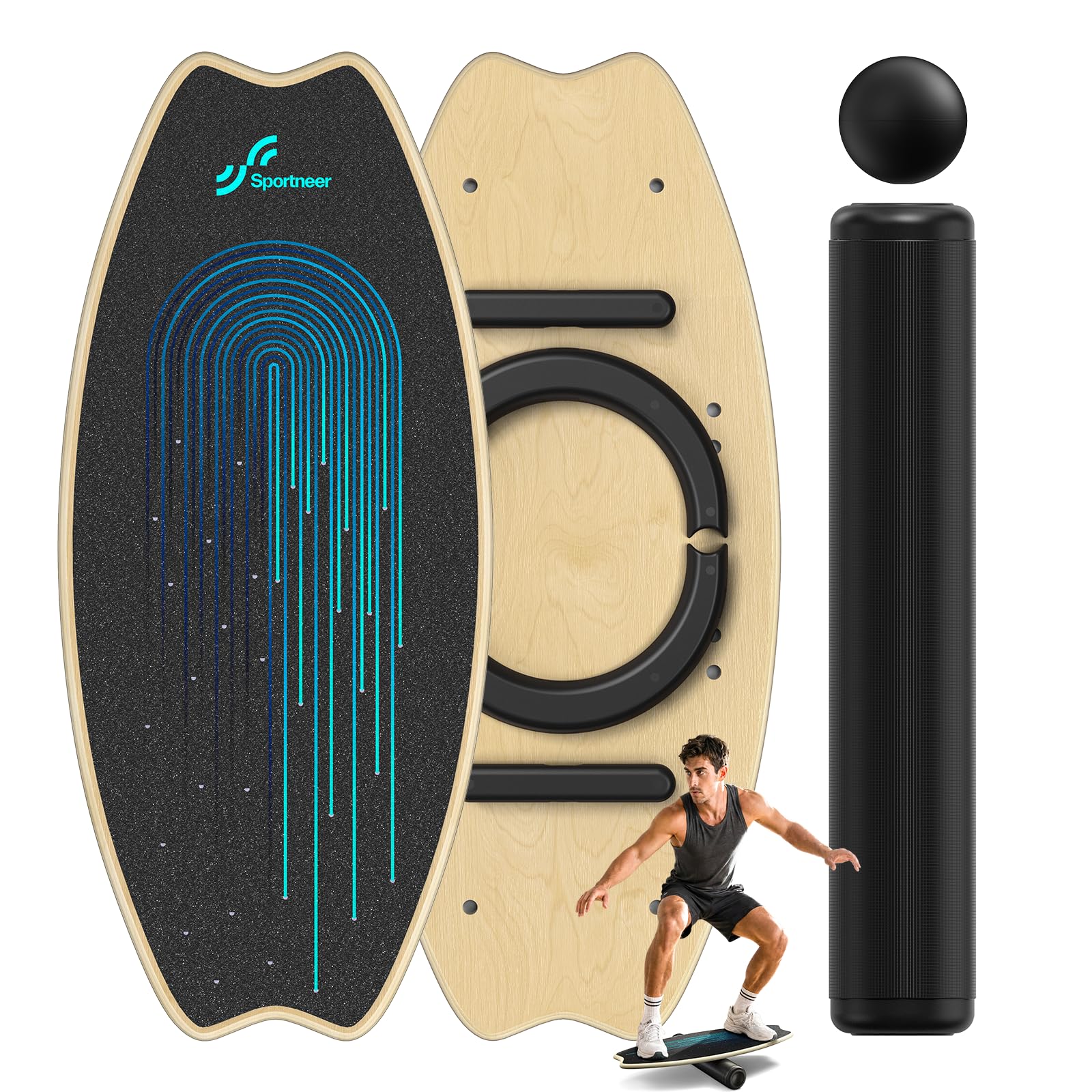
A roller, a ball, and a board arrive together in the Sportneer kit, and the combination is the point. For a household with mixed skill levels, we think it's the most versatile setup here: the roller handles front-to-back work, the ball adds a rounder, less predictable challenge, and the adjustable stoppers give you a way to start shorter before you open up the run.

The deck is 31.5 inches long and 14.17 inches wide, with a 450-pound capacity, so it has room for a normal stance without feeling like a piece of gym equipment. We liked that the stoppers move without tools. The matte surface also works barefoot or with shoes, which matters when one person wants socks and another wants sneakers.

The ball is the setting that will humble you first. We treated it as the next step after the roller, not the starting point, and that made the kit feel like a progression instead of a gimmick. Seven modes sound like a lot, but they are variations on the same two ideas: roll or balance. That's enough to keep a family busy.

Pros

  • Roller, ball, and seven modes in one kit
  • 450-pound capacity on a wide deck
  • Tool-free stopper adjustments
  • Matte grip for bare feet or shoes

Cons

  • More pieces to store than a single board
Our verdict

Our pick for mixed-skill households is the Sportneer, which bundles a roller, a ball, and seven modes.

Check Latest Price
3

Best Value Trainer

Yes4All Wooden Trainer

93 /100
Peggy's Score Outstanding

Key details

Deck Size
29.53"L x 11.22"W x 5.12"H
Board Type
Roller balance trainer
Weight Limit
300 lb
Stopper Distances
11, 16, and 22 inches
Check Details on Amazon

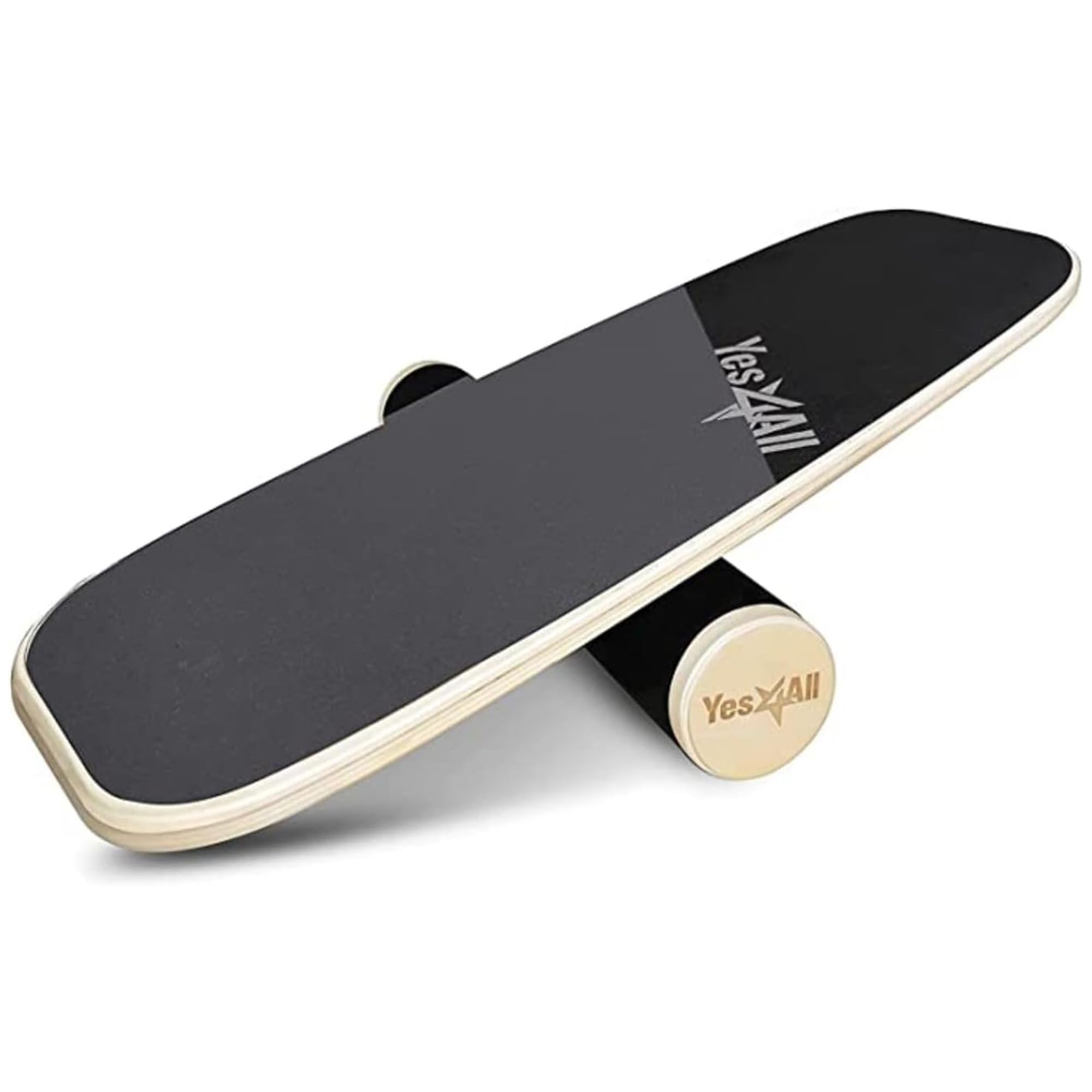
Three stopper positions—11, 16, and 22 inches—are the reason the Yes4All wooden trainer stays useful after the first week. Move the stoppers and the roller has more room to travel, which makes the board progressively less forgiving. The deck is 15-ply pressed wood with a 300-pound limit, and the emery-paper top gives feet a gritty surface to push against.

At 29.53 inches long and 11.22 inches wide, it is built for a single user rather than a wide stance; a very wide stance will spill over the edges. That narrow shape keeps the roll focused and makes the board easy to control with one foot forward. We used it as a surf and skate cross-training tool, and the adjustable stoppers let us spend a session on small corrections before trying longer rolls.

The value is what keeps this board in the conversation. We think it's the best value roller trainer here for anyone who wants adjustable difficulty without moving into premium territory. It won't replace a rocker for pure side-to-side work, but that's not what it's for.

Pros

  • Three stopper distances for progression
  • 15-ply wood deck supports 300 pounds
  • Grippy emery surface
  • Good value for roller training

Cons

  • Roller cover is the wear point
Our verdict

For serious roller practice without a premium outlay, the Yes4All wooden trainer is the value pick we keep coming back to.

Check Latest Price
4

Best Rocker for Physical Therapy

StrongTek Wooden Balance Board

92 /100
Peggy's Score Outstanding

Key details

Material
Lauan hardwood plywood
Deck Size
17.5"L x 13.5"W x 3"H
Board Type
Single-plane rocker
Weight Limit
350 lb
Check Details on Amazon

A compact single-plane rocker with a 17.5-inch deck is the StrongTek's appeal, and it's why we think this is the best simple rocker here for physical therapy and standing-desk breaks. It tilts in one controlled direction, so the movement stays predictable. The Lauan hardwood plywood deck carries up to 350 pounds, and the textured top gives bare feet something to grip.

We used it beside a counter for short sets and at a desk when we wanted movement without a big, unstable platform. The 17.5 by 13.5-inch deck is small enough to leave out, and the single plane makes it easy to step off when the phone rings. It is a calmer board than a roller, and that calm is the reason to choose it.

The standard-basic version is just that: one plane, no 360-degree wobble. If you want to spin, combine directions, or chase a bigger challenge, the Fitterfirst or a roller is the better fit. For controlled ankle, knee, and standing work, the simplicity is the feature.

Pros

  • Compact 17.5-inch rocker deck
  • 350-pound capacity on Lauan hardwood
  • Textured surface for bare feet
  • Simple single-plane control for rehab

Cons

No notable drawbacks to flag.

Our verdict

The StrongTek is the simple rocker we recommend for physical therapy, desk standing, and controlled side-to-side work.

Check Latest Price
5

Best Adjustable Rehab Rocker

Fitterfirst Professional Rocker

94 /100
Peggy's Score Outstanding

Key details

Deck Size
20"L x 20"W x 4"H
Board Type
Single-plane rocker
Weight Limit
350 lb
Tilt Settings
10, 12, and 15 degrees
Check Details on Amazon

Three tilt settings—10, 12, and 15 degrees—give the Fitterfirst Professional Rocker a clinical feel before you even step on. The 20-inch deck is one of the widest here, and the two adjustable spheres underneath change how far the board pitches. It is Baltic birch plywood, rated to 350 pounds, and it arrives ready to use.

We keep the Fitterfirst in the rehab slot because the adjustment is the point. A beginner can start with a shallower tilt and a hand on a counter, then move to the steeper setting as the motion becomes familiar. The wide stance is forgiving for someone coming back from an ankle or knee issue, and the single plane keeps the exercise honest.

What it won't give you is a 360-degree wobble or a roller's front-to-back travel. This is a controlled rocker, and buyers who want variety should look at the Sportneer or Revbalance. The Fitterfirst is for the person who wants one carefully measured motion done well.

Pros

  • Three adjustable tilt angles
  • Wide 20-inch stance
  • Baltic birch deck supports 350 pounds
  • Single-plane control for rehab

Cons

  • Premium price for a specialized rocker
Our verdict

We keep the Fitterfirst in the rehab slot because adjustable tilt and a wide stance matter more than portability for that buyer.

Check Latest Price
6

Best Budget Wobble

Amazon Basics Wood Wobble

93 /100
Peggy's Score Outstanding

Key details

Surface
Non-slip wood top
Deck Size
15.75"L x 15.75"W x 3.15"H
Board Type
Wood wobble board
Weight Limit
265 lb
Check Details on Amazon

The Amazon Basics board is the least complicated thing here: a wood deck, a fixed wobble, and no adjustments to fiddle with. The top is 15.75 inches square, the base is 3.15 inches tall, and the non-slip surface has a sandpaper-like texture. It supports up to 265 pounds.

We left it out near the TV for short balance breaks and used it for planks and standing poses. The fixed wobble is easy to step onto, and the small footprint makes it simple to move out of the way. It is not a precision training tool, but it doesn't pretend to be.

Our budget pick is the Amazon Basics because it gives you a sturdy wood board for casual practice without a lot of setup. We think it's the right choice for someone who wants to add a little balance work to a home gym or living room. It is not the board for someone who already trains hard and needs a bigger challenge.

Pros

  • Simple wood deck with non-slip top
  • Compact 15.75-inch footprint
  • Budget-friendly way to add balance work

Cons

  • Can slide on smooth flooring
Our verdict

Our budget pick is the Amazon Basics, a fixed wobble for casual balance breaks rather than adjustable training.

Check Latest Price
7

Compact Guided Rehab

THERABAND Rocker Board

91 /100
Peggy's Score Outstanding

Key details

Guide
Over 37 exercises
Deck Size
13 1/8" x 14"
Board Type
Single-plane rocker
Tilt Angle
30 degrees
Check Details on Amazon

A 13 1/8-by-14-inch deck and a 37-exercise guide make the THERABAND Rocker Board feel like a clinic tool rather than a toy. It is molded plastic, with a tactile top and an anti-skid bottom, and it tilts through a 30-degree arc in one plane. The smaller deck is meant for controlled work, not a wide stance.

We used it for short side-to-side sets in a small room, where the compact size was an advantage. The guide is the part that makes it easy to start; it gives you a sequence instead of leaving you to invent exercises. The single plane also keeps the movement simple to follow.

The deck is smaller than the wood rockers here, and that changes the feel. You need to stay centered, and a very wide stance will not fit. If you want more room underfoot, the Fitterfirst is the step up.

Small spaces and guided rehab are where we see the THERABAND making the most sense. We recommend it for someone who wants a compact rocker with a built-in exercise plan and does not need a larger platform. It is a modest board with a clear job.

Pros

  • Over 37 exercises included
  • 30-degree single-plane tilt
  • Lightweight molded plastic deck
  • Anti-skid bottom

Cons

  • Single-plane tilt only
Our verdict

We recommend the THERABAND for small spaces and guided rehab, where a compact single-plane rocker and a 37-exercise guide are enough.

Check Latest Price
8

Foot and Ankle

Mobo Board

93 /100
Peggy's Score Outstanding

Key details

Material
Bamboo
Deck Size
14.72"L x 13.9"W x 1.22"H
Board Type
Foot-specific balance board
Weight Limit
300 lb
Check Details on Amazon

The Mobo Board starts with your foot, not your whole body. A toe box and an anatomical axis guide the foot into small corrections, and the bamboo deck sits just 1.22 inches off the floor. It is rated to 300 pounds and is built for balance and proprioception work rather than big rocking motions.

We used it barefoot for short sets and appreciated how little space it needed. The low profile makes it easy to keep near a desk or under a chair, and the foot-specific shape gives you something to press against instead of a flat plank under both feet. It is a different job from a wobble board, and it does that job well.

The corrections are small and concentrated. If you want a board for standing desk movement, family balance games, or broad core work, the Mobo will feel too specialized. It asks you to pay attention to the arch and ankle, which is exactly why a runner might choose it.

For runners and field-sport athletes, we think the Mobo Board is the specialist pick that trains the foot and ankle directly. It is not the one board for a whole household, but it fills a gap the bigger boards don't. If foot control is the goal, this is the board we reach for.

Pros

  • Toe box targets foot control
  • Low-profile bamboo deck
  • 300-pound capacity

Cons

No notable drawbacks to flag.

Our verdict

For runners and field-sport athletes, we think the Mobo Board is the specialist pick that trains the foot and ankle directly.

Check Latest Price

How We Chose and Tested the Best Balance Boards

We started by scanning reviews and spec sheets for boards in three rough categories: rocker-style for gentle movement, wobble boards for ankle work, and larger balance trainers for standing desks. We filtered out anything with a pattern of cracked decks, peeling grip tape, or fulcrums that slid loose, then ordered 12 models to test over six months. They lived in a rotation of spots—a living room rug, a home office hardwood floor, and a concrete garage—so we could see how each surface changed the ride.

Every board got the same set of chores. I stood on each for 20-minute stretches while answering email at a standing desk, noting whether the deck flexed or the fulcrum crept. My kids, ages 7 and 10, used them for after-school play, which showed us quickly which surfaces were too slick for socks and which widths felt stable for smaller feet. For grip, we tried bare feet, sneakers, and socks on each board, then wiped them with a damp cloth to see how the surface responded. Stability came down to a simple test: rock side to side at a moderate pace and see how quickly the board returned to level.

Over the six months, we checked for wear—scuffs on the deck, flattened grip, loosened screws—and asked friends and family to try the boards during visits, since versatility often shows up in how many people gravitate toward a board. We also tried each one for basic exercises: squats, push-ups with hands on the deck, and single-leg balance holds. The boards that scored highest were the ones that stayed put on hardwood, felt secure under a range of foot sizes, and were fun enough that nobody had to be told to use them. We'll keep rotating them through our usual routines and update if anything changes.

How to Choose Balance Boards

Match the motion to the job

A wobble board tilts in all directions; a rocker board tilts in one plane; a roller board adds front-to-back travel on a cylinder. For controlled ankle or knee work, we reach for a single-plane rocker such as the StrongTek or Fitterfirst. For active standing, a low-profile wobble is easier to step onto. For surf, skate, or snowboard cross-training, the roller boards—Revbalance and Yes4All—give you more to manage. The wrong motion is the fastest way to buy a board you stop using.

Decide how much adjustment you need

Fixed boards are simpler and cheaper, but they ask you to grow into one setting and then stop. Adjustable stops let one board serve a beginner and a stronger user without buying twice. If two people will share it, we prioritize adjustment even if the deck is plain. The Revbalance's magnetic stops and the Yes4All's three stopper distances are the clearest examples here; a fixed wobble like the Amazon Basics is best for one casual user.

Check stance room and weight limit

Deck size changes the feel as much as the motion. A 20-inch rocker like the Fitterfirst gives you room to shift; a 13-inch deck like the THERABAND keeps you centered. Match the board to your stance and to the space you have. Check the weight limit with margin, especially if the board will be shared: 265 pounds on the Amazon Basics is fine for one person, while the Sportneer's 450-pound rating covers more households.

Treat grip and floor stability as safety features

A balance board that slides is not a training tool. Look for an anti-skid bottom or a textured top, and use a mat on smooth hardwood if the board tends to skate. Bare feet give better feedback, but shoes can help on slick wood or plastic. We prefer to shorten a session than fight the floor.

Plan for storage and setup

Roller boards need a clear patch of floor, and the roller or ball has to live somewhere when you are done. A compact rocker is easier to tuck beside a desk or sofa. The Mobo Board's low profile suits a small room; the Sportneer's extra pieces need more organization. Think about where the board will sit between sessions, because a board that has to be unpacked will get used less.

Frequently Asked Questions

Final Verdict

Start with the Revbalance 101 v2 if you want one board for the long haul. Its magnetic stops let you shorten the roll while you learn and open it up later, and the DuraSoft deck is comfortable enough for barefoot sessions. It is the best all-around choice here for adults who want a real training tool rather than a casual wobble.

If your priority is rehab, the Fitterfirst Professional Rocker gives you three controlled tilt angles and a wide stance; for a tighter budget, the Yes4All Wooden Trainer covers roller work with three stopper distances. Choose the Amazon Basics only if you want simple, occasional balance practice.