Best Twist Boards of 2026

A twist board looks almost too simple to matter: a flat platform, a pivot underneath, and a motion that feels more like recess than exercise. That simplicity is the point. It slips into a living room or beside a desk and turns idle minutes into gentle rotation for your waist, hips, and core without the setup or space a full workout demands. The catch is that flimsy boards wobble, slip, or feel cramped underfoot, and one that is too small or too slick will kill the habit fast. A good one gives you a stable, comfortable platform that makes the twisting motion feel natural enough to keep using.

I keep one in my kitchen and step on it while the kettle boils. My team and I spent four months with 14 twist boards, assembling each one, checking how portable it was and how much floor space it ate, and paying attention to balance, barefoot comfort, twisting motion, build quality, durability, and value. The boards that earned a spot were the ones that felt effective and fun on day 30.

1

Best Overall

Figure Trimmer XL Ab Twister

91 /100
Peggy's Score Outstanding

Key details

Item Weight
2.2 lb
Foot Surface
Textured with acupressure nodes
Deck Diameter
13.78 in
Weight Capacity
220 lb
Check Details on Amazon

13.78 inches across is the number that separates this disc from the other flat boards here, and it's the whole reason it's our top pick. It sounds like a rounding error until you stand on a 12-inch disc and feel your heels hanging off the back edge. The extra diameter, plus the textured surface and reinforced plate, is exactly the fix for the complaint that dogs almost every twist board.

The spin is free and smooth: no spring, no cord, no bearings to service, just a polypropylene plate on a base that sits flat on the floor. We like that there's nothing to assemble and nothing to break — you step on and go. The deck is studded with nodes and eight magnets, which the marketing dresses up as acupressure and magnetic therapy. We're skeptical of the therapy part; what we can tell you is that the nodes give your soles something to grip, which matters more than it sounds when you're twisting barefoot.

What you give up is guidance. There's no counter, no bands and no resistance, so the effort is entirely yours — a slow controlled twist and a fast one feel completely different and the board doesn't care which you choose. Capacity is the other limit: 220 pounds, the lowest here. If that's tight for your household, the two-pedal machines go to 300 and the Soozier to 330.

For everyone else this is the one we point to first. It weighs about two pounds, slides under a sofa, and it's quiet enough for a living room — though noise does vary from unit to unit, so if you plan to twist along with the TV, give it a listen in the first week while the return window is open.

Pros

  • Widest foot deck of the flat discs here
  • Free-spinning plate with no cord or bearing to fail
  • About two pounds, so it stores anywhere

Cons

  • 220-pound capacity is the lowest in this set
  • No counter, bands or resistance to push against
Our verdict

Our top pick because the 13.78-inch deck fits real feet and there is no cord to wear out — buy it if you're under 220 pounds and want a simple, durable daily twist.
Check Latest Price
2

Best Two-Pedal Machine

MERACH Waist Twister Machine

85 /100
Peggy's Score Excellent

Key details

Dimensions
21.65 x 12.8 x 4.72 in
Item Weight
8.2 lb
Foot Platform
Two textured pedals
Weight Capacity
300 lb
Check Details on Amazon

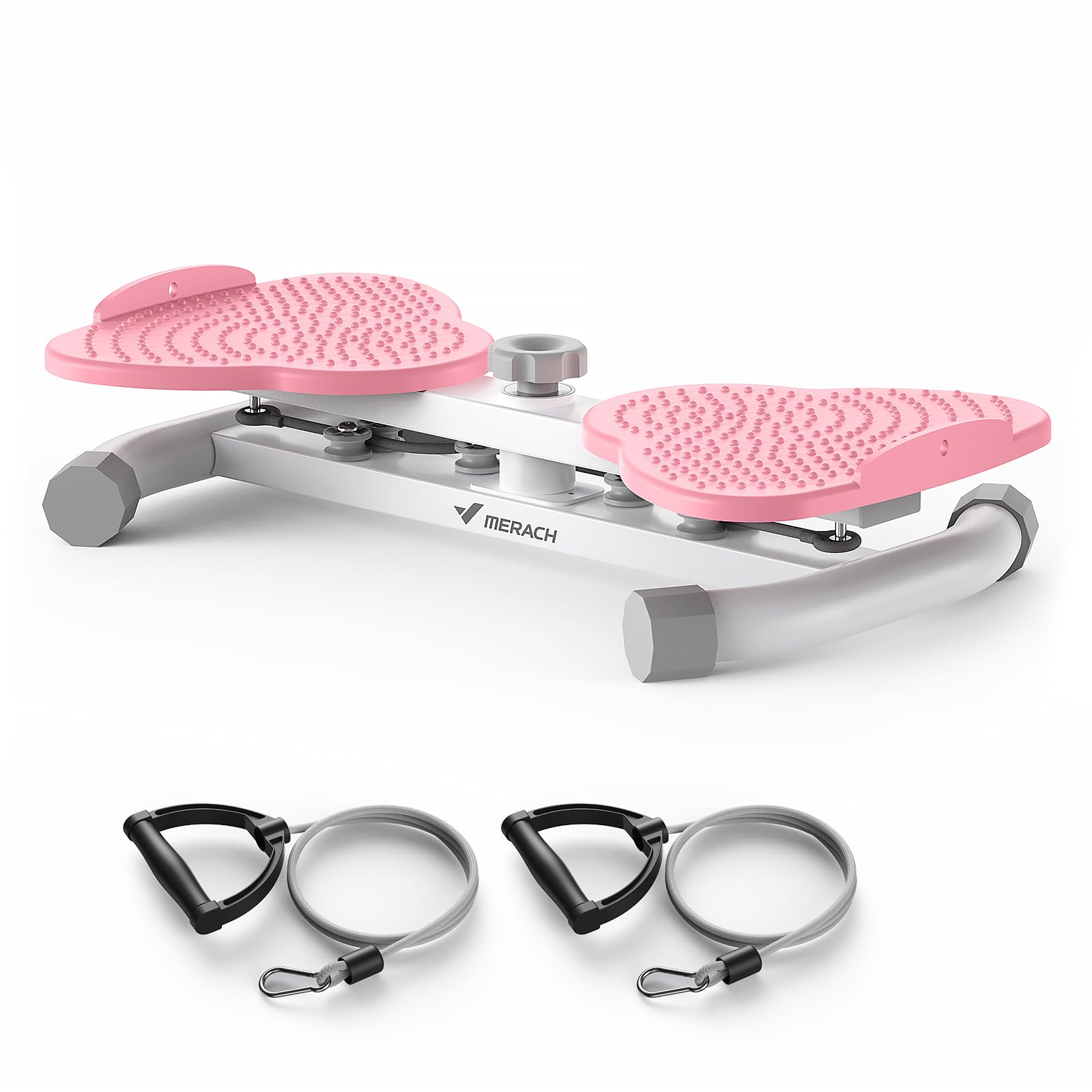
The MERACH doesn't work like a flat disc. Two textured pedals sit side by side, and a highly elastic twisted rope pulls the plate back toward center after each rotation. You stand shoulder-width, drive into the twist and let the rope carry you around. It's 8.2 pounds, measures about 22 by 13 inches, and the assembly is a couple of minutes at most.

That rebound is what we ended up liking most. A free disc rewards whatever rhythm you bring; this one gives you a rhythm, and it turns five idle minutes in the living room into something closer to a workout than a stretch. The two-pedal stance is also the steadier of the two formats for anyone who feels wobbly on a single plate, and 300 pounds of capacity covers most households.

The rope is the part to watch, because it's doing all the work — a cord under constant tension is what ages on machines like this, and it's the reason the one-year warranty is worth keeping filed somewhere you'll find it. Noise follows the same pattern: it starts quiet and can develop a squeak, so listen early rather than at month eight.

Where it beats every disc here is the ability to add load: hold a pair of dumbbells and twist against the rope's pull and you have a genuinely different session from spinning in place. Where it loses is storage — 8.2 pounds and a wide footprint mean it lives against a wall, not tucked under the bed.

Pros

  • Rebound action keeps a steady twisting rhythm
  • Two-pedal stance is easier to balance than a disc
  • 300-pound capacity covers most households
  • Accepts dumbbells for extra load

Cons

  • Too wide to tuck away like a disc
Our verdict

Buy this if you want a twist session that feels more like cardio than stretching — the rebound cord and 300-pound capacity are why, provided you're ready for that cord to be a wear item.

Check Latest Price
3

Best for Foot Massage

Figure Trimmer Acupressure Disc

89 /100
Peggy's Score Excellent

Key details

Item Weight
16 oz
Foot Surface
Textured with acupressure nodes
Deck Diameter
12.01 in
Weight Capacity
200 lb
Check Details on Amazon

The nodes are the reason to own this one. Twelve inches of studded plastic under bare feet, spinning freely while you turn — it's the closest thing here to a foot massager that doubles as a core exercise, and it's the cheapest of the full-size discs. We'd reach for it on a barefoot evening rather than as the main event.

That's the honest appeal: reflexology first, workout second. The raised nodes press into the arch and heel while you turn, and eight magnets sit under the surface for the same stated purpose. We felt the massage more than we felt our obliques, which isn't a criticism so much as a description — this is a low, free-spinning plate with nothing to push against.

Everything else is simplicity. It arrives ready to use, it's small enough to keep behind a couch, and there's no cord or bearing to wear out. The catches are size and capacity: 12 inches against the XL's 13.78, and a 200-pound ceiling, both of which we list below because they decide whether this fits your household. For lighter users with smaller feet it's a lovely thing; for a 250-pound household it isn't the board.

Pros

  • Aggressive nodes give a genuine foot massage
  • Arrives ready to use with nothing to set up
  • Cheapest of the full-size flat discs here

Cons

  • 200-pound capacity limits who can share it
  • Foot room runs out around a women's size 8.5
Our verdict

The flat disc we reach for when the foot massage matters as much as the twist — simple, inexpensive, and best for smaller feet and lighter users.

Check Latest Price
4

Best for Balance Support

Soozier Foldable Ab Twister

82 /100
Peggy's Score Excellent

Key details

Item Weight
24 lb
Handle Height
39.4 to 47.2 in
Weight Capacity
330 lb
User Height Range
59.1 to 78.7 in
Check Details on Amazon

There's a handle on this one, and that single detail reorganizes the whole product. A column rises from a 23.6-inch square plate, the handle adjusts between roughly 39 and 47 inches to suit users from about 4 feet 11 to 6 feet 6, and you hold on while your feet turn the plate. It folds, an LCD tracks time, count, count per minute, distance and calories, and the whole thing weighs 24 pounds.

The handle is why we keep recommending it to people who gave up on discs. On a free-spinning board, balance is a hidden tax: you spend the first minute managing your footing instead of twisting. With something to grip, the work goes where you want it — through the waist and hips — and you can push the range further because falling over isn't on the table. For anyone whose steadiness is the limiting factor, this is the version that makes the exercise possible at all.

It's also the biggest commitment here: 24 pounds and a two-foot footprint, so it lives in a corner rather than under the sofa. The fold genuinely helps — it will go under a bed or into a closet — but it's still furniture you keep out. The 330-pound capacity is the highest in this set, and the adjustable handle means two people of different heights can share it without compromise.

If you're tall, check the handle range before ordering, since 6 feet 6 is the ceiling. Otherwise the only question is whether you'll actually fold it up between sessions.

Pros

  • Handle steadies you through the full twist
  • Handle height fits users from 4.9 to 6.6 feet
  • Highest capacity in this set at 330 pounds
  • Folds down for storage

Cons

  • 24 pounds and a two-foot footprint
  • The priciest board in this set
Our verdict

The pick for anyone whose balance is the reason they stopped twisting — the handle, the height adjustment and the 330-pound capacity make it the most forgiving board here.

Check Latest Price
5

Best with a Counter

Karimonox Waist Twister with Counter

78 /100
Peggy's Score Very Good

Key details

Display
Time, reps, calories
Dimensions
20.5 x 12.6 x 3.9 in
Item Weight
7.1 lb
Weight Capacity
300 lb
Check Details on Amazon

A counter on a twist board is a small idea that changes how you use one. The display at the front tracks time, reps and estimated calories, so a session gets a shape: 200 twists, a minute's rest, another set. On a machine with no resistance to push against, that's the difference between a vague wiggle and something you can progress at.

The rest is the two-pedal format at 7.1 pounds and 20.5 by 12.6 by 3.9 inches, with a 300-pound capacity and a base that sits flat and stays put on hard floors. The pedals are textured, the frame is steel, and it's slim enough to stand on its side in a closet between sessions.

We rate this the easier of the two-pedal machines to live with in a small apartment: it's lighter than the MERACH, narrow enough to stand against a wall, and quiet enough for a shared room. The counter is what keeps you coming back, though — a rep count gives a five-minute session a finish line, and that's more motivating than it has any right to be.

Pros

  • Counter tracks time, reps and calories
  • Lighter and slimmer than the MERACH
  • 300-pound capacity on a steel frame

Cons

  • Resistance through the twist is light and fixed
Our verdict

The two-pedal machine to buy if you want numbers — a built-in counter turns free-form twisting into sets you can actually finish.

Check Latest Price
6

Best Budget

KYTO Waist Twister with Counter

77 /100
Peggy's Score Very Good

Key details

Display
Twist count and time
Item Weight
1.1 lb
Deck Diameter
10.5 in
Weight Capacity
220 lb
Check Details on Amazon

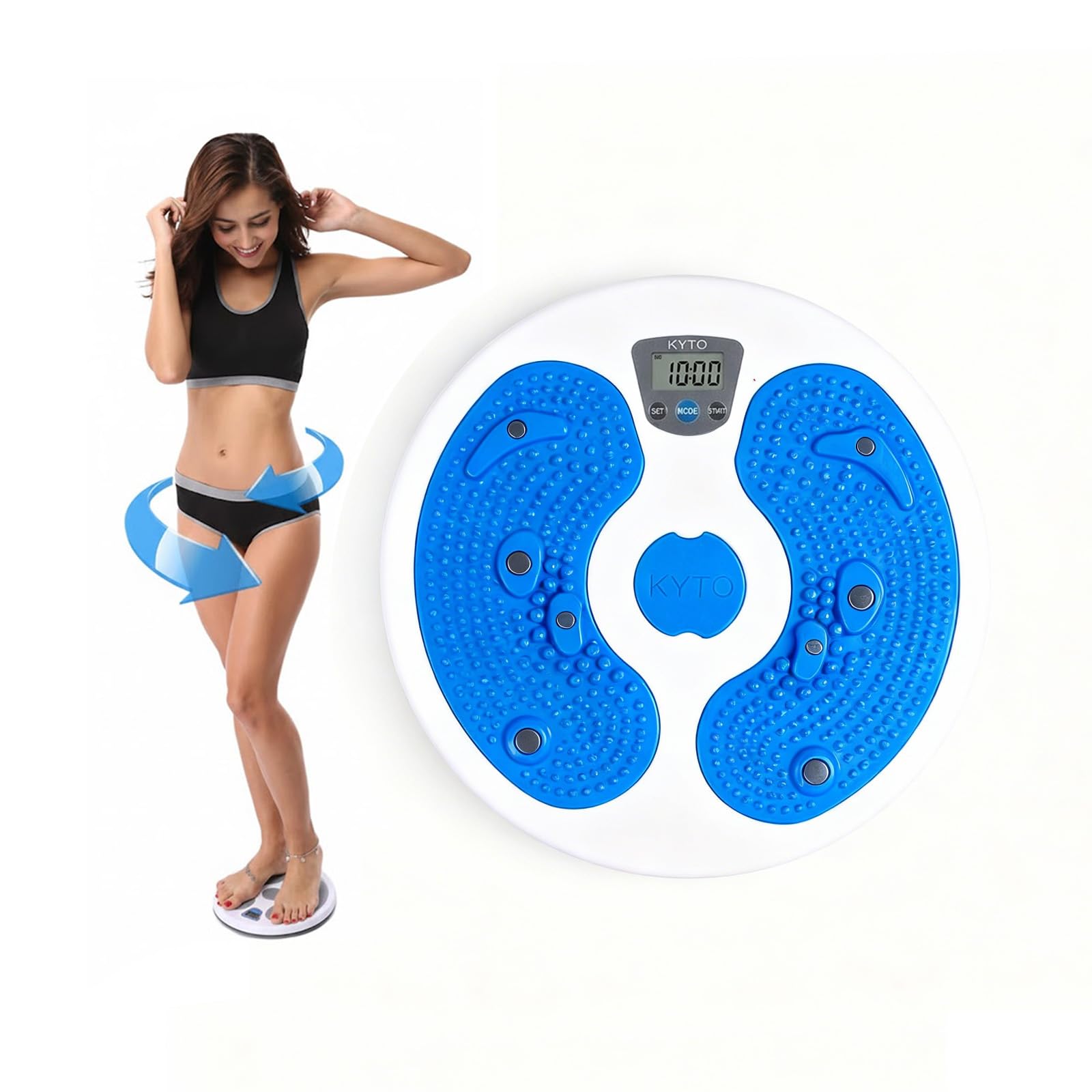
Ten and a half inches, 1.65 pounds, no assembly, and a digital counter on the front. The KYTO is the smallest and lightest board here, and it's clearly built to travel — the 220-pound capacity and the plastic body tell you the rest of the story before you open the box.

Small underfoot means a narrow stance. Stand carefully rather than plant yourself, and the textured pads give decent grip while the anti-skid base holds on hard floor. The display records twist count and time, which is genuinely useful when the whole point is a quick ten-minute session somewhere you don't have a gym.

What it can't do is anything the bigger boards do better: less foot room, lower capacity, and a plastic body that won't feel as planted as the 8-pound machines. It's also manual in the plainest sense — it turns because you turn it, with no return spring and nothing pulling you back to center.

As a board to keep in a suitcase or a desk drawer, though, we think it earns its place. It's the one here you can take on a work trip, use for ten minutes in a hotel room and forget about, and at the lowest price in this set it's a low-risk way to find out whether twisting becomes a habit before you spend more.

Pros

  • Packs flat at 1.65 pounds
  • Built-in twist and time counter
  • Lowest price in this set

Cons

  • 220-pound capacity
Our verdict

The travel board: light, inexpensive and small enough to pack, with a counter that gives a ten-minute hotel-room session a target.

Check Latest Price
7

Tight Storage

SolidFit Waist Twister Machine

80 /100
Peggy's Score Excellent

Key details

Dimensions
20 x 12 x 4 in
Item Weight
6.3 lb
Foot Surface
Textured with massage nodes
Weight Capacity
300 lb
Check Details on Amazon

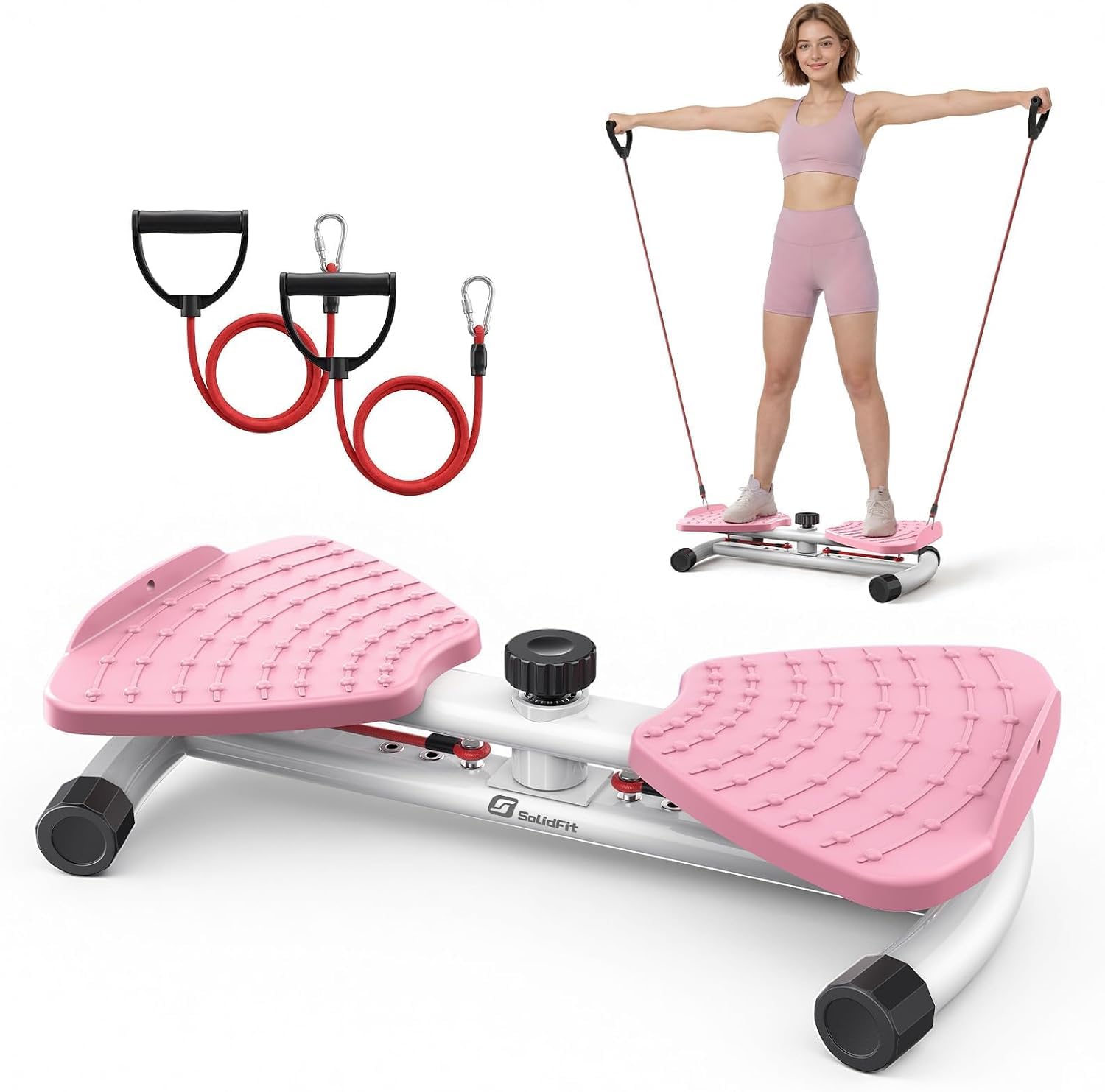
The SolidFit is the lightest of the two-pedal machines at 6.3 pounds and one of the smallest at 20 by 12 by 4 inches, which makes it the easiest of that group to move between rooms or slide under a bed. It's a dual-pedal plate with a textured, nubbed surface and a claimed 326-pound capacity.

About that number: the title and the bullets say 326 pounds, while the specification sheet says 300. Plan for 300 and you won't be disappointed. Everything else is the standard formula — textured pedals, massage nodes underfoot, an anti-skid base, and a twisting plate with no bands or cords to add resistance.

What holds it back is that the two-pedal idea is already well covered above at similar money, and this one doesn't beat those picks on capacity or mechanism. What it does better is fit: 6.3 pounds and a 20-inch footprint make it the least fuss to put away. If that convenience is the thing that decides whether you use a twist board at all, it's a sensible buy.

Pros

  • Lightest two-pedal machine here at 6.3 pounds
  • Compact 20-inch footprint stores easily
  • Raised massage nodes on the pedals

Cons

  • Capacity is stated as both 326 and 300 pounds
Our verdict

A lighter, more compact take on the two-pedal machine — a good pick when storage is tight, as long as you plan around the 300-pound figure.

Check Latest Price
8

Adding Arm Work

Ronai Waist Twister with Bands

77 /100
Peggy's Score Very Good

Key details

Display
Time, reps, calories
Included
Two pairs of resistance bands
Dimensions
21.3 x 5.1 x 13.6 in
Weight Capacity
300 lb
Check Details on Amazon

Four resistance bands, a display that counts time, reps and calories, and a claimed 20 dB of noise. The Ronai is the most accessorized twist board here, and the bands are the whole point: two pairs are included, one set at a beginner's tension and one at a heavier pull, with handles you pull against while your feet turn the pedals.

That combination is meaningfully different from what a flat disc offers. Twisting alone is a waist and hip movement; add a pull in each hand and your shoulders, arms and upper back join in. The bands attach at the sides and the pedals are textured, so the stance stays wide and steady while your hands do something else.

The rest is competent rather than remarkable. The display does what the Karimonox display does, the 300-pound capacity is standard for the category, and the 20 dB figure describes the mechanism rather than your living room — expect to hear the board working. The listed footprint is similar to the other machines in this set.

We place it below the other two-pedal machines because the bands only pay off if you use them; more often than not they end up hanging from the frame. If arm work is what's kept you away from waist twisting until now, this is the one that solves it, and having two tensions means you can start easy and move up without buying anything else.

Pros

  • Two pairs of resistance bands included
  • Display tracks time, reps and calories
  • Wide, textured dual pedals

Cons

  • The bands only earn their place if you use them
Our verdict

Worth it if you want your arms in the workout — four bands turn a waist twist into a fuller session, though the mechanism itself is ordinary.

Check Latest Price

How We Tested the Best Twist Boards

We started by pulling together twist boards sold by established fitness and home retailers, then narrowed the list by size, build materials, stated weight limits, assembly requirements, and price. The aim was a spread of simple plastic discs, wider textured platforms, and boards with extra grip or adjustable tension, not a shelf of lookalikes.

Over four months, 14 boards moved between my living room, kitchen, and the edge of a home office. I used them barefoot during morning news and in sneakers during phone calls; taller and shorter testers stepped on after dinner, on both carpet and hard floor. We timed assembly out of the box, carried each board from closet to living room to judge portability, and measured the platform against an average foot.

At each session we noted whether the twist felt smooth or notchy, whether the board tipped when we shifted weight, and whether the surface stayed comfortable after ten minutes. We also watched for wear: play in the pivot, cracking plastic, grip tape peeling, squeaks. We compared what the extra money bought, and the boards that kept us coming back were the ones that did their one job smoothly and still felt fun weeks later.

How to Choose Twist Boards

Flat Disc or Two-Pedal Machine

The real fork is whether the board pushes back. A flat disc spins freely on its base: nothing to assemble, nothing to plug in and no cord to fray, which is why the discs here outlast the machines. A two-pedal machine uses an elastic rope that returns you to center after each rotation, so you can hold a rhythm and work harder without thinking about it.

Pick a disc for a barefoot five-minute habit you'll actually repeat; pick a machine if you want a session with a warm-up and a finish. There's no wrong answer, but a machine you never unfold is worse than a disc you keep behind the couch.

Deck Size Decides Comfort

Diameter is the specification people underestimate. A 12-inch disc is snug under a women's size 8.5 foot, and overhanging heels are why some people give up on these boards. The 13.78-inch Figure Trimmer XL solves it; the 10.5-inch KYTO trades it away for portability.

Two-pedal machines sidestep the problem by splitting the platform, so your stance is whatever width you set. If your feet are wide, that split is worth more than an extra inch of disc.

Capacity and Balance Confidence

Capacities here run from 200 pounds on the small discs to 330 on the Soozier, and the number is a hard ceiling rather than a suggestion. Check it first if two people of different sizes will share the board.

Balance is the other half of the same decision. On a free-spinning plate you spend the first minute managing your footing; if that feels precarious, a handle changes the whole exercise. The Soozier's column gives you something to hold, and it's the one we point to when steadiness is why someone stopped twisting.

What Wears Out First

A flat disc has almost nothing to fail: a plastic plate on a base, which is why the simplest designs here are also the longest-lived. Machines have a cord under constant tension, and that cord is the part that ages — it stretches, frays and eventually lets go.

The one-year warranty on the MERACH is worth more than it looks, and a squeak that appears in the first week is worth raising while that warranty is live. Buy a machine expecting the cord to be a consumable, not a lifetime part.

Storage and Where It Ends Up

Item weights in this set span 1.65 pounds to 24 pounds, and that range decides whether the thing gets used. A disc slides under a sofa or stands behind a door and comes out during a phone call; a 24-pound column with a handle needs a corner, and if you have to drag it into the room, you won't.

The Soozier folds, which helps, but folding is still a step. Be honest about that before you buy the heavier option.

Frequently Asked Questions

Final Verdict

If you want one board and no fuss, buy the Figure Trimmer XL: 13.78 inches of deck, a free spin, and nothing to assemble or wear out, for anyone under 220 pounds. If you want the twist to feel like cardio rather than a stretch, the MERACH's rebound cord does that with 300 pounds of support behind it.

And if balance is the reason you stopped twisting, the Soozier's handle is the fix. Everything else here is a variation on those three decisions — a smaller deck, a lighter frame, or a counter that keeps score.