Best Step Counters of 2026

A step counter that pads your number is worse than no step counter at all — you'll hit 10,000 steps on the couch and stop trusting the thing by Thursday. What you actually want is a small, honest device that clips on and disappears until you check it. The right one fixes a surprisingly specific problem: it gives you a daily number you believe, without asking you to carry your phone, charge another gadget, or learn an app.

I've worn a clip-on counter on and off for years, mostly because I like seeing the number without unlocking anything. Over the past four months, my team and I have worn 16 of them through dog walks, commutes, and grocery runs, and the differences come down to a few unglamorous things: the cheap ones tend to count arm swings as steps, so where you clip it matters more than the box suggests. A few made it easy to forget they were there; others needed a pen tip to reset. The ones worth keeping are below.

1

Best Overall

Realalt 3DTriSport 3D Pedometer

82 /100
Peggy's Score Excellent

Key details

Weight
1.6 oz
Warranty
18 months
Battery Life
Up to 12 months
Display Size
1.7 inches
Check Details on Amazon

What sold us on the 3DTriSport is what happens at the end of the day: it does not wipe itself. The unit keeps a running record of recent days and totals them up, so missing your usual evening check-in does not cost you the count. For a device whose only job is a number, that is the difference between a gadget you humor and a habit you keep.

It is also the most complete of the clip-ons here. Steps, distance, and calories all live on a 1.7-inch screen alongside a clock, and the box includes a waist clip and a lanyard. The coin cell is rated at up to 12 months, which we read as a best case, since checking the screen constantly eats into any battery. Eighteen months of warranty is the longest coverage in this group, and it is a large part of why we make this the default pick.

Setup is the friction. Before it reports distance you enter stride, weight, and time, and the entry windows close if you are slow off the mark; we found the included manual and a few unhurried minutes at the kitchen table made the difference between fiddly and broken. The waist clip holds on denim but can slide off smoother fabric, so we run the lanyard through a belt loop as backup. Neither is a reason to skip it, because both are solved once and then forgotten.

Pros

  • Keeps a running record instead of wiping daily
  • Steps, distance, calories, and a clock
  • Rated up to 12 months on one coin cell
  • 18-month manufacturer warranty

Cons

  • Small label text above the digits is hard to read
Our verdict

If you want one clip-on that counts steps, distance, and calories and does not wipe itself at midnight, this is the one we hand most people.

Check Latest Price
2

Best No-Setup Pick

NESKLA 838 3D Pedometer

82 /100
Peggy's Score Excellent

Key details

Weight
0.96 oz
Battery Life
Up to 12 months
Display Size
1.73 inches
Check Details on Amazon

There is nothing to program. Pull the battery tab, clip it on, and it counts: no stride length, no weight, no app to install. On a shelf full of pedometers that ask you to enter your height before they will do anything, that is the entire appeal, and it is why the 838 is the one we reach for when we want a number without a ritual.

The 1.73-inch display is what we came back to. It shows one set of digits and nothing else, which means you can read it while it is still clipped to your waistband instead of unclipping and squinting. At 27.22 grams with a removable clip and a lanyard, it disappears on a belt or inside a pocket, and the CR2032 is rated for a year, the kind of thing you put on in October and do not think about until the following fall.

The screen is where these end. It is bare plastic over an LCD, and a knock against a doorframe or a drop on tile is the sort of thing that ends the count, so we clip ours inside a pocket rather than on the outside of a belt. We treat the number as a daily guide rather than an archive, which is the honest way to use a counter this inexpensive, and a fair trade for a year of counting.

Pros

  • Nothing to program before you walk
  • 1.73-inch display reads from your waistband
  • Clip and lanyard both included
  • Rated a year on a single CR2032

Cons

  • Count can reset on its own mid-day
Our verdict

Our pick for anyone who wants to walk out the door and count steps with zero setup: press one button, read one number.

Check Latest Price
3

Best Value

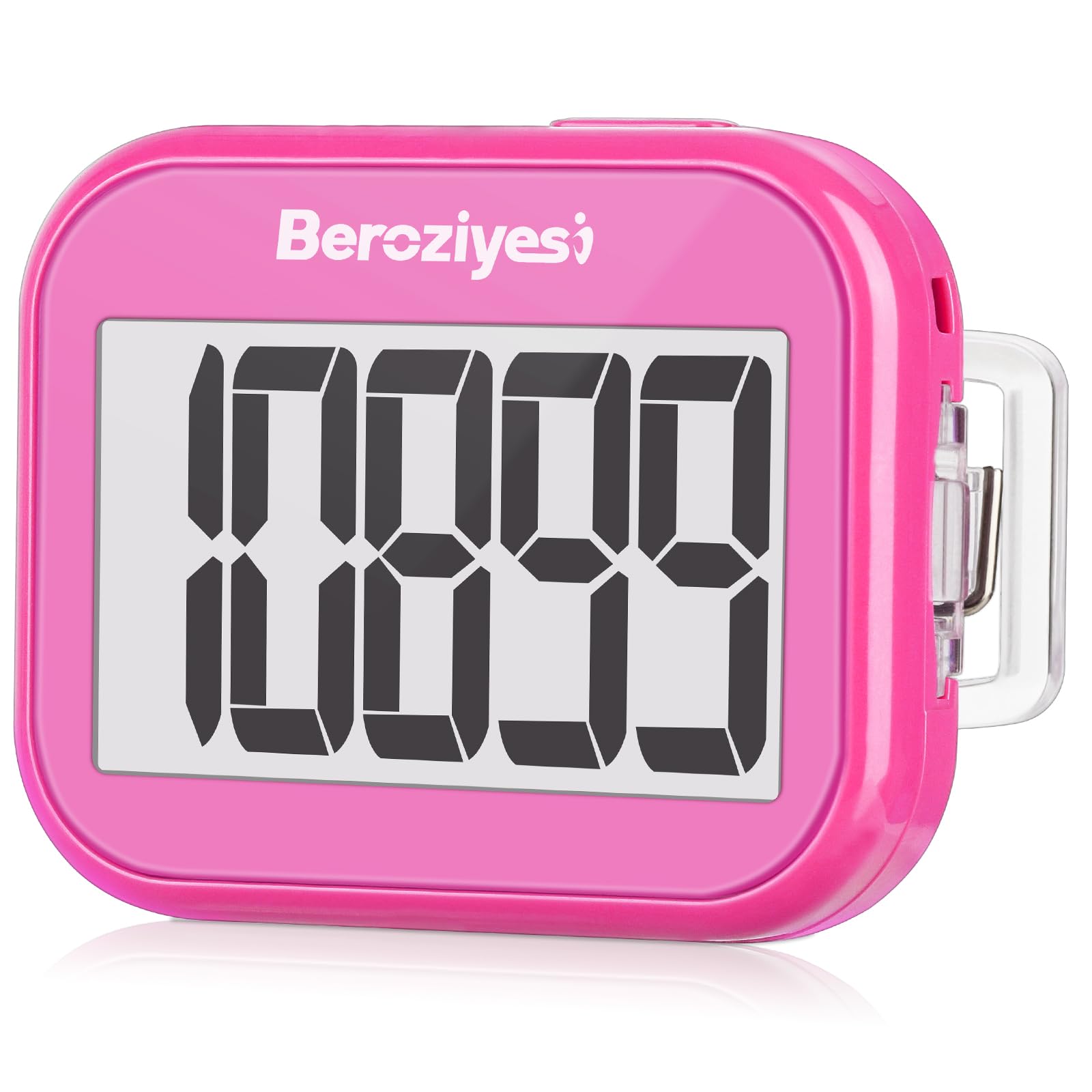
Beroziyesi Bero-P03 3D Pedometer

83 /100
Peggy's Score Excellent

Key details

Weight
0.95 oz
Warranty
6 months
Battery Life
6 months
Display Size
1.73 inches
Check Details on Amazon

The Bero-P03 is the cheapest thing in this guide, and it does not act like it. A 1.73-inch full-screen display shows the number big enough to read from your waist, the counter runs to 99,999 before it rolls over, and the clip bites down hard enough that a waistband feels like a secure home for it.

Ease of use is where it earns its place. There is one button, a long hold clears the count, and the whole thing weighs 27 grams, light enough that you forget which pocket it is in. We noticed the display stays legible at arm's length even when you are moving, which matters more than any feature on the box for a device you check mid-walk.

Where it gives ground is the kind of walking it counts. A steady route outdoors reads true, while a treadmill session does not move the unit the way it expects and short indoor shuffling is where the number gets fuzzy. If your miles come from a gym machine, look elsewhere. If they come from the sidewalk and the dog, this is the best value in the group.

Pros

  • Lowest price in this guide
  • Full-size 1.73-inch display
  • Clip grips a waistband firmly
  • One-button operation with no app

Cons

  • Coin cell rated for six months, not a year
Our verdict

It costs the least here and still gives you a full-size display; we point bargain hunters to it first.

Check Latest Price
4

Rechargeable Simplicity

StepLify CR-837 3D Pedometer

84 /100
Peggy's Score Excellent

Key details

Power
USB rechargeable
Battery Life
12 weeks
Display Size
1.3 inches
Check Details on Amazon

No coin cell, no screwdriver, no Saturday trip to the store: the CR-837 charges over USB, which makes it the only rechargeable unit in this guide. If you have had a pedometer die mid-week with no spare battery in the house, you already know why that matters.

The rest of it is deliberately plain. One button does everything, a five-second hold clears the count, and the backlight means you can read it in a dark hallway or before sunrise without angling for a streetlight. The 1.3-inch screen is the smallest here, fine for a glance at the number and less so if small digits are a struggle.

What you trade for the cable is patience with the cable. The rating works out to about 12 weeks per charge, so a few times a year you will want the cord handy, and there is a USB port to keep dry on a wet walk. That is a fair swap for someone already charging a phone every night, and the backlight plus the slimmer body make this the easiest of the clip-ons to wear all day.

Pros

  • USB rechargeable, so no coin cells
  • Backlight for early or dim walks
  • One button with a five-second reset

Cons

  • Smallest display of the picks here
  • Needs a charge roughly every 12 weeks
Our verdict

We recommend the rechargeable one for anyone who prefers plugging in a cable to hunting for a coin cell.

Check Latest Price
5

Wrist Tracking

TIMEURE TU2308 Pedometer Watch

79 /100
Peggy's Score Very Good

Key details

Weight
1.76 oz
Case Size
40 mm
Wrist Size
6.29 to 9.44 inches
Water Resistance
50 m
Check Details on Amazon

A watch solves the problem a clip-on creates: you cannot leave it on a nightstand or lose it in a laundry basket. The TU2308 puts the count on your wrist with no app, no pairing, and no charger, because the battery is a button cell you replace rather than a cable you remember.

Rain, handwashing, and a swim are all covered by the 50-meter rating, which is more water resistance than any clip-on here claims, and the five-second backlight is genuinely useful on a winter morning. You set it up once, then it is a watch that also tells you how far you have walked, which is the least intrusive version of step counting we tried.

The band is the weak point. It is a PU strap that is not replaceable, so when it goes, the watch goes with it, and that is the thing to weigh against the convenience. What you get in return is real, though: no charger, no app, and a watch that shrugs off handwashing and rain. Buy it for steps on your wrist, not for a decade of service.

Pros

  • No app, no pairing, no charging
  • 50 m water resistance for rain and swims
  • Backlight and large digits

Cons

  • Band cannot be replaced when it wears through
  • 40 mm case and 50 g is a lot on a small wrist
Our verdict

Buy it if you want steps on your wrist with no app and no charging, and accept that the band is the part that wears out.

Check Latest Price

How We Chose and Tested the Best Step Counters

We built a shortlist of 16 counters — clip-on pedometers, wristband styles, and a couple of pocket models — filtering out anything with a display we couldn't read at a glance or a reset that required a trip to the hardware drawer. Over four months, each one got a full week of real life: clipped to a waistband for the morning dog walk, dropped in a pocket for the commute, and worn through an afternoon of errands and stairs at home. We also walked a measured mile on a local track and counted steps by hand, then compared that tally to the device's number and to a phone's step count.

Setup tripped up more models than we expected: we noted whether a counter arrived ready to wear or demanded the time, date, and stride length before it would count a single step. After each outing, we checked whether the count held overnight, whether a bumped button wiped it, and how easy it was to zero out — some needed a paper clip, others a fingernail. We also paid attention to size and clip tension: did it disappear against a waistband, or catch on a pocket seam and pop off? At the end, we dropped each one onto a tile floor, ran one through a wash cycle by accident, and weighed what it did against what it cost.

How to Choose Step Counters

Where You Carry It Decides the Count

The waistband is the reference point for a reason: a unit clipped at the hip sees a clean, repeatable swing with every stride. Put the same pedometer in a bag or swing it from a lanyard and it either misses short steps or invents them from the sway. Clip it to a belt, a waistband, or a front pocket at hip height, then walk 100 counted steps and compare. That two-minute test tells you more about accuracy than any claim on the box, and every clip-on here ships with both a clip and a lanyard so you can try both positions.

One Number or a Small Dashboard

Steps-only models spend the entire screen on four digits, which is why they read from a waistband at arm's length. Multi-metric models split that space between the number and a label row for steps, distance, and calories, so the digits you actually want get smaller. If you check the count without reaching for glasses, a 1.73-inch steps-only display is the easier thing to own. If distance and calories are the point, plan on bringing the unit closer to your face.

Setup: None, or One Sitting

A steps-only pedometer needs no calibration; the count starts when you move. A multi-metric one wants your stride length, weight, and the time before distance and calories mean anything, and the entry windows close if you are slow, which is where most of the frustration lives. Do it once at a table with the manual open, and hand it to someone with younger eyes if the small print is a factor. If you know you will not do it, buy the steps-only version and skip those features entirely.

Coin Cell or USB

Button cells are rated between six months and a year depending on the model, cost little to replace, and never leave you hunting for a cable. A rechargeable saves the trip to the store but adds a cord, a port to keep dry, and a routine to remember; the rechargeable unit here is rated around 12 weeks per charge. For something that lives on a waistband, a year on one cell is hard to beat. If you already plug in a phone every night, USB is no burden at all. Either way, keep spare cells out of reach of children.

Watch or Clip

A pedometer watch counts arm swing rather than hip motion, which is close enough for walking and impossible to leave on a dresser. The cost is bulk: a 40 mm case at 50 grams sits heavier than the watch you may be used to, and the band on an inexpensive watch usually is not replaceable. Choose the watch if losing a clip-on is the more likely failure. Choose the clip if you want the most consistent count and nothing on your wrist.

Frequently Asked Questions

Final Verdict

Start with the Realalt 3DTriSport. It counts steps, distance, and calories, keeps a record instead of wiping at midnight, and carries the longest warranty in this guide. Set it up once at the kitchen table and it becomes the least demanding thing you own.

Change one requirement and the answer changes. If programming of any kind is a dealbreaker, the NESKLA 838 counts steps with one button and nothing else. If you prefer not to shop for coin cells, the USB-rechargeable StepLify CR-837 is the one to clip on.