Best Heart Rate Monitors of 2026

A heart rate monitor that lies to you is worse than no monitor at all. You pace a long run off a number that's ten beats high, or you glance down mid-interval and the reading hasn't budged since you started, and now the whole training block is built on bad data. What a good one actually buys you is quieter than that: a number you stop second-guessing. Chest straps read the heart's electrical signal, while wrist and arm sensors read blood flow through the skin, and that single difference explains most of why two monitors disagree about the same hill.

Accuracy is where everyone starts, rightly, but a strap that's spot-on and digs into your ribs by mile four ends up in a drawer, and the cleanest app in the world won't save a monitor that drops its connection halfway through a ride. Over nine months, my team and I wore 12 of them, chest straps, armbands, and wrist units, through intervals, long rides, and gym sessions. The ones worth keeping got the readings and the comfort right at once, and they're the ones below.

1

Best Overall

Garmin HRM 200

86 /100
Peggy's Score Excellent

Key details

Battery
Up to 1 year, replaceable
Strap Sizes
XS-S and M-XL
Connectivity
ANT+ and Bluetooth
Water Rating
3 ATM
Check Details on Amazon

Garmin's premium strap costs about twice as much, and what the extra money buys is running dynamics and watch-free recording, not a better heartbeat. That distinction is why the HRM 200 is the one we point most people to. It sends real-time heart rate and heart rate variability to a Garmin watch, a bike computer, a gym machine, or a phone app, and it asks nothing of you between sessions.

What we appreciated most is how little there is to manage. The user-replaceable coin cell is rated for up to a year, so there is no charging routine to build your week around, and the pod weighs about two ounces, light enough to forget under a shirt. The strap goes in the washing machine, a small thing that stops being small by the third sweaty session of the week. A 3 ATM rating covers sweat and rain.

Where a chest strap earns its keep is at the top of a hard interval, and this one behaves there: the number climbs and settles rather than drifting the way a wrist reading can. Two things to check before ordering. The M-XL strap runs snug, so measure rather than assume if you are broad-chested, and skip this one if you want a strap that records a session on its own, which is the 600's job.

Pros

  • Steady readings through hard intervals
  • Up to a year on a replaceable battery
  • Machine-washable strap in two sizes
  • Works with watches, apps, and gym equipment

Cons

  • M-XL strap runs snug on broad chests
  • No on-board recording or running dynamics
Our verdict

The heart rate monitor we recommend to most people: steady readings, a comfortable washable strap, and a year between battery changes.

Check Latest Price
2

Best for Running Data

Garmin HRM 600

89 /100
Peggy's Score Excellent

Key details

Battery
Rechargeable, about 2 months
Strap Sizes
XS-S and M-XL
Connectivity
ANT+ and Bluetooth
Running Data
Stride length and step speed loss
Check Details on Amazon

The HRM 600 is the only strap in this group that keeps working when your watch stays in the locker. Leave it on for a team sport or a gym session where a watch is not allowed and it records the workout itself, heart rate, calories, speed and distance, then syncs to Garmin Connect afterwards. It pulls daily metrics like steps and calories into the same app.

Then there is the running data, and it is the reason to pay the premium: stride length and step speed loss, which together show whether you are scrubbing speed every time your foot lands. We found that more useful than another decimal place on heart rate, but it only works if you already train with a Garmin watch, because the running metrics are built for that ecosystem rather than for a phone app.

The hardware is the nicest here. The silicone strap is thicker than the others and holds its shape, the pod detaches for washing, and the battery is rechargeable, rated at roughly two months of training. That last part is a trade, since a coin cell you swap once a year never needs a cable, and the clips holding the pod to the strap are stiff enough that you want to ease it off rather than yank it.

Pros

  • Running dynamics including stride and step speed loss
  • Records a workout with no watch present
  • Thick silicone strap that holds its shape
  • Rechargeable battery, no coin cells to source

Cons

  • Running metrics need a compatible Garmin watch
  • Stiff clips when removing the pod to charge
Our verdict

Worth the premium for runners who want form data and a strap that records without a watch, provided you already train inside Garmin's ecosystem.

Check Latest Price
3

Best Armband

COROS Heart Rate Monitor

85 /100
Peggy's Score Excellent

Key details

Type
Optical armband
Battery
38 hours
Band Fit
Large band fits 9.4-16.9 in. arms
Paired Devices
Up to 3 at once
Check Details on Amazon

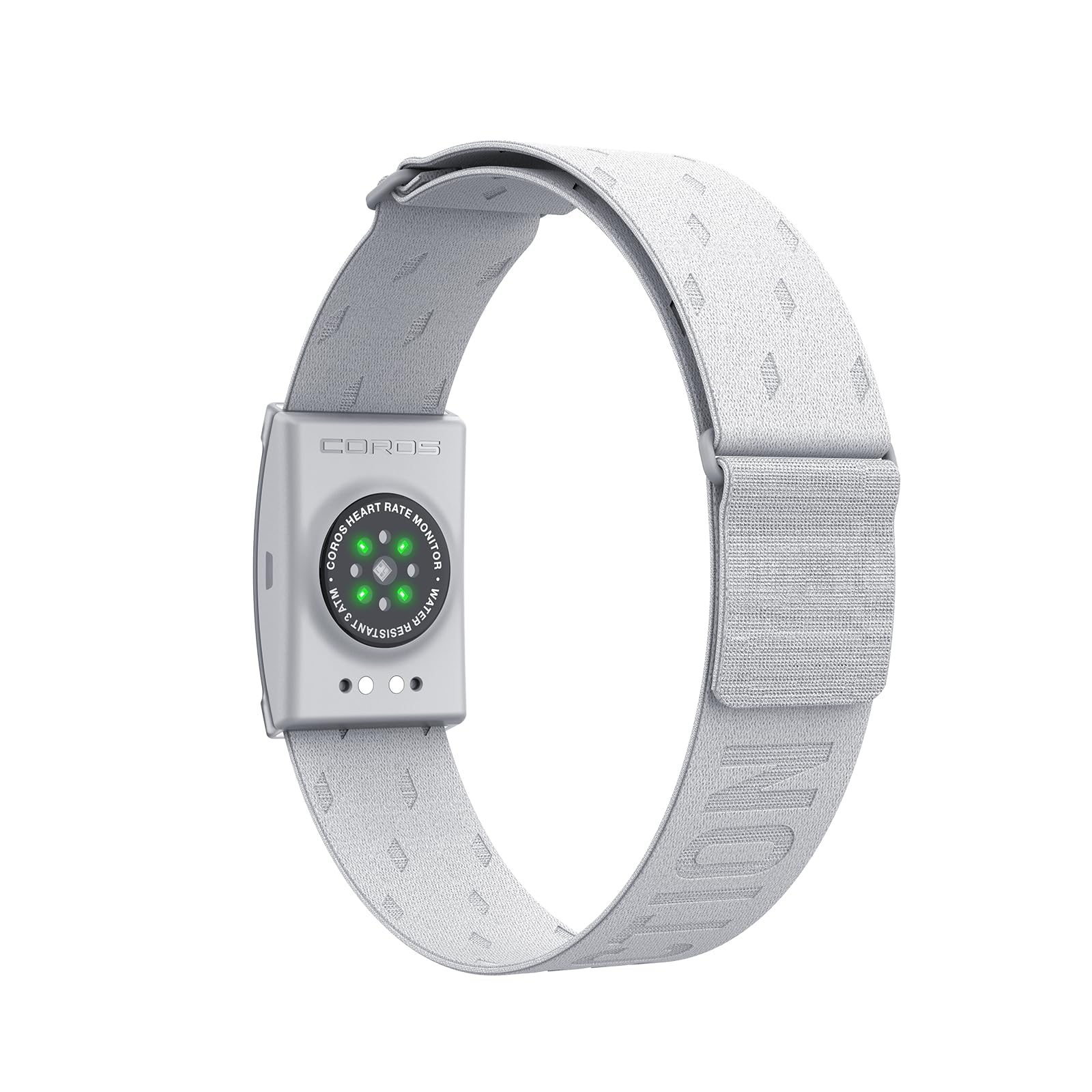
If a chest strap is the reason you stopped tracking heart rate, this is the alternative we hand people. The COROS sits on the upper arm, held by a textured band that lies flat and locks where you put it, and it is light enough that the usual complaint about a band you notice on every stride does not apply.

It measures optically at the arm, which is a better spot than the wrist for blood flow and a worse one than the chest at the very top of an effort. For steady runs, rides, and circuits the difference is not something we noticed. Battery is rated at 38 hours and charges over USB, the sensor pops out so the band can be washed, and it holds a connection to three devices at once, covering a watch, a phone app, and a gym machine in the same session.

Two things to know. COROS sells this for sport rather than for daily wear, so do not plan on sleep tracking with it. And pairing outside the COROS ecosystem is the weak spot: the band can connect and then hold a fixed number, and the COROS app is not much of a live display for heart rate.

Pros

  • Band stays put without chest pressure
  • Up to 38 hours per charge
  • Connects to three devices at once
  • Sensor detaches so the band can be washed

Cons

  • Sold for sport, not all-day or sleep tracking
  • Pairing outside COROS watches can be unreliable
Our verdict

The armband we recommend to anyone who finds chest straps uncomfortable or distracting, as long as you can live without all-day tracking.

Check Latest Price
4

Best Value

POWR LABS Chest Strap

81 /100
Peggy's Score Excellent

Key details

Strap
Adjustable elastic
Battery
Replaceable, no charging
Connectivity
ANT+ and Bluetooth 4.0
Water Rating
IPX67
Check Details on Amazon

POWR LABS sells a chest strap for a good deal less than the flagship options and claims the same plus or minus one beat per minute. What we can say after training with it is that the readings hold up against a wrist sensor even in the middle of a hard session. This is not a cheap strap that wanders.

It is dual-band, so it talks to ANT+ gym equipment and Bluetooth apps, and it carries an IPX67 rating, which is enough for sweat and rain. The strap is a soft, seamless band that adjusts over a wide range and did not chafe over long sessions, and the battery is replaceable with no charging cable to lose. Pairing with a Garmin watch and a phone app took seconds.

The catch is longevity. This is the one place the price shows: the band and pod are the parts that give out, and it is worth buying this one expecting to replace it rather than counting on years of service. Fit is the other caveat, since the band runs large and on a small frame it can slip unless you cinch it tighter than is comfortable. Spend more if you want to buy once; for a second strap in a gym bag, the value is real.

Pros

  • Readings that track a wrist sensor closely
  • Dual ANT+ and Bluetooth
  • Soft band that does not chafe
  • Sweat and rain resistant at IPX67

Cons

  • Longevity is the weak point; expect to replace it
  • Band runs large on small frames
Our verdict

If you want accurate dual-band heart rate without flagship money and can accept a shorter lifespan, this is the strap we recommend.

Check Latest Price
5

Best Budget

CooSpo H808S

81 /100
Peggy's Score Excellent

Key details

Battery
300 hours, CR2032
Connectivity
ANT+ and Bluetooth 4.0
Water Rating
IP67
Sensor Weight
0.53 oz
Check Details on Amazon

CooSpo's own instructions tell you to pair the H808S inside the app rather than in your phone's Bluetooth menu, and that one line explains most of the pairing trouble these straps get blamed for. Do it that way and the H808S connects fast and holds through a ride, a run, or a session on a gym machine.

At this price the value is hard to argue with: dual ANT+ and Bluetooth 4.0, a claimed plus or minus one beat per minute, an LED that flashes to confirm it is awake, and a beep when it connects. We kept it in a gym bag as the strap that goes with everything, and it held steady readings through steady cardio, which is most of what a budget strap needs to do.

The catch is current draw. The CR2032 is rated at 300 hours, but a pod left snapped onto a damp strap keeps drawing, so the battery goes faster than the number suggests. Unclip it and rinse the electrodes after every session and you get much closer to the rating.

Pros

  • Dual ANT+ and Bluetooth at a low price
  • Fast, stable pairing through the app
  • Accurate through steady cardio
  • LED and beep confirm it is running

Cons

  • Can stop working within a few months
Our verdict

The budget strap we recommend for a gym bag or a first setup, with the caveat that you should buy it somewhere returns are easy.

Check Latest Price
6

Soft Strap Comfort

Polar H9

82 /100
Peggy's Score Excellent

Key details

Battery
400 hours, CR2025
Strap Sizes
Medium to XX-Large
Connectivity
ANT+ and Bluetooth
Check Details on Amazon

Polar's soft strap is the best part of the H9: a wide band that sits flat, does not dig in, and comes in sizes up to XXL, which is more range than most of the straps here offer. The pod works with anything that speaks ANT+ or Bluetooth, watches, phones, bike computers, gym machines, and the coin cell is user-replaceable.

On the days it behaves, it reads like a Polar should: steady through steady work, quick to pair, and comfortable enough that you forget the band is on. The problem is the days it does not, which is why we rank it below the Garmin here rather than beside it.

The two-year warranty is the longest in this group, and the XXL sizing makes it the easiest recommendation for a bigger chest. If you want Polar's soft strap and can live with a strap you may end up replacing, it is fair value. If you want one you keep, the HRM 200 is the better bet.

Pros

  • Soft, wide strap in sizes up to XXL
  • Works with nearly any ANT+ or Bluetooth device
  • Two-year manufacturer warranty
  • User-replaceable coin cell

Cons

  • Battery life can fall to weeks, not the rated 400 hours
  • Connections and readings can fail within months
Our verdict

A comfortable, widely compatible strap with the longest warranty here, though the HRM 200 is the safer buy at a similar price.

Check Latest Price
7

Multi-Device Setup

Wahoo TRACKR

83 /100
Peggy's Score Excellent

Key details

Weight
1.06 oz
Battery
Rechargeable
Connectivity
ANT+ and Bluetooth, 3 at once
Water Rating
IPX7
Check Details on Amazon

Three Bluetooth connections at once is the feature that earns the TRACKR its place. A treadmill, a phone app, and a bike computer can all read the same strap in the same session, and none of them drops out when the next one wakes up. We used that more than we expected to, particularly indoors, where the machine and the app both want a number.

It is rechargeable, which puts it with the HRM 600 and the COROS rather than the coin-cell straps. Wahoo rates the battery in the hundreds of hours; in practice you are charging it about once a week if you train most days. The pod weighs 30 g, carries an IPX7 rating, and has an LED that confirms detection, battery state, and connection, which sounds minor until you have stood in a cold garage wondering whether the strap is awake.

The strap is the weak link. It ships in one size and runs snug, so a broad chest ends up near the end of the adjustment. Putting it on takes a bit of care compared with the soft Polar band, and the charging routine means the pod comes off and goes back on far more often than a coin cell ever demands.

Where it lands for us: if you want a rechargeable chest strap that can feed a treadmill and an app at the same time, this is the one to get, and the LED feedback makes it the least fussy strap here to troubleshoot. If neither of those matters, the HRM 200 costs less, needs no charging, and has been the more consistent performer in this group.

Pros

  • Feeds three Bluetooth devices at once
  • Rechargeable, with no coin cell to source
  • IPX7 and light at 30 g
  • LED confirms detection and battery

Cons

  • One-size strap runs snug on broad chests
  • Can stop charging within the first months
Our verdict

Pick this if you want a rechargeable strap that can broadcast to several devices at once; otherwise the HRM 200 is simpler and steadier.

Check Latest Price
8

First-Time Buyers

GEOID HS500

84 /100
Peggy's Score Excellent

Key details

Battery
800 hours, CR2032
Connectivity
ANT+ and Bluetooth
Wake-Up Time
Under 1 second
Water Rating
IP67
Check Details on Amazon

A flashing red light is the whole idea here. The HS500 shows it is awake and reading with an LED, wakes in under a second when it touches your skin, and beeps when it connects. For a first strap, that confirmation is worth more than another decimal place of accuracy.

It is dual protocol, ANT+ and Bluetooth, IP67, and it runs on a user-replaceable coin cell rated at 800 hours, the longest claim among the coin-cell straps here. The elastic strap adjusts over a wide range and the pod is light enough that the whole thing disappears under a shirt.

The readings are the variable. Steady work reads fine, but hard efforts are where this one can lose the plot, with numbers running high or sticking at a ceiling until you stop and restart. If you train mostly in zones 2 and 3 you will rarely see it. If you do intervals, you will.

At the bottom of the price range that is a fair trade. It is the strap to start with if you are unsure whether chest-strap training will stick, and the money left over covers a spare battery and a few weeks of gym visits. Setup help is thin, so plan on pairing it inside the app and working the rest out yourself.

Pros

  • Lowest-priced dual-band strap in this group
  • LED and beep confirm it is on
  • 800-hour replaceable battery
  • IP67 for sweat and rain

Cons

  • Readings can run high on hard intervals
  • Setup instructions are minimal
Our verdict

A cheap, honest first chest strap for steady training, provided you are not relying on it for precise interval work.

Check Latest Price

How We Tested the Best Heart Rate Monitors

We started with spec sheets for more than 40 monitors and cut the list down by sensor type, claimed battery life, water resistance, and whether each one paired over both Bluetooth and ANT+, since a monitor that only talks to its own app is a monitor you'll quietly stop using. Price narrowed it further: anything costing noticeably more than a plain chest strap that measures the same thing got dropped, as did models whose recent reviews were full of dropped-connection complaints.

The 12 that made the cut were worn for nine months, always against the same reference chest strap on the same routes. That meant treadmill intervals, cold early-morning runs (optical sensors hate cold hands), 90-minute sessions on a bike trainer, a packed HIIT class, and a handful of swims. Every 30 seconds we compared the number on the monitor to the reference, watching for lag at the start of a hard effort, readings that froze, and spikes that never happened. At the end of each session we lined up average and max heart rate side by side.

Comfort got tested the boring way: full workdays, long rides, and washing the strap after every session to see whether it stretched or the clasp loosened. We paired each monitor with two phones and a bike computer at once, then re-paired it in a gym full of other people's devices to see how quickly it found a signal again. Battery life was logged workout by workout, including how many sessions fit between charges and whether a low-battery warning arrived before the monitor died mid-run. Value came down to whether the extras over a basic strap were features we actually reached for.

How to Choose Heart Rate Monitors

Chest strap or armband?

A chest strap reads the heart's electrical signal across your ribs. An armband reads blood flow optically at the upper arm, the same idea as a watch but in a spot with fewer things to go wrong. In practice the chest strap is the steadier choice at the top of a hard effort, and the armband is the one you forget you have on.

Pick an armband if a band around your ribs bothers you, chafes, or gets in the way of rowing, lifting, or contact sport; the COROS is the one here we hand to chest-strap refugees. Placement matters more than people expect, so wear it high on the upper arm rather than down by the elbow, where the reading lags.

Protocols, pairing, and what your gym uses

Two broadcasts matter: ANT+ and Bluetooth Low Energy. Gym equipment, bike computers, and older watches usually want ANT+, while phones and apps want Bluetooth, so dual-band is the safe buy and every chest strap here has both. The trap is where you pair. Connect in your phone's Bluetooth settings and the strap can end up locked to the system rather than to the app that needs it, which is why CooSpo's own instructions tell you to pair inside the app.

If you want to feed two things at once, say a treadmill and a phone app, look for a strap that lists simultaneous connections. The COROS armband and the Wahoo TRACKR each handle three.

Battery: coin cell or rechargeable

Coin cells are the low-effort option: rated from 300 to 800 hours depending on the strap, replaceable in a minute, and nothing to charge before a session. Rechargeables cost more upfront and add a cable to your routine, but they suit anyone who trains indoors on a schedule and would rather plug in than hunt for a CR2032.

Whichever you choose, unclip the pod from the strap after a sweaty session. A sensor left sitting on damp elastic keeps drawing current, and that is where most disappointing battery life comes from.

Fit, washing, and how long it lasts

Strap ranges differ enough by brand that you should measure rather than assume. Garmin ships XS-S and M-XL, Polar's soft strap runs up to XXL, and the Wahoo TRACKR comes in one size that sits snug on a broad chest. A detachable pod is worth insisting on, because it lets you machine wash the band, which is the difference between a strap that lasts a season and one that smells like a season.

Expect the elastic to give out before the electronics do. The band is the wear item, so a strap you can replace on its own is worth more than a longer warranty.

Frequently Asked Questions

Final Verdict

The Garmin HRM 200 is the heart rate monitor we recommend for most training: steady heart rate and HRV to whatever you already use, a strap that survives the washing machine, and a battery that asks for attention once a year.

If a chest band is the reason you stopped tracking, the COROS armband is the alternative we hand people. The Garmin HRM 600 earns its price only if you want running form data and watch-free recording, and on a tight budget the CooSpo H808S gets both protocols right for very little.