Best Stability Balls of 2026

A stability ball is a simple thing until it isn't. The one bought on a whim is usually the one that hisses quietly through a plug that never seated right, or slides out from under you halfway through a set of crunches because it was never really the right size for your height in the first place. What you actually want is boring: a ball that holds its air, holds its shape, and stays put while you work.

I've used one as a desk chair, a footrest, and a stand-in for just about every core exercise I know, and the gap between a good ball and a frustrating one comes down to unglamorous details — wall thickness, valve quality, and whether the pump in the box is worth the cardboard it shipped in. Over the past four months, my team and I inflated, sat on, and exercised with 16 balls to see which ones still felt firm a month in. Sizing trips up more people than anything else: buy by your height, and size up if you're between.

1

Best Overall

Trideer Yoga Ball

93 /100
Peggy's Score Outstanding

Key details

Surface
Frosted anti-slip
Diameter
65 cm
Included
Hand pump, two stoppers, instructions
Load Capacity
330 lb
Check Details on Amazon

The 65 cm size is the one we treat as the default for most adults, and the Trideer ball is the easiest recommendation in this group because it gets that basic fit right. It supports up to 330 lb, uses a slow-deflate anti-burst shell, and comes in five diameters from 45 to 85 cm, so a household can size one ball for a teenager and another for a tall parent without changing brands.

The surface is the detail we appreciate most. Anti-slip stripes and a frosted finish give the ball a slightly tacky feel under hands and clothing, which matters when you are rolling out on a wood floor or holding a plank. It is not a sticky rubber coating that collects dust; it is a practical grip that makes the ball feel less like a toy.

For core work, stretching, and occasional active sitting, the package is complete: hand pump, two stoppers, and instructions. The 65 cm version suits the widest band of adults, with 55 cm for shorter users and 75 or 85 cm for taller ones. That range is why it works as a household ball, and why it is the one we recommend before a specialist pick.

Pros

  • Grippy frosted surface with anti-slip stripes
  • 330 lb anti-burst load rating
  • Pump, stoppers, and instructions included
  • Five sizes from 45 to 85 cm

Cons

  • Durability can vary with heavy daily use
Our verdict

We recommend the Trideer as the best all-around stability ball for most adults: the 65 cm size fits a broad height range, the frosted surface grips, and the pump gets you started.

Check Latest Price
2

Best for Shorter Users

Core Balance Exercise Ball

93 /100
Peggy's Score Outstanding

Key details

Diameter
55 cm
Included
Pump
Material
Anti-burst PVC
Warranty
1 year
Check Details on Amazon

The buyer who keeps sliding forward on an oversized ball is the one we have in mind here. Core Balance's 55 cm version is small enough for shorter adults to sit with feet flat, and its anti-burst PVC shell has a reassuringly simple brief: it is a stability ball, not a Swiss Army knife.

We think it earns a runner-up slot because the proportions are honest. At 55 cm and 1.2 kg, it is easy to move from a closet to a living-room floor, and the included pump and one-year warranty cover the basics. The ball has a light, slightly soft feel underfoot, comfortable for gentle stretching, though not the dense rubbery support of the THERABAND.

Core Balance also includes a pump and a one-year warranty, which is more than some basic balls offer. The 55 cm size is the one to choose if you are around the lower end of the height chart; taller users should move up rather than overinflate. It is a tidy, low-drama ball for the right frame.

Pros

  • 55 cm size suits shorter users
  • Anti-burst PVC construction
  • Pump and one-year warranty included

Cons

  • Air retention can be inconsistent
Our verdict

We recommend the Core Balance for shorter adults and smaller spaces: the 55 cm shell is easier to straddle, and the anti-burst PVC keeps the kit simple.

Check Latest Price
3

Best for Clinic-Style Durability

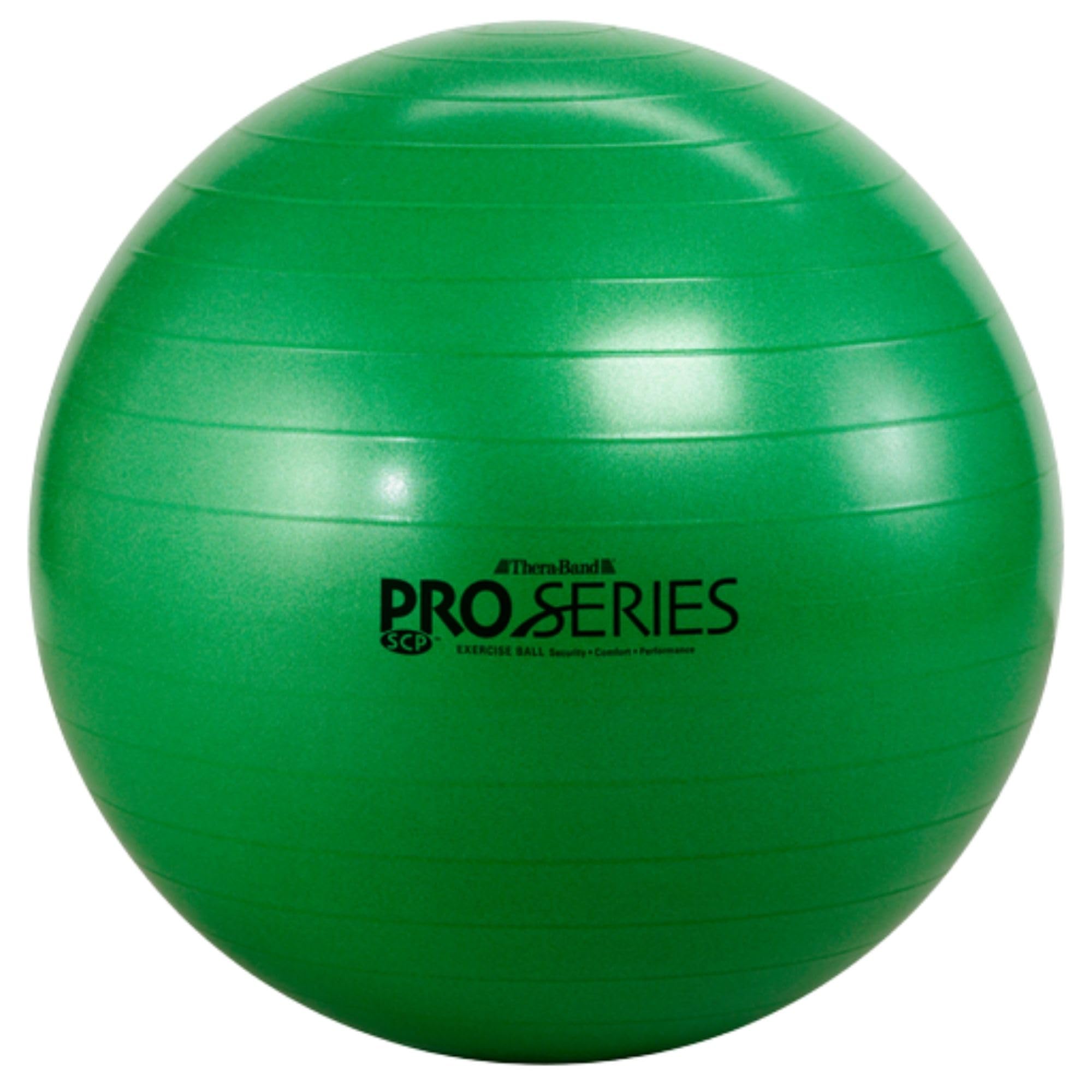
THERABAND Exercise Ball

92 /100
Peggy's Score Outstanding

Key details

Diameter
65 cm
Included
1 exercise ball
Material
Rubber
Height Range
5 ft 7 in to 6 ft 1 in
Check Details on Amazon

The first thing to know about the THERABAND ball is what is not in the box: a pump. That is not a dealbreaker if you already own a floor or electric pump, but it does make this the least plug-and-play pick in the group.

What you get instead is dense rubber and a slow-deflate build. The 65 cm size is aimed at users from 5 ft 7 in to 6 ft 1 in, and the ball feels substantial under sitting and stretching. In a rehab or clinical-style routine, that firmness is the point: it holds its shape well when you move around it, and it does not have the hollow give of a cheap PVC shell.

Where it earns our recommendation is durability and a straightforward, no-frills feel. The rubber shell is the one we trust for a home therapy corner where the ball gets used in short, frequent sessions, and the slow deflate is the safety feature that matters if something sharp finds it. Just measure your height carefully, since the nominal 65 cm does not flatter every frame.

Pros

  • Dense rubber shell feels substantial
  • Slow-deflate anti-burst design
  • Strong durability for rehab-style use

Cons

  • Smooth surface can feel slick during floor work
Our verdict

We recommend the THERABAND for a clinic-style ball that feels dense and steady; just plan on supplying your own pump.

Check Latest Price
4

Best High Weight Capacity

APEXUP Yoga Ball

91 /100
Peggy's Score Outstanding

Key details

Diameter
65 cm
Included
Pump
Construction
Honeycomb PVC
Load Capacity
660 lb
Check Details on Amazon

The 660-pound load rating is the number that separates the APEXUP from most of the balls here, and it is the reason we keep it in the conversation for heavier users or shared home-gym setups.

The honeycomb PVC shell and textured surface support that role. It has a practical, grippy feel rather than a soft, pillowy one, and the five-size range goes from 45 to 85 cm, so taller users are not pushed into an undersized ball. For seated core work and slow, controlled drills, that firmness is welcome.

Inflation is the ordinary weak spot. The included hand pump gets the job done, but a floor pump makes lighter work of a full inflation, and the plug needs to be seated squarely. None of that is unusual for an anti-burst ball; it is just the part of ownership that takes a few minutes of patience.

We recommend it when capacity is the deciding feature: it gives a heavier user more margin than a 330-pound ball without turning the surface into a slippery dome. If you are an average-sized user who wants the softest feel, look elsewhere; if you want a sturdy, grippy ball with a high stated limit, this one makes sense.

Pros

  • 660 lb stated load capacity
  • Honeycomb PVC construction
  • Textured anti-slip surface
  • Sizes from 45 to 85 cm

Cons

  • Air retention can require occasional topping up
  • Durability may be uneven under heavy use
Our verdict

We recommend the APEXUP for anyone who wants a higher load rating without giving up grip: 660 lb, honeycomb PVC, and a textured surface make it a sturdy active-sitting option.

Check Latest Price
5

Best for Pregnancy

YOTTOY Exercise Ball

90 /100
Peggy's Score Outstanding

Key details

Diameter
65 cm
Included
Foot pump
Material
High-density PVC
Wall Thickness
2.8 mm
Check Details on Amazon

Pregnancy is the use case that sold us on the YOTTOY: the 65 cm ball is sized for a wide range of expectant mothers, the honeycomb PVC is thickened to 2.8 mm, and the surface is designed to stay comfortable against skin.

The foot pump is the practical detail we appreciate most. In late pregnancy, bending over a hand pump is its own workout, and a foot pump lets you inflate the ball while standing or sitting. The ball also has a pleasant, low-odor finish, which matters in a small bedroom or nursery.

For prenatal stretching, gentle bouncing, and a comfortable seat during the last trimester, it feels supportive without being rock-hard. The 65 cm size is a good starting point for many users, though shorter users may prefer a 55 cm option. Keep the plug clean and expect to top it up after the first few days.

Pros

  • Thick 2.8 mm honeycomb PVC
  • Foot pump is easier during pregnancy
  • Low-odor, skin-friendly finish

Cons

  • May need re-inflation between uses
Our verdict

We recommend the YOTTOY for pregnancy and recovery: the thick honeycomb PVC feels supportive, the foot pump is easier on the hands, and the 65 cm size suits many expectant mothers.

Check Latest Price
6

Best for Verifying Size

MANTRA SPORTS Yoga Ball

92 /100
Peggy's Score Outstanding

Key details

Diameter
65 cm
Included
Hand pump, tape measure, two plugs
Height Range
5 ft 4 in to 5 ft 10 in
Load Capacity
1,000 lb
Check Details on Amazon

A tape measure in the box sounds like a small thing until you have inflated a ball that turns out to be an inch short of the height chart. MANTRA includes one, along with a 1,000-pound rating and a two-year warranty, which makes this the most reassuring pick for a first-time buyer who wants to get sizing right.

We like the MANTRA for that measured approach. The 65 cm version is aimed at users from 5 ft 4 in to 5 ft 10 in, the frosted surface has a useful grip, and the hand pump is included. The ball feels dense and stable when seated, and the load rating gives heavier users more headroom than the 330-pound class.

The trade-off is that the hand pump takes patience; a floor pump is a worthwhile shortcut if you have one. For the buyer who wants a clear size chart and the means to check it, this is a practical, well-equipped ball rather than a fashion pick.

Pros

  • Tape measure included for size checks
  • 1,000 lb stated load capacity
  • Two-year warranty
  • Frosted non-slip surface

Cons

  • Air retention can weaken over time
Our verdict

We recommend the MANTRA for shoppers who want to verify the fit: it includes a tape measure, states a 1,000 lb rating, and comes with a two-year warranty.

Check Latest Price
7

Best Workout Kit

Gaiam Balance Ball Kit

89 /100
Peggy's Score Excellent

Key details

Workout
105 minutes
Diameter
55 cm
Included
Pump and workout guide
Height Range
5 ft 0 in to 5 ft 5 in
Check Details on Amazon

The workout guide is the reason to look at the Gaiam kit rather than another bare ball. The 55 cm ball is paired with a 105-minute routine, and the package includes a pump, so a beginner can open the box and follow a plan instead of inventing one.

We recommend it for shorter users who want structure. The size is aimed at people from 5 ft 0 in to 5 ft 5 in, and the textured surface gives enough grip for seated and floor exercises. The routine is a real advantage for someone who has never used a stability ball and does not know where to start.

The ball itself is a simple PVC build, so treat the kit as a starter set rather than a buy-it-for-life purchase. Inflate it in two stages, let it stretch, and top it up before the first workout. For the right height and a guided introduction, the combination is more useful than another generic ball.

Pros

  • 105-minute workout guide included
  • 55 cm size suits shorter users
  • Pump included

Cons

  • Pump is basic and slow
Our verdict

We recommend the Gaiam kit for shorter users who want a guided start: the 55 cm ball, pump, and 105-minute workout make it easy to begin.

Check Latest Price
8

Desk-Side Storage

Retrospec Luna Exercise Ball

88 /100
Peggy's Score Excellent

Key details

Diameter
65 cm
Included
Ball and base
Construction
Anti-burst PVC
Load Capacity
1,000 lb
Check Details on Amazon

The included base is the first thing you notice about the Retrospec Luna, and it is worth understanding before you buy: it is a parking aid that keeps the ball from rolling across the room, not a stability ring that stops it wobbling while you sit.

The ball itself is a 65 cm anti-burst PVC build with a 1,000-pound rating, and it has a soft, slightly matte feel. For desk-side use, the base is genuinely handy: you can step away and the ball stays put instead of drifting under the couch.

Where the package gets less convincing is in the base's limits. It holds the ball in place when you are not on it, but it does not turn a stability ball into a chair; you still need to balance, and the base can shift if you push sideways. The ball also needs the usual break-in period and occasional topping up.

We recommend the Luna for a home office where the ball lives between sessions and you want it contained. If you need a base that stabilizes you during active sitting, this is not that product; a plain 65 cm ball and a little floor space are the better answer.

Pros

  • Base keeps the ball from rolling away
  • 1,000 lb stated load capacity
  • 65 cm size suits many adults
  • Anti-burst PVC construction

Cons

  • Durability can be uneven with daily use
Our verdict

We recommend the Retrospec Luna for a desk-side ball you want to park between sessions: the base contains it, though it is not a wobble-stopping stand.

Check Latest Price

How We Tested 16 Stability Balls Over Four Months

We started by pulling every ball we could find that listed an actual diameter and a weight capacity, then cut the list down by price, included accessories, and the pattern of complaints in customer reviews — splitting seams, leaking valves, pumps that quit halfway through. Sixteen made the cut, from bare-bones models to kits with a pump, extra plugs, and a plug remover.

Inflation came first. We timed how long each ball took to fill using its own pump, counted strokes, and noted whether the nozzle fit the valve without an adapter fight. Each ball was measured with a tape at the recommended inflation, then again at 24 hours, one week, and one month; the ones that lost noticeable height by week two went into the maybe pile, and the ones that held went into daily rotation.

Every ball spent full workdays as a desk chair and evenings on the living room floor for crunches, planks, wall squats, and back extensions. We watched for sturdiness in the small ways it shows up — whether the surface slid on hardwood, whether it got slick once we were sweating, whether it squished out sideways under a two-footed plank. A few testers used theirs for physical therapy exercises, a gentler but much longer test of the same qualities.

At the end of four months we checked seams, surface wear, and whether each plug still sat flush or had started to creep out. We also loaded each ball to its stated weight limit with sandbags and watched the seam area for give. Value was the last pass: what came in the box, how long the pump survived, and whether the price bought a thicker wall or just nicer packaging.

How to Choose Stability Balls

Start With Height, Not the Number on the Box

Stability balls are sold by diameter, but the number that matters is how you sit on it: feet flat, knees around 90 degrees, and hips level with or slightly above the knees. A 65 cm ball is the common starting point for adults roughly 5 ft 4 in to 5 ft 10 in, while 55 cm suits many shorter users and 75 cm is the better bet for taller frames. Inflate in two stages and recheck the diameter, because PVC stretches after the first fill. A tape measure, like the one in the MANTRA kit, is more useful than guessing from the box.

Treat Anti-Burst as a Safety Feature, Not a Strength Score

An anti-burst ball is designed to deflate slowly if punctured rather than popping suddenly, which is the feature to look for if you plan to sit, bounce, or hold weights. The stated load rating is a separate claim: 330 lb is common, while the APEXUP lists 660 lb and the MANTRA lists 1,000 lb. Choose a rating that leaves margin for the person using it, and inspect the shell for punctures before each session. A higher number does not make a thin ball indestructible, so keep sharp objects and rough floor edges away.

Pumps, Valves, and the First Week

Most kits include a hand pump, and some include a foot pump. The pump is not the glamorous part, but it decides whether you use the ball on day one or leave it half-inflated in a closet. A foot pump is easier on the hands, while a floor or electric pump is faster if you already own one. Seat the plug squarely and inflate in two stages: fill, let the PVC stretch for a day, then top up to the stated diameter. A ball that softens overnight usually has a valve or plug issue, not a mysterious leak.

Grip, Surface, and Active Sitting

A textured or frosted surface gives you more control on wood floors and mats, while a smooth rubber ball can feel slick against clothing. That matters most when you are balancing, stretching, or sitting at a desk for short blocks. For active sitting, a 65 cm ball is the usual starting point, and a firm ball is more supportive than a squishy one. A base can keep the ball from rolling away between sessions, but it does not stop the ball wobbling while you sit. The Retrospec base is a parking aid, not a chair conversion.

Buy the Kit You Will Actually Use

Pumps, plugs, a measuring tape, a workout guide, and a base all add value only if they match your routine. A guided kit like the Gaiam makes sense for a beginner who wants a plan, while a bare ball with a good pump is enough for someone who already follows a program. Accessories can also hide a compromise: if the ball is the wrong diameter, a free workout guide will not fix the fit. Put height and load rating first, then choose the extras that remove friction from your actual use.

Frequently Asked Questions

Final Verdict

The Trideer is the stability ball we recommend first because it gets the fundamentals right: a grippy 65 cm surface, a 330 lb anti-burst shell, and a pump in the box. It is the best default for a mixed household or a first home-gym ball.

If you are shorter, the Core Balance 55 cm is the easier fit; if you want the densest, most clinic-like rubber, choose the THERABAND. For a higher load rating, the APEXUP is the sturdier alternative.