Best Pilates Mats of 2026

Pilates mats live in a tug-of-war: the cushioning that saves your spine during roll-downs is the same cushioning that turns standing balance work into a wobble board, and the thicker it gets, the more annoying it is to roll up and haul to class. What you're actually shopping for is a mat that stays put under bare feet, doesn't reek of factory rubber for a month, and has enough give for your tailbone without making every leg lift a balancing act.

Over the past six months, my team and I worked through a dozen mats — foam, natural rubber, cork, and a few hybrids — in living rooms, studios, and one memorably slippery hotel carpet. One thing I wish someone had told me earlier: thickness is quoted for the whole mat, not per layer, so a thick foam and a thin rubber can feel like entirely different products under your sit bones. The picks below are the ones that held up.

1

Best Overall

BalanceFrom All Purpose 1-Inch Mat

95 /100
Peggy's Score Outstanding

Key details

Weight
2.2 lb
Included
Carrying strap
Material
High-density foam
Dimensions
71"L x 24"W x 1"Th
Check Details on Amazon

If the reason you're shopping for a mat is that your spine, hips or knees object to a bare hardwood floor, this is the one we hand people first. It's a full inch of high-density foam, 71 inches long and 24 wide, and it turns a hard floor into something you can lie back on without flinching. Across our sessions it was the mat that made the difference on the parts of Pilates that hurt most — kneeling for a side-leg series, rolling down through the spine, holding a bridge — and of the thick mats here it's the one that best holds its shape.

What surprised us is the weight. A mat this deep sounds like a roll of carpet, but it comes in at 2.20 pounds, less than the 3.5 pounds of dense PVC in the Gaiam Essentials. It rolls quickly, the velcro-tipped straps cinch the bundle tight, and we never minded carrying it from room to room. There's a two-year warranty on the foam as well, which is the sort of promise you want on something that will spend its life under knees and elbows.

Where it stops being the right mat is standing work. An inch of foam gives under a single standing leg, and a one-legged sequence on it feels like balancing on a mattress. The fix is simple: do the standing half of your class barefoot on the floor, or keep a firmer mat for those days, and let this one handle everything that happens on the ground.

Pros

  • An inch of cushioning that spares knees, hips and spine
  • Carries lighter than the 6mm PVC mats here at 2.20 pounds
  • Two-year warranty on the foam

Cons

  • Dents and tears where hands and feet dig in
Our verdict

The mat we recommend first when knees, hips or a spine complain on a hard floor: a full inch of support that still carries lighter than the firm 6mm mats here.

Check Latest Price
2

Best Looking

Gaiam Premium 6mm Print Mat

95 /100
Peggy's Score Outstanding

Key details

Weight
3.1 lb
Included
Online yoga library
Material
PVC, 7P-free
Dimensions
68"L x 24"W x 0.24"Th
Check Details on Amazon

You look at the thing for an entire session, which is why the print matters more than it sounds. Gaiam's Sublime Sky design is a soft blue gradient that reads as calm rather than loud, and it's the only mat here that made us stop and look at it on the way past. The surface still looked new after several weeks of use, and the edges haven't started to curl.

Underneath the print is 6mm of PVC, and we think that's the right amount of cushioning for a home practice that mixes mat work with standing poses. It's enough to soften a roll-down on a wood floor without turning your standing leg into a spring. Gaiam also makes it without seven phthalates, and the purchase includes access to the brand's online class library — a small thing, but useful if you're building a routine from scratch.

The one number to weigh is length. At 68 inches this is the shortest mat in the group, so if you're much over six feet, one of the 72-inch options will serve you better; for everyone else there's plenty of mat. What you're really paying for here is a surface you won't mind looking at five times a week, and that's a reasonable thing to want.

Pros

  • A print that holds up and looks good enough to leave out
  • 6mm of firm cushioning that doesn't feel squishy
  • Made without seven phthalates

Cons

  • Grip fades once hands and feet get damp
Our verdict

For a home practice built around a mat you're happy to leave unrolled in the living room, this is the one we point to — pretty, cushioned, and fine as long as your hands stay dry.

Check Latest Price
3

Best for Learning Alignment

YOGATI Alignment Yoga Mat

91 /100
Peggy's Score Outstanding

Key details

Weight
1.81 lb
Markings
Laser-etched alignment lines
Material
Thermoplastic elastomer
Dimensions
72"L x 24"W x 0.24"Th
Check Details on Amazon

Laser-etched lines run down the centre of this mat, with small marks for where your palms and heels belong. We were skeptical — a line can't correct your form — but they earned their keep in table top and downward dog, where a hand an inch off centre throws off the whole shape of the pose. If you've ever finished a set wondering why one side felt harder than the other, the markings answer the question.

The rest is a well-mannered mat. It's 72 inches long, made of TPE rather than foam or PVC, and weighs 820 grams, which puts it among the lightest here. The surface is closed-cell and reversible, warm sand on one face and caramel on the other, and it rolls tight enough for the shoulder harness that comes with it.

We kept coming back to it as the mat for someone new to Pilates, or coming back after a long break, who wants a bit of feedback between classes. The marks are a teaching aid rather than a gimmick, and that's the reason it earns a place here instead of being just another thin TPE mat at the cheap end of the shelf.

Pros

  • Alignment markings that help you square up
  • Light at 820 g with a shoulder harness included
  • One of the least expensive mats in this guide

Cons

  • Thin under knees and hip bones
  • Turns slick as hands and feet sweat
Our verdict

The best mat here for learning where your body actually is: etched alignment lines, a light roll, and a price at the bottom of the group.

Check Latest Price
4

Best for Carrying to Class

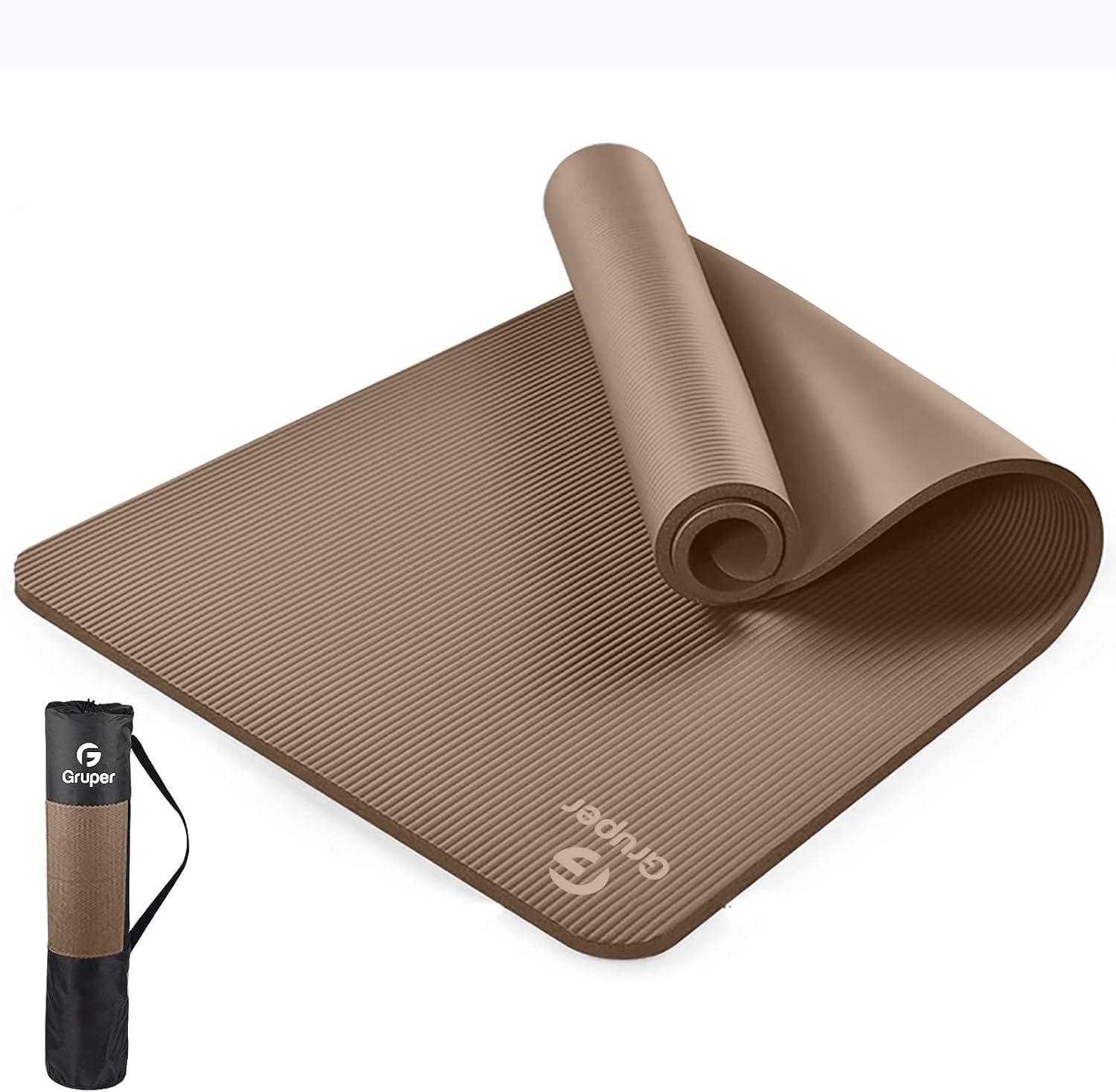
Gruper Eco TPE Yoga Mat

89 /100
Peggy's Score Excellent

Key details

Weight
1.65 lb
Included
Carrying strap and bag
Material
Thermoplastic elastomer
Dimensions
72"L x 24"W x 0.24"Th
Check Details on Amazon

Ten minutes before class you're on the bedroom floor rolling a mat and hunting for something to tie around it. This one arrives with a carry strap and a drawstring bag, and at 0.75 kg it's the lightest mat in our group — light enough that the walk to the studio stops being a reason to skip.

The surface is a double-layer TPE with texture on both faces, 72 inches long and just under a quarter of an inch thick, and it's sold in a standard build or a thicker one. We used the thinner of the two, which rolls down to something you can tuck under an arm. It wipes clean with a damp cloth, and the closed-cell surface doesn't drink sweat the way foam does.

What it doesn't try to be is a plush mat for a long daily session on a board floor — the cushioning is there, but it's modest. It's the one that lives in a bag by the door and comes out three times a week, and for that job it's the easiest of these to live with.

Pros

  • Strap and drawstring bag included
  • Lightest mat in this guide at 0.75 kg
  • 72 inches of mat that rolls down small

Cons

  • Gets slippery once you're working hard
Our verdict

The mat we reach for when it has to leave the house: light, long, and sold with both a strap and a bag for the walk to class.

Check Latest Price
5

Best Value Extra-Thick

Fitvids 1/2-Inch Exercise Mat

91 /100
Peggy's Score Outstanding

Key details

Included
Carrying strap
Material
NBR foam
Dimensions
71"L x 24"W x 0.5"Th
Check Details on Amazon

Half of the top pick, at the bottom of the price range. Fitvids gives you a 1/2-inch slab of NBR foam instead of a full inch, and at 71 inches it runs longer than the 68-inch mat here. For anyone who has been doing Pilates on a bare floor or a thin travel mat, the change is immediate: your spine stops finding the boards during roll-downs and your knees stop complaining in a kneeling series.

We think this is the value pick of the group, and the reason is that the half inch is doing most of the work. It cushions without turning your standing poses to jelly, which is more than we can say for the full-inch mats, and it rolls down tight enough for the included strap. Nothing about it is fancy; it's a straightforward mat that handles mat work, stretching and floor exercises without fuss.

The catch is grip once you're warm — damp hands slide, and a towel or a pair of socks fixes it more reliably than a new mat will. Set that against a mat that sits at the bottom of the price range and still gives you 71 inches, and the trade is easy to make.

Pros

  • Half an inch of cushioning at a budget price
  • 71 inches, longer than the 68-inch mat here
  • Rolls tight with a strap included

Cons

  • Indentations linger after pressure
Our verdict

Half an inch of cushioning, 71 inches of mat and a budget price — the combination we point to when the top pick is more foam than you need.

Check Latest Price
6

Closest to a Studio Mat

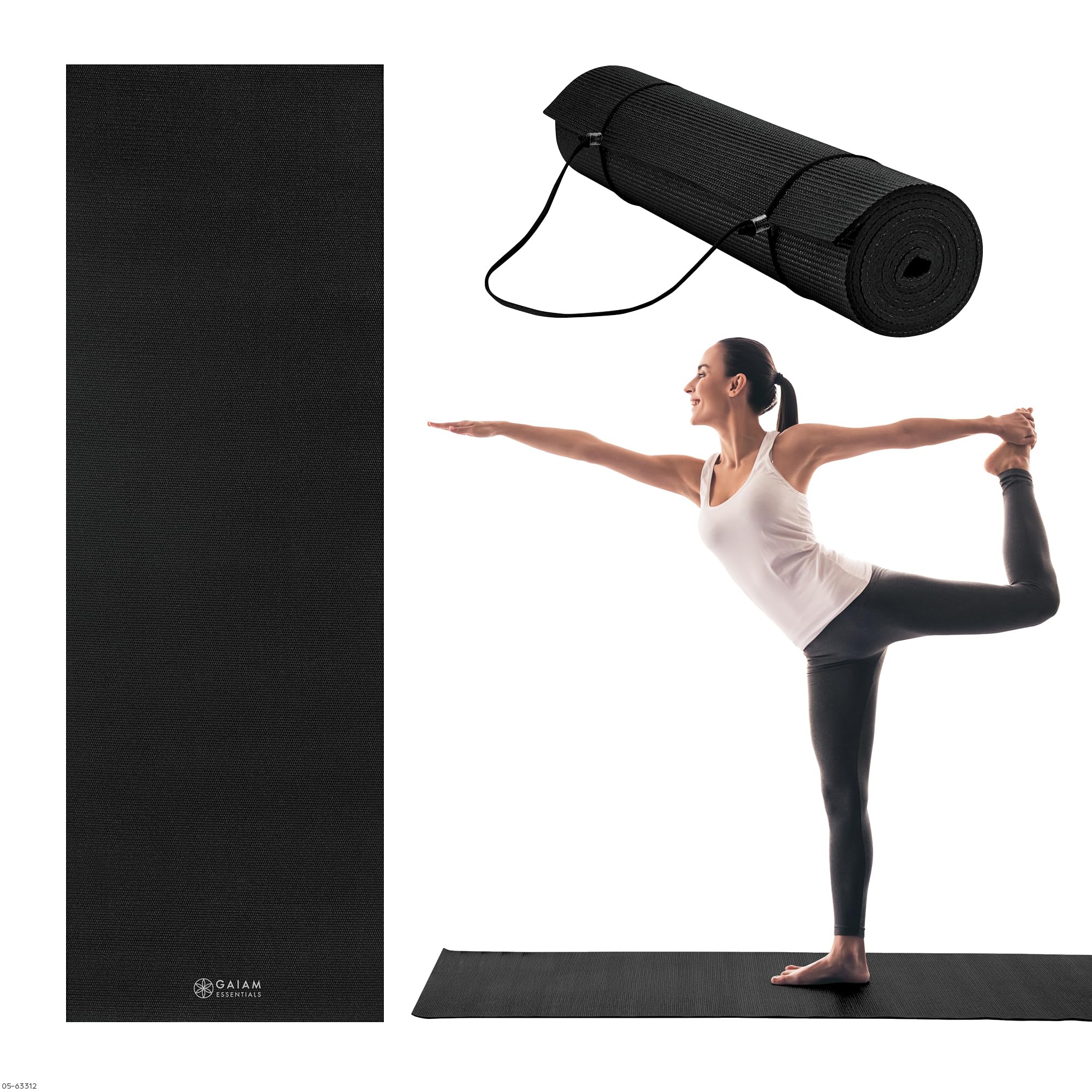
Gaiam Essentials 6mm Mat

93 /100
Peggy's Score Outstanding

Key details

Weight
3.5 lb
Included
Carrying sling
Material
PVC, 6P-free
Dimensions
72"L x 24"W x 0.25"Th
Check Details on Amazon

At 3.5 pounds this is the heaviest mat in our group, and the weight buys something specific: 6mm of dense PVC that doesn't compress the way foam does. Standing sequences feel planted rather than spongy, and one-legged work loses that sinking, wobbling quality you get from an inch of soft foam. If your class spends real time on your feet, that firmness is worth more than extra cushioning.

The surface has a fine texture rather than a deep ridge, the mat runs 72 inches, and it wipes down easily after a session. Gaiam makes the PVC without six phthalates, and a carrying sling comes in the box. It's a plain mat in plain colours — nothing here is trying to be decorative, which is fine on something that spends most of its life on the floor.

The firmness cuts both ways. The same density that steadies a standing sequence lets a bony hip find the floor during side-lying work, so tuck a folded blanket under you for that portion and the mat is comfortable again.

Pros

  • A dense 6mm base that doesn't compress underfoot
  • 72 inches of mat with a carrying sling
  • PVC made without six phthalates

Cons

  • Grip fades when hands get damp
Our verdict

Our pick for standing-heavy Pilates: 6mm of dense PVC that gives you a steadier base than any of the thick foam mats here.

Check Latest Price
7

Plush Home Workouts

Gruper 10mm NBR Yoga Mat

91 /100
Peggy's Score Outstanding

Key details

Weight
1.8 lb
Included
Carry bag and strap
Material
NBR foam
Dimensions
72"L x 24"W x 0.4"Th
Check Details on Amazon

Open the box and you get three things: a mat, a carry strap and a drawstring bag. That sounds like small change until you've bought a mat on its own and then gone looking for something to carry it in. The bag is the part of this purchase we appreciated most, because it gives the mat somewhere to live between sessions instead of leaning against a wall.

The mat itself is 10mm of NBR foam, 72 inches long and 24 wide, and it weighs 1.8 pounds. That's a useful middle ground: deep enough that kneeling and supine work feel properly padded, thin enough that you aren't fighting it during a plank. The surface is textured on both faces and wipes clean with soap and water.

The behaviour worth planning around is how it moves on a smooth floor. Foam this soft can skate when you're shifting quickly between positions, and a quick wipe of the floor and the mat's underside before you start keeps it planted far better than any grippy claim on the packaging.

Where it lands for us: more give than a 6mm mat, less wobble than a full inch, and a bag to keep it in. For a home practice on a hard floor, an hour at a time, that's a sensible middle.

Pros

  • 10mm of cushioning with a strap and bag included
  • 1.8 pounds, light for its thickness
  • Textured on both faces and easy to wipe clean

Cons

  • Porous foam holds dust and sweat
Our verdict

A plush 10mm mat, a strap and a bag in one purchase — a sensible middle option if a full inch of foam feels like overkill.

Check Latest Price

How We Tested Pilates Mats

We started by gathering every mat sold for Pilates rather than general yoga, filtering by material, thickness, weight, price, and whether the surface was closed-cell or open-cell. From roughly 40 candidates we cut the list to 12, keeping a mix of foam, natural rubber, cork-topped, and hybrid designs so we were comparing materials honestly instead of stacking one style against itself.

Each mat went through the same rotation: mat sessions on hardwood in a living room, on a studio's sprung floor, and on carpet. We noted where hands and heels slipped during side-lying leg work and whether the mat crept out from under us during standing sequences, then timed how long each took to roll and unroll, carried them to and from a weekly class, and weighed them once packed.

Comfort came down to how the surface felt through the spine during roll-downs and how knees held up in kneeling work — the thinnest mats were fine for balance but bruising on the tailbone. For durability, we watched for compression lines where sit bones and knees land, edge curling after months of rolling, and surface flaking after wipe-downs. Odor got its own check: each mat was unboxed in a small room and sniffed at 24 hours, one week, and one month, because a mat you can't stand being near is a mat you won't use.

Value was the last filter — a mat had to justify its price in use rather than on the spec sheet, and several cheaper ones beat pricier models on grip and stayed flatter after rolling. We're still using the finalists weekly and will update this list if anything delaminates or starts to slide.

How to Choose Pilates Mats

How thick should a Pilates mat be?

Thickness is the first thing anyone compares and the last thing that should decide the purchase alone. A mat in the 4mm to 6mm band, where the Gaiam Essentials and the YOGATI sit, puts you close to the floor — exactly what you want under a standing leg, and exactly what your spine does not want during a roll-down. Half an inch, as on the Fitvids, is the common compromise. A full inch, as on the BalanceFrom, is the most forgiving surface in this guide and the least steady one for balance work.

Pick by the part of the class you dread. If it's kneeling, roll-downs or bridge work on a hard floor, go thick. If it's standing balance or long plank and side-plank holds, go firm and thin. The trap is reading "extra thick" as more mat for the money: a surface that sinks under your standing foot makes a one-legged sequence harder, not safer.

Grip is two problems, and only one is about sweat

A mat has to hold your hands and feet, and it has to hold the floor, and those two fail differently. Surface grip is what goes first when you sweat — none of these mats is genuinely grippy under wet palms, so a hand towel or a pair of yoga socks solves it more reliably than another purchase. Floor grip is usually a dust problem rather than a material problem: a mat with a film of dust or pet hair underneath will walk across a wood floor however textured it claims to be.

When a new mat arrives slick, wash it before you blame it. Fresh mats carry manufacturing residue, and a wipe-down with mild soap and water changes the feel more than any sticky claim on the packaging.

What the material tells you about weight and wear

NBR foam is the softest and lightest of the three materials here, and the one that dents and tears first — press a thumb in and the mark stays for a while. PVC is dense and firm, which is why the Gaiam mats weigh more than the thick foam ones and compress far less underfoot. TPE, used on both Gruper mats and the YOGATI, sits in between: light, closed-cell, and easier to wipe down than foam.

Choose by where the mat lives. One that stays on the floor wants density, because heavier mats sit flatter and stay put. One that travels wants foam or TPE, and you accept that it will show wear sooner.

Length and what actually comes in the box

Nearly every mat here is 24 inches wide, so width is not the decision — length is. The 68-inch mats suit most people and run short for anyone much over six feet, who will spend a long session with heels or head off the end. The 71- and 72-inch options give you that extra room for very little extra weight.

Then look at the accessories. A strap turns a mat into something you can carry; a bag is what stops it unrolling in a closet. Open the box and confirm the strap is in there before the return window closes, because it is the accessory that is easiest to leave out and the one you will miss most.

Frequently Asked Questions

Final Verdict

Buy the BalanceFrom mat if cushioning is what's missing from your practice. A full inch of foam is the difference between finishing a roll-down sequence and negotiating with your spine, and it still carries lighter than the firm 6mm mats that give you none of that comfort.

If your class is heavy on standing work, go the other way: the Gaiam Essentials gives you a dense 6mm base that doesn't sink under a single leg, and that steadiness matters more than padding once you're upright. And if the mat leaves the house several times a week, the Gruper TPE travels best.