Best Mini Steppers of 2026

A mini stepper is cardio in the footprint of a doormat. It slides under a desk, lives beside the couch, and gets your heart rate up during a phone call instead of a commute to the gym. What the pitch leaves out is how quickly a cheap one tells on itself: the belt starts chirping by week three, the pedals rock, and one hydraulic cylinder runs hotter than the other, so your left leg quietly does more work than your right. The fix isn't a bigger machine — it's a small one sturdy enough that you don't dread stepping onto it.

I've spent four months with 12 of them, in ten-minute bursts between meetings and longer sessions in front of the TV, and the field sorted itself out fast. Quiet mattered more than I expected; so did a base that stays put on hardwood. What a stepper really buys you is consistency, which is why the picks below are the ones I kept stepping on long after the novelty wore off.

1

Best Overall

Niceday Mini Stepper

89 /100
Peggy's Score Excellent

Key details

Drive
Hydraulic
Weight
13.9 lb
Dimensions
12.5"L x 13.5"W x 16"H
Weight Capacity
300 lb
Check Details on Amazon

The Niceday gets the balance most mini steppers miss: a 300-pound capacity without the bulk of a heavy-duty machine. At 12.5 by 13.5 inches and about 14 pounds, it can live beside a couch or slide under a bed, and that is why we rank it first. It arrives ready to step on, with no real assembly to sort out.

The step action is hydraulic, with a silicone cushioning pad under the pedals. We like that combination for apartment floors because it addresses the thump that makes a mini stepper feel louder than it is, though a squeak can still develop over time. The pedals are wide enough for a normal stance, and the low deck is easy to step onto.

The LCD covers the basics, and the compact deck makes short sessions easy to start. This is not a machine for long, hard climbs; it is the one we leave out for daily stepping because it asks so little of the room. If you want a simple cardio habit at home, that trade is a good one.

Pros

  • 300-pound capacity in a compact frame
  • Ready to use with no real assembly
  • Silicone-cushioned hydraulic stepping

Cons

  • Durability is the open question over months of use
Our verdict

For most homes, the Niceday is the mini stepper we recommend: 300-pound support, a compact footprint, and smooth hydraulic stepping make it the easiest default.

Check Latest Price
2

Best for Heavier Users

Keppi Fitstep500

87 /100
Peggy's Score Excellent

Key details

Weight
13.2 lb
Warranty
Lifetime warranty
Dimensions
14.5"L x 12.8"W x 7"H
Weight Capacity
350 lb
Check Details on Amazon

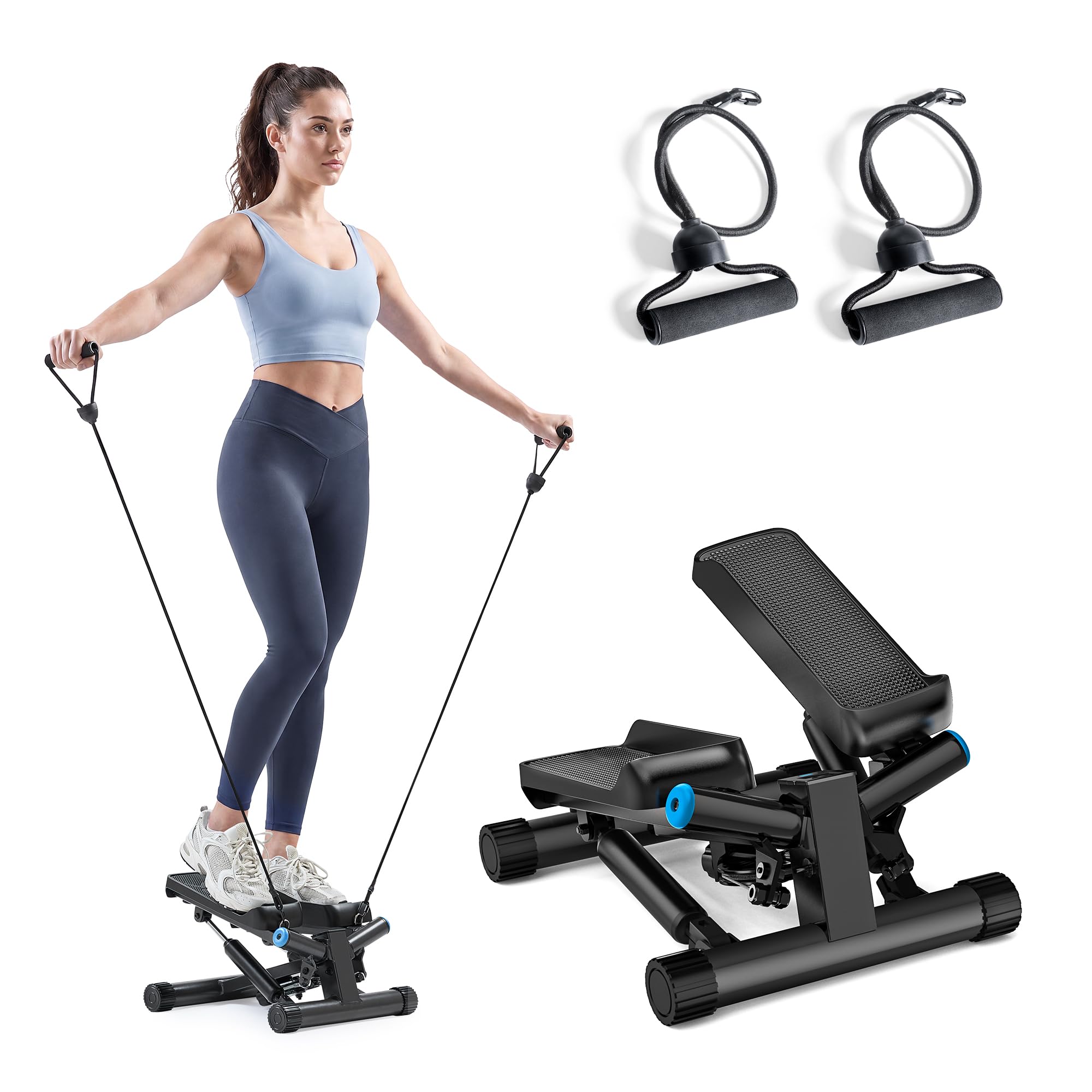
Keppi's Fitstep500 is rated to 350 pounds and comes with two pairs of resistance bands. The frame is compact at 14.5 by 12.8 inches and 13.2 pounds, and the warranty runs for the lifetime of the machine.

The front knob changes stride length, so you can keep the steps short for a quick session or lengthen them when you want more glute and thigh work. We like the low 7-inch deck for stepping on without a big lift, and the hydraulic system feels planted rather than toy-like.

We rank it as the heavier-user pick, not the default, because the extra capacity comes with a little more machine to move. The lifetime warranty is the reassurance: if you are near the top of a 300-pound limit, the Fitstep500 is worth the step up.

Pros

  • 350-pound capacity with a lifetime warranty
  • Two pairs of resistance bands included
  • Compact 14.5 by 12.8 inch frame
  • Adjustable stride length

Cons

  • Noise can develop with use
  • Durability is the open question
Our verdict

The Fitstep500 is the safer buy for larger users, with a 350-pound frame and a lifetime warranty that most budget steppers do not offer.

Check Latest Price
3

Best Twist Stepper

Sunny Twist Stair Stepper

89 /100
Peggy's Score Excellent

Key details

Weight
19.4 lb
Dimensions
19.5"L x 18.9"W x 14.8"H
Connectivity
Bluetooth, SunnyFit app
Weight Capacity
350 lb
Check Details on Amazon

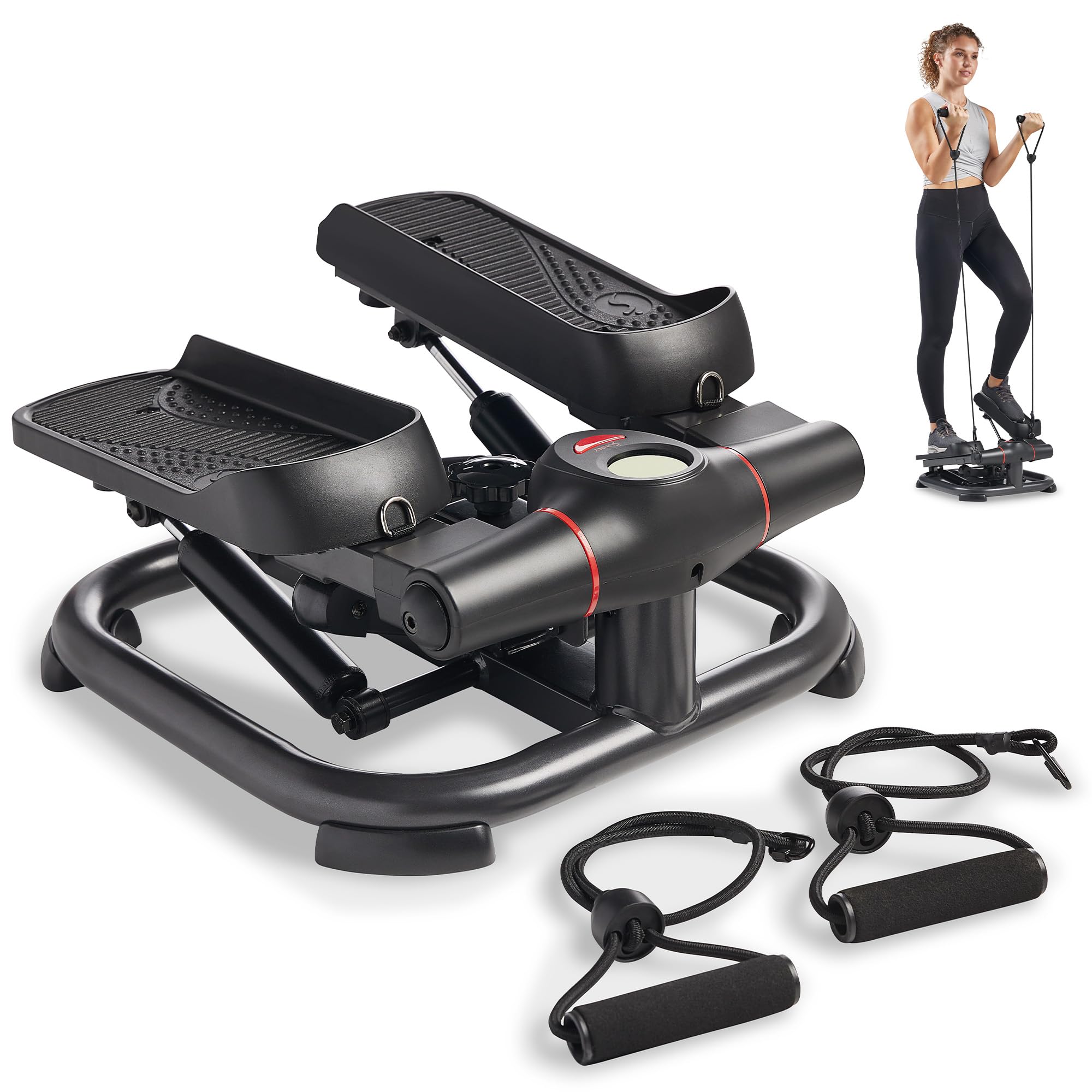
The Sunny Twist Stair Stepper makes its case with motion: each step travels through a side-to-side path rather than straight up and down. That twist is meant to bring in the glutes, thighs, calves, and core, and it gives the machine a different feel from the straight steppers here. The 350-pound frame and Bluetooth connection to the SunnyFit app are the other reasons it stands out.

We think the twist is worth it if you get bored on a conventional stepper, because the lateral path asks for a little more balance and coordination. The app adds structure if you like guided sessions, though the on-machine LCD already covers time, calories, steps, and total count.

The step height is adjustable, and the resistance bands add upper-body work. We see it as the most engaging twist stepper here, but not the one to pick if you want the simplest possible motion.

Pros

  • Side-to-side twist engages core and glutes
  • 350-pound capacity
  • Bluetooth with SunnyFit app
  • Adjustable step height

Cons

  • Wider footprint than most mini steppers
  • Squeaking can develop with use
Our verdict

The Sunny Twist is our pick for side-to-side stepping, with 350-pound support and app tracking; choose it for variety, not the smallest footprint.

Check Latest Price
4

Best Budget

Sweetcrispy Mini Stepper

81 /100
Peggy's Score Excellent

Key details

Weight
11.9 lb
Included
Stepper and bands
Upper-Pole Tilt
21°
Weight Capacity
300 lb
Check Details on Amazon

The Sweetcrispy is the one to choose when the goal is to spend little and still get a 300-pound-capacity stepper. It is the lightest machine here at 11.9 pounds, and the 21-degree upper-pole tilt is designed to keep the knees tracking in a more comfortable line. We think it earns the budget slot because it covers the basics without asking for much space.

The step height adjusts with a knob, and the included bands let you add arm work. The motion is hydraulic and smooth enough for short sessions. The 300-pound rating is the same as the Niceday's, but the Sweetcrispy feels like a lighter-duty machine because there is less mass under you.

What we like most is the combination of low weight and a 300-pound rating: it is easy to move from room to room, and it does not dominate a corner. This is a starter machine, and it is honest about that.

Pros

  • 300-pound capacity for an 11.9-pound machine
  • 21-degree upper-pole tilt
  • Easy to move and store
  • Resistance bands included

Cons

  • Bands feel long and light
  • Step-height range is limited
Our verdict

The Sweetcrispy is our budget pick: a 300-pound stepper that weighs just 11.9 pounds and tilts to keep knees comfortable, with light bands as a bonus.

Check Latest Price
5

Best Heavy-Duty

Sunny Power Stepper

86 /100
Peggy's Score Excellent

Key details

Weight
26.5 lb
Dimensions
18.7"L x 17.1"W x 13.9"H
Connectivity
Bluetooth, SunnyFit app
Weight Capacity
400 lb
Check Details on Amazon

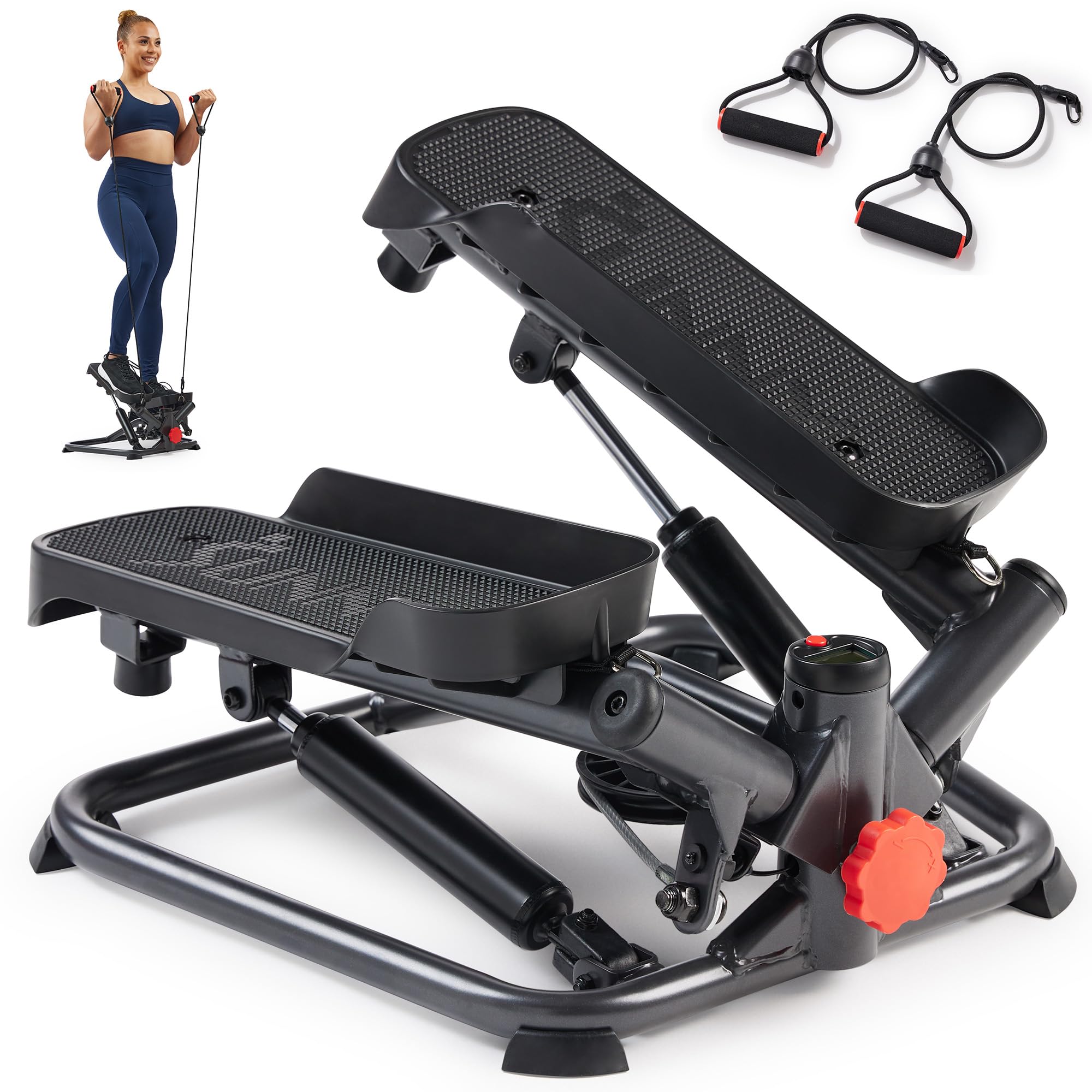
The Sunny Power Stepper is the machine for someone who has been told to look for a 400-pound capacity and does not want a full-size climber. The V-shaped steel frame is reinforced, the pedals are wide and non-slip, and the whole thing is built to feel planted. At 26.5 pounds, it is the heaviest model here, which is the trade-off for that rating.

The step height adjusts, and the Bluetooth connection to the SunnyFit app adds guided workouts and tracking. We like the stability of the wide base for larger users; the app is a useful extra, but the frame is the reason to choose this one.

We rank it as the heavy-duty option, not the everyday default, because the 400-pound frame is the reason to choose it. If you are near or above 300 pounds, the security of that rating is the whole point.

Pros

  • 400-pound capacity
  • Wide, non-slip pedals and stable base
  • Bluetooth with SunnyFit app
  • Adjustable step height

Cons

  • Tension knob can feel inconsistent
Our verdict

The Sunny Power Stepper is the 400-pound-capacity choice for larger users who want a planted machine; it is heavy, but the stability is the point.

Check Latest Price
6

Adjustable Stepping

JLL Smart Twist Stepper

86 /100
Peggy's Score Excellent

Key details

Weight
17 lb
Dimensions
16.5"L x 15.2"W x 14.8"H
Weight Capacity
300 lb
Step-Height Range
4.2" to 14.8"
Check Details on Amazon

The JLL Smart Twist Stepper has an unusually broad step-height range: 4.2 to 14.8 inches. That is the kind of adjustment that lets one person start with short, gentle steps and gradually open up the motion, and it is the main reason this one earns a look. Twin hydraulic cylinders and a side-to-side twist path define the motion.

We see it as a strong choice for someone who wants to progress in small increments without buying a second machine. The twist adds a balance and core element, while the twin hydraulics are meant to keep the motion smooth. It is also reasonably compact at 16.5 by 15.2 inches and about 17 pounds, so it can live in a corner.

The 300-pound rating is the main limit; if you need more, the Keppi or Sunny Power are the better choices. For everyone else, the broad adjustment is the draw.

Pros

  • Broad 4.2-to-14.8-inch step range
  • Twin hydraulic cylinders
  • 300-pound capacity
  • Compact 16.5 by 15.2 inch footprint

Cons

No notable drawbacks to flag.

Our verdict

The JLL Smart Twist is for the tinkerer who wants a 4.2-to-14.8-inch step range; its 300-pound frame and twist motion make it a capable specialist.

Check Latest Price
7

Balance Training

Merach Rocking Stepper

81 /100
Peggy's Score Excellent

Key details

Motion
3D lateral rocking
Weight
13 lb
Dimensions
10.63"L x 10.63"W x 19"H
Weight Capacity
330 lb
Check Details on Amazon

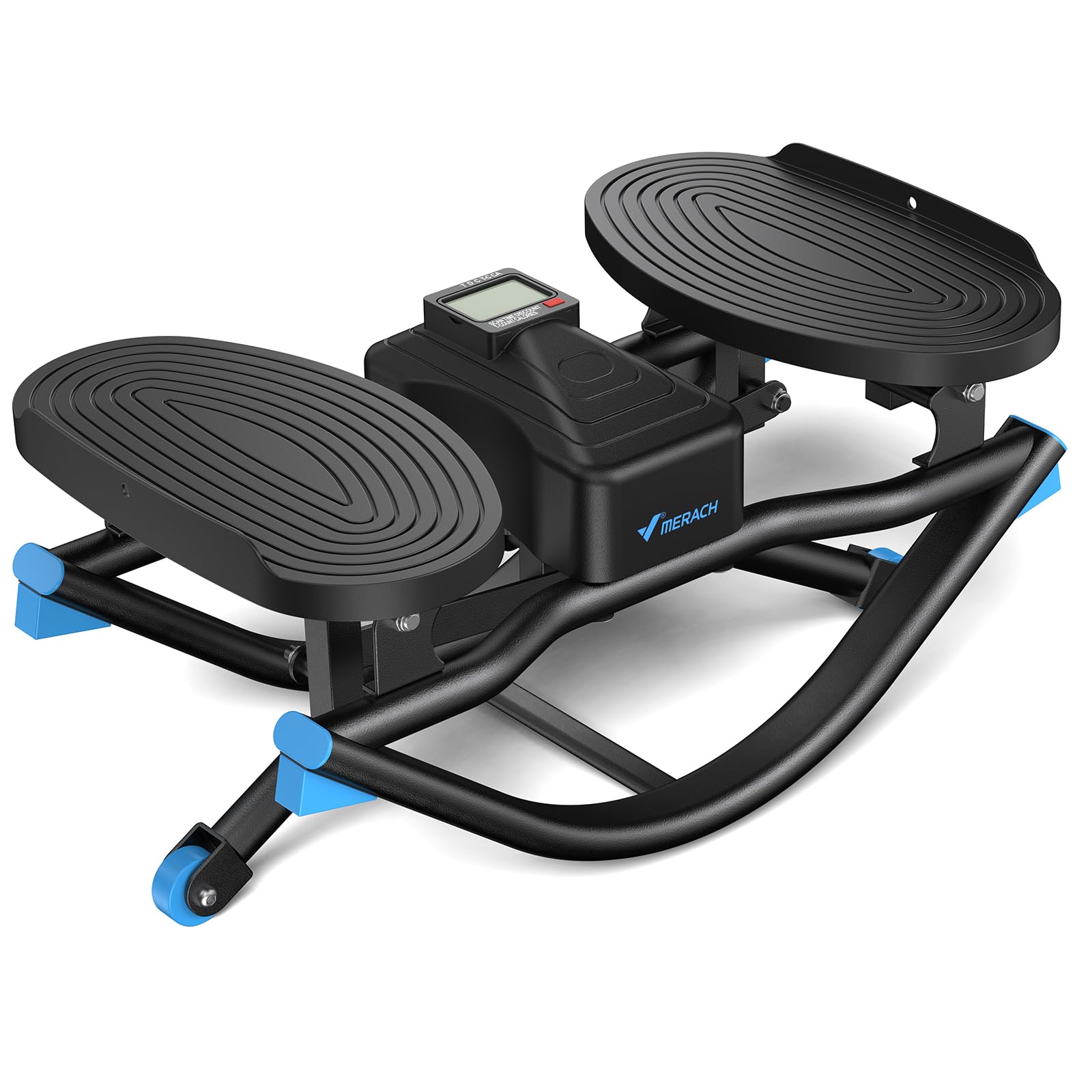
The Merach Rocking Stepper does not move like the others. Its platform rocks side to side in a 3D path, which is designed to bring in the hips, thighs, glutes, and core while asking you to balance. At 12 pounds and 10.63 by 10.63 inches, it is one of the smallest footprints here, and the 330-pound frame is rated for more weight than its size suggests.

The motion is the point: it turns a few minutes of stepping into a balance challenge, and the included bands add a little upper-body work. We think it is the most fun alternative in this set if you want something different from a straight up-and-down stepper. The motion is not for everyone, and it takes a few sessions to find a rhythm.

The 19-inch height is tall for a mini stepper, so check clearance before you plan to use it at a standing desk. The 330-pound capacity is generous for the size, and the machine is light enough to move between rooms.

We rank it below the top picks because the rocking motion is a taste you have to acquire, not a flaw you can tune out. If you want a compact balance challenge, it is a genuinely different option; if you want predictable cardio, choose a straight stepper.

Pros

  • 330-pound capacity in a 12-pound frame
  • 3D rocking motion for balance and core
  • Compact 10.63 by 10.63 inch footprint
  • Resistance bands included

Cons

  • Rocking motion can feel unstable
Our verdict

The Merach is for a balance-focused, 3D session; its 330-pound frame is compact, but the rocking motion will not suit every stepper.

Check Latest Price

How We Tested the Best Mini Steppers

We started with the specs that actually narrow the field: resistance type, step height, stated weight capacity, and footprint. Anything rated under 220 pounds or built on a base narrower than a pair of size-10 shoes got cut before it ever came out of the box. That left 12 steppers across the price range, from bare-bones models to ones with handlebars and a digital counter.

Each one lived on hardwood and carpet for four months and got used the way people actually use them: ten minutes between calls, twenty during an episode, sometimes barefoot and sometimes in sneakers. I noted whether the base crept forward across the floor at a decent pace, whether the pedals stayed level underfoot, and how many steps it took to find a rhythm worth keeping.

Noise got its own test. I took a phone decibel reading at arm's length during a steady pace, then repeated it in week four and week twelve, because these machines are quiet out of the box and squeaky later. Every chirp, click, or groan that showed up after the first month went into the notes.

On resistance, we checked whether the tension was there at a slow walk or only once we sped up, and on adjustable models whether we could switch levels mid-stride without stopping. Durability came down to daily wear: we felt the cylinders after twenty minutes to see which ran hot, checked the bolts for loosening, and tracked how long resistance held before fading. We weighed each unit and carried it to a closet and back, since a stepper only stays convenient if you can move it with one hand. Value had the last word — we asked whether the pricier models did anything the cheap ones couldn't, and the answer was usually quieter, steadier, or both.

How to Choose Mini Steppers

Start With Weight Capacity and Stability

A mini stepper's maximum user weight is a hard limit, not a suggestion. Our picks range from 300 to 400 pounds, and the higher-rated frames usually weigh more and take up more floor. If you are near 300 pounds or share the machine, look at the 350- or 400-pound options rather than assuming a budget model will feel the same.

A wide base and non-slip pedals matter too, especially on smooth floors. A mat can keep the machine from creeping, but it does not raise the weight limit. Pick a rating that leaves room for the way you actually step, not just the number on your scale.

Measure the Space You Will Actually Leave It In

Mini steppers are small, but they are not all equally small. The Niceday is 12.5 by 13.5 inches; the Sunny Power is 18.7 by 17.1 inches. The difference matters when the machine lives beside a couch or under a desk. Height matters too: a low deck is easier to step onto, while a taller machine may not clear a standing desk.

Measure the floor space and the clearance before you buy, then decide whether you want to store it or leave it out. A machine that has to be dragged from a closet every time is the one that stops getting used.

Decide How Much Adjustment You Need

Step height changes the range of motion; a shorter step is easier to sustain, and a taller step asks more of your legs. That is different from resistance, which on these machines comes from the hydraulic system and the bands. The JLL's 4.2-to-14.8-inch range is the broadest here, while simpler models offer a narrower knob adjustment.

If you want one machine for gentle days and harder days, pay for range. If you just want to step while watching TV, a simpler knob is enough.

Expect Some Noise and Plan for It

Squeaking and thumping are the shared complaints in this category, and they tend to show up after the first few weeks rather than on day one. A silicone pad or a mat under the machine can soften the sound, and keeping the pedals and hydraulic area clean helps, but no mini stepper is silent forever.

If you live above a neighbor or step during early meetings, place it on a rug and test the noise before you commit to a long session. The quietest design is the one with cushioning and a stable base, not the one with the biggest noise claim.

Treat Resistance Bands as a Bonus

Bands add variety, but they are not the reason to buy a stepper. On several models they feel light or long, which limits how much upper-body work they can do. Use them for shoulder raises, curls, and rows at the start or end of a session; do not expect them to replace dumbbells.

If upper-body strength is your main goal, choose a machine with two pairs of bands, like the Keppi, and still plan to progress to weights.

Frequently Asked Questions

Final Verdict

Start with the Niceday. Its 300-pound capacity, compact footprint, and smooth, hydraulic stepping make it the best default for a small home gym, and it is the machine we recommend for most buyers. If you need a higher weight limit, the Keppi Fitstep500 is the better buy at 350 pounds, with a lifetime warranty that adds peace of mind.

For a 400-pound frame, the Sunny Power Stepper is the heavy-duty alternative; just accept that it is a machine you leave in place.