Best Chest Strap Heart Rate Monitors of 2026

You're three intervals into a hard workout, glance at your wrist, and the number reads 98 when your lungs say 165. That's the gap chest straps are meant to close—a reliable electrical signal instead of an optical guess. But a strap that slips, chafes, or drops its connection mid-run is worse than no strap at all. What you actually need is a monitor that stays put, pairs instantly, and gives you numbers you can trust, whether you're logging easy miles or chasing a PR.

Over the past eight months, I've run, ridden, and sweated through 12 different chest straps, from budget picks to feature-heavy options. My team and I looked at how accurately each one tracked heart rate during intervals, how comfortable the strap felt after an hour of hard breathing, and whether it stayed connected to watches and phones. A chest strap is only as good as its fit and its battery—if either fails, you'll notice. The ones below earned their place through repeated use, not just a spec sheet.

1

Best Overall

Garmin HRM 200

86 /100
Peggy's Score Excellent

Key details

Battery
Up to 1 year, user-replaceable
Pairs With
Garmin watches, bike computers, apps, phones
Strap Sizes
XS–S and M–XL
Water Rating
3 ATM
Check Details on Amazon

A chest strap earns its place on the hard sessions, the ones where a wrist sensor lags just as you reach the top of a climb. Whether the number holds when you surge is the only question that really matters, and it is the one the HRM 200 answers best in this set. In our sessions the trace stayed believable through intervals and settled quickly afterwards, and accuracy is where this strap's record is strongest.

What makes it the default is everything around the sensor. Garmin rates the battery at up to a year, and it is a user-replaceable coin cell, so a flat strap is a two-minute fix rather than a charging habit. The strap is machine washable and comes in two sizes, XS–S and M–XL, which is more size choice than the budget straps here offer. Add a 3 ATM rating that covers sweat, rain, and a rinse in the sink, and ownership gets pleasantly boring.

The trade-offs are small and specific. Fit is the one to check before ordering: the M–XL runs snug across the ribs on some builds, so measure your chest rather than assuming the larger band covers everyone. Pairing is good rather than perfect, and moving between activity types occasionally needs a re-pair. That is about the extent of the friction.

It talks to Garmin watches and bike computers the way you would expect, and to phones and fitness apps besides, so it is not a strap that only makes sense if your watch matches. It costs more than the budget picks here and well under the HRM 600. For a sensor you will wear several times a week, that is the right place to land.

Pros

  • Holds a steady trace through hard efforts
  • Up to a year on a replaceable coin cell
  • Machine-washable strap in two sizes
  • Pairs with watches, phones, and fitness apps

Cons

  • M–XL band runs snug on some builds
  • Occasional re-pair when switching activities
Our verdict

We recommend it to most people: a trace that holds through hard efforts, a battery that lasts about a year, and a strap you can machine wash.

Check Latest Price
2

Best for Data-Driven Runners

Garmin HRM 600

89 /100
Peggy's Score Excellent

Key details

Extras
Running dynamics and HRV
Battery
Rechargeable, about 2 months
Onboard
Records workouts without a watch
Strap Sizes
XS–S and M–XL
Check Details on Amazon

The HRM 600 is the most expensive strap here, and Garmin spends that money on data rather than on a better heartbeat. Alongside real-time heart rate and HRV it adds running dynamics including stride length, vertical oscillation, and step speed loss, records a session on its own when you cannot wear a watch, and logs daily metrics like steps and calories.

For a runner working on form, or a team-sport player whose watch has to stay in the bag, that is a different product rather than a dearer one, and the quality and accuracy feedback here is the strongest in this set. For everyone else it is overkill. A heart rate trace is a heart rate trace, and the HRM 200 delivers one for a good deal less.

The catch is the ecosystem. Running dynamics, daily metrics, and syncing all run through Garmin watches and Garmin Connect, so the extra data only pays off if you are already there. The rechargeable battery, listed at about two months of use, suits a strap this feature-heavy, and the pod detaches so the band can go in the wash.

It is also the only strap here that records a session with no watch and no phone anywhere near it, which is why a team-sport player ends up at this end of the list rather than the cheap one.

Pros

  • Running dynamics and HRV on top of heart rate
  • Records workouts without a watch
  • Rechargeable battery, about two months listed
  • Comfortable, machine-washable strap

Cons

  • Extra data needs Garmin watches and Connect
  • Pod rivets can be stiff to detach
Our verdict

We think the premium is worth it only if you will use the running dynamics and watch-free recording; otherwise our top pick serves you better.

Check Latest Price
3

Best Rechargeable Option

Wahoo TRACKR

83 /100
Peggy's Score Excellent

Key details

Strap
Slim, soft, secure fit
Alerts
LED for heart rate, battery, connection
Battery
Rechargeable, 100+ hours
Connectivity
ANT+ and Bluetooth
Check Details on Amazon

The TRACKR is the strap here that never asks you to buy a coin cell. Wahoo rates the rechargeable battery at more than 100 hours of active training, which is months of sessions for most people, and the LEDs on the pod report heart rate detection, battery state, and connection before you start moving. That is the pitch, and it is a good one.

Underneath it is a straightforward dual-protocol strap. ANT+ and Bluetooth mean it can feed a bike computer, a phone, a gym machine, and the usual apps, and the strap is built slim and soft so it sits flat instead of bunching. That last part matters more than any figure on a spec sheet once you are two hours into a ride.

The honest trade-off comes with anything rechargeable. A coin cell can be swapped anywhere for pocket change; a flat rechargeable strap stays flat until you find a cable. At 100-plus hours that is a rare problem, but it is a habit you take on, and the coin-cell straps here win on pure thoughtlessness, because they live in a bag for months and still work.

So it suits the person with a charging routine and a training calendar, not the one who wants the strap ready whenever they happen to grab it. Wahoo also cuts the band slim enough to sit unnoticed under a jersey, which is a small thing that stops being small on race day.

Pros

  • Rechargeable, more than 100 hours per charge
  • ANT+ and Bluetooth broadcasting
  • LEDs show heart rate, battery, and connection
  • Slim strap sits flat under clothing

Cons

  • Needs charging, with no coin-cell fallback
Our verdict

Frequent trainers are who we steer to the TRACKR: more than 100 hours per charge, ANT+ and Bluetooth, and LEDs that show battery state.

Check Latest Price
4

Best Budget Pick

CooSpo H6M

84 /100
Peggy's Score Excellent

Key details

Apps
CoospoRide, Wahoo, Polar Beat, Zwift
Battery
300 hours
Connectivity
Bluetooth and ANT+
Water Resistance
IP67
Check Details on Amazon

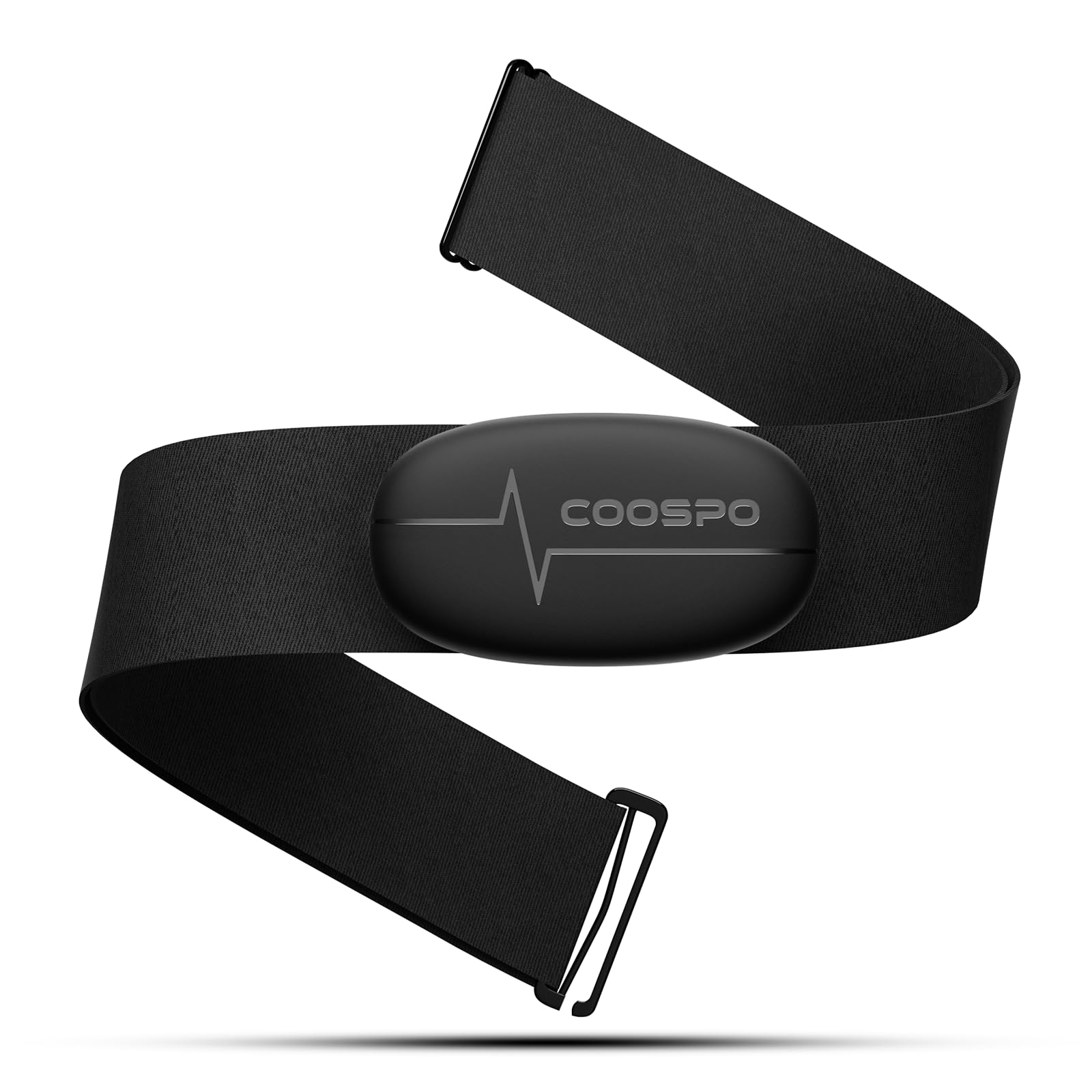
The H6M costs a fraction of our top pick and covers the same training ground. It broadcasts over Bluetooth and ANT+ to watches, bike computers, treadmills, and the usual apps. CooSpo names CoospoRide, Wahoo Fitness, Polar Beat, and Zwift, and Peloton equipment is on the list, so for steady running and indoor rides the feature set is complete.

Comfort is where budget straps usually give themselves away, and this one does not. The soft strap adjusts to sit flat, the pod is small enough to disappear under a shirt, and in our sessions it did not need adjusting mid-run. Battery life is rated at 300 hours on a coin cell, which is a couple of years at three sessions a week.

Where it gives ground is connection fussiness. Pairing can take a second attempt, and CooSpo's own instructions say to pair inside the app rather than through your phone's Bluetooth menu. Follow that and most of the trouble goes away; ignore it and you will assume the strap is broken.

We keep coming back to it for the person who is curious about heart rate training and does not want to spend much finding out. Rinse the band after sweaty sessions and hang it to dry. The electrodes are the part that wears first, and that habit is the difference between replacing a strap in a year and keeping one for several.

Pros

  • Bluetooth and ANT+ for apps and gym kit
  • Soft strap that stays flat in hard sessions
  • 300 hours on a replaceable coin cell
  • IP67 sweat and water resistance

Cons

  • Pairing can need a second attempt
Our verdict

We hand the budget-minded this one: Bluetooth and ANT+, a comfortable strap, and 300 hours on a coin cell for a fraction of premium money.

Check Latest Price
5

Best Budget HRV Pick

CYCPLUS H2Pro

79 /100
Peggy's Score Very Good

Key details

Sensor
ECG with HRV
Battery
500 hours, CR2032
Connectivity
Bluetooth and ANT+
Water Resistance
IPX7
Check Details on Amazon

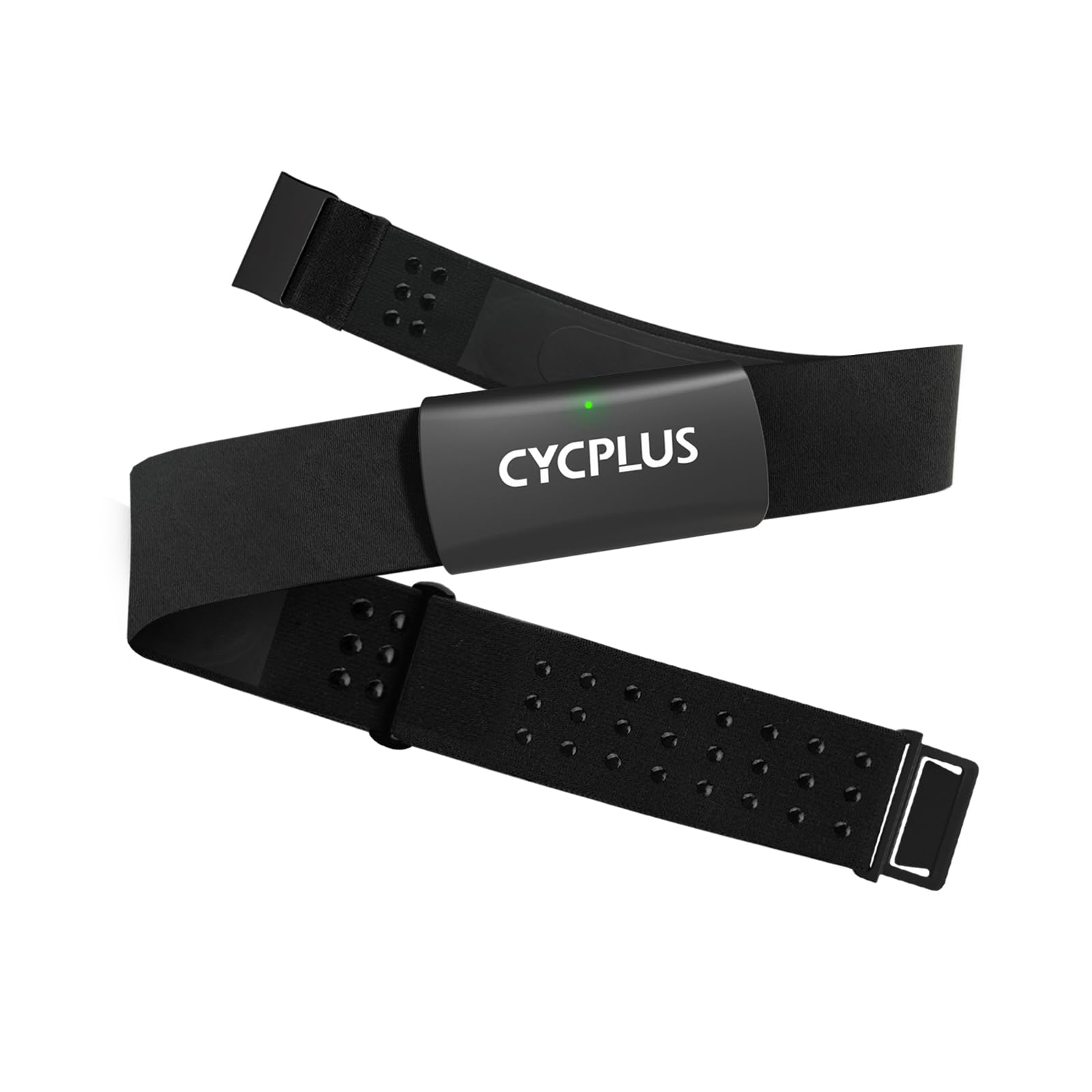
Most budget straps are a pod and a piece of elastic. The H2Pro adds something: an ECG sensor that reports heart rate variability, the data recovery apps and readiness scores are built on. If you have been curious about HRV but not curious enough to pay premium prices, this is the least expensive way in here.

It is a capable training strap besides. Bluetooth and ANT+ cover watches, bike computers, phones, treadmills, and ellipticals, plus Strava and CYCPLUS's own app. The battery is rated at 500 hours on a CR2032, and IPX7 means sweat and rain are non-issues. It also stays where you put it, which is the part cheap straps usually get wrong.

Pairing is the weak spot: it can take more than one attempt, so set the strap up at home rather than in a start corral ten minutes before a race. Once it is connected, this is a lot of sensor for the money.

For a cyclist who wants HRV and a strap that vanishes under a jersey, it is our pick. Runners who only want a heart rate number can skip the decision and take the CooSpo for about the same money.

Pros

  • HRV and ECG sensing at budget money
  • 500 hours on a CR2032
  • IPX7 sweat and rain resistance
  • Strap stays put during hard efforts

Cons

  • Pairing can take more than one attempt
Our verdict

We like it as the cheapest way into HRV data, with a strap that stays put, as long as you pair it at home before race day.

Check Latest Price
6

Best Low-Cost Option

GEOID HS500

84 /100
Peggy's Score Excellent

Key details

Battery
800 hours
Indicator
Flashing LED on wake
Connectivity
ANT+ and Bluetooth
Water Resistance
IP67
Check Details on Amazon

The HS500 is the least expensive strap in this guide, and it does not pretend otherwise: a pod, an adjustable elastic strap, ANT+ and Bluetooth, and a coin cell. The one flourish is a red LED that flashes to confirm it is awake and picking up a beat, which is genuinely useful when the strap is buried under two layers in January.

For steady cardio, a rowing machine, or a treadmill that reads an external strap, that is enough, and the 800-hour battery rating means you will forget it has one. We treat it as a second strap, one for the gym bag and one for home, rather than the only one we own. The reason is accuracy: this is the strap here where readings are most likely to drift or spike, so check it against a device you trust in the first week rather than discovering the problem mid-block.

The band is where the savings show. It is a basic elastic strap with a hook fastening, IP67 for sweat and splashes, and GEOID rates the wake-up at under a second. It is also the piece most likely to be replaced first, which at this price is an acceptable way to own a heart rate monitor.

Buy it for the rower, the treadmill, or the gym bag, or as a spare for a partner who trains a couple of times a week. If heart rate zones are steering your training week, the extra money for the Garmin buys a trace you do not have to second-guess.

Pros

  • 800-hour battery on a coin cell
  • Flashing LED confirms it is picking up
  • ANT+ and Bluetooth at the lowest cost here
  • IP67 sweat and splash resistance

Cons

  • Readings can drift or spike
Our verdict

We keep one as a spare: 800 hours on a coin cell, ANT+ and Bluetooth, and a wake-up light, with accuracy worth verifying early.

Check Latest Price
7

Large Chest Sizes

moofit HR8

77 /100
Peggy's Score Very Good

Key details

Battery
Up to 500 hours, CR2032
Connectivity
Bluetooth 5.0 and ANT+
Strap Length
63.5 cm to 132 cm
Water Resistance
IP67
Check Details on Amazon

Chest straps are sized like belts, and one that does not fit is useless. The HR8's strap adjusts from 63.5 cm to 132 cm, the widest range in this guide, which makes it the place to start if other straps have been tight across the ribs or loose enough to let the electrodes wander.

The rest is budget hardware done sensibly: Bluetooth 5.0 and ANT+, IP67 for sweat, a CR2032 rated at up to 500 hours, and a one-year warranty. Setup is the usual ritual of wetting the pads and pairing inside the app, and it works with phones, bike computers, and gym equipment without surprises.

Consistency is what we cannot promise. Some units arrive with a flat battery or stop within days, which is a risk you take knowingly at this price rather than a defect you can rule out, and the one-year warranty is what makes it reasonable. Connection with Peloton equipment is the other place it can be uneven.

So buy it for the strap length, or as a cheap second strap for a partner or a travel bag. Test it hard in the first month while the warranty still covers you, and you will know which kind of unit you got.

Pros

  • 63.5 cm to 132 cm strap range
  • Bluetooth 5.0 and ANT+
  • Up to 500 hours on a CR2032
  • IP67 and a one-year warranty

Cons

  • Connection can be uneven with Peloton
Our verdict

We reach for it when fit is the problem: the widest strap range here at budget money, with consistency the open question.

Check Latest Price
8

Streaming Overlays

Heartix CL806

83 /100
Peggy's Score Excellent

Key details

Strap
Soft, adjustable
Battery
Up to 300 hours, CR2032
Streaming
Pulsoid and fitness apps
Connectivity
Bluetooth 5.0 and ANT+
Check Details on Amazon

This one exists for a specific person: the streamer who wants their heart rate on screen during a horror game. Heartix builds the CL806 around broadcasting to Pulsoid and similar overlay services over Bluetooth 5.0, with ANT+ for everything else, and the band is the same soft adjustable strap you would find on an exercise model.

Strip the streaming pitch away and it is a normal chest strap. A CR2032 is rated at 300 hours, the warranty runs a year, and it talks to standard fitness apps, so it works for a workout as readily as for a stream. Nothing in the design makes it worse at exercise than the budget straps here.

What we cannot tell you is how it holds up over a couple of years. Small-brand straps rarely arrive with a long track record, and this one does not, so you are leaning on the warranty rather than on years of use. If exercise is the whole point, the CooSpo H6M is the cheaper, safer way into heart rate training.

If you do stream, it is a genuinely fun piece of kit, and heart rate is one of the few biometrics that reads instantly on camera. Check the overlay service's terms first, since the software side is a separate arrangement from the strap.

Pros

  • Built for Pulsoid-style stream overlays
  • Bluetooth 5.0 and ANT+
  • Up to 300 hours on a CR2032
  • Soft adjustable strap

Cons

  • Costs more than the exercise-focused budget straps
Our verdict

For streamers we see the appeal: Pulsoid-style overlay support, Bluetooth 5.0 and ANT+, and a strap that is comfortable for a long session.

Check Latest Price

How We Tested Chest Strap Heart Rate Monitors

We started by researching the market—reading specs, filtering by compatible protocols, price, and strap materials—then narrowed the field to 12 units. Over eight months, we wore each strap for at least a dozen workouts: outdoor runs in the rain, indoor cycling classes, gym sessions, and a few long, sweaty hikes. We paired each with two different GPS watches and a phone, then noted how long pairing took and whether the connection dropped when we walked across the room.

Accuracy got the closest look. We ran the same interval workout with each strap and watched for spikes, dropouts, or a heart rate that lagged behind how we actually felt. Comfort mattered just as much: after 90-minute runs we checked for chafing, and we noted whether the strap stayed put during sprints or needed mid-workout adjustments. We also timed how fast we could put each one on in the dark, one-handed, and how easily the pod snapped off for washing.

Battery life and durability came out over the long haul. We logged hours and noted when we had to swap coin cells, then inspected each strap for frayed edges and corroded contacts after eight months of weekly washing. For value, we weighed what each monitor offered against its price. The straps that scored highest did so because they held a steady signal, felt invisible after a few minutes, and didn't make us think about them again until laundry day.

How to Choose Chest Strap Heart Rate Monitors

Fit Is the Whole Ballgame

Straps are sized by chest circumference, not T-shirt size, so measure around your ribcage where the band will actually sit and compare that with the listed range. Some makers split the range into two bands, as Garmin does with the HRM 200 in XS–S and M–XL, while others stretch one strap across everything: the moofit HR8 runs from 63.5 cm to 132 cm.

The trap is assuming the largest size covers every build. A band that is too loose slides down and loses contact mid-interval, and one that is too tight is the reason a strap ends up in a drawer. If you are between sizes, go with the band that sits snug without digging in.

Contact, Moisture, and the First Few Minutes

A dry strap reads low until you sweat, which is why every chest strap wants the same thing before you start: wet the electrode pads. A few drops of water is enough, and electrode gel works better if you are starting cold or training in a dry room. Sit the band just below the sternum, tight enough that it does not shift when you bend.

Expect the first minute or two of a session to settle. If a strap reads badly early and comes good later, contact is what needs fixing, not the sensor.

Coin Cell or Rechargeable

Battery is a lifestyle choice as much as a specification. Coin cells run 300 to 800 hours, cost very little, and can be swapped anywhere, which suits a strap that lives in a gym bag: the CooSpo H6M is rated at 300 hours, the GEOID HS500 at 800. The Wahoo TRACKR takes the other route with a rechargeable cell rated at more than 100 hours.

We lean toward coin cells for a strap you wear sporadically and toward rechargeable for one you wear four or five times a week. What neither type survives is a pod that does not sleep, so unclip the sensor from the band between sessions.

Protocols and Pairing

Nearly every strap here broadcasts on both ANT+ and Bluetooth, and that dual support is what lets one sensor feed a bike computer, a phone, and a gym machine. The Garmins are the exception in how they are described: Garmin lists watches, bike computers, fitness equipment, and apps rather than protocols.

The trap is where you pair. Do it inside the app or on the device receiving the data, not in your phone's Bluetooth settings, which is where most failed pairings begin.

Extras Worth Paying For

Beyond a heart rate number, the extras that earn their keep are HRV, running dynamics, and onboard recording. HRV appears at budget money on the CYCPLUS H2Pro and at the top of the range on the Garmin HRM 600, and it is worth having if you track recovery or readiness.

Running dynamics and watch-free recording are the HRM 600's real reason to exist: they suit runners working on form and team-sport players who cannot wear a watch. If neither describes you, that is money you do not need to spend.

Frequently Asked Questions

Final Verdict

If you want one strap that works and then stops being a topic of conversation, the Garmin HRM 200 is where we point: a trace that holds through hard efforts, a year on a coin cell, and a band that goes in the wash. Spend more only if you will use the HRM 600's running dynamics and watch-free recording. Those are the reasons to pay for it, and there is no other one.

On a tight budget, the CooSpo H6M covers the same training basics for a fraction of the money. You are trading a little pairing fuss for a lot of savings.