Best Hamstring Stretchers of 2026

A hamstring stretcher is a simple piece of gear: a frame or strap holds your leg at an angle so you can settle into a stretch without a partner pushing on your heel. The difference between a useful one and a closet dust-collector comes down to fit—too short and you slide out of position, too wobbly and you tense up instead of relax. Over the past six months, I've tested 12 of them, from basic strap-and-handle designs to adjustable frames, and the ones that work share one job: they hold a steady angle so you can actually relax into the stretch instead of fighting your setup.

The trick is that adjustability matters more than the number of settings; you want a stretcher that meets your leg length and current flexibility where they are. We also paid attention to build quality, durability, and whether the stretch felt like a hamstring pull rather than an awkward tug. Value mattered, too: a stretcher only earns its floor space if it delivers the stretch it promises.

1

Best Overall

OPTP Original Stretch Out Strap

95 /100
Peggy's Score Outstanding

Key details

Weight
4 oz
Includes
Exercise book
Material
Nylon
Strap Type
Non-elastic
Check Details on Amazon

Four ounces of thick, slightly stiff green nylon is the whole product, and that spareness is the point. The webbing doesn't give a fraction of an inch when you pull, so the length you set is the length you hold, and the loops stay open instead of folding flat against your arch halfway through a set.

What earns it the top spot is the little book in the box. Every exercise is drawn with the strap threaded a particular way, so there's no guesswork about which loop your foot belongs in, and that matters most in the first week when your hamstring is tight enough to make you unsure whether you're doing it right at all. We reached for the book more than once while working through the leg and lower-back positions, and it's the reason this strap gets used rather than stored.

It isn't the plushest strap in this group. There's no padding anywhere on it, and the firm nylon feels rougher against a bare arch than the wider, cushioned webbing on the CTRL Sports strap, which you notice somewhere in the second set. We didn't mind that trade, because the same stiffness is what keeps a loop from collapsing while you're reaching for it.

What keeps it in rotation is how little there is to maintain: no stitching at the loops to fray, no buckle, no hinge, nothing to store but a coil of webbing. Ours lives over a door handle, which is about as close as a stretching tool gets to being used without thinking about it.

Pros

  • Non-elastic nylon holds the length you set
  • Illustrated book shows how to thread each stretch
  • Thick webbing keeps loops open under load
  • Four ounces, so it travels anywhere

Cons

  • No numbered loops for recording progress
Our verdict

We recommend it as the default hamstring stretcher: a fixed non-elastic length, loops that stay open, and a booklet that shows exactly where your foot goes.

Check Latest Price
2

Best Value

Trideer Stretching Strap with Loops

95 /100
Peggy's Score Outstanding

Key details

Width
1 inch
Length
75 inches
Weight
3.2 oz
Material
Polypropylene
Check Details on Amazon

Loops run the entire length of the Trideer at close intervals, and that's the whole trick: your hands go wherever your hamstring is today, and a month from now they go a loop further. The polypropylene webbing has no give to it, so the distance you set stays the distance you hold, and at 3.2 ounces the strap disappears into whatever bag you're carrying.

What you don't get is guidance. The brochure is a folded sheet of positions, thinner than the book in the OPTP box, and it won't walk you through a program the way an illustrated chart will. If you're starting from nothing, that's the one place this strap asks you to supply the know-how yourself.

The thing that keeps it useful is that it's a length of webbing and nothing else. No buckle to gouge your foot, no hinge, no bag to lose; it goes in a suitcase or a glovebox and comes out the same. Ours has been folded and unfolded enough that the creases are permanent, and it still pulls straight.

Pros

  • Loops spaced along the full 75 inches
  • Non-elastic webbing for controlled pulls
  • Rolls up small at 3.2 ounces
  • Low enough cost to keep a spare

Cons

  • Thin unpadded one-inch webbing
  • Shorter than the longest straps here
Our verdict

We think it's the low-risk way in: plenty of loop positions, webbing that doesn't give, and a price that makes a second one for the gym bag easy.

Check Latest Price
3

Best Padded Grip

CTRL Sports Stretching Strap

95 /100
Peggy's Score Outstanding

Key details

Loops
10
Width
1.5 inches
Length
78 inches
Material
Nylon
Check Details on Amazon

Only one strap in this guide comes with handles. The CTRL Sports strap is 78 inches of 1.5-inch nylon with ten loops and a pair of neoprene grips at the ends, and those grips change how a long hold feels: you're holding a padded bar rather than pinching a loop between finger and thumb while your forearm burns.

That extra half inch of width matters more than it sounds. Webbing an inch wide concentrates the pull into a narrow band across your arch and your palm; at 1.5 inches it spreads out, so the sensation stays a stretch instead of turning into a pressure point. It arrives with a drawstring bag and a printed guide, which makes it the one here that packs like a piece of kit rather than a stray strap.

Where it gives ground is cost, since it asks more than the plain looped straps that stretch the muscle just as well. We think the handles are worth it if you're doing three sets per leg, and pointless if you're not. The drawstring bag is the weak point: it swallows the strap and nothing else, so the printed guide travels loose.

Pros

  • Neoprene handles at both ends
  • 1.5-inch webbing spreads the pull
  • 78 inches with ten loops
  • Drawstring bag and printed guide included

Cons

  • Heavier and bulkier to pack than a bare strap
Our verdict

We reach for this one when our hands are the limiting factor: wider webbing and neoprene handles make three long holds comfortable.

Check Latest Price
4

Best for Tall Users

Acozycoo 86-Inch Stretching Strap

91 /100
Peggy's Score Outstanding

Key details

Loops
10 numbered
Width
1.5 inches
Length
86 inches
Includes
Carry pouch and guide
Check Details on Amazon

If your fingertips stop a hand's width short of your toes, the number to look at is 86. That's how long the Acozycoo Pro strap runs, which makes it the longest one in this guide and the one with the most slack left over when a tall user sets up a hamstring hold.

Length is cheap to add and easy to get wrong, and this one gets the rest right too: the webbing is 1.5 inches wide with ten numbered loops, so you have reach and fine adjustment in the same strap, plus a carry pouch and a guide. For very tight hamstrings, that combination is the difference between a stretch you can hold and one you abandon halfway. It's the widest and longest thing here short of the frame device.

Check which strap you're ordering. The same listing also sells a 75-inch version without the printed numbers and without the pouch, and it's the 86-inch Pro that does the work described above. It's also the newest design on this page, so it hasn't been punished as long as the OPTP has.

Pros

  • 86 inches, the longest strap here
  • Ten numbered loops for repeatable positions
  • Carry pouch and exercise guide included

Cons

  • Newer design with a shorter track record
Our verdict

We point long-legged, tight-hamstringed shoppers here: 86 inches gives slack that 75 doesn't, and the numbered loops keep progress visible.

Check Latest Price
5

Best for Tracking Progress

KneeSled Ultra Stretch Strap

93 /100
Peggy's Score Outstanding

Key details

Loops
10 numbered
Width
1 inch
Length
80 inches
Material
Nylon
Check Details on Amazon

Ten numbered loops and an illustrated chart make the KneeSled feel less like gym kit and more like a course of treatment, which we think is exactly right if you're working through a prescribed home program and overkill if you just want to touch your toes. The numbers are the point: 'loop four, twice a day' is something you can write down and beat next week, where 'that felt about right' is not.

Everything else is standard-issue but well done: 80 inches of nylon webbing, ten loops, an illustrated stretch chart in the box, and seams doubled and tripled where the loops meet the strap. It's the kind of thing a clinic would hand you without comment, and it rolls up small enough to keep beside the sofa.

The part we didn't expect was how much the numbers change the second week. The first week you're hunting for a loop you can tolerate; the second you're pulling toward the next one, and that's a small piece of motivation no unmarked strap provides.

Pros

  • Ten numbered loops for logging progress
  • Reinforced stitching where the loops meet
  • Illustrated stretch chart included

Cons

  • One-inch webbing with no padding
Our verdict

We like it for anyone whose rehab has a number attached: ten numbered loops make a stretch something you can log and repeat.

Check Latest Price
6

Best Hands-Free Option

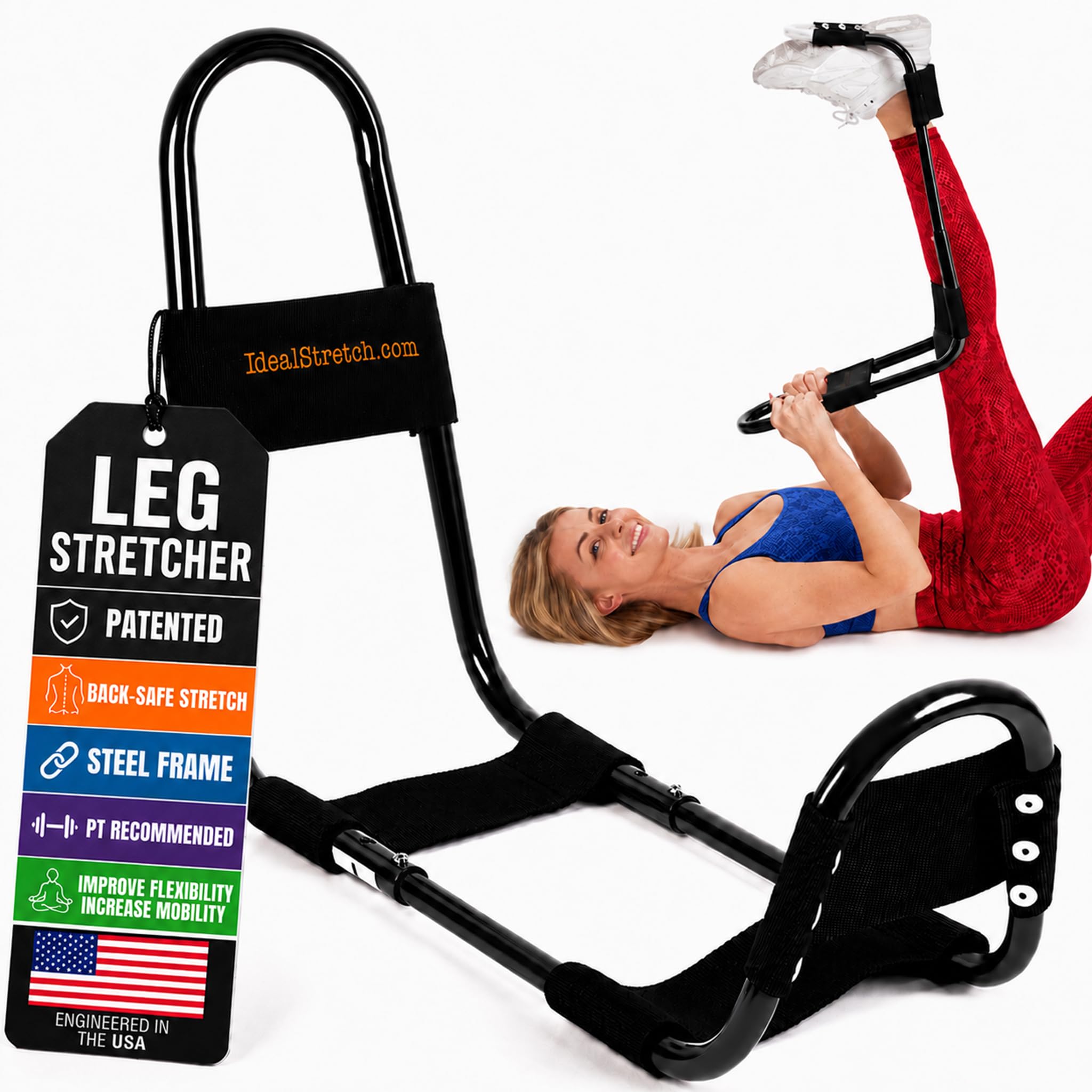
IdealStretch Leg Stretcher

90 /100
Peggy's Score Outstanding

Key details

Frame
Alloy steel
Weight
2.3 lb
Footprint
16 x 8 x 7 inches
Max User Weight
220 lb
Check Details on Amazon

The IdealStretch is the only thing here that holds your leg for you. You lie back, set a foot into the cradle and work the handle, and the steel frame keeps the leg where you put it instead of letting the angle drift as your arms tire. That's the one job a strap cannot do.

It changes the exercise more than you might expect. A strap stretch ends when your grip or your shoulder gives out; with the frame, the limiting factor becomes the hamstring itself, which is the point. It measures 16 by 8 by 7 inches and 2.3 pounds, small enough to live beside a sofa, and the manufacturer rates it to 220 pounds.

We think it earns its floor space for anyone doing daily hamstring work with a back or shoulder that complains, or whose home program calls for a long passive hold. It's the closest thing to having someone push your leg for you, and for a lot of people that's precisely what has been missing.

Two reservations worth weighing. Fully extended, it can still stop short for taller users, which limits how far the stretch goes for long legs. And it is the most expensive thing in this guide by a wide margin, a serious outlay for a job a strap does passably.

Pros

  • Frame holds the leg through a passive hold
  • Rated to a stated 220-pound user weight
  • Small footprint at 16 x 8 x 7 inches

Cons

  • Fully extended, it can still be short for tall users
Our verdict

We suggest it when arms, shoulders or back can't do the pulling: the frame holds the leg and the stretch outlasts your grip.

Check Latest Price
7

Calf and Arch

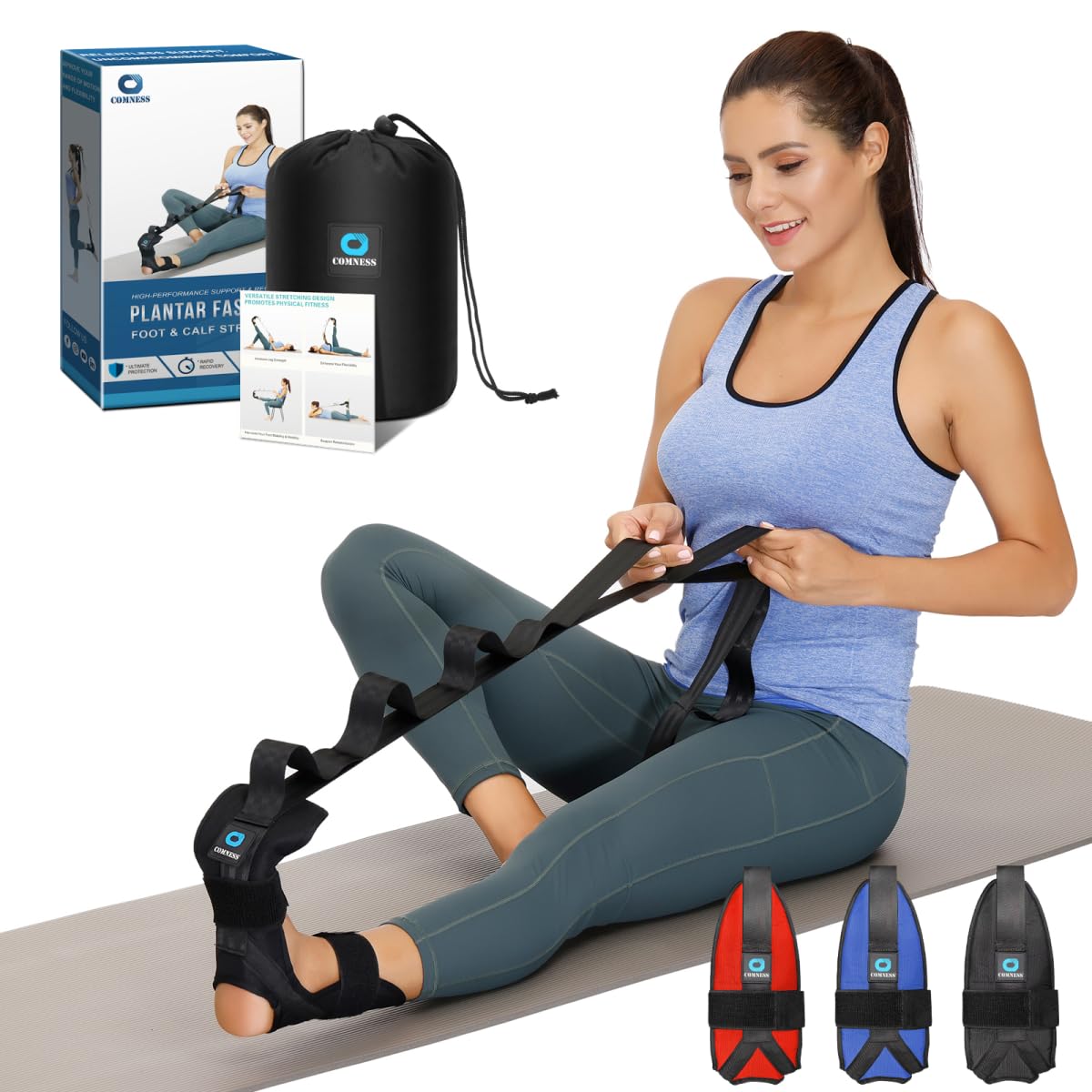
comness Foot and Calf Stretcher

89 /100
Peggy's Score Excellent

Key details

Loops
6
Length
60 inches
Material
Nylon laminate
Cradle Width
5 inches
Check Details on Amazon

The comness does something a plain looped strap can't: it holds your foot. A five-inch-wide cradle cups the forefoot and a six-loop webbing runs from it to your hands, so you're pulling against a sling rather than trying to keep an ankle flexed inside a loop for thirty seconds.

That shape is aimed at the plantar fasciitis and tight-calf crowd, and it works for hamstrings too, because the cradle can be set in two orientations so you can pull with the toes up or held straight. Sixty inches sounds short next to the straps here, and it is, but your hands start at your foot rather than your ankle so there's less distance to cover.

Two things to check before you load it. The one-size cradle sits differently on a wide forefoot than a narrow one, and a loose fit lets it slide toward the toes mid-pull, so set your foot deep before you tension the strap. And give the stitching on the loop web a hard look out of the box; if a seam looks light, sort it out before you start pulling hard, not after.

Where it earns its place is the foot-and-calf work a hamstring strap only half covers. If your arch and calf are part of why your leg feels short, the cradle is worth more than an extra foot of webbing.

Pros

  • Five-inch cradle holds the forefoot
  • Six-loop webbing for adjustment
  • Two orientations for toes-up or toes-straight pulls
  • Carry pouch included

Cons

  • One-size cradle can slide on a narrow foot
Our verdict

We choose it when the calf and arch are part of the problem: the cradle holds your forefoot so your foot can finally relax.

Check Latest Price
8

Spare Gym-Bag Strap

Abiarst Stretching Strap

94 /100
Peggy's Score Outstanding

Key details

Loops
10
Width
1 inch
Length
75 inches
Material
Fabric
Check Details on Amazon

Every strap in this guide does the same basic job, which is what makes the least expensive one worth a look. The Abiarst is a 75-inch run of webbing with ten loops, sold in enough colors that you can claim one as yours, and it stretches a hamstring exactly as effectively as anything else on this page.

Softness is the surprise. Most of the webbing in this category is flat and a bit slick; this one has more texture, is described as skin-friendly, and washes clean, which matters if it goes to a hot class or lives in a bag alongside damp kit. Ten loops run its length, so grip points aren't in short supply.

The straps that cost more buy comfort and bookkeeping, not function. A wider or padded strap doesn't stretch a hamstring any better; it makes the hold more pleasant, and printed numbers make the progress easier to log. If you already know what you're doing, that's money you don't need to spend.

So this is the one to buy in multiples: one in the car, one in the gym bag, one that can go missing without ruining the week. It's the strap we've tossed in a bag without a second thought, and it has come out the other end no worse for it.

Pros

  • Ten loops along a 75-inch strap
  • Soft, washable, skin-friendly fabric
  • Lowest price in this guide

Cons

  • One-inch webbing with no padding
  • Shorter than the long straps here
Our verdict

We keep one of these as the second strap: ten loops, washable webbing, and the lowest price in this guide.

Check Latest Price

How We Tested a Dozen Hamstring Stretchers

We started by scanning the market for hamstring stretchers from specialty fitness brands and larger retailers, then narrowed the list by adjustability, materials, weight limits, and price. The goal was a mix of strap-and-handle designs, adjustable frames, and floor-based boards—not just the most expensive options. We ended up with 12 units and tested them for six months.

Each stretcher lived on a living room rug, a gym floor, and next to a desk for quick work-break stretches. Testers ranging from 5-foot-2 to 6-foot-4 used them most days, and we timed how long it took to set up and switch angles solo. We watched for the things that make a stretch work: whether the frame stayed put under load, whether straps slipped or dug in, and whether we could relax into the hamstring rather than brace against the equipment. We also noted whether the stretch landed where it should—through the belly of the hamstring—or pinched behind the knee.

After six months, we checked joints, welds, foam padding, and strap stitching for wear, and compared what each unit promised—angle range, foldability, weight limit—with what it actually delivered. Value came down to whether we reached for it without dread and whether the price matched the build. The stretchers that scored best were the ones that adjusted easily, held their position, and made a daily stretch feel almost automatic.

How to Choose Hamstring Stretchers

Strap, Foot Sling, or Frame

Before comparing anything, work out what gives out first. If it's your hands or shoulders, a strap will frustrate you and a frame device that holds the leg for you is the better spend. If your foot won't stay flexed, or your arch and calf are part of the problem, a cradle sling does something a plain loop can't. Everyone else is best served by a looped strap, which is cheaper and lighter and does exactly the same thing to the muscle.

We put the plain straps at the top of this guide for that reason: they cover the most people for the least money, and the extras you pay for further up are about comfort and bookkeeping rather than a better stretch.

Non-Elastic, Numbered, and Why the Loops Matter

A stretch strap should not stretch. Elastic gives back as you pull, so the resistance changes through the hold and you can't tell whether you're looser than last week. Non-elastic webbing fixes the distance, which turns the loops into a tape measure: grip loop four today, loop five in a fortnight.

That only works if the loops are close enough together to give you small steps, and better still if they're numbered. Two picks here print numbers along the edge for exactly this reason. On an unnumbered strap the progression is just as real, it's simply harder to remember.

Length Is the Number to Check

The straps here run from 60 to 86 inches, and that difference decides whether you can set up at all. At average height and reasonable flexibility, 75 inches is plenty. Tall, long-legged, or tight enough that your hands stop well short of your foot, and the 80- and 86-inch straps give you slack to hold a position instead of chasing it.

Treat 'one size' as meaningless on a listing and look for the inches. A 60-inch cradle sling works for a different reason: your hands start at your ankle rather than out at your toes, so there's less distance to cover.

Grip and Foot Comfort for Thirty Seconds

Half a minute doesn't sound long until it's your palm. One-inch webbing concentrates the pull into a narrow band, which is tolerable for a set or two and less so by the fourth; 1.5-inch webbing and padded handles spread it out, and that's most of what the widest strap here is selling.

For the foot, a broad cradle beats a thin loop, especially with a high arch or a wide forefoot. The trade is bulk: a padded, handled strap doesn't fold into a jacket pocket the way a bare one does, so decide whether it lives in a bag or a drawer.

The Guide in the Box

The thing that decides whether any of this works isn't the strap, it's the paper. An illustrated book showing where the strap goes and which part of the leg you should feel is the difference between a habit and a drawer ornament, and it's the strongest argument for our top pick over cheaper straps that ship with a folded sheet.

If you already have a program from a therapist, ignore this section entirely and buy on length and grip.

Frequently Asked Questions

Final Verdict

Start with the OPTP Original Stretch Out Strap. It isn't the flashiest thing here, but non-elastic webbing that holds its shape plus a book showing where your foot goes removes the two reasons home stretching quietly stops: not knowing what to do, and not being able to hold it long enough to matter.

If you're tall or tight enough that 75 inches leaves you reaching, the Acozycoo's extra eleven inches are the fix. And if your hands or shoulders quit before your hamstring does, the IdealStretch takes them out of the equation entirely.