Best Foot Stretchers of 2026

A tight arch or a cranky calf has a way of announcing itself with your first step out of bed. A foot stretcher is the low-tech fix: a wedge, rocker, or strap-assisted platform you stand on or press into for a controlled stretch — no curb, rolled towel, or doorway gymnastics required. The right one turns a daily stretch into something you'll actually do; the wrong one slides across the floor, flexes under your weight, or puts your foot at an angle that misses the spot entirely.

I've spent the past four months with 14 foot stretchers, from simple slant boards to adjustable rocker designs, and the differences come down to build quality, how securely your foot stays put, and whether the slant height suits your calf and arch. Value matters here too — a flimsy stretcher that creaks and shifts is no bargain, even at a low price. Below are the ones that held up to daily use and felt sturdy enough to trust barefoot.

1

Best Overall

OPTP Stretch Out Strap

95 /100
Peggy's Score Outstanding

Key details

Weight
4 oz
Included
Illustrated exercise book
Material
Non-elastic nylon
Stretch Control
Loop ladder, adjusted hand over hand
Check Details on Amazon

The loops are the whole argument for this strap. You hook a hand through one, catch your foot in the webbing further along, and pull; when you want more range, you move up a loop instead of hauling harder. That is what lets you hold a stretch long enough to matter without your shoulders quitting first, and it is why we recommend this one before any of the fancier tools here.

There is nothing to fit, either. A flat strap has no shoe size, no weight cap, and no reason to put shoes on, so you can do a plantar fascia pull barefoot at the edge of the bed, which is exactly when that stretch is worth doing. At 4 ounces it rolls into a bag and disappears until you need it, and the thick green nylon webbing has taken daily pulling without fraying.

The included exercise book does more work than the price suggests. It runs through positions by muscle group, so you are not improvising with a strap that has more loops than instructions, and it covers the foot and calf positions as well as the hamstring ones. The pages are brief: good for following with the strap in your hand, thin if you want a full program.

What it cannot do is take your hands out of the equation, and for some people that is the whole problem. If grip, shoulder mobility, or arthritis makes holding a strap for a minute unpleasant, the rockers below do the same job with your foot alone. For everyone else, and especially for anyone who wants one tool covering foot, calf, hamstring, and hip, this is the one we hand people first.

Pros

  • Loop ladder lets you ratchet the stretch hand over hand
  • Barefoot use with no shoe-size or weight limit
  • 4 ounces and rolls flat for a gym bag
  • Illustrated exercise book included

Cons

  • No foot cradle; the foot presses against flat webbing
Our verdict

Buy this if you want one strap that stretches foot, calf, and hamstring with no fit caveats; it is the most useful stretching tool here for the money.
Check Latest Price
2

Best Hands-Free Stretch

ProStretch Original

91 /100
Peggy's Score Outstanding

Key details

Foot Fit
Adult shoes up to size 12
Footprint
6 x 12 x 8 inches
Stretch Type
Hands-free foot rocker
Weight Limit
250 lb
Check Details on Amazon

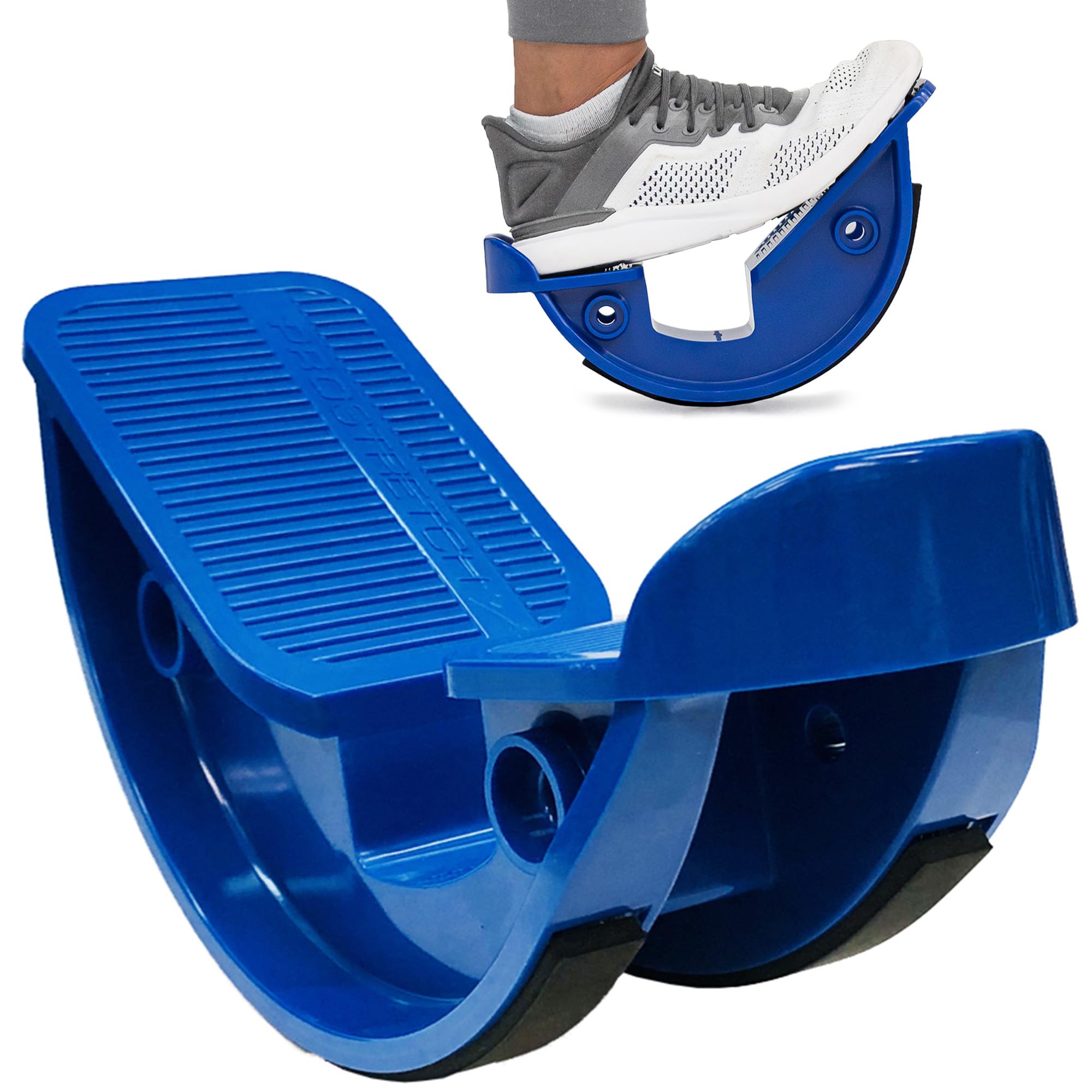
If holding a strap for a minute sounds like more work than the stretch itself, this is the tool that removes your arms from the job. You put a shod foot on the rocker, let the heel drop, and lean; your body weight supplies what a strap supplies with your hands. We used it on the days when we wanted the stretch without the setup, and it never asked anything of our grip.

The angle is the point. The rocker holds the foot in a fixed position, so the same stretch happens every session, which matters more than it sounds when you are trying to tell whether a tight calf is actually loosening week to week. It felt solid under full weight with no flex, and the rubber strips kept it planted on a hardwood floor. Instructions included with the unit cover a couple of positions, including one that shifts emphasis from the calf toward the plantar fascia.

It is designed to be used in athletic shoes and socks, which stops the heel sliding but makes it a garage or hallway tool rather than a barefoot bedside one. You also stretch one leg at a time, so a full session takes twice as long as a two-foot board; we did not mind, since each stretch is short. Set against a strap, it is the choice for someone who wants the stretch decided for them.

Pros

  • Body weight does the pulling, no grip needed
  • Fixed foot position makes every session repeatable
  • Non-skid rubber strips keep it planted
  • Takes full body weight without flexing

Cons

  • Fits adult shoes only up to size 12
  • 250 lb weight limit
Our verdict

Buy the ProStretch if you want a hands-free calf and plantar fascia stretch that never depends on your grip, and you wear shoes to stretch.

Check Latest Price
3

Best for Loaded Calf Work

StrongTek Wooden Slant Board

96 /100
Peggy's Score Outstanding

Key details

Deck
Lauan hardwood plywood
Handles
Side carry handles
Surface
Non-slip grip tape
Incline Settings
5 positions, 15° to 35°
Check Details on Amazon

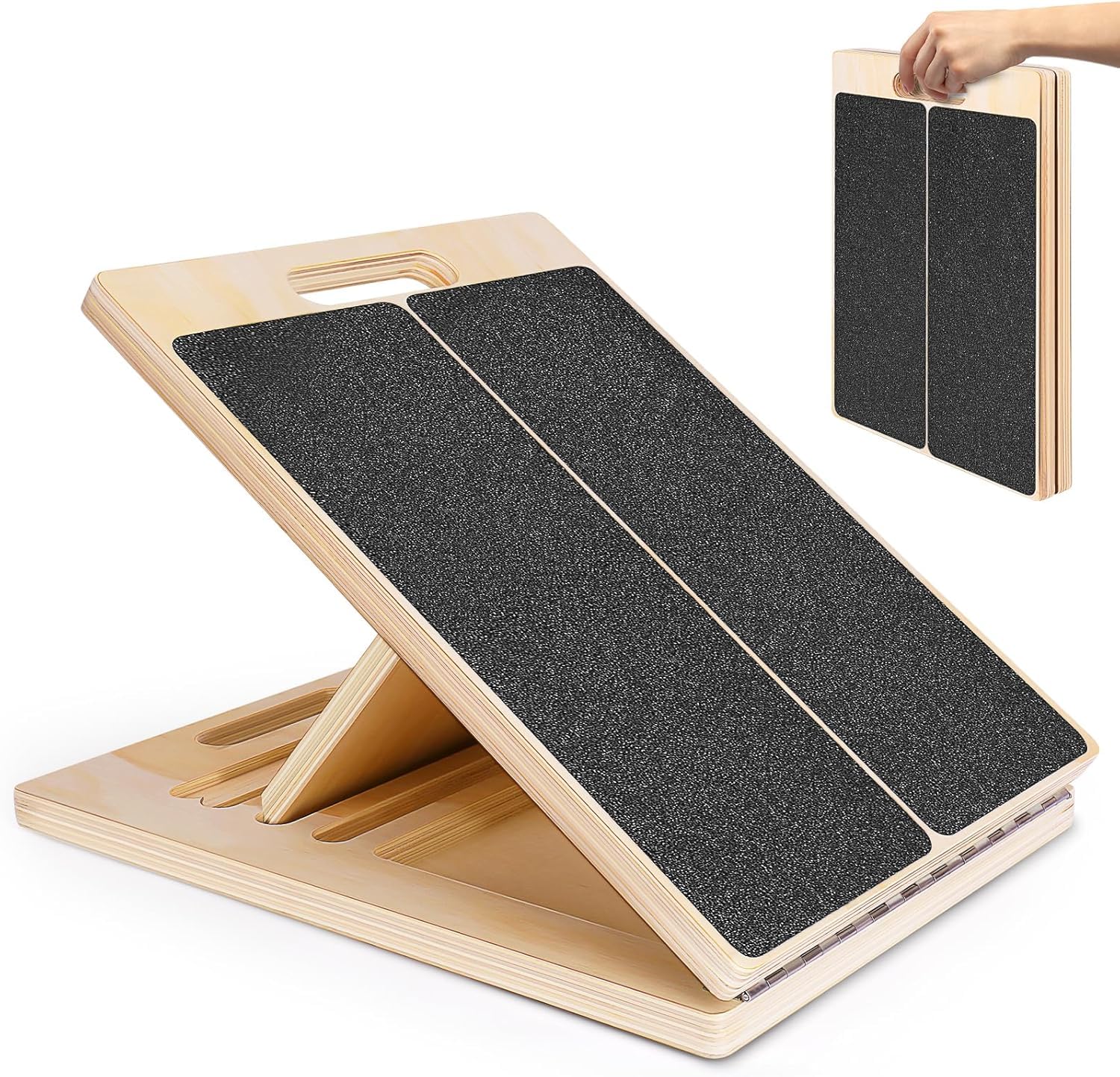
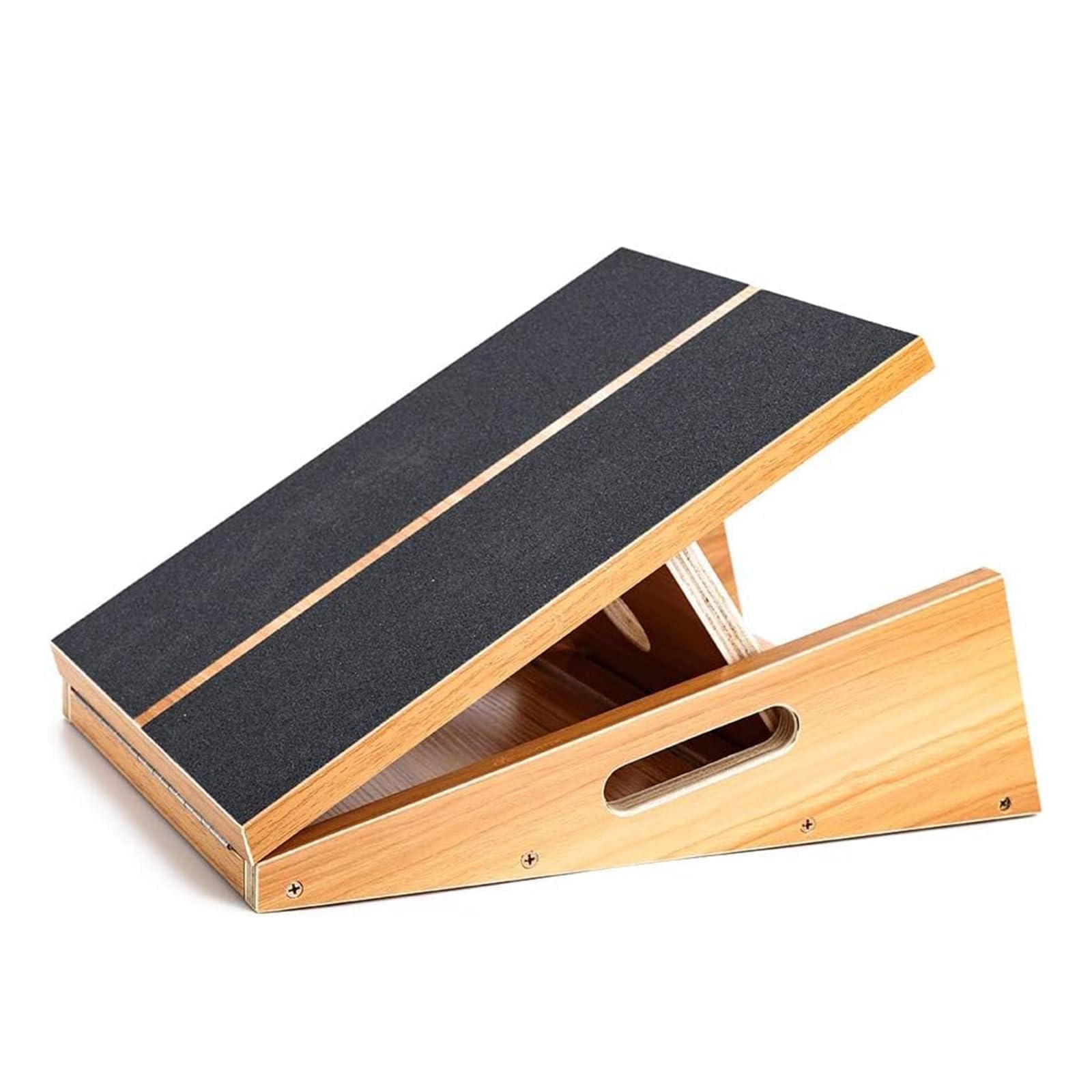
Fifteen degrees is the number that sells this board. It is the gentlest of the five settings, and it is where a tight calf or an angry Achilles will actually tolerate a stretch long enough to do something; the folding board in this guide starts at 30 and goes up. From there you work through 20, 25, 30, and 35 degrees as the tissue gives.

The build explains the rest. Lauan hardwood plywood, a wide deck with grip tape that stays grippy through sweaty sessions, and side handles that let you shift it from room to room without pinching your fingers. It arrives assembled, so there is nothing to put together before the first stretch, and the grip tape has held up through months of use.

Where it earns its place is loading. Standing on a board drives body weight through the calf and Achilles in a way a strap cannot, and the adjustable incline lets you start where you can tolerate it and add a few degrees as you improve. It is also the piece here that stays out on the floor rather than living in a drawer, and that is the trade. Ours sits beside a kitchen counter, because at 35 degrees you will want something to hold.

Pros

  • Starts at 15 degrees, the gentlest setting in this guide
  • Hardwood build with grip tape and side handles
  • Ships assembled and ready to stand on

Cons

  • Costs the most of any pick here
Our verdict

Buy this board if you want to load the calf and Achilles under body weight and need a 15-degree starting angle that a tight calf will accept.

Check Latest Price
4

Best Padded Grip

CTRL Sports Stretching Strap

95 /100
Peggy's Score Outstanding

Key details

Loops
10
Width
1.5 inches
Length
78 inches
Included
Carry bag and stretching guide
Check Details on Amazon

This is the strap we reach for when our hands are the problem rather than our calves. Same non-elastic loop ladder as our top pick, with two changes that matter: the webbing is 1.5 inches wide, and the handholds are padded with neoprene. On a long hamstring hold, that padding is the difference between finishing the set and letting go.

Ten loops across 78 inches gives you handholds at short and long reach, and the extra length means taller users are not sliding a hand down to the last loop. The stitching is substantial at every handhold, and the nylon does not give under a hard pull, which is the entire point of a non-elastic strap.

It rolls into the included drawstring bag and weighs 200 grams, so it is the one that lives in a gym bag without being noticed. A stretching guide comes in the box as well, thin but adequate for the basic positions.

Two small frictions. The loops are sewn rather than adjustable, so the increments are fixed; we did not miss a cinch, but if you want a strap that shortens at one end, this is not it. And the end loops are snug on a bare foot, which a sock solves. What you are buying is the padding, and after a long set of hamstring holds it earns its keep.

Pros

  • Padded neoprene handholds are kinder on sore hands
  • 1.5-inch webbing spreads the pull across the palm
  • 78 inches and 10 loops suit tall users
  • Drawstring carry bag and stretching guide included

Cons

  • Priciest strap in this guide
Our verdict

Buy this strap if long holds leave your hands sore; the wide webbing and padded handles are the reason to choose it over a plainer loop strap.

Check Latest Price
5

Best Budget Strap

Trideer Stretching Strap

95 /100
Peggy's Score Outstanding

Key details

Width
1 inch
Length
75 inches
Weight
3.2 oz
Material
Non-elastic polypropylene
Check Details on Amazon

Cheap straps usually show it at the loops, and this one does not. The stitching is reinforced at every handhold, the polypropylene webbing is genuinely non-elastic, so pull as hard as you like and it will not give, and 75 inches is enough length for a tall user to get a hamstring stretch without sliding down to the end. It feels as substantial as the straps here that cost several times as much.

There is no dedicated foot loop at the center, so you drape the strap over the ball of your foot and hold both ends. That works, and it is how most flat straps work, but a cradle holds a foot more securely. At 3.2 ounces it disappears into a gym bag, and it is the strap we hand a beginner who is not sure they will stick with it.

Pros

  • Reinforced stitching at every loop
  • Non-elastic webbing holds firm under hard pulls
  • 75 inches covers tall users

Cons

  • Narrow 1-inch webbing with no padding
  • Included brochure stops at the basics
Our verdict

Buy this if you want a no-frills loop strap that pulls hard without stretching and costs less than everything else here; beginners may want more guidance.

Check Latest Price
6

Best for Small Spaces

PowerStep UltraFlexx

90 /100
Peggy's Score Outstanding

Key details

Use
With sturdy athletic shoes
Weight
14.1 oz
Dimensions
10 x 5 x 1 inches
Stretch Type
Hands-free foot rocker
Check Details on Amazon

Ten inches long and an inch tall: that is the UltraFlexx's pitch, and it is a real one. It sits lower to the ground than the ProStretch, so the stretch starts closer to standing, and it slides under a sofa or into a gym bag instead of claiming floor space permanently.

Plastic body, non-skid strips underneath, a curved underside that rocks as you shift weight forward. It is meant to be used with sturdy athletic shoes, and the stretch is set by how far you rock rather than by a dial. In use it is closer to standing on a step edge than to the ProStretch's cradled position, so you are balancing as much as stretching at first, and a wall or counter within reach helps.

Construction is honest rather than luxurious: it takes full weight without flexing or creaking, but it feels like a molded plastic tool. That is fine, because the point is a rocker that vanishes when you are done and asks less of your wallet than the alternative. If you want equipment that stays out and looks like equipment, the ProStretch is the one; if you want a rocker that fits in a drawer, this is it.

Pros

  • Rocks hands-free with body weight
  • Ten-inch footprint slides under furniture
  • Non-skid base stays put on hard floors

Cons

  • Short platform suits smaller feet better
Our verdict

Buy this rocker if you want a hands-free stretch in a small apartment or a gym bag, and your feet are on the smaller side of average.

Check Latest Price
7

Folding Incline Work

NORBASE Wooden Slant Board

92 /100
Peggy's Score Outstanding

Key details

Build
Wood
Dimensions
15.74 x 11.81 x 1.37 inches
Incline Settings
4 positions, 30° to 45°
Check Details on Amazon

The fold-flat hinge is the whole reason to look at this board instead of a solid wooden one. Folded, it is around an inch and a half tall, so it goes under a bed or behind a door, and it has a carry handle and a clasp that keeps it shut in transit. It is the only incline in this guide you could reasonably put in a car.

Four settings, 30, 35, 40, and 45 degrees, put it at the steep end of this group, and that shapes who it is for. This is a board for loaded calf work and squats, and for calves already used to being stretched; our StrongTek pick starts at 15 degrees for anyone who is not there yet. As a portable second board it earns its place. As your only board, it would be the wrong shape for a lot of people.

The deck itself is pleasant to stand on: textured, wide enough for a full foot, stable under weight with no creak. We kept ours tucked beside a desk, which is the kind of place a folding board actually gets used. Give the hinge a look every few months, since it is the part that takes the load.

Pros

  • Folds flat with a carry handle and clasp
  • Four settings from 30 to 45 degrees
  • Textured non-slip deck

Cons

  • Hinge and screw points can crack with use
Our verdict

Buy this if you need a board that folds away or travels and your calves are ready for a 30-degree start; it is a second board, not a first one.

Check Latest Price
8

Cradled Foot Stretching

DMoose Foot and Calf Stretcher

89 /100
Peggy's Score Excellent

Key details

Loops
7 hand loops
Width
2 inches
Length
52 inches
Padding
8 mm neoprene
Check Details on Amazon

Most straps ask you to hook a bare foot into a loop and keep it there. This one wraps instead: a padded cradle with two hook-and-loop straps closes over your forefoot so the foot stays put while you pull on the seven hand loops. If keeping a foot balanced against thin webbing is the part that stops you stretching, this design solves it.

Eight millimeters of neoprene is enough that the strap does not dig into the arch, and enough that the whole thing feels bulky next to a flat nylon strap. At 52 inches it is the shortest strap here, which suits seated and floor work more than a long hamstring pull.

Fit is the catch, and it is the question to settle before you buy. The cradle is one size and it runs large, so smaller feet swim in it, the straps have to be cinched right down, and that is where pressure points come from. A step-by-step e-guide is included, and the setup it describes is more involved than draping a strap over your foot.

Our take: this is the strap for someone who has already tried a flat loop strap and found the foot slipping or the webbing uncomfortable. For that specific problem it works, and the padding is the reason. If your feet are average or smaller, though, fit is the deciding issue, and a flat strap costs less and does the same job without the bulk.

Pros

  • Padded cradle holds the forefoot without gripping
  • Dual hook-and-loop straps adjust around the foot
  • Seven hand loops and an e-guide included

Cons

  • One-size cradle runs large for smaller feet
  • Bulky padding next to a flat strap
Our verdict

Buy this if a flat strap slips off your foot or hurts your arch; the padded cradle holds it, as long as your feet are not on the small side.

Check Latest Price

How We Chose and Tested Foot Stretchers

We started with a shortlist of 30 foot stretchers from major retailers and specialty running shops, then narrowed it to 14 based on slant height, materials, fixed versus adjustable design, and price. I ruled out models with a fixed angle that looked too steep for a beginner and any that reviewers described as sliding or flexing underfoot. The final group included flat slant boards, rocker-style stretchers, and a few adjustable designs.

For four months, I used each one barefoot and in socks, usually first thing in the morning before walking the dog and again after evening walks. I kept one beside my bed, one under my desk during work calls, and rotated the rest through a post-walk routine. I measured the slant height of each with a ruler and noted whether the incline hit my midfoot or pushed my toes up, then held a stretch for a slow count of 30 to see if my arch cramped or my heel lifted.

Sturdiness and durability got the same treatment: I stood on each one on hardwood and carpet, shifted my weight side to side, and checked for wobble, creaking, or flex. I used every model daily for at least a week and looked for cracked plastic, flattened grip tape, or loosening joints. At the end, I compared what each one cost against how solid it felt and how easy it was to get a useful stretch — a cheap stretcher that slides is not a value.

How to Choose Foot Stretchers

Strap, Rocker, or Slant Board

Three designs do the same job with different amounts of you involved. A strap extends your reach and lets your arms supply the pull, so you can work the plantar fascia lying on your back. A foot rocker fixes the angle of your foot and lets body weight do the work while your hands stay free. A slant board raises the forefoot and turns an ordinary standing position into a calf stretch.

Choose the strap if you want one tool that also covers hamstrings, hips, and lower back, and if packing it flat matters. Choose the rocker if grip strength, shoulder mobility, or arthritis makes holding a strap unpleasant, because it is the hands-free option. Choose the board if you want to load the calf and Achilles under body weight rather than pull from a lying position. One trap to know: a rocker's angle is set by its shape, so progression comes from leaning further, not from changing a setting.

Read the Bottom Incline, Not the Number of Settings

The lowest angle a board offers tells you more than how many positions it has. Boards in this group start anywhere from 15 to 30 degrees, and that difference decides whether a tight calf can tolerate the first stretch at all. The StrongTek runs 15 to 35 degrees; the folding NORBASE starts at 30 and goes to 45.

If you are working through a grumpy Achilles or a first-thing-in-the-morning plantar fascia stretch, buy for the low end and ignore the top. The steep settings are for loaded work such as heel-elevated squats and calf raises, and plenty of people never need to go past 30 degrees. If you are already strong and mobile and want the board for lifting, the steep range is the point and the gentle one is wasted.

Check Fit, Weight, and Shoes Before You Order

Rockers are the ones with limits. The ProStretch fits adult shoes up to size 12 and is rated to 250 lb, and it is meant to be used in athletic shoes; the PowerStep is compact enough that a large foot overhangs the platform. Boards are the opposite, since you stand on them in socks or barefoot, but a wooden board is still worth checking against any weight guidance the maker gives.

Straps have one fit question: length. Anything around 75 inches or more covers tall users and long hamstring pulls, while a 52-inch strap is a floor-work tool. Cradle-style straps are one size by design, so check the foot range the maker states before you commit rather than assuming one size wraps everyone.

Grip, Padding, and Where It Will Live

Narrow webbing is fine until you are pulling hard for a minute, and then it presses into your fingers and you let go early. Padded handles and wider webbing cost more and earn it if you have grip issues or arthritic hands. The same logic applies at the foot: a padded cradle is kinder to a sensitive arch and bulkier than a flat strap.

Then be honest about storage. A strap that lives in a drawer gets used; a board that has to be hauled out of a closet does not. A solid hardwood board is the sturdiest thing you can stand on and the least likely to be moved, while a folding board and a flat strap are what actually travel. Buy for the room where the stretching happens.

Frequently Asked Questions

Final Verdict

The OPTP Stretch Out Strap is what we hand most people. It stretches the foot, calf, and hamstring, it works barefoot with no size or weight caveat, it weighs 4 ounces, and the included book tells you where to start. Few tools this simple leave so little to figure out.

Buy the ProStretch instead if grip strength or shoulder mobility is what stands between you and a daily stretch, since the rocker takes your arms out of it. And if you are loading a stubborn calf or Achilles under body weight, the StrongTek's 15-degree bottom setting is the one to build from.