Best Calf Stretchers of 2026

A calf stretch is only as good as your setup. A wall or stair edge works until you need a deeper angle, and a flimsy gadget slides before you feel anything. A good calf stretcher fixes that by holding your foot at a repeatable angle, so you can settle in, breathe, and make real progress on tightness and heel pain.

Over the past six months, my team and I tried 11 calf stretchers, from compact foot rockers to adjustable boards, caring about quality you can feel underfoot, a stable base that doesn't skate on hardwood, and a footbed that fits a range of feet without pinching. Firmness mattered more than I expected: some were so hard they made sore mornings worse, while cushy ones let the stretch go vague. Value showed up in how often we reached for each one, not just in what it cost. The keepers made a calf stretch feel controlled rather than like balancing on a wobbly step, and they held up after daily use without flexing or cracking—the right pick is below.

1

Best Overall

StrongTek Wooden Slant Board

96 /100
Peggy's Score Outstanding

Key details

Weight
8.97 lb
Material
Lauan hardwood plywood
Incline Settings
15°, 20°, 25°, 30°, 35°
Check Details on Amazon

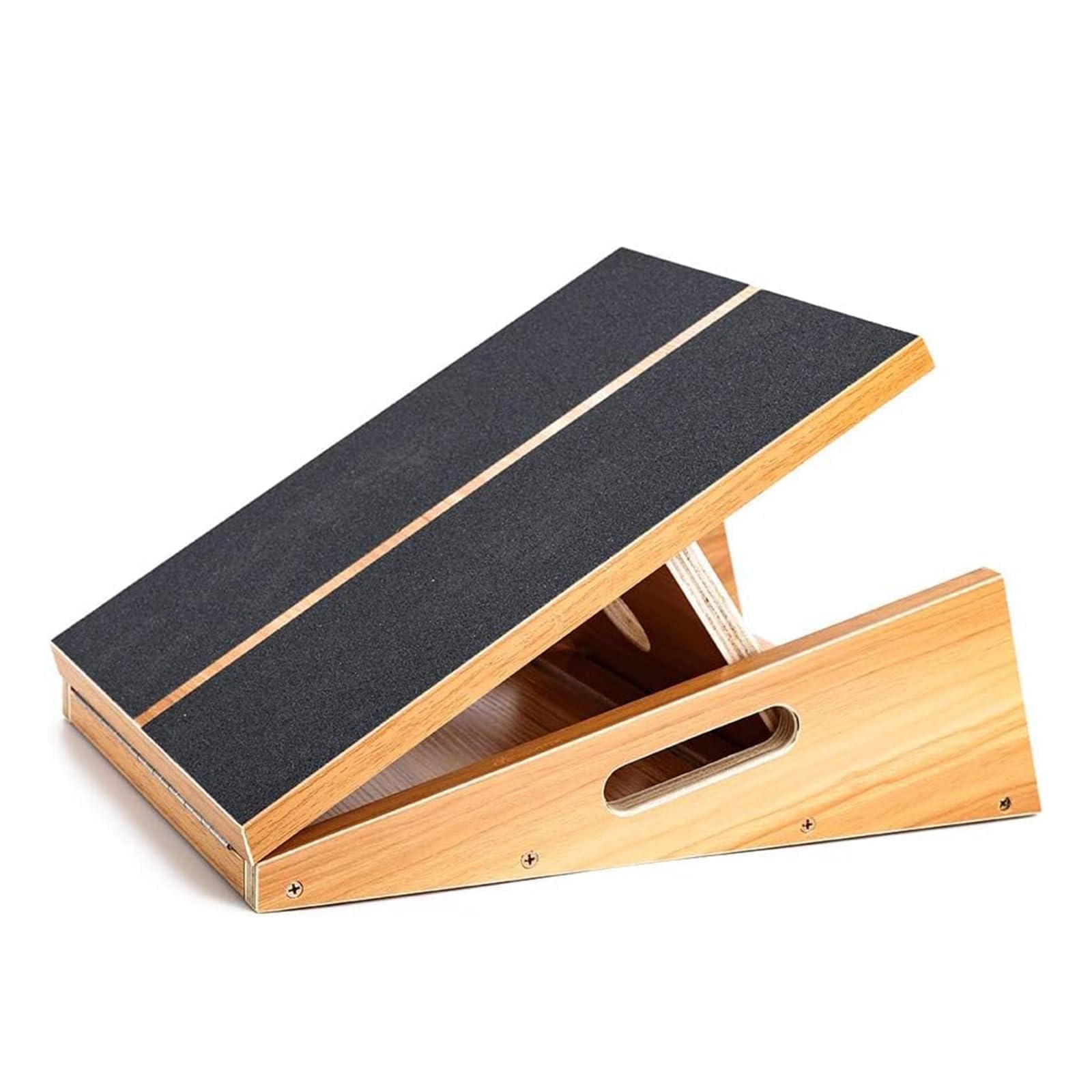
Fifteen degrees is the number that matters here. The five settings run from 15 to 35 degrees, and the lowest one is what makes this board usable for someone whose calves are actually tight — you can stand on it with both heels down and feel a stretch rather than a punishment. Boards that start at 30 degrees get tried once and then live behind a door.

The deck is 16 inches deep and 12.5 inches wide, enough to fit a whole foot with room to angle the toes in or out and shift the stretch toward the inner or outer calf. The grip tape holds a socked foot without slipping, so shoes aren't mandatory the way they are on a rocker, and the side handles make it easy to carry from bedroom to living room. Lauan hardwood plywood and a build just under nine pounds mean it doesn't skitter when you lean into it.

We compared it most closely with the MUCITAGF below, which offers the identical five angles for less money and states a 500-pound capacity plus a three-year warranty. This one is the priciest board in the group. We still start people here because the hardwood deck and taped surface feel like the more finished piece of equipment under a bare or socked foot, and because the design has been sold unchanged long enough that its stability isn't a guess.

The trade-off is weight. At nearly nine pounds it's a board you set down and leave down, and carrying it to the gym is not the point. For a home board parked beside a couch or desk, that heft is exactly what keeps it planted while you hold a stretch through a slow count.

Pros

  • Five inclines starting at a gentle 15 degrees
  • Grip tape holds socks and bare feet
  • Sturdy hardwood deck with carry handles
  • Wide 16 x 12.5 inch platform

Cons

  • Nearly 9 pounds, so it stays in one room
  • Priciest board in this set
Our verdict

Buy it if you want one board that takes a genuinely tight calf from a gentle 15-degree stretch upward without wobbling underfoot.
Check Latest Price
2

Best Foot Rocker

ProStretch Original Calf Stretcher

91 /100
Peggy's Score Outstanding

Key details

Weight
14 oz
Shoe Fit
Adult shoes up to size 12
Weight Limit
250 lb
Check Details on Amazon

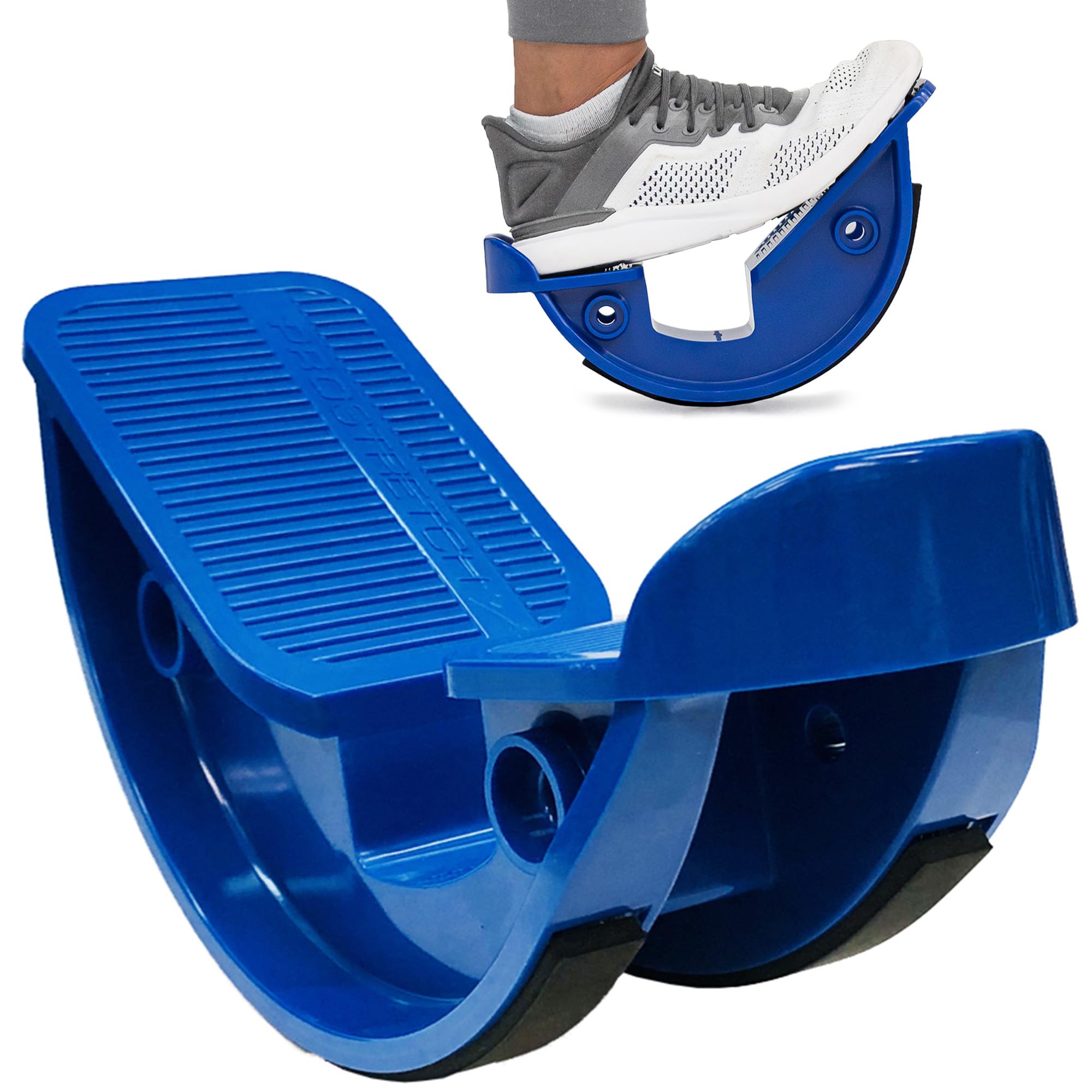
The first thirty seconds out of bed are when a tight calf and a cranky plantar fascia announce themselves, and a rocker is built for that moment. Your foot sits with the heel back and the toes forward, and you rock forward until the stretch arrives — no wall, no step, no balancing act with a coffee cup in your hand.

Of everything here, this is the tool we reach for when a single calf needs work and we want to feel precisely where the stretch lands. Because the foot stays fixed, you control intensity by how far you rock rather than by moving a pin or changing a notch, and the rubber strips underneath keep the whole thing from walking across the floor. It's the most direct feedback loop in this group.

Two limits come with the design, both printed on the packaging: it fits adult shoes up to size 12 and is rated to 250 pounds, and it wants socks and athletic shoes rather than bare feet. A rocker rolls the foot against a firm edge, and bare skin doesn't enjoy that. The shoe requirement is also why it works so naturally as a pre-run or post-run tool — you're already dressed for it — and at 14 ounces it disappears into a gym bag.

Pros

  • Works in shoes, so it fits a gym routine
  • Only 14 ounces and easy to carry
  • Fixed foot position gives precise control
  • Slip-resistant rubber pads underneath

Cons

  • Rated to 250 pounds, lower than the boards
  • Athletic shoes required, not bare feet
Our verdict

Buy it if you want a light, portable rocker for one tight calf and you'll put athletic shoes on to use it.

Check Latest Price
3

Best Value Slant Board

MUCITAGF Wooden Slant Board

93 /100
Peggy's Score Outstanding

Key details

Platform
16 x 12.5 inches
Warranty
3 years
Weight Capacity
500 lb
Incline Settings
15°, 20°, 25°, 30°, 35°
Check Details on Amazon

Take the shape of our top pick, add a bigger stated weight limit and a longer warranty, and subtract some money, and you have the MUCITAGF. The five settings are identical — 15, 20, 25, 30 and 35 degrees — and the platform is the same 16 by 12.5 inches, which is enough room to angle a foot and shift the stretch around the calf.

The differences are in the build. The deck is plywood rather than hardwood, the top is a textured surface rather than tape, and the base carries a slip-resistant pad. In socks the texture grips well enough that the board stays put through a long hold, which matters more than it sounds when your hands are on a counter and your heels are the only thing keeping you honest. A printed exercise guide comes in the box, genuinely useful if you're working back from an Achilles injury and need to know how many variations exist.

The case for it over the StrongTek is on paper and in the household: a 500-pound capacity and a three-year manufacturer warranty both matter if the board will be shared, used by a heavier family member, or pressed into service for heel-elevated squats as well as calf work. We still give the top spot to the StrongTek, because the hardwood-and-tape combination feels like the more durable surface for daily standing, but this is the board we point to when the numbers decide it.

Pros

  • Stated 500-pound weight capacity
  • Three-year manufacturer warranty
  • Textured top and slip-resistant base
  • Same 15-degree floor as our top pick

Cons

  • At 8.5 pounds it's a leave-in-place tool
Our verdict

Buy it if you want the same five gentle-to-steep angles as our top pick with a 500-pound rating and a three-year warranty behind it.

Check Latest Price
4

Best Budget Strap

comness Stretching Strap

89 /100
Peggy's Score Excellent

Key details

Loops
Six
Strap Width
5 inches
Strap Length
60 inches
Check Details on Amazon

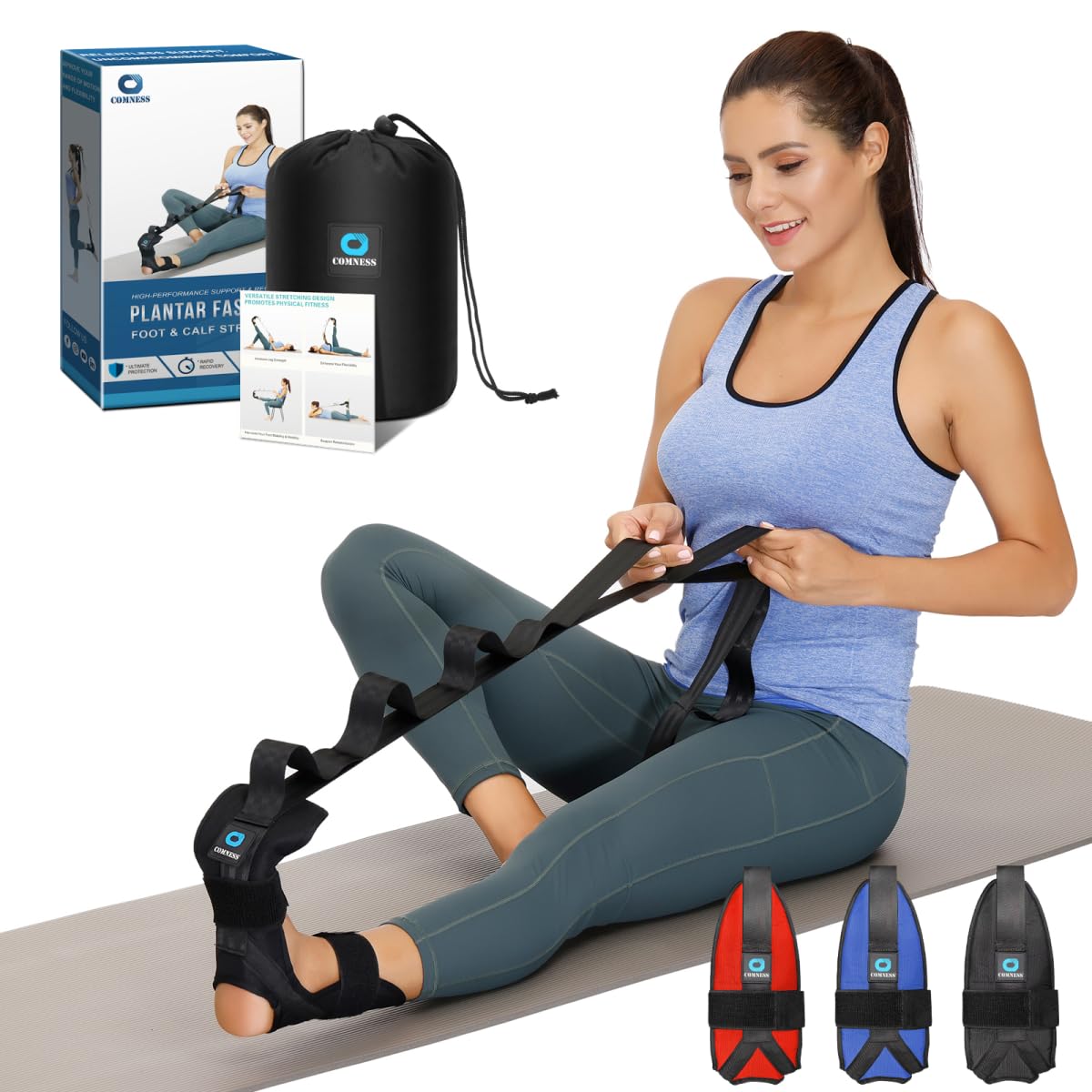
A board only stretches what you can stand on, and that's the gap this strap fills. Lie on your back, hook the cradle over your forefoot, and pull the webbing to bring your toes toward you — a calf stretch you can hold for a full minute without a wall, a step, or a balance wobble. Point the ankle and pull for the calf; keep it flexed and the same strap reaches the hamstring.

Sixty inches of webbing with six loops along it gives you a graded pull: move your hand down a loop and the stretch deepens by a small, repeatable amount. The cradle can be flipped to work the foot in two orientations, and the whole thing rolls into the pouch that comes with it, which is why it's the pick for a suitcase.

It's the cheapest thing on this page, and it's also the fussiest to put on. The cradle is a pocket you have to seat on the right part of the foot, and it takes a couple of tries to get there — land it wrong and the pull bites into the toes or the top of the foot instead of the arch. We'd still choose it over a board for a first stretching habit, because the cost of trying it is so low.

Pros

  • Costs the least of any pick here
  • Rolls into a pouch for travel
  • Six loops give a graded pull
  • Stretches calf and hamstring lying down

Cons

  • Stitching has failed at the loops
  • Cradle takes practice to seat correctly
Our verdict

Buy it if you want to stretch your calves lying on the floor or from a hotel room, and you don't mind learning to seat the cradle.

Check Latest Price
5

Best Foam Wedge

OPTP PRO-Slant Wedge

92 /100
Peggy's Score Outstanding

Key details

Size
11¾ x 11¾ x 3¾ inches
Weight
14.1 oz
Incline
18 degrees
Material
Closed-cell foam
Check Details on Amazon

Eighteen degrees, fixed. That sounds like a limitation, and in one way it is: there's nothing to adjust, nothing to pin, nothing to fiddle with between sets. It's also the point. This is a wedge you step onto and stand on, and for feet that flinch at the idea of a 30-degree board, a single low angle that never moves is exactly the right amount of technology.

Each wedge measures 11¾ inches square and 3¾ inches high and weighs just over 14 ounces, and the closed-cell foam stays firm rather than squashing flat. The pair is the quiet luxury here: one by the desk, one in a gym bag, and no carrying anything between rooms.

One wedge gives you a calf stretch; two, side by side or stacked, become a squat ramp, a heel-elevated platform, or a pair of blocks for calf raises. That's more range of use than a fixed-angle tool usually earns, and it's why clinics keep sets of them around.

The foam is where the experience divides. Under a heavy load it gives more than wood or plastic will, and if you want a hard, unyielding edge under your arch, this isn't it. What you get instead is something you can stand on barefoot without wincing — and a stretch you'll actually hold for a full minute because it doesn't hurt to hold it.

Pros

  • Light enough to carry in a gym bag
  • A pair gives you a spare or a stacked angle
  • Gentle 18 degrees suits sore feet
  • Closed-cell foam is easy barefoot

Cons

  • Fixed 18-degree angle, no adjustment
  • Foam gives underfoot more than wood
Our verdict

Buy it if your feet are too sore for a steep wooden board and you want a light, gentle wedge you can stand on barefoot.

Check Latest Price
6

Small Spaces

TEMI Slant Board

89 /100
Peggy's Score Excellent

Key details

Dimensions
15.75 x 11.8 x 1.55 inches
Weight Capacity
500 lb
Incline Settings
20°, 25°, 30°, 40°
Check Details on Amazon

It folds flat and it has a handle, which sounds minor until you've stepped over a wooden slant board left in a hallway. Closed, this one slides under a couch or stands against a wall; open, it's a 15.75 by 11.8 inch platform with a non-slip surface that grips socks as readily as shoes.

What we appreciate most is the bottom of the range. Four settings run 20, 25, 30 and 40 degrees, and that 20-degree starting stop is more forgiving than most folding boards manage — plenty of them open at a level a tight calf can't tolerate on day one. The hardwood deck is rated to 500 pounds, and the angle changes are simple enough to make mid-session.

The hinge is the part to watch. An adjustable board takes the whole load at the joint, and this design has cracked there for some users, with boards failing after a few months of regular standing. Ours has held up so far. Open and close it a few times when it arrives, keep the packaging until you've put real weight on it, and treat a creak or a wobble as a reason to send it back rather than something to live with.

Pros

  • Folds flat for storage in tight spaces
  • Starts at a gentle 20 degrees
  • Stated 500-pound capacity
  • Non-slip surface grips socks and shoes

Cons

  • Hinge has cracked on some boards
Our verdict

Buy it if floor space is tight, since it folds flat and still starts at a gentle 20 degrees, but inspect the hinge on arrival.

Check Latest Price
7

Sensitive Feet

DMoose Foot and Calf Strap

89 /100
Peggy's Score Excellent

Key details

Loops
Seven
Padding
8 mm neoprene
Strap Width
2 inches
Strap Length
52 inches
Check Details on Amazon

The neoprene is the whole idea. Eight millimeters of it wraps the cradle that goes over your forefoot, so the pull spreads across the arch instead of concentrating in one narrow band — the difference between a strap you'll hold for twenty minutes and one you'll drop after two. If you've ever pulled a plain webbing strap across a sore plantar fascia, you'll feel the point immediately.

Two hook-and-loop straps wrap the foot rather than one, and the nylon webbing runs 52 inches with seven loops spaced along it, so the stretch deepens in small increments instead of jumps. The dual straps also keep the cradle seated when you relax between pulls, which is where cheaper straps tend to slide.

Set against the comness strap, this is the more comfortable of the two and the more expensive, and it's shorter — taller users will find the last bit of reach harder to come by. The padding is the reason to pay the difference, and it's most worth it for anyone with neuropathy, a recent injury, or skin that complains about webbing.

One size supposedly fits everyone, and it doesn't quite: the cradle can sit loose on smaller feet, so test the straps cinch down far enough before you settle into a long session. A visual exercise guide is included, and in the first week, when you're still working out the angle of the pull, that's more useful than another loop.

Pros

  • 8 mm padding cushions the arch and heel
  • Dual hook-and-loop straps hold the foot
  • Seven loops give fine pull adjustments
  • Comes with a visual exercise guide

Cons

  • One-size cradle runs loose on small feet
  • Shorter at 52 inches than budget straps
Our verdict

Buy it if your feet are sensitive and you want padding between the strap and your arch, and your feet aren't on the small side.

Check Latest Price

How We Chose and Tested the Best Calf Stretchers

To build our shortlist, I started with calf stretchers from established fitness and recovery brands, then compared footbed dimensions, angle settings, materials, and return policies. I ruled out fixed-angle models that would only work for one calf length and anything with vague sizing. The final field was 11 stretchers, which we used for six months.

Testing happened where calf tightness actually shows up: beside my desk during workday breaks, in the living room before breakfast, and on the gym floor after runs. I tried each one barefoot and in sneakers, and a teammate with larger feet checked whether the footbed and heel cup felt roomy or pinched. At every angle setting, we held a 30-second stretch and noted whether it landed in the calf or slid into the Achilles; after runs, we paid attention to whether soreness eased or just moved around.

We pushed down hard on the frame to check for wobble, watched whether the base crept across hardwood or carpet, and pressed a thumb into the footbed to gauge firmness under the arch. Over six months, we checked for flexing, cracking at seams, loosened hardware, and grip that wore smooth. We also noted which ones we reached for without thinking—that was our value test—and which stayed too hard on sore mornings.

How to Choose Calf Stretchers

Start With the Position You'll Stretch In

Standing on an incline puts your body weight into the stretch, which is efficient and easy to read: step on, heels down, feel it arrive. A strap works from the floor instead — lie on your back, hook the cradle over your forefoot, and pull — which suits anyone who can't balance comfortably, anyone stretching a hamstring at the same time, and anyone whose calves are too sore for full weight.

Be honest about which of those you'll do. If the board lives by the kitchen counter and you stand on it while the kettle boils, buy a board. If you'd rather stretch during a TV episode, a strap will get used and a board won't.

The Lowest Angle Matters More Than the Highest

A board that reaches 45 degrees looks more capable than one that stops at 35, but the number that decides whether you'll use it is the bottom of the range. Fifteen to 20 degrees is a stretch a genuinely tight calf can settle into; a board whose easiest setting is 30 degrees asks a lot on the first day and often ends up in a closet. Our two favorite boards both start at 15 degrees, and the folding TEMI starts at 20.

One piece of technique worth knowing: keep the knee straight to bias the upper calf, then bend it slightly to reach the deeper soleus. A board you can stand on with a bent knee does more for you than one extra notch of angle.

Match the Rating to the Body Standing on It

Read the stated weight limit before anything else if the board will be shared. A rocker acts as a lever under your full body weight and its limit is often lower than a board's — the ProStretch is rated to 250 pounds, where the wooden boards here state 500. Higher ratings also matter if you plan to do loaded squats with your heels elevated.

Then check what the surface expects. Foot rockers specify socks and athletic shoes; most boards use grip tape or a textured deck that holds a socked foot fine. The one combination to avoid is a hard plastic rocker used barefoot, which turns a stretch into a pressure point.

Plan Where It Lives Before You Buy

Storage quietly decides how much a stretcher gets used. A nearly nine-pound hardwood board is a piece of furniture: wonderful beside a couch or desk, annoying if you have to haul it out of a closet. If floor space is tight, a folding board or a strap in a drawer is the better purchase even if it costs you a little stability.

Pick the spot first — bottom of the stairs, next to the desk, under the coffee table — then buy the tool that fits it. We'd rather see you own the second-sturdiest board that stays out than the best one that lives behind the coats.

Frequently Asked Questions

Final Verdict

For most people, the StrongTek wooden slant board is the one to buy: five settings starting at a gentle 15 degrees, a stable hardwood deck, and a taped surface that grips a socked foot. It's the board we'd leave by the couch and step onto every evening.

If you want the same range for less, the MUCITAGF adds a 500-pound rating and a three-year warranty. For one tight calf you can work in shoes at the gym, take the ProStretch rocker; and if a board would never leave the closet, the comness strap in a drawer beats a slab you don't use.