Best Exercise Sliders of 2026

A slider is nothing more than a smooth disc under your hand or foot, and yet it can turn a small living room into a serious core workout. The catch is that the material matters more than the marketing: plastic discs need carpet to offer any resistance, while fabric ones grip plush carpet but grab and pill on tile or laminate. Most sets never tell you which floor they were built for, which is why so many end up shoved in a closet after two sessions. The right pair fixes that quietly — it glides when you push and holds when you lean in.

I've kept a pair under my sofa for years, so I have strong opinions about which ones survive bare feet and which ones shred. Over the past four months, my team and I worked through 16 sets on hardwood, carpet, tile, and a rubber gym mat, with bare feet and sneakers. Here's something first-time buyers rarely think about: hand discs should be smaller than foot discs, and a set with one uniform size is a compromise you'll feel in your shoulders. The picks below are grouped by the floors and workouts they actually suit, so start with yours.

1

Best Overall

Synergee Core Sliders

91 /100
Peggy's Score Outstanding

Key details

Diameter
7 inches
Surfaces
Carpet and hard floors
Warranty
Lifetime
Set Includes
2 sliders and exercise manual
Check Details on Amazon

Two 7-inch discs, one face for carpet and one for hard floors, a printed exercise sheet and a lifetime warranty. That combination is why this is the pair we point most people to. Nothing about it is clever or engineered-looking; it's a well-priced dual-sided disc that behaves the same way in a living room as it does in a gym bag, and it sits near the bottom of this group on price rather than the top.

In our sessions the 7-inch size turned out to be the sweet spot. It's wide enough to take a flat hand in a plank and stable under a forefoot in a reverse lunge, and the discs hold their line on the floor instead of skittering away when you load them. On low-pile carpet the textured face travelled easily. On hardwood we flipped to the other face and got the same easy glide with no catching at the edge.

The surface that defeats it is rubber gym flooring, where the slick face has nothing to bite and the discs skate rather than track under you. If your gym has rubberized floors, this is the pair to leave at home. On carpet, rugs and wood we had no trouble at all, and the discs wiped clean with a damp cloth between sessions.

What you're paying for is mostly the second face and the warranty. Covering both floors means you don't buy twice, and lifetime cover turns a split disc into a conversation rather than a loss. The included exercise sheet is thin, but it's a reasonable first week for someone who has never used a slider and doesn't want to start on a video.

Pros

  • Two faces cover carpet and hard floors
  • 7-inch discs sit well under hands and feet
  • Lifetime warranty on an inexpensive pair
  • Printed exercise guide in the pack

Cons

  • Sock feet can creep off the smooth face
Our verdict

Our default pick: a 7-inch dual-sided pair that works on carpet and hardwood, ships with a printed workout guide, and carries a lifetime warranty.

Check Latest Price
2

Best for Grip

BODi Strength Slides

93 /100
Peggy's Score Outstanding

Key details

Design
Extra-wide with covered face
Surfaces
Hardwood, carpet, concrete
Set Includes
2 slides and 2 booties
Check Details on Amazon

The rim is the thing. Where most sliders are a flat circle, these curve upward at the edge, so your toes meet a lip instead of open floor and a foot has somewhere to sit when a lunge gets long. A pair of booties comes in the box as well, which does the same job for the top surface that a bare or socked foot otherwise slips across.

That shape is worth real money if slipping is what puts you off sliders in the first place. We think the wider face and the cupped edge together make this the more forgiving pair in this group: in mountain climbers and sliding lunges you spend less of the set repositioning your feet and more of it working. If you've never had that problem, a flat disc does the same job for a good deal less.

The part to watch is the cover. The fabric that supplies the grip is bonded to the shell at the rim, and that seam is what goes first, with a lifted edge turning into a peel. It isn't a reason to avoid the pair, but check the rim every few weeks and retire them once the cloth starts to separate, because a bare plastic edge is far less forgiving than the covered one.

Pros

  • Cupped rim keeps feet on the disc
  • Wide face for bigger feet and both toes
  • Booties included to solve sock slip

Cons

  • Drags on Berber carpet and rubber gym floors
Our verdict

Buy these if you keep losing your footing on flat discs: the cupped rim, wide face and included booties hold your feet where you put them.

Check Latest Price
3

Best for Higher Weight Limits

Gaiam Core Sliding Discs

89 /100
Peggy's Score Excellent

Key details

Weight
4.96 oz
Material
PVC and EVA foam
Surfaces
Carpet and hardwood
Maximum Weight
400 lb
Check Details on Amazon

Four hundred pounds is an unusual number in a category where most pairs that publish a limit stop at 300. That rating is the reason these earn a place here. If you're a heavier lifter, or you're buying one pair for two people of very different sizes, the figure settles the choice before anything about the disc's shape matters.

The construction is the familiar two-face arrangement, with a foam face for hard floors and a plastic face for carpet, in a disc that weighs under five ounces. That's light even by slider standards, which makes these the pair that vanishes into a backpack or a drawer and the one you're most likely to actually take to a class.

Where we steady expectations is the foam side on a low-pile rug or a smooth mat, which is where it's likeliest to grab rather than glide. It's happiest on hardwood and tile, and if your space is a low-pile rug you'll get more consistent travel by turning the plastic face down. Neither face is fussy to clean, and a damp cloth takes off the dust that otherwise turns into drag.

Pros

  • 400-pound weight rating
  • Foam and plastic faces for both floors
  • Under five ounces, so it packs anywhere

Cons

  • Fabric backing can peel with heavy use
Our verdict

The pair to pick when weight capacity decides it: a 400-pound rating, foam and plastic faces, and a disc light enough to disappear into a bag.

Check Latest Price
4

Best for Training in Shoes

Elite Sportz Core Sliders

89 /100
Peggy's Score Excellent

Key details

Weight
6.4 oz
Diameter
7.09 inches
Material
Plastic
Maximum Weight
300 lb
Check Details on Amazon

Keep your shoes on. That's the case for this pair. A 7.09-inch face is a shade wider than the standard 7-inch disc, and with a 300-pound rating behind it, that extra width is what stops a larger shoe from hanging over the rim mid-lunge. If your routine is knee tucks and sliding lunges with sneakers on, the difference is more useful than it sounds on paper.

We noticed it most in movements where you drive off the ball of the foot rather than sliding flat, because a shoe that overhangs the edge tips the disc instead of gliding on it. The plastic face is deliberately slick, and the top has enough bite that a rubber sole pushes rather than skates. At 6.4 ounces each they still pack flat in a gym bag.

The limitation is carpet depth. On low-pile and on hardwood these travel cleanly and land where you sent them. On a thick, plush rug the plastic face digs in and the disc stops short of your push, which turns a smooth rep into a shove. If your living room rug is deep, a domed pair handles pile better than any flat disc will.

Pros

  • Wider face that fits a shoe
  • 300-pound weight rating
  • 6.4 ounces each and packs flat

Cons

  • Bogs down on thick, plush carpet
Our verdict

The pair for people who train in sneakers: a slightly wider 7.09-inch face and a 300-pound rating that keep a shoe on top of the disc.

Check Latest Price
5

Best Budget

Mr. Pen Core Sliders

90 /100
Peggy's Score Outstanding

Key details

Weight
1 oz
Diameter
7 inches
Material
ABS plastic
Surfaces
Carpet, hardwood, tile
Check Details on Amazon

The cheapest pair in this group is also a full 7 inches across, and that's the whole argument for it. You can spend several times as much on sliders and receive the same basic object: two discs, one face for carpet and one for hard floor, that let your hands and feet travel while your middle does the work.

What you give up is finish. The top is a plain ABS shell rather than a padded or textured face, so a bare foot has less to push against, and we found that matters most in a plank where you're pressing down and back at the same time. In socks or shoes it's a non-issue. The upside of the hard shell is that it wipes clean in a second and doesn't hold carpet fibre the way foam does.

Where the low price really pays off is in not caring about it. This is the pair to throw in a gym bag, leave in a desk drawer, or hand to someone who has never used sliders and wants to find out whether they'll stick with them. If sliders become a habit, buy a nicer pair later and keep these for travel.

Pros

  • Lowest price of any pair here
  • Full 7-inch diameter despite the price
  • One ounce each, disappears in a bag

Cons

  • Tight top surface for larger hands
Our verdict

The least expensive way to try sliders: a full 7-inch dual-sided pair that handles carpet and hardwood, without the padding of pricier sets.

Check Latest Price
6

Guided Workouts

Iron Core Fitness Sliders

88 /100
Peggy's Score Excellent

Key details

Weight
5.29 oz
Diameter
6.9 inches
Included
Exercise guide
Maximum Weight
300 lb
Check Details on Amazon

A printed booklet with step-by-step photos is an odd thing to get enthusiastic about, but it's the reason to look at this pair instead of the cheaper discs beside it. Several sliders here ship with a link, a code or nothing at all; this one ships with a small book of exercises and images, which is exactly what someone who has never touched a slider needs on day one.

The hardware itself is a 6.9-inch, 300-pound-rated dual-sided set weighing about 5 ounces, with a smooth face for low-pile rugs and a foam face for hardwood and tile. That's the same arrangement the rest of this group uses, executed competently and without anything that stands out. If you already know what a sliding lunge is, nothing here will change your workout.

The pairing of tool and instructions is the pitch, then, and we think it holds. Starting from nothing, having a sequence to follow beats guessing at exercises from a video short, and the booklet survives being left in a gym bag in a way a QR code doesn't. It isn't the pair for a deep-pile rug, where the foam face drags and you'll be pushing rather than gliding.

Pros

  • Printed guide with step-by-step photos
  • 300-pound weight rating
  • Dual-sided for rugs and hard floors

Cons

  • Foam face drags on plush carpet
  • Plastic shell scuffs with use
Our verdict

A sensible first pair for someone who wants instructions with the tool: 6.9-inch dual-sided discs, a 300-pound rating and a printed guide.

Check Latest Price
7

Carpet-Only Spaces

Tumbl Trak Sliders

89 /100
Peggy's Score Excellent

Key details

Weight
8 oz
Diameter
9 inches
Surfaces
Carpet
Top Surface
Padded
Check Details on Amazon

A domed base and a padded top are what separate these from a flat disc. The convex underside rides over pile rather than digging into it, and the padding forms around whatever is pressing down, so a knee or an elbow rests on give instead of hard plastic. It's a design aimed squarely at carpet, and on carpet it does things a flat 7-inch disc simply can't.

The size is the second difference: 9 inches across against the 7-inch standard, enough for a whole foot or a full knee with room left over. That matters more than it sounds for mountain climbers and for anything done on the knees, where a small disc forces you to hold position with muscle rather than letting the surface do some of it. The padding is the detail we noticed most on long sets.

Packing them is the small annoyance. Nine inches of dome doesn't stack flat in a gym bag the way a disc does, and at 8 ounces they're not heavy, just bulky. The shell is the part to keep an eye on, since it's plastic and a crack across the dome ends the pair.

If your training space is a rug and your routine leans on mountain climbers, knee slides and plank work, the extra surface and the cushioning are worth both the money and the shelf space. If your workouts move between a carpeted room and a garage floor, take a flat dual-sided disc that serves you in both places, because this one serves you in one.

Pros

  • 9-inch surface fits a whole foot or knee
  • Padded top cushions joints
  • Convex base rides over carpet pile

Cons

  • Carpet only, no gliding on hard floors
  • Domed base pops and whistles
Our verdict

Worth it if your training room is carpeted: a 9-inch padded dome that rides over pile and cushions knees and elbows.

Check Latest Price
8

Pilates and Barre

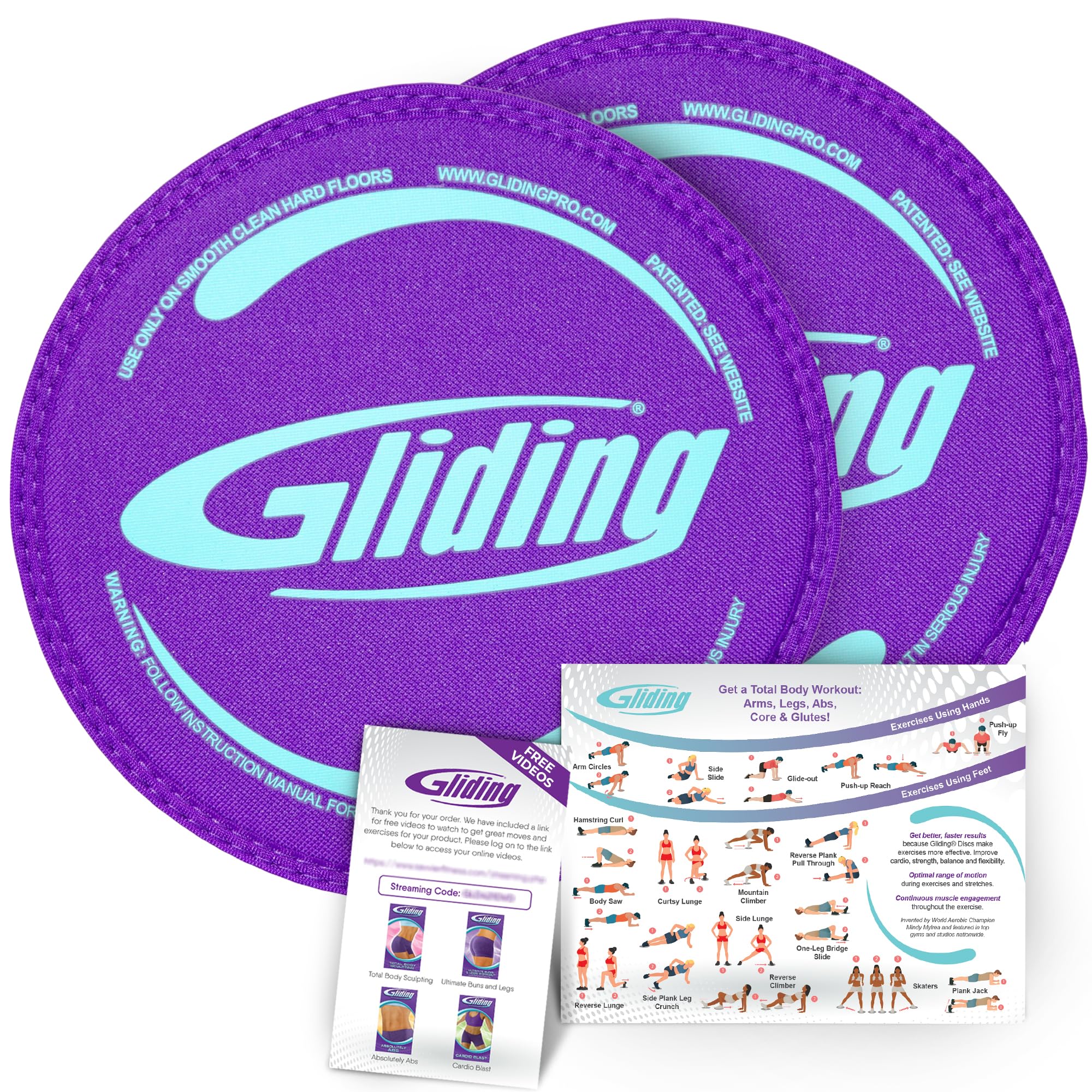
Gliding 9-Inch Sliders

88 /100
Peggy's Score Excellent

Key details

Weight
5 oz
Diameter
9 inches
Included
Streaming video workouts
Material
Nylon
Check Details on Amazon

These are the closest thing in this group to the discs a Pilates studio keeps in a stack by the reformer: 9 inches of nylon, flat, with no padding and no give. That's a compliment if your workouts are barre, mat Pilates and long stretches. It's a caution if you were hoping for something that would also work on a rug.

The nylon face is meant for hardwood, tile and laminate, and it's the only surface it's meant for, because there is no second face to flip. On sealed wood they travel with very little effort, which is what lets you hold a slow hamstring slide instead of muscling through it, and the 9-inch diameter gives a knee or a whole foot somewhere to sit without hanging over the edge.

Four streaming workouts come with the pair, covering total body, legs and abs, and it's a genuine extra rather than filler. Test the access code on the day the box arrives. A dead link is a minor annoyance that's much easier to sort out in the first week than three months later when you've forgotten which drawer the card is in.

Where they don't fit is a carpeted room or a mixed-surface gym, and that is essentially the whole decision. If your floor is hard and your routine leans toward slow, controlled movement, these are the pair we reach for. If you train on carpet, or you want one pair that covers everything, a dual-sided disc is the better buy.

Pros

  • 9-inch face gives knees and feet room
  • Glides easily on sealed hard floors
  • Four streaming workouts included
  • Durable nylon construction

Cons

  • Hardwood and tile only
  • Video access code can fail
Our verdict

For a hard-floor home studio: 9-inch nylon discs that slide with almost no effort and suit Pilates, barre and stretching especially well.

Check Latest Price

How We Tested the Best Exercise Sliders

We built the shortlist by pulling the sets with real review histories rather than just the best-sellers, then narrowed by material (plastic, fabric, and dual-sided), diameter, and the complaints that kept repeating about scuffed floors and discs that split at the seam. From there we bought 16 sets ourselves, from brands we already trusted and a few we didn't, and gave each one four months of regular use.

Every set got the same run: barefoot mountain climbers and reverse lunges on plush living room carpet, pikes and plank jacks on hardwood, hamstring curls on kitchen tile, and a session on a rubber gym mat. We noted whether each disc broke loose smoothly or stuck and jumped mid-rep, then repeated the same movements in sneakers to see whether the extra resistance changed the way the disc tracked. We also timed how long it took to get set up, swap discs between hands and feet, and wipe them down afterward.

Flooring compatibility was the axis that separated the field most. We checked hardwood and laminate for scuff marks after every session and watched for fabric pills and frayed edges as the weeks went on. A couple of sets that glided beautifully on carpet were nearly unusable on tile; others held their shape fine but slid so freely on hardwood that the moves got sloppy. After four months, we looked at which discs had flattened, cracked, or lost their grip, and set that against what each set cost.

How to Choose Exercise Sliders

Start With Your Floor, Not the Disc

Almost every slider is sold as dual-sided, but the two faces are not interchangeable. The hard plastic face is the one that travels on carpet; the foam or fabric face is the one for hardwood, tile and laminate. Getting that the wrong way around is the reason a lot of people decide sliders don't work on the first day and never come back to them.

The trap is the two surfaces that defeat both faces. Deep, plush carpet swallows a flat disc and stops it short of where you pushed, and rubberized gym flooring gives the slick face nothing to grip at all. If either is your only training space, a flat disc will frustrate you. Look at a domed carpet-specific pair for pile, and skip the discs entirely on rubber.

Seven Inches Is the Default for a Reason

The standard disc is 7 inches across: big enough to take a flat hand in a plank, small enough to steer with a forefoot in a fast knee tuck. Going up to 9 inches buys you room under a knee, an elbow or a whole foot, and it costs you some precision when you change direction quickly. A 9-inch disc is a studio tool; a 7-inch disc is a general one.

The other half of the decision is what sits on top. A plain plastic shell is fine in socks or shoes and miserable barefoot, because there is nothing to push against. Padding, texture or a cupped rim all add grip, and any of them makes long sets considerably less fiddly.

Match the Disc to What You Wear

Footwear changes the answer more than most shoppers expect. Socks on a smooth plastic face is the combination where a foot creeps off mid-lunge, and no amount of technique fixes it entirely. A shoe, a bootie, or a rim that curves up around the edge solves it outright, and if you have no intention of taking your sneakers off, buy for the shoe and take the wider face.

Take the stated weight rating seriously too, because it is the one figure that says how much load the shell is built for. The pairs here that publish one run from 300 to 400 pounds. If you are near the top of that range, or two very different people will share the pair, the higher rating should settle the choice before anything else does.

What Ships With the Pair, and What Wears Out

The disc itself is a piece of moulded plastic, so the differences live in the extras and the bonded layers. A printed guide or a set of streaming workouts is worth real money to someone who has never used a slider, and one pair here includes booties that remove the grip problem altogether. None of that matters if you already know the movements.

Expect the foam or fabric face to be the part that ages. It lifts at the rim first, then peels, and once the cloth separates you are sliding on bare shell. Wipe grit off both faces before each session; a clean face travels predictably and lasts measurably longer than one carrying dust and carpet fibres.

Frequently Asked Questions

Final Verdict

The Synergee Core Sliders are the pair we hand most people. Two 7-inch discs, one face for carpet and one for hardwood, a printed guide, a lifetime warranty, and a price at the bottom of this group rather than the top. They won't flatter you on a rubber gym floor, and a sock foot can creep off the slick face during a fast rep, but as a first pair or a second pair they are the sensible default.

Change the requirement and the answer changes. If losing your footing on a flat disc is what derails a set, the BODi slides with their cupped rim and included booties are worth stepping up for. If you are near or above 300 pounds, the Gaiam pair's 400-pound rating should decide it. And if your training room is carpeted and stays that way, the padded Tumbl Trak domes do something no flat disc here can.