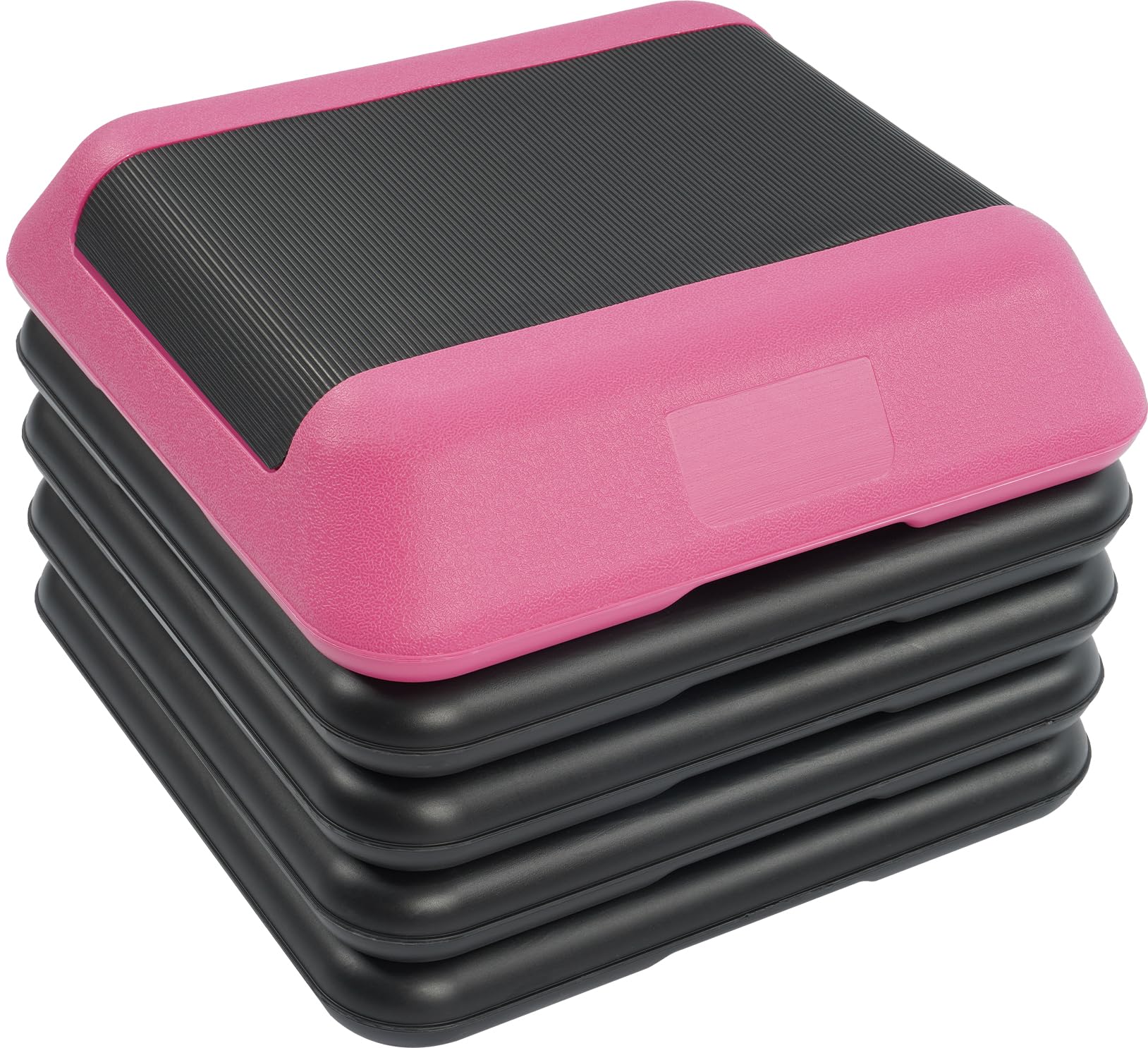
Best Aerobic Step Platforms of 2026

It’s strange how quickly a simple step platform can turn a living-room workout into a trust exercise. The wrong one shifts under a side step, flexes when you push off, or comes with risers that feel more like a suggestion than a secure height setting. A good platform does the opposite: it stays planted on carpet, hardwood, or a garage floor, gives you enough room to land a full step without watching your feet, and lets you change height without rebuilding the thing from scratch.

I’ve used step platforms for years, and our team recently spent six months with 13 of them, from compact home models to wider studio-style decks. The differences that matter aren’t flashy: how solid the deck feels underfoot, whether the surface grips when shoes get sweaty, how cleanly the risers lock in, and whether the footprint suits your space and workout. Durability matters too—a platform that creaks by week three is not a bargain. Below are the ones that held up, plus what to know before you choose.

1

Best Overall

Reebok Step Original

95 /100
Peggy's Score Outstanding

Key details

Warranty
2-year manufacturer
Height Settings
5.9, 7.9, 9.8 in
Riser Attachment
Click-and-lock
Stepping Surface
47.8 x 13.3 in
Check Details on Amazon

At 47.8 inches, the Reebok Step is the longest deck in this group, and length is what decides whether you can take a real class on a platform or just march in place. There is room to travel across the top and step off the ends, and your whole foot lands without a glance down. That is the thing every good step platform gives you and most compact ones do not.

Its three heights, 5.9, 7.9, and 9.8 inches, lock with a click rather than a press, and we rate that as the best riser system here: the click tells you the risers are seated instead of leaving you to test with a wiggle. The multi-textured top earns its keep during fast knee repeats, when your foot needs a landmark rather than a guess, and the rubber feet hold a wood floor without a mat underneath.

The limit is at the bottom of the range. Six inches is the lowest setting, so there is no true beginner height, and if you are starting from scratch or coming back from a knee injury the ZENY or the Freestyle Step will be kinder. A 48-inch deck also commits you to floor space; this one lives against a wall or under a bed, not in a drawer.

What the extra money buys is a deck that does not flex at the edges, risers that do not rattle, and a two-year warranty that matches the best here. After a few sessions you stop thinking about the step at all, which is the highest compliment we can pay a piece of home equipment.

Pros

  • Longest deck here, with room for travel moves
  • Click-and-lock risers hold at all three heights
  • Textured top with target zones for foot placement
  • Two-year warranty, matching the best in this group

Cons

  • Long deck needs wall or floor space to store
Our verdict

For anyone following real step routines, this is the one: a 47.8-inch deck, three locked heights, and a build that does not flex underfoot.

Check Latest Price
2

Best Full-Size Value

ZENY 43-Inch Stepper

92 /100
Peggy's Score Outstanding

Key details

Height Settings
4, 6, 8 in
Included Risers
4
Weight Capacity
550 lb
Stepping Surface
43 x 16 in
Check Details on Amazon

Sixteen inches of width is what the ZENY brings, nearly three more than our top pick, and it is the difference between a side step you take confidently and one you take carefully. You stop checking where your feet are and start watching the screen instead.

The rest of the package makes it the value pick among full-size decks: 43 inches long, heights at 4, 6, and 8 inches, and a stated 550-pound capacity that is the highest here. That four-inch setting matters, because it is where most beginners should start and our top pick does not offer it at all. At 43 by 16 inches the deck also doubles as a bench for hip thrusts and seated presses, which is more than most steps here can say.

The risers stack rather than lock, so lifting the step means lifting deck and risers together or re-seating them. That is a habit rather than a fault, but it is worth knowing if you move the step mid-workout. At just over 18 pounds it is also a deck you find a home for rather than carry room to room.

Set against the Reebok, you give up click-lock risers and nearly five inches of length to gain deck width, a beginner height, and change left over. For a home routine that leans on lateral moves, that is the better trade.

Pros

  • Widest long deck here at 16 inches
  • Three heights including a true 4-inch setting
  • 550-pound stated capacity, highest in this group
  • Full-size surface for less than our top pick

Cons

  • Bonded top mat can lift along the edges
Our verdict

A full-size deck for less: 43 inches long, 16 wide, with a true four-inch setting and the highest stated capacity in this group.

Check Latest Price
3

Best Budget

Freestyle Step F1070

93 /100
Peggy's Score Outstanding

Key details

Riser Storage
Nests under platform
Height Settings
4, 6 in
Weight Capacity
400 lb
Stepping Surface
26 x 11 in
Check Details on Amazon

Compact steps are the ones that skate across a smooth floor, and the Freestyle Step F1070 has the best stability record of the compact decks here. That is why it is the one we point to for a spare room, a small apartment, or a twenty-minute session that has to be over before the kettle boils. At 26 by 11 inches with 4- and 6-inch settings, it is a stepping platform rather than a class deck, and it makes no apology for that.

The detail we appreciate most is the risers: they nest into the bottom of the platform and lock to it, so the step carries in one piece and stores flat behind a door or under a bed. The stated capacity is 400 pounds, generous for the size, and at about six and a half pounds it is light enough to move with one hand or to take to a friend's house.

Where it gives ground is durability. The deck and risers are plastic on plastic, and the riser fit is where a step like this shows its age. Set it down rather than drag it and it holds up better; drag a loaded step across a floor and you are asking to re-seat the risers.

Two people in a small apartment could each have one of these for the price of a single full-size deck, and that is really the case for it: it goes wherever the workout is happening, then gets out of the way.

Pros

  • Best stability record of the compact decks here
  • Risers nest and lock for flat storage
  • 400-pound stated capacity at a budget price
  • About six and a half pounds, easy to carry

Cons

  • No 8-inch setting for harder intervals
  • 11-inch deck is tight for sideways moves
Our verdict

The compact step we point to first: the best stability record of the small decks here, at about six and a half pounds and a budget price.

Check Latest Price
4

Low-Impact Sessions

Amazon Basics Aerobic Step

90 /100
Peggy's Score Outstanding

Key details

Material
Recycled polypropylene
Height Settings
4, 6 in
Weight Capacity
400 lb
Stepping Surface
26.8 x 11 in
Check Details on Amazon

The risers on the Amazon Basics step clip into the underside of the platform, so the whole thing stores as one flat slab. That is the detail that makes it the easiest compact step here to put away, and in a small apartment it is the detail that decides whether the step gets used.

The numbers are modest: 26.8 by 11 inches, heights at 4 and 6 inches, and a stated 400-pound capacity that is high for the size. The top is textured, the feet are non-skid, and the body is molded from recycled polypropylene, which is a reasonable tiebreaker if you are weighing two nearly identical compact steps.

We judge it on what it is for: ten minutes of step-ups, balance work in a hallway, a stable platform for PT exercises by the couch. It can creep on a smooth floor, so try it on the surface you will actually use before you build a routine around it, and give it a rug if the floor is polished.

It is not the step you build a fitness year around, and it does not pretend to be. It is the one that stays out of the way until you need it, which is a real job in a house where floor space is the scarce thing.

Pros

  • Risers clip under the deck for flat storage
  • 400-pound capacity on a 26.8-inch deck
  • Body molded from recycled polypropylene

Cons

  • Only two heights, topping out at 6 inches
Our verdict

A small-space step that stores flat, with a 400-pound capacity that is high for a 27-inch deck.

Check Latest Price
5

Step-Ups and Strength

Fitvids 16-Inch High Step

93 /100
Peggy's Score Outstanding

Key details

Height Settings
4 to 12 in
Platform Weight
12 lb
Weight Capacity
400 lb
Stepping Surface
16 x 16 in
Check Details on Amazon

A 16-inch square deck is the wrong tool for step aerobics: there is no room to travel and side steps get cramped fast. It is the right tool for step-ups, hip thrusts, split squats, and elevated push-ups, and the Fitvids high step covers that job from 4 inches all the way to 12 in two-inch increments.

We rate it the best of the high steps here on the things that matter at height: a stated 400-pound capacity, a non-slip top, risers that store under the platform, and a 12-pound body that moves without a second trip. Five levels also means you can add two inches as a rehab knee gets stronger or a set of step-ups gets easy, and the small increments are more useful than a big jump would be.

The square footprint is the point. At 10 or 12 inches, a compact base is steadier to stand on than a long deck that invites you to step off the side, and the platform gives you somewhere to put both feet for a hip thrust without hunting for the edge.

If your training is step-ups, thrusts, and split squats, this is the shape you want, and it costs less than the full-size decks here. For a mixed week of cardio and strength on one platform, the ZENY does more of both.

Pros

  • Five heights from 4 to 12 inches
  • 400-pound capacity, the higher of the high steps
  • Risers store under the platform
  • 12-pound body is easy to reposition

Cons

  • Risers press in rather than click
Our verdict

Our pick for step-ups, hip thrusts, and rehab work: five heights to 12 inches and a 400-pound capacity in a 12-pound frame.

Check Latest Price
6

High Step Training

Yes4All 16-Inch High Step

94 /100
Peggy's Score Outstanding

Key details

Height Settings
4 to 12 in
Included Risers
4
Weight Capacity
300 lb
Stepping Surface
16 x 16 in
Check Details on Amazon

Five settings from 4 inches to 12 make the Yes4All the most adjustable step here alongside the Fitvids; where the two part company is what you are standing on at the top of that range.

The Yes4All rates lower on capacity than the Fitvids, and its bonded top mat is the piece to watch: a lift at the corner is what turns a high step into a wobbly one. Check all four edges before your first session, and check again before you load it with a barbell.

What it has going for it is a one-year warranty with a 30-day return window, four risers that store under the deck, and a platform that feels solid when you are standing on it at height. It is a sensible second choice when the Fitvids is out of stock or priced higher than you want to go on the day.

For hip thrusts, step-downs after a knee injury, and box-style step-ups, the 16-inch square is the right footprint at any of these heights. It just is not a step-class deck, and nothing about the design pretends otherwise.

Pros

  • Five heights from 4 to 12 inches
  • Four risers store under the deck
  • One-year warranty and 30-day return

Cons

  • Bonded top mat can lift at the corners
  • Lower capacity rating than the Fitvids
Our verdict

A second high step worth knowing about: five heights to 12 inches, four risers that store underneath, and a one-year warranty.

Check Latest Price
7

Starter Kit

WF Athletic Step Set

92 /100
Peggy's Score Outstanding

Key details

Included
Pair of 2-lb dumbbells, tape measure
Height Settings
4, 6 in
Weight Capacity
550 lb
Stepping Surface
26.8 x 11 in
Check Details on Amazon

A step, two dumbbells, and a tape measure in one box: the WF Athletic set is aimed at people who want to start stepping without assembling a kit, and at the lowest price of anything here.

The platform is the familiar compact shape, 26.8 by 11 inches with a diamond-groove top and non-skid feet, two risers for 4 and 6 inches, and a stated capacity of 550 pounds that is level with the ZENY at the top of this group. The dumbbells are two pounds each, which is warm-up weight rather than training weight, and the tape measure is a tape measure.

Sliding is the weak spot: on a smooth floor this one can creep more than the Freestyle Step, so start it on a rug or a mat. The riser plastic is the other part to inspect, because a crack where the risers meet the deck is what takes a cheap step out of service. Check them before you jump on it.

As a starter set for a teenager, a dorm room, or a guest room that hosts an occasional workout, the bundle makes sense and the capacity rating is reassuring. As the deck you will still be using in five years, it is not; the Freestyle Step is the better small step if you can spend a little more.

Pros

  • Includes two 2-lb dumbbells and a tape measure
  • 550-pound stated capacity, level with the ZENY
  • Diamond-groove top and non-skid feet
  • Lowest price of anything in this group

Cons

  • Only 4- and 6-inch heights
Our verdict

A cheap, complete starter set, with the step, two light dumbbells, and a tape measure in one box, plus a 550-pound stated capacity.

Check Latest Price

How We Tested the Best Aerobic Step Platforms

We started by pulling together the step platforms that kept showing up in fitness forums, studio equipment lists, and retailer reviews, then narrowed the field by deck size, height range, replacement-riser availability, and price. That left 13 models, which we used for six months in living rooms, a basement gym, and a garage with a concrete floor. Each platform stayed in rotation for at least a few weeks, including daily step workouts and shared sessions with people of different heights and experience levels.

We did lateral step-overs, basic step-ups, straddles, and quick direction changes while watching for flex in the deck, movement at the corners, and any rocking at each height setting. To check slip resistance, we used the same platforms on carpet, hardwood, and concrete, first with dry sneakers and later after a sweaty workout; we noted whether the deck or feet shifted and whether the surface felt slick underhand. We also looked at build quality up close—molded edges, riser fit, and whether the platform felt like one solid piece or a stack of loose parts.

Height changes got timed and repeated: clipping risers on and off, checking that they seated evenly, and stepping on and off at the lowest and highest settings to see if the platform stayed level. Size was judged by footprint and usable deck area—could a taller user land a full step without catching a heel, and could the platform slide under a sofa or stand against a wall between sessions? For durability, we kept using the busiest picks through the full six months and checked for cracks, creaking, worn tread, and risers that loosened over time.

How to Choose Aerobic Step Platforms

Length for Travel, Width for Confidence

The deck length sets how much choreography you can do. A 43- to 48-inch platform, like the ZENY and the Reebok, lets you travel across the top and step off the ends; a 26-inch deck is for stepping in place, physical therapy, and small rooms. Width matters just as much once you move sideways, and 16 inches feels very different from 11 in socks. Measure the floor you will use, then be honest about whether you are following a class or just moving for ten minutes.

Check the Lowest Height, Not the Highest

Four inches is where most beginners should start, six is the standard class height, and eight is a hard set. Shoppers fixate on a 12-inch maximum and then never use it. What matters is whether the height you will actually step at is available and locks solidly. Two risers usually give 4 and 6 inches, four risers give 4, 6, and 8, and high steps stack to 10 or 12. If a 4-inch starting point is not offered, that is worth knowing before you order.

How the Risers Attach

Click-and-lock risers, like the Reebok's, hold the riser to the deck with a positive click, so you can feel that a height is seated rather than testing it with a wiggle. Press-fit risers simply stack, which is fine while the step stays put and less fine when you drag it across the room, because the deck lifts off and leaves them behind. If your step lives in a closet and comes out for every session, favor a lock or a design where the risers nest under the platform.

Grip, Floors, and What Goes Underneath

Two surfaces matter: the top you stand on and the feet on the floor. A molded, textured top wears better than a mat bonded to the deck, which is the part that lifts at the corners on some platforms. Check all four edges when the box arrives, while the return window is open. On hardwood and laminate, non-skid feet do most of the work, and a thin mat underneath helps without fixing an uneven setup. Carpet grips better but lets a light deck rock.

Capacity, Weight, and Storage

Where a capacity is listed here, it runs from 300 to 550 pounds. Buy for your body weight plus whatever you are holding, not for the biggest number on the page. Weight cuts both ways: the ZENY, at just over 18 pounds, stays put but takes two hands to move, while a six-pound deck slides under a bed and shifts more easily underfoot. Decide where the step lives before you buy, because a 48-inch deck needs wall space and a 26-inch one fits in a closet.

Frequently Asked Questions

Final Verdict

For most homes we recommend the Reebok Step. The 48-inch deck and the click-locked risers are what make a real class feel possible in a living room, and it is the best-supported build here.

Change one requirement and the answer changes. If you need a four-inch starting height or the widest deck for lateral work, the ZENY is the better buy. If the step has to live in a closet and come out for twenty minutes at a time, the Freestyle Step is the one that disappears.