Best Adjustable Kettlebells of 2026

I traded a shelf of cast-iron kettlebells for one adjustable bell and never looked back. What you're really buying here is space and money at once: a single handle that covers swings, cleans, presses, and carries instead of six singles you'll outgrow. The catch is that the mechanism sits exactly where your hand and forearm go. Cheap ones rattle at the top of a swing, fib about the weight, and dig into your wrist on cleans.

We've spent the past six months putting 12 adjustable bells through real training blocks, and the gap between them is wider than the price tags suggest. The ones worth owning feel like a single piece of iron, change weight in seconds without a fight, and hold that setting swing after swing. Worth knowing before you shop: handle diameter and how the adjustment collar sits matter more than the maximum weight on the box — a bell that's fine for two-handed swings can be miserable overhead. Everything below is sorted around that.

1

Best Overall

BowFlex SelectTech 840

96 /100
Peggy's Score Outstanding

Key details

Material
Composite
Adjustment
Turn-dial selector
Handle Diameter
28 mm
Weight Settings
8, 12, 20, 25, 35, 40 lb
Check Details on Amazon

Six weights — 8, 12, 20, 25, 35, and 40 pounds — live inside one shell the size of a large kettlebell, and a dial at the top moves between them. That is the whole case for the SelectTech 840, and it holds up: we could change weight between sets without breaking rhythm, which is the thing you pay a selector mechanism for. For a home gym squeezed into a spare room, it replaces a rack of bells with one object that lives on a shelf.

The shape is where it gives ground. The body is taller and rounder than a cast-iron bell of the same weight, and the plastic handle measures 28 millimeters — comfortable in one hand, tight for a big two-handed swing. Drills that pass the bell under a leg or catch it in a clean ask more of you, because there is simply more bell to clear. If your training is mostly swings, goblet squats, and presses, that will not bother you much.

The settings are not evenly spaced. The largest gap is 10 pounds between the 25 and the 35, so check where your working weight falls before you commit — you may end up choosing between lighter and heavier than you wanted. The two-year warranty covers the part that matters, the dial and the retainers inside it.

Pros

  • Six weights from 8 to 40 lb in one bell
  • Dial changes weight without breaking rhythm
  • Small footprint for a home setup

Cons

  • Composite shell should be set down, not dropped
  • Taller body is awkward on pass-through drills
Our verdict

Six weights from 8 to 40 pounds under a single dial, in a footprint that fits a shelf — this is the adjustable kettlebell we recommend to most home lifters.

Check Latest Price
2

Best Value

Yes4All Adjustable Kettlebell Set

90 /100
Peggy's Score Outstanding

Key details

Material
Cast iron
Handle Diameter
1.2 in
Weight Settings
7 settings, 7.8 to 40 lb
Check Details on Amazon

Cast iron instead of a composite shell, seven settings instead of six, and a good deal less money than the dial-driven bells — the Yes4All makes its case quickly. The plates stack inside the bell with visible markings, and a locking mechanism holds them through swings; nothing about the finished weight feels improvised. If you came to kettlebells for the feel of iron in the rack position, this is the closest thing to a fixed bell in this group after the REP.

The honest caveat is the numbers. The settings read 7.8, 12.4, 17.9, 23.9, 29.9, 35.4, and 40 pounds, and the plates behind them do not divide into tidy five-pound steps, so the side of the bell and a bathroom scale will not always agree. We do not think that undoes the pick — you still get a usable spread from a warm-up weight to a heavy one — but if you log every lift to the pound, it will grate.

The part we liked most is the grip. The handle is 1.2 inches in diameter and wide enough for two hands, which is where cheaper adjustable bells usually cut corners, and the flat base stands upright for storage and floor work. The one-year warranty is shorter than the BowFlex's two, and that is part of how the price stays down — worth knowing rather than a reason to walk away.

Pros

  • Cast iron at well under the dial-bell price
  • Wide 1.2-inch handle suits two hands
  • Seven settings from 7.8 to 40 lb

Cons

  • Marked settings do not match true plate weight
  • Powder coat can chip on arrival or in use
Our verdict

We point cast-iron loyalists here: seven settings from 7.8 to 40 pounds, a wide two-handed handle, and a price well below the dial-driven bells.

Check Latest Price
3

Best Feel

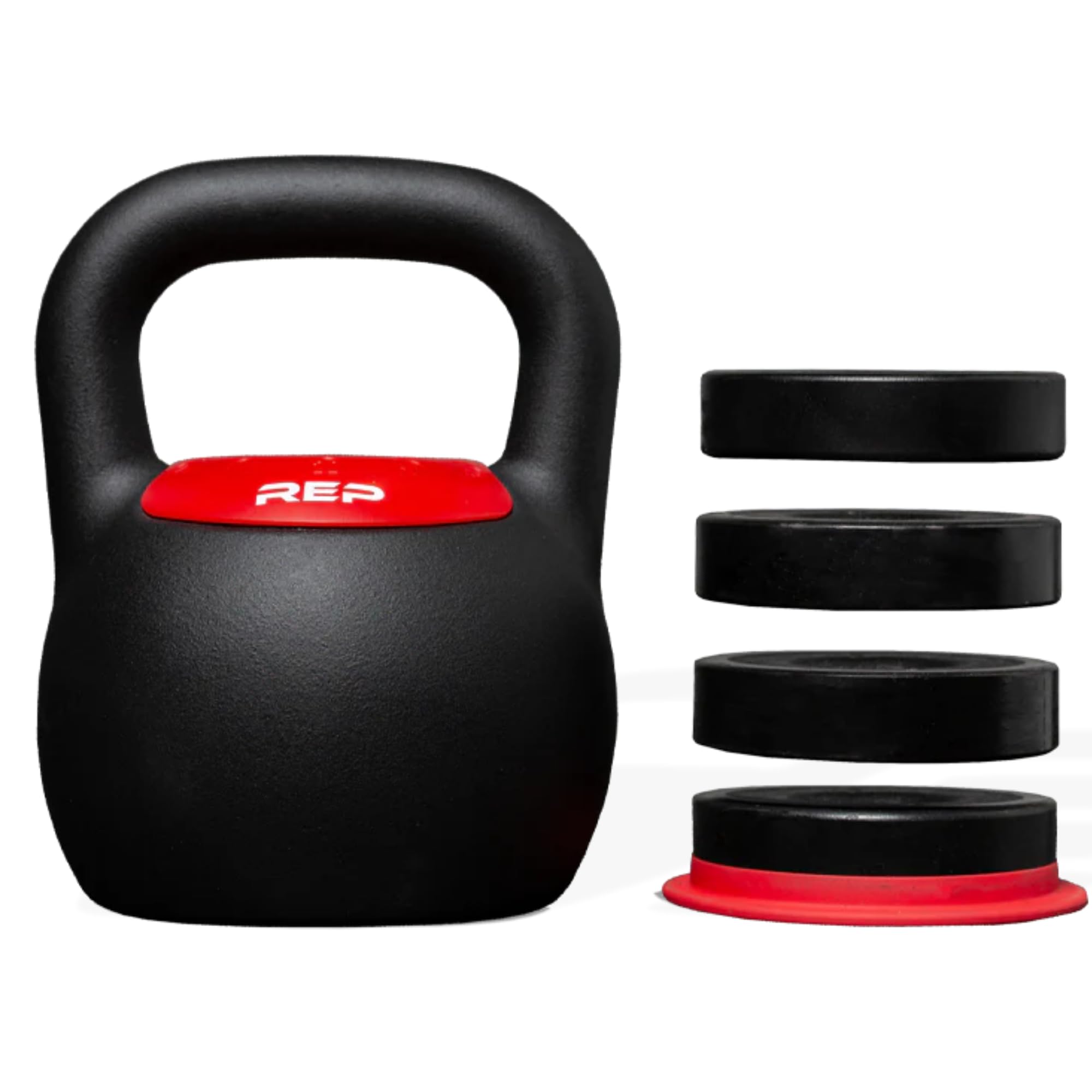
REP Fitness Adjustable Kettlebell

88 /100
Peggy's Score Excellent

Key details

Material
Iron
Adjustment
Push-and-twist selector
Model Weight
40 lb
Handle Diameter
1.3 in
Check Details on Amazon

The detail that separates the REP from every other selector bell here is the finish: a matte powdercoat that keeps its grip when your hands get damp, where glossy shells turn slick. Pair that with the 1.3-inch handle — the thickest in this group — and the 40-pound model racks, swings, and presses like a fixed bell in a way the composite options do not quite match. That is why we reach for it first when a session is built around swings.

Selection is a push-down-and-twist dial on top, with the weights held by internal nylon retainers. It moves fast enough to change mid-circuit and seats firmly when you commit to the twist. Our one reservation is inside the shell: shake the bell deliberately and the weights can feel slightly loose in their seats. Seat the selector fully and check it before anything goes overhead.

Two things to plan around. The listing sells this in 16 kg, 24 kg, and 40 lb models and never spells out the step size between settings, so match the increments to your program before you order — a 10-pound jump is fine for swings and miserable for presses. And it is the priciest bell in this group, which you are paying for in iron and finish rather than in range.

Pros

  • Matte powdercoat keeps its grip when hands sweat
  • 1.3-inch handle feels like a fixed bell
  • Quick push-and-twist weight changes

Cons

  • The most expensive bell in this group
Our verdict

If you want an adjustable bell that swings like a fixed one, the 1.3-inch handle and matte powdercoat here are what sell it.

Check Latest Price
4

Best for Beginners

Polyfit Adjustable Kettlebell

94 /100
Peggy's Score Outstanding

Key details

Material
Polyethylene
Handle Diameter
30–38 mm
Weight Settings
5, 8, 12 lb
Check Details on Amazon

This is a beginner's bell and does not pretend otherwise: 5, 8, and 12 pounds in one soft green shell, twisted apart and back together as you progress. It is the right range for someone learning a hinge, a swing, and a press for the first time — small jumps between settings matter more in month one than a 40-pound ceiling does.

We think the polyethylene shell is the right call for that job. It is quiet, it will not chip a floor or crack a shin, and the finish is pleasant enough to leave out rather than hide in a cupboard. The handle is listed at roughly 30 to 38 millimeters and grips comfortably even in a small hand. One habit worth having: the weight segments twist together, and if the collar is not fully seated a segment can re-engage when you are not expecting it, so check the setting before each set.

It also travels well — small enough for a suitcase and light enough to pack without thinking about it — and the included workout guide gives a beginner somewhere to start. When you outgrow it, you will know, and by then you will know exactly which bell to buy next.

Pros

  • Three light settings for genuine beginners
  • Soft polyethylene shell won't mark floors
  • Compact enough to store or travel with

Cons

  • Tops out at 12 pounds, so it can't follow progress
Our verdict

Starting from zero? Three light settings, a soft shell that will not mark floors, and a size that tucks into a closet make this the one to learn on.

Check Latest Price
5

1-Inch Plate Owners

Apex 20lb Kettlebell Handle Set

89 /100
Peggy's Score Excellent

Key details

Material
Cast iron
Plate Capacity
Up to 50 lb
Starting Weight
20 lb
Plate Compatibility
Standard 1-inch plates
Check Details on Amazon

The Apex arrives as a 15-pound cast-iron handle on a 5-pound base, with four spacer disks and a locking pin — 20 pounds of bell and no plates. That is the catch, and it is the whole design: this is a kettlebell for people who already own standard 1-inch weight plates and want to put them to work instead of buying a stack of new bells.

Load it and the arithmetic is easy: pull the base, swap the spacers for 2.5, 5, or 10-pound plates, and the bell climbs toward a claimed 50 pounds. That figure is a ceiling rather than a promise, though. The spacers take up room inside the shell, so how close you get depends on how thick your plates are — weigh the finished bell once before you trust the number in your program.

What we appreciated most is the handle: a wide cast-iron grip that takes two hands and feels like gym equipment rather than a gadget. What we minded is the bottom screw — every change means unscrewing the base, which is fine between sets and genuinely irritating in a circuit. And 20 pounds is the floor, so there is nothing here for a beginner to learn on; this is a bell for someone who already trains.

Pros

  • Loads with standard 1-inch plates you own
  • Wide cast-iron handle for two-handed work
  • Solid cast-iron build for the money

Cons

  • Ships without any weight plates
  • Bottom screw makes weight changes slow
Our verdict

Buy this if you already own 1-inch plates: it turns them into a 20-to-50-pound kettlebell without adding another piece of equipment.

Check Latest Price

How We Tested Adjustable Kettlebells

We started with roughly 30 adjustable kettlebells sold by major fitness retailers and read the spec sheets closely, filtering on weight range, the increments between settings, handle diameter, footprint, and price per usable setting. That narrowed things to 12 models, covering both dial-style and pin-and-plate designs, which we bought at retail and used for six months.

Testing happened where kettlebells actually live: a garage on a rubber mat, a carpeted living room, and a small apartment floor where noise genuinely mattered. Two of us trained three to four mornings a week with swings, cleans, snatches, presses, and loaded carries, some sessions bare-handed and some with sweaty palms.

At every setting we weighed the bell on a digital scale and compared it to the number on the dial; two ran noticeably light, and one drifted further off as the settings climbed. We timed each weight change with a stopwatch mid-session, hands chalky, because a 30-second swap wrecks a superset, and we pressed and swung at the top setting to see whether it stayed solid at capacity. For ergonomics we did cleans and snatches with every bell and noted where the collar or locking pin caught the forearm, and whether the handle was wide enough for two hands or too thick for smaller grips. Quality showed up as rattles at the apex of a swing, weld and seam finish, chips in the coating, and whether the plates still locked down tight in month five. For value, we weighed cost per usable setting against what the equivalent pair of fixed bells would run.

How to Choose Adjustable Kettlebells

Start with the range, not the maximum

An adjustable bell earns its keep where its settings overlap your training. A 5-to-12-pound model is a teaching tool; an 8-to-40-pound dial covers a warm-up, a working set, and most home pressing. Look at the bottom of the range as carefully as the top — a handle that starts at 20 pounds leaves a beginner with nothing light to learn a get-up on.

Read the steps too, not just the ends. Even jumps force you to choose between a bell that is too light and one that is too heavy, and that gap is most obvious on presses, where five pounds is a real difference.

Dial, plate stack, or plate-loaded handle

Three mechanisms turn up here, and each asks something different of you. A turn-dial changes weight in a second and suits circuits. A stacked plate set with a locking pin is slower but behaves more like iron. A plate-loaded handle keeps the price down because you supply the plates yourself.

Whichever you pick, seat the lock fully before every set — that habit is what keeps an adjustable bell safe overhead. And weigh the finished bell once if the number matters to your program; marked settings do not always match a scale.

Shape and handle: the part you feel on every rep

Housing plates inside a shell makes a bell bigger than the fixed version of the same weight, and you notice it in cleans, snatches, and any drill that passes the bell under a leg. If those moves are central to your training, favour the slimmer iron-bodied options; if you mostly swing, squat, and press, the extra bulk costs you almost nothing.

Handle diameter matters just as much. Around 28 millimeters is comfortable in one hand but tight for a big two-handed swing, while 1.2 to 1.3 inches gives you room to work — worth checking before you commit, because it is the one part of the bell you cannot change.

Construction, care, and how much range you need

Cast iron takes a knock; composite shells and plastic retainers do not. No adjustable model here is built to be dropped, so the habit that keeps one working is setting it down at the end of a set rather than letting go of it.

Beyond that, count the settings you will actually use. A five-in-one that lands on your warm-up weight and your working weight is worth more than a wider spread whose extra steps you never touch.

Frequently Asked Questions

Final Verdict

For most people putting together a home gym, the BowFlex SelectTech 840 is the one to buy: six weights from 8 to 40 pounds on a dial you can turn between sets, in a footprint small enough for a closet shelf. What it asks in return is that you set it down rather than drop it, and that you accept a body rounder and taller than iron.

If swings are the whole point of your training and you want the bell to feel like a bell, the REP is worth the extra. If you already own standard 1-inch plates, the Apex turns them into a kettlebell without another piece of equipment taking up room.