Best Kettlebells of 2026

A kettlebell looks like the simplest thing in the gym: a lump of iron with a handle. That simplicity is exactly why a bad one is so annoying. A rough seam or slick finish can turn every swing into a hand-sanding session, and a bell that is off-weight or poorly balanced makes squats and carries feel harder than they should.

Over six months, my team and I worked through 12 kettlebells at home and in the garage, doing swings, cleans, presses, Turkish get-ups, and farmer carries until the differences were obvious. We cared about weight accuracy, handle quality and grip, finish and construction, and whether the price reflected better durability and comfort rather than a prettier coat of paint. The right kettlebell should feel secure in your hands, sit properly on your forearm, and survive being set down on concrete. The picks below are the ones that earned a permanent spot on the floor.

1

Best Overall

Amazon Basics Cast Iron Kettlebell (25 lb)

96 /100
Peggy's Score Outstanding

Key details

Weight
25 lb
Dimensions
7.9"L x 4.6"W x 9"H
Construction
Solid cast iron
Handle Diameter
1.5 inches
Check Details on Amazon

If you're buying your first kettlebell and don't want to think about it too hard, this is the one. A 25-pound single-piece cast-iron bell with a wide handle, a flat base and a price that leaves room for a second weight later is the simplest good decision in this category. Twenty-five pounds is the size most people can hinge, swing and goblet-squat on day one without their form falling apart, and it stays useful once you're stronger.

The handle measures 1.5 inches across, the widest of the cast-iron bells here and easily the most forgiving if you like both thumbs on the horn. It's textured rather than glossy, so it doesn't feel like holding a doorknob, but it's still a painted surface, and once your palms are wet it lets the bell rotate a little in your grip. Chalk is the fix, and chalk costs less than a new bell.

The casting is clean: no seam across the handle, no rough flashing to file down, and an even black finish all the way around. The thing to watch is what happens when iron meets concrete. Chip the powder coat and you've exposed bare metal that will rust, so this is an indoor bell, and the handle is worth a glance before each session.

It's a single fixed weight, which means it isn't the last kettlebell you'll buy. Most people end up wanting something heavier for swings and something lighter for pressing, and that's fine — buy this as the anchor of a small collection rather than the whole collection, and the arithmetic works out in its favor. The flat base and 7.9-by-4.6-inch footprint mean it tucks onto a shelf between sessions instead of living on the floor.

Pros

  • Solid one-piece cast iron with a clean casting
  • Wide 1.5-inch handle leaves room for two hands
  • Flat base stands the bell upright

Cons

  • Powder coat chips on concrete or against other bells
Our verdict

If you're buying your first kettlebell, this is the one we point you to: solid cast iron, a handle that fits two hands, and a weight most people can swing with good form.

Check Latest Price
2

Best Adjustable

BowFlex SelectTech 840

96 /100
Peggy's Score Outstanding

Key details

Handle
28 millimeters, plastic
Footprint
8.82"L x 7.01"W
Weight Range
8 to 40 pounds
Weight Settings
8, 12, 20, 25, 35 and 40 pounds
Check Details on Amazon

Six kettlebells' worth of weight sits in a footprint of roughly nine by seven inches, which is the entire argument for this thing. The dial moves between 8, 12, 20, 25, 35 and 40 pounds, so a warm-up, a working set and a finisher can all use different loads with nothing behind you but a closet door.

We think that trade is worth making when square footage is what you're short of. The dial clicks through its settings in a couple of seconds, the handle is comfortable for swings and rows, and the whole unit disappears into a corner between sessions. What you give up is the feel of iron: the body is composite, the handle is plastic, and the jumps aren't even — going from 25 to 35 pounds is a big step when you're working near your limit.

The mechanism is what you're paying for, and it's covered for two years. Change weight with the bell on the floor rather than in mid-air, keep it out of a damp garage, and the dial should stay smooth. This is the only pick here with moving parts, which makes it the only one that asks for a little care.

Pros

  • Replaces six weights from 8 to 40 pounds
  • Dial changes load in seconds between sets
  • Footprint of a single bell

Cons

  • Tall, boxy body is awkward for cleans and under-leg passes
Our verdict

When the gym lives in a closet, this is the pick: eight to forty pounds, one footprint, and a dial that changes the load between sets.

Check Latest Price
3

Best for High-Rep Work

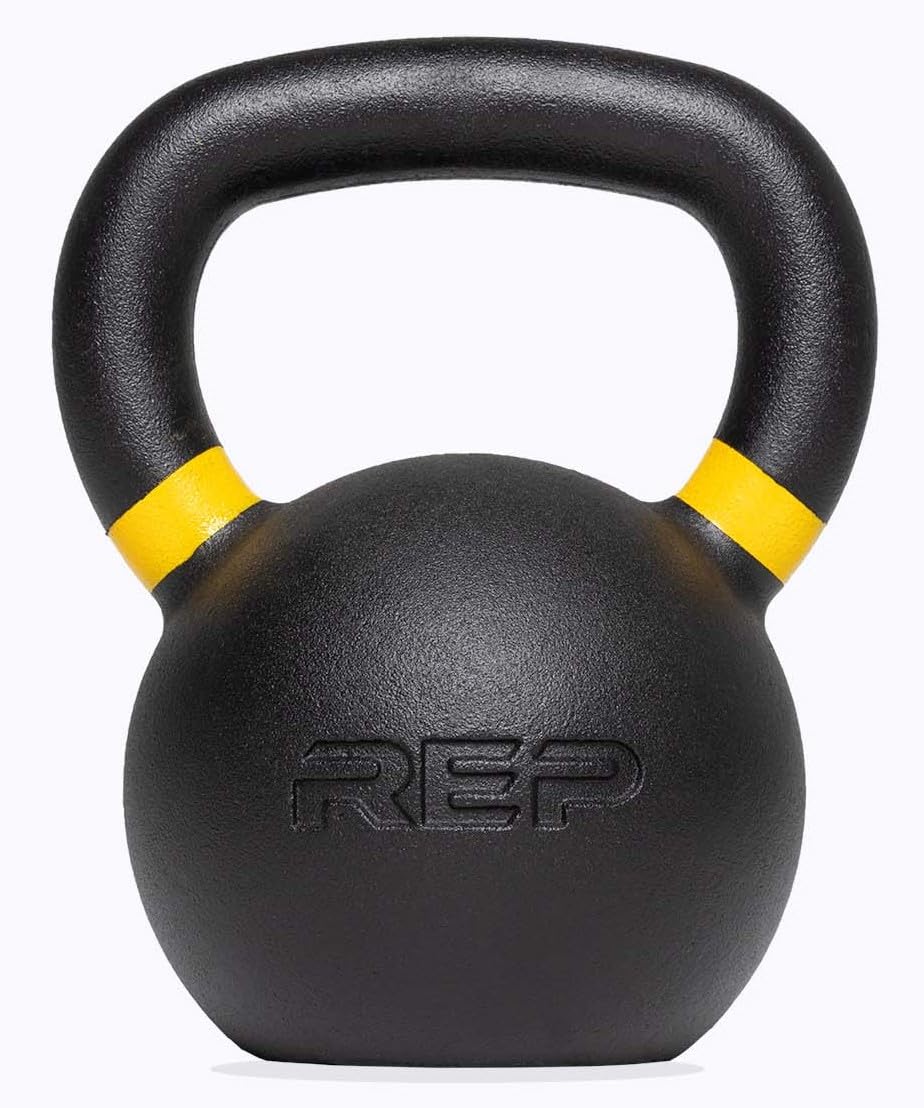
REP Fitness Kettlebell (16 kg)

94 /100
Peggy's Score Outstanding

Key details

Finish
Textured matte powder coat
Weight
35 pounds (16 kg)
Size Range
9 to 53 pounds
Handle Diameter
1.25 inches
Check Details on Amazon

The handle is the first thing we noticed, and it's the reason this bell stays in rotation. REP finishes it with a textured matte powder coat that feels smooth in the hand but has just enough tooth to hold chalk and skin, so a long set of swings doesn't turn into a grip contest. At 1.25 inches it's narrower than the Amazon Basics handle, which suits one-handed work and cleans.

Everything else is tidy. The bell is gravity cast in one piece, the base is flat enough to stand upright and stable enough for renegade rows, and there's a color-coded ring at the base so you can find the 16-kilogram bell on a crowded rack without reading anything. The range runs from 9 to 53 pounds, so building a pair or a ladder is straightforward.

Sixteen kilograms is 35 pounds, which is where swings start feeling like conditioning rather than practice — useful if you've been training a while, too heavy as a first bell. Our reservation is cosmetic: the paint chips where bells knock together, and a painted bell will eventually look like a used one. Buy it for the handle and the casting, and accept the scuffs as the cost of doing business.

Pros

  • Textured matte handle grips without tearing palms
  • Clean gravity casting with a stable flat base
  • Sizes from 9 to 53 pounds for building a rack

Cons

  • Paint chips where bells knock together
  • Costs noticeably more than the plain cast-iron picks
Our verdict

We reach for this when the set runs long: the matte handle keeps its bite through high reps, and 16 kilograms suits anyone past the learning stage.

Check Latest Price
4

Best Soft Kettlebell

Bionic Body Soft Kettlebell (15 lb)

96 /100
Peggy's Score Outstanding

Key details

Shell
Soft vinyl over weighted core
Weight
15 lb
Warranty
2 years
Handle Diameter
1 inch
Check Details on Amazon

The soft shell is the whole product, and it changes where you're willing to train. The wrap gives before your forearm does on a sloppy clean, and a hard set-down on a wood floor lands as a thud rather than a dent. In an apartment or a living room, that difference is worth more than any specification on this page.

Underneath the wrap it's still a real weight: 15 pounds with a 1-inch handle that's comfortable in one hand or two, and a shell that's stitched and finished neatly enough to leave out. It's held up to being set down and knocked around, which is the opposite of what soft usually means. Fifteen pounds is light for anyone past the beginner stage, though — this is a bell for fast circuits and for learning, not for heavy swings.

The cost is the catch: you're paying a premium for vinyl over what is essentially a 15-pound weight. What buys it back is where you'll use it — apartments, garages with concrete floors, small rooms, and anyone coming back from an injury who doesn't want to think about iron. The two-year warranty helps too.

Pros

  • Soft shell protects floors, shins and forearms
  • Comfortable 1-inch handle for one or two hands
  • Two-year warranty on a soft-shell design

Cons

  • Some units weigh heavier than the marked weight
Our verdict

For fast circuits in a living room or over a hard floor, this soft-shell bell is the one we hand people who don't want to worry about dropping it.

Check Latest Price
5

Best Budget Starter

Amazon Basics Vinyl Kettlebell (15 lb)

95 /100
Peggy's Score Outstanding

Key details

Weight
15 lb
Coating
Vinyl over cast iron
Dimensions
6.88"L x 4.3"W x 7.5"H
Handle Diameter
1.13 inches
Check Details on Amazon

Fifteen pounds is a learning weight, and this is the least expensive sensible way to own one. The bell is cast iron wrapped in vinyl, with a flat base, the weight molded into both sides and a 1.13-inch handle that's comfortable in one hand or two. The wrap does three jobs at once: it protects a wood floor, it muffles the clunk when you set the bell down, and it keeps the iron underneath from rusting.

For someone learning a hinge and a swing, that's the right set of priorities in the right order. The wrap is the weak point — vinyl scuffs, cuts and peels in a way powder coat doesn't, so keep it off rough concrete and away from whatever's rattling around in the trunk. It's also light enough that you'll want a heavier bell before long, which is exactly why the price is the point: nothing here gives you a reason to put off the next size up.

Pros

  • Vinyl shell protects floors and quiets the bell
  • Light enough to learn swings and squats
  • Flat base with the weight marked on both sides

Cons

  • Vinyl scuffs and peels more easily than powder coat
Our verdict

Our pick for a true beginner: light, floor-friendly, and priced so that buying a second, heavier bell later doesn't sting.

Check Latest Price
6

Best Set for a Household

Best Choice Products 3-Piece Set

95 /100
Peggy's Score Outstanding

Key details

Storage
Included rack
Construction
HDPE shell over concrete core
Set Dimensions
11"L x 9"W x 11"H
Weights Included
5, 10 and 15 pounds
Check Details on Amazon

Two people, one room, different strength levels — that's the case for a set like this. Five, ten and fifteen pounds cover a beginner learning a hinge, a partner doing high-rep circuits, and the rehab-and-mobility work nobody puts on a program but everybody ends up doing.

Each bell is a high-density polyethylene shell over a concrete core, with a wide handle that takes both hands and a flat base that stands the bell up between sets. The shells are seamless and the grips are broad enough that a two-handed swing feels secure, which is more than you'd expect at this end of the market. If you're used to iron, the first thing you'll notice is how light they feel for their size.

For light, controlled work we think this is honest equipment at a price that makes sense, and the three weights let one person progress while another starts from scratch. The limits are physical rather than cosmetic, though, and they matter once you're swinging rather than rehabbing. Treat it as a starter set for the house and it does the job; once you're training seriously with ballistics, you'll want cast iron.

The rack is what makes it a set rather than three things on the floor, and in a small apartment or a shared garage that's worth something. The weights stay visible, upright and out of the walking path, and the whole footprint is about a foot square. It's the difference between equipment you use and equipment you move out of the way.

Pros

  • Three weights plus a rack in one purchase
  • Wide handles take both hands
  • Low-cost way to equip two people

Cons

  • Bells run oversized for their weight
  • Bases can crack and shed core material
Our verdict

The set we recommend for two people training at different levels, since three weights and a rack cost not much more than a single good bell.

Check Latest Price
7

Mid-Weight Cast Iron

Yes4All Powder Coated Kettlebell (26 lb)

93 /100
Peggy's Score Outstanding

Key details

Weight
26 lb
Size Range
9 to 88 pounds
Handle Diameter
1.3 inches
Stated Weight Tolerance
25.22 to 26.78 pounds
Check Details on Amazon

The listing gives a weight tolerance of 25.22 to 26.78 pounds for the 26-pound bell, which is more honesty than this category usually offers. If you're logging loads or splitting work between two bells, that half-pound either way is worth knowing about, and it suggests somebody is actually weighing these rather than rounding the label.

The handle is 1.3 inches across and powder coated: wide enough for two hands, textured enough to hold chalk, and smooth enough that it doesn't chew your palms through a long set. It stays grippy once your hands get wet, which isn't a given with a painted bell, and the 26-pound weight suits swings, goblet squats and presses for most people who've been training a while.

Sizes run from 9 to 88 pounds, so this is a bell to build a rack around rather than a one-off. The flat non-slip base sits still on a wood floor and doesn't wander during renegade rows, and the blue finish makes it easy to find in a pile of black iron.

As a training tool we have no complaints: it swings, it presses, and it stands up where you leave it. The differences between this and the REP are in the hand rather than in the workout, and the gap in price is real — which is why this one earns a place for anyone who wants capability without polish.

Pros

  • Published weight tolerance tells you what you're getting
  • Wide 1.3-inch handle keeps its grip when wet
  • Sizes from 9 to 88 pounds

Cons

  • Handle finish varies, with rough patches and weld lines
  • Powder coat chips where it meets other weights
Our verdict

A capable mid-weight bell with a published weight tolerance — just plan on checking the handle for rough casting when the box arrives.

Check Latest Price
8

Building a Set

Marcy Hammertone Kettlebell (20 lb)

94 /100
Peggy's Score Outstanding

Key details

Finish
Hammertone enamel
Weight
20 lb
Size Range
10 to 55 pounds
Handle Diameter
1.25 inches
Check Details on Amazon

Ten sizes from 10 to 55 pounds in five-pound steps, backed by a two-year limited warranty — that's the pitch, and it's a good one if you're the sort of person who adds a bell every few months rather than buying a set. Five-pound jumps mean you can keep your press and your swing on separate ladders instead of forcing one bell to do both jobs.

The hammertone enamel gives the bell a slightly dimpled, industrial look and a finish that shrugs off rust better than a plain painted coat. The handle is 1.25 inches with a light texture, the base is flat and stable, and the size is compact enough that a 20-pounder doesn't feel like a cannonball with a handle.

Twenty pounds is a useful second bell: heavy enough for goblet squats and presses, light enough to learn cleans with. Because the range runs to 55 pounds in the same shape and finish, a pair of 20s or a 20-and-25 combination stays consistent in the hand, which matters more than it sounds when you're switching between them mid-circuit.

For anyone building a collection rather than buying a single bell, this is the sensible spine to build it around: a size for every stage, a warranty longer than most here, and a finish that survives a garage. It isn't the bell you buy for its handle. It's the one you buy for the fifth and sixth sizes.

Pros

  • Ten sizes from 10 to 55 pounds in 5 lb steps
  • Hammertone enamel resists rust and wear
  • Two-year limited manufacturer warranty

Cons

  • Rough casting inside the handle needs filing
  • Enamel chips with hard use
Our verdict

The pick if you plan to collect sizes over time: ten weights in five-pound steps, a rust-resistant finish and a two-year warranty behind it.

Check Latest Price

How We Tested Kettlebells at Home and in the Garage

We started with a long list of kettlebells in common weight increments, comparing handle shape, finish, casting style, and price tier before ordering 12 to test over six months. We skipped novelty shapes that did not seem useful for standard swings and presses, and we made sure the group included entry-level cast bells and pricier competition-style options. That gave us a fair read on quality, construction, and value rather than just a lineup of lookalikes.

Each bell lived on a garage rack and came inside for living-room sessions. We used them for two-handed swings, one-arm swings, cleans, presses, squats, Turkish get-ups, and carries, often bare-handed and sometimes with chalk or sweaty palms. We noted whether the handle cleared the wrist on cleans, whether the bell sat comfortably on the forearm, and whether the finish felt sharp, slick, or inconsistently smooth. We also weighed every kettlebell on a kitchen scale, checked seams and casting for rough spots, and set each one down on concrete and rubber mats after sets to watch the finish and construction hold up.

We rotated the bells among testers with different hand sizes to judge grip and handle comfort over repeated sets, not just the first set. At the end, we compared what each one delivered against what it cost: accurate weight, a clean handle, stable balance, and a finish that did not chip or turn slick. The strongest picks were not always the most expensive; they were the ones that still felt secure after a full workout and showed no wear at the contact points.

How to Choose Kettlebells

Start With a Weight You Can Swing

The bell you press is lighter than the bell you swing, and both are usually lighter than people expect. A swing is a hip snap rather than a lift, so an over-heavy bell turns into a back exercise the moment your form goes. Somewhere around 18 to 26 pounds suits most beginners, while people who already strength train tend to land nearer 26 to 35. Buy the one you can hinge with confidently today and treat the next size up as a purchase for later — the cost of starting too heavy is a tweaked back, not a refund.

Handle Width and Texture Decide Comfort

The handle is where you and the bell negotiate, and two numbers tell you most of it. Below roughly 1.1 inches, a two-handed grip gets cramped; the 1.5-inch handle on the Amazon Basics is the widest in this group and the easiest to take with both hands. Texture matters just as much: a glossy coat looks smart and goes slick the moment your palms sweat, while matte and textured finishes keep their bite. If your hands tear during swings, suspect the finish before you blame your grip.

Coating: Floors Versus Durability

Vinyl, neoprene and soft shells exist to protect things that aren't the kettlebell: hardwood, tile, shins. A vinyl bell set down hard on oak leaves a scuff at worst, where bare cast iron leaves a dent. The trade is durability — wraps cut, peel and scuff faster than powder coat, and wrapped or filled bells run large for their weight. Training in a garage or on mats, bare cast iron is the better long-term buy. Training in a living room above a neighbor, pay for the wrap.

One Bell, an Adjustable, or a Set

A single fixed bell is the cheapest way in and the least flexible a year later. An adjustable unit like the BowFlex SelectTech 840 covers eight to forty pounds in one footprint, which is the answer when space is the constraint rather than money. A three-bell set with a rack suits a household where two people train at different levels. Whichever you pick, assume you'll add weight eventually: most people end up owning two or three bells, and the order you buy them in matters less than starting.

Frequently Asked Questions

Final Verdict

Start with the Amazon Basics 25-pounder. It's the least complicated way into the habit, and nothing about the price gives you a reason to wait.

If floor space is what's scarce, the BowFlex SelectTech puts eight to forty pounds in one footprint and earns its premium. And if the bell will live on a wood floor and get set down hard, the Bionic Body soft bell is the one we hand people.