Best Adjustable Dumbbells of 2026

A rack of fixed dumbbells is still the best strength equipment money can buy — right up until you have to find a wall for it. Adjustable sets trade that wall for a dial or a pin, and suddenly a run from five pounds to fifty fits in the footprint of a nightstand. The catch is that a set is only as good as its weakest mechanism: a plate that rattles at the top of a press, a handle that shifts mid-curl, a dial that jams when your hands are sweaty. Get it right and you've got a whole gym's worth of increments without giving up the floor.

My team and I have spent the past six months living with seven sets — on carpet, on concrete, and on the rubber mat I dragged into the living room — and the differences rarely show up in a product photo. One thing first-time buyers don't expect: the number on the box is the total weight of both dumbbells, not the per-hand weight. The seven below earned their place the honest way, one sweaty session at a time.

1

Best Overall

PowerBlock Elite EXP 90

92 /100
Peggy's Score Outstanding

Key details

Warranty
5-year limited
Expansion
Add-on kits to 70 and 90 lbs
Increments
16 settings, 2.5-lb micro weights
Weight Range
5 to 50 lbs per hand
Check Details on Amazon

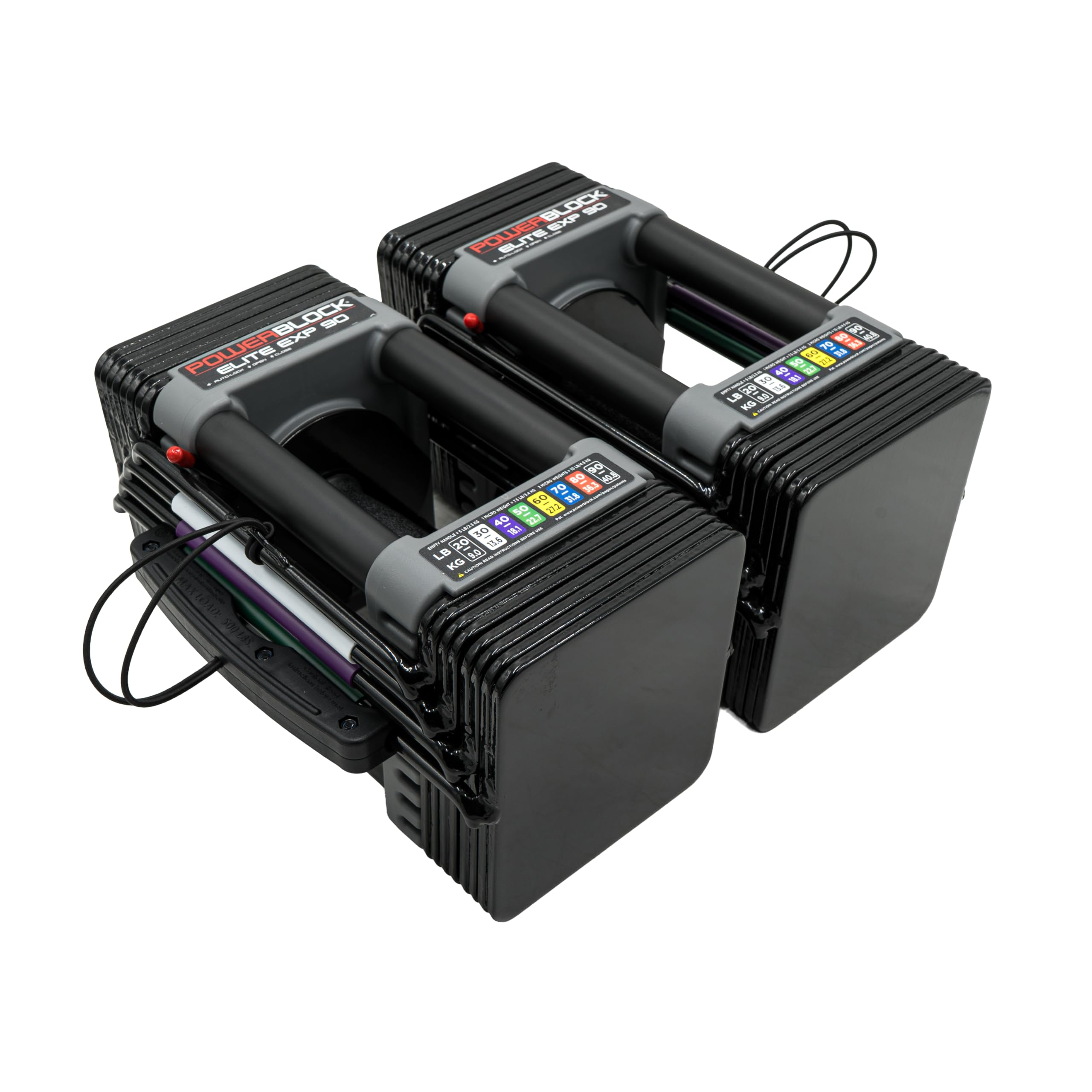
The Elite EXP 90 is the pair we recommend first, and the reason is the growth path rather than any single figure on the box. It arrives as a 5-to-50-lb set, and PowerBlock sells Stage 2 and Stage 3 kits that take each hand to 70 and then 90 pounds. That matters because the most common way an adjustable set stops being useful is that you get stronger than it, and this is the only pair here with a documented way out of that corner.

Sixteen settings per hand, including 2.5-lb micro weights, all chosen with a magnetic pin. The part we appreciate most is that you don't need the cradle: pull the pin, lift, and the plates you didn't select stay where they are. In a superset or a drop set, that's the difference between finishing the round and losing it to a walk back to a base.

The block shape is what you trade for all that. At 12 inches long it's shorter than the spinlock sets here, but it's square in cross-section, so it rests on your thigh differently for a chest press and can feel odd against the outside of your leg during lateral raises. We also noticed the balance shifts when you add the 2.5-lb micro weights instead of stepping up in bigger jumps. A week of use settles most of it.

Add a 5-year limited warranty and a frame that replaces 16 traditional dumbbell pairs, and the case for the extra spend is straightforward. If you're lifting under 25 pounds and staying there, this is more machine than you need. If you plan to still be lifting in three years, it's the pair to buy, and the expansion kits mean you won't be shopping again at 60 pounds.

Pros

  • Sixteen settings from 5 to 50 lbs per hand
  • Expands to 70 and 90 lbs per hand
  • Changes weight without a cradle
  • 5-year limited warranty

Cons

  • Square block shape sits oddly for some lifts
  • Micro-weight changes are fiddly
Our verdict

We recommend the Elite EXP 90 as the default for anyone who wants one pair to last: 16 settings, a 5-to-50-lb range that expands to 90, and no cradle between you and the next set.

Check Latest Price
2

Best Wide Weight Range

NordicTrack Select-a-Weight 55 lb

90 /100
Peggy's Score Outstanding

Key details

Settings
15 per dumbbell
Warranty
2 years
Increments
2.5, 5, and 10 lbs
Weight Range
Up to 55 lbs per hand
Check Details on Amazon

There's a 10-lb handlebar inside each of these dumbbells that slides out and works on its own, and it's the detail that makes the design click. For a warm-up set of lateral raises or a few curls before the working sets, you don't have to load the whole 55-pound assembly or find the tray. It's a small convenience, and it's the kind you use every session rather than the first week.

The rest is a conventional selectorized dumbbell: 15 settings per hand up to 55 pounds, in 2.5, 5, and 10-lb increments, sitting in molded trays marked with the weight levels. Fifteen settings is a lot of range for the footprint, and the 2.5-lb steps do work that 5-lb jumps can't when you're pressing overhead and stalling between 35 and 40 pounds.

Where it asks for patience is the changeover. The dumbbell has to be seated in the tray and the selector moved before you lift, so a fast drop set means a walk back to the base. We kept an eye on the slide mechanism as well: when the dumbbell isn't seated square the pin can catch, and the plastic-and-steel build is the part of this set with the most to go wrong over years of use. We think that's a fair trade for someone working in the 30-to-55 band, and it's the reason this isn't our top pick.

At the same money as the PowerBlock you're buying 5 extra pounds per hand and a more familiar knurled handle, and giving up the expansion path and the pin that works in mid-air. For a lifter who knows their top set is a 50-pound press, that's the right way round.

Pros

  • 15 settings up to 55 lbs per hand
  • 2.5-lb increments for small jumps
  • 10-lb handlebar works on its own
  • Trays marked with weight levels

Cons

  • Every weight change happens in the tray
  • Selector can catch if not seated square
Our verdict

If your lifts live between 30 and 55 pounds, this is the pair we point to, with 15 settings and a detachable 10-lb handlebar — as long as you don't mind changing weight at the tray.

Check Latest Price
3

Best for Small Spaces

Lifepro Adjustable Dumbbell Pair

92 /100
Peggy's Score Outstanding

Key details

Footprint
13.6"L x 6.7"W
Adjustment
Quick-adjust dial
Increments
2.5 lb
Weight Range
5 to 25 lbs per hand
Check Details on Amazon

At 13.6 inches long and 6.7 wide, this pair takes up about as much shelf as two shoe boxes, which is the whole point. The Lifepro is what we point at when someone lifts in a corner of a bedroom and needs the weights to disappear afterward — the pair plus its tray slides under a bed or onto the bottom of a closet, and there's nothing left on the floor to trip over.

Five to 25 pounds per hand in 2.5-lb steps, chosen with a dial. Those 2.5-lb steps are why this one is here instead of the cheaper dial set further down: when you're pressing 10 pounds, a 5-lb jump is half your working weight again, and you feel it in your shoulder for a week. The tray also holds the plates you're not using, so nothing migrates under the couch.

Twenty-five pounds per hand is a real ceiling, and it's the trade for the small body: this is a set for lighter dumbbell work, high-rep sets, and anyone who doesn't press or row heavy. The one thing to inspect on arrival is the end caps on the plates — check that they're seated before your first workout, because that's the failure worth catching early rather than mid-set.

Pros

  • 2.5-lb steps from 5 to 25 lbs per hand
  • Takes about as much room as two shoe boxes
  • Tray holds the plates you're not using

Cons

  • Selector can stick between settings
Our verdict

For tight spaces and lighter lifters, this is our pick: 2.5-lb steps that matter at 10 pounds, in a body the size of two shoe boxes, with a 25-lb ceiling that only bites if you press heavy.

Check Latest Price
4

Best Budget

Amazon Basics 38 lb Set

93 /100
Peggy's Score Outstanding

Key details

Plates
Four 5-lb, four 2.5-lb, four 0.5-lb
Collars
Threaded spinlock
Storage
Hard case with handle
Total Weight
38 lb
Check Details on Amazon

Thirty-eight pounds is the weight of the whole set, not of each dumbbell, and that's the number to understand before you order. Two 3-lb handles, four 5-lb plates, four 2.5s, and four 0.5-lb collars add up to roughly 19 pounds loaded in each hand at most. That's enough for a first year of curls, rows, and shoulder work, and not much beyond it.

What you get is a traditional plate-loaded pair. The collars thread on, so changing weight takes a minute or two rather than a second, and you won't be adjusting between sets — you decide the load, load it, and train. That's the honest trade at this end of the market: the plates and the handles are ordinary and sturdy, and the speed you give up is the speed you're not paying for.

The included case is the surprise. It holds both handles and every plate, which is the reason a set like this doesn't end up scattered across a floor, though the latches are the flimsiest part of the package — carry it by the handle and they'll last. The knurling is another matter, and we'd reach for gloves if we could; on long sets, most people will.

We recommend it as a first set, a spare pair for a rental, or a gift for a teenager: someone who needs plates and a case and doesn't yet know what their working weights will be. If you can already strict-press 25 pounds, spend more. You'll be at this set's ceiling inside a season, and the upgrade will cost more than buying the right pair now.

Pros

  • About 19 lbs per hand from 38 lbs of plates
  • Hard case holds every plate and handle
  • Standard 1-inch handles and threaded collars

Cons

  • Sharp knurling makes gloves advisable
  • Plating can flake at the collar threads
Our verdict

We keep the Amazon Basics set on the list for first home gyms: about 19 lbs per hand, a case for every plate, and a spinlock changeover that takes a minute rather than a second.

Check Latest Price
5

Best for Yoga and Rehab

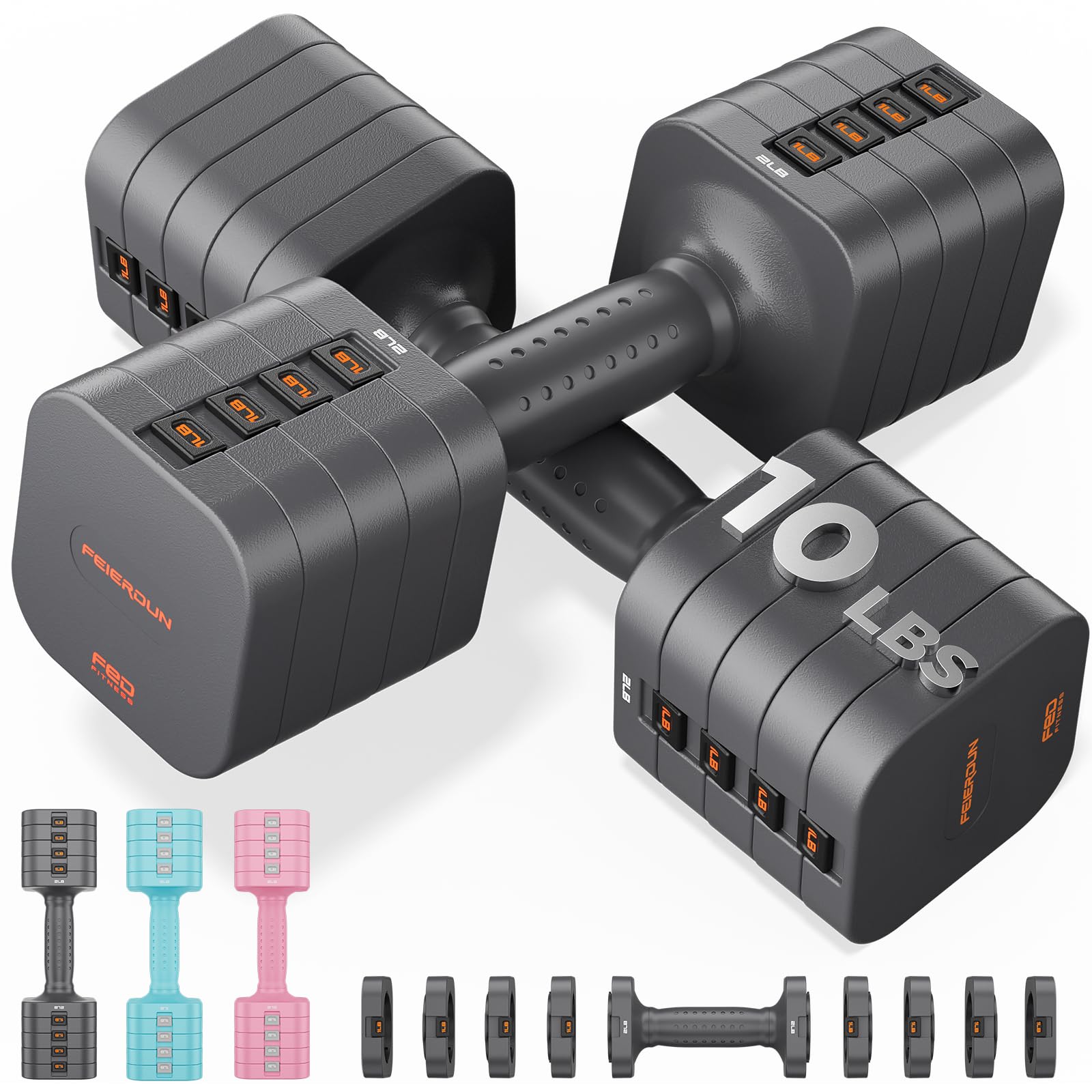
FEIERDUN DB3 5-in-1

94 /100
Peggy's Score Outstanding

Key details

Handle
4.5-inch TPU
Settings
5 (2, 4, 6, 8, 10 lbs)
Weight Range
2 to 10 lbs per hand
Storage Footprint
Under 0.2 sq ft
Check Details on Amazon

Two pounds per hand is where this set starts, and that's rarer than it should be. Most adjustable dumbbells bottom out at five or eight pounds, which is too much for a rotator cuff program, a first workout after a layoff, or the light weights at the top of a yoga flow. If your training is currently measured in one-pound decisions, this is the part of the market that takes you seriously.

Changing weight takes about a second — you twist and the plates engage — and the square body means the dumbbells sit still on the mat instead of rolling away mid-pose. We think that shape is the underrated part of the design: a round dumbbell next to a yoga mat is a hazard waiting for a bare foot, and this one stays exactly where you put it.

The handle is 4.5 inches of soft TPU with a raised dot pattern, comfortable for smaller hands and secure through a sweaty set. What it isn't is a strength set. It complements a heavier pair rather than replacing one, and ten pounds per hand is the boundary. For rehab, Pilates, walking workouts, and a first month of training, that's precisely the right amount of weight to have on hand.

Pros

  • Starts at 2 lbs per hand
  • Square body won't roll on the mat
  • One-second changeover between weights
  • Soft TPU handle suits smaller hands

Cons

  • Only five settings, in 2-lb steps
Our verdict

We reach for this pair for rehab, Pilates, and yoga, where a 2-lb starting weight and a square body that won't roll matter more than load.

Check Latest Price
6

High-Load Budget Set

Yaheetech Spinlock Set

89 /100
Peggy's Score Excellent

Key details

Plates
16 plates in 4 sizes
Collars
Star-lock spinlock
Max Weight
66 lbs total
Plate Material
Concrete-filled plastic
Check Details on Amazon

This is the most weight in this group for the least money: 66 pounds of plates and two bars, sixteen plates across four sizes with four of each, held on by star-lock collars on threaded ends. If your idea of a home gym is a garage corner and a heavy set of rows, the arithmetic here is hard to argue with, and the plates are what a beginner actually needs.

The trade shows up the moment you pick one up. The plates are plastic shells over concrete rather than cast iron, so they're chunky for their weight and they clunk when they meet, and a fully loaded hand here is far bulkier in front of your shins than the PowerBlock. That's what the low price buys: load in exchange for refinement, which is a fair swap if the weights never leave the garage.

The collars are the thing to stay on top of. They thread tight and hold, but a spinlock that backs off mid-set is how plates land on a foot, so check both sides before every set and keep the load matched left and right. Gloves make the bar easier to hold for long sets, and the plates appreciate a wipe down and a few days of air before they live indoors.

Pros

  • Most weight per dollar in this group
  • Sixteen plates in four sizes
  • Star-lock collars hold when tightened

Cons

  • Plastic-shelled plates smell when new
  • Bulky for their weight
Our verdict

We point to this set when load matters more than refinement: 66 pounds of plates, and the bulk, plastic shells, and collar checks that come with the price.

Check Latest Price
7

Compact Dial Changes

LifeOG FDB2 5-in-1

93 /100
Peggy's Score Outstanding

Key details

Set
Pair, 50 lbs total
Grip
33 mm silicone
Settings
5
Weight Range
4 to 25 lbs per hand
Check Details on Amazon

A 33-mm handle is on the thick side, and LifeOG wraps it in silicone with a texture that grabs back when your hands are sweaty. That's the detail we keep coming back to on this pair. Most sets at this size give you a thin steel bar or a hard plastic grip, and the difference shows up in the last few reps of a set of rows rather than in the first.

Five settings from 4 to 25 pounds per hand, changed one-handed by twisting the handle while the dumbbell sits in its dock. The dual-lock system engages positively and each weight has a clear marker, so you're not guessing at a glance. It's quick, the pair is stable in the trays, and the whole thing takes up roughly the space of a small suitcase.

Changing weight happens in the dock, which means the dumbbell has to be seated before you twist. This isn't the set for drop sets or for supersetting a press with a row without a walk back to the base. In exchange, the dock doubles as storage and keeps the plates off the floor between sessions, which matters more in a living room than a garage.

Where that leaves it: the pick when you want dial convenience and a comfortable handle at 25 pounds and under, from a set with less of a track record behind it than the Lifepro. If you mostly train in the 15-to-25-lb band, the coarse steps stop mattering and this becomes an easy recommendation for the money.

Pros

  • 33-mm silicone grip stays put when sweaty
  • One-hand change in about a second
  • Pair replaces five dumbbell sets

Cons

  • 5-lb jumps between settings
  • Weight changes only while docked
Our verdict

We think the silicone handle and one-second dial make this the best value among the dial sets here, provided your working weights sit above 15 pounds.

Check Latest Price
8

Very Light Training

equipro 4-in-1 Set

93 /100
Peggy's Score Outstanding

Key details

Handle
Soft TPU rubber
Settings
4 (2, 3, 4, 5 lbs)
Dimensions
8.66"L x 3.43"W
Weight Range
2 to 5 lbs per hand
Check Details on Amazon

Not everyone wants to grip a one-inch steel bar, and this little set is built for the people who don't: a soft TPU handle, a body small enough to keep in a desk drawer, and a range of 2 to 5 pounds per hand. We think of it as a set of hand weights that happens to adjust, rather than a dumbbell set that goes light.

The changeover is a rotating collar — take off the end, add or remove a ring, put it back — and the rings lock positively enough that nothing shifts mid-rep. At 8.66 inches long and under four inches wide, it disappears into a bag, which is the reason it exists at all. A pair of fixed five-pound dumbbells takes up more room and does less.

This is for wrist and shoulder rehab, a first month of movement, walking workouts, and anyone who wants a pair by the desk for a set between meetings. It won't replace a strength set and isn't meant to, but as the light end of a home gym it's more pleasant to hold than any of the steel-handled sets here.

Pros

  • Starts at 2 lbs with a soft TPU handle
  • Small enough for a drawer or gym bag
  • Weight rings lock without shifting

Cons

  • Tops out at 5 lbs per hand
Our verdict

This is the pair we hand to anyone starting rehab or finding a steel handle unpleasant: 2 lb to 5 lb, soft TPU, and small enough for a drawer.

Check Latest Price

How We Picked and Tested Adjustable Dumbbells

We started with every adjustable set with real review volume behind it, then cut anything with a ceiling under 50 pounds per hand, jumps bigger than 5 pounds between settings, or a footprint that wouldn't tuck into a closet corner. That left seven sets, which we bought at retail and put into rotation for six months.

Each set spent those six months on presses, rows, split squats, and curls. We timed every weight change with a stopwatch — first with fresh hands, then mid-workout with sweaty ones, since a dial that needs two clean palms and a steady look is one you'll stop using. We noted whether the knurling bit into bare palms or went slick after ten reps, whether plates shifted or rattled overhead, and whether a loaded dumbbell felt balanced or end-heavy at the bottom of a curl. We also unboxed each one in a closed room to catch rubber and paint smell, then checked again a week later.

Bulkiness got its own tests: whether the plates clipped a thigh on the way up in a bench press, whether the set cleared your knees in a seated curl, and whether the cradle tucked under a standard bench. We carried each set from closet to floor by its handle or tray to see what dug in, set them down hard from waist height at the end of sets the way you actually do, and checked for chipped paint, cracked plastic, and loose hardware at the one-, three-, and six-month marks. Last, we weighed what each set gives you per dollar — weight range, increment size, and whether you'd need a second set within a year to keep progressing.

How to Choose Adjustable Dumbbells

Start With the Load in One Hand

Almost every listing leads with a total, and a total is not what you lift. The Amazon Basics set is 38 pounds across both dumbbells, which works out to about 19 pounds loaded in each hand; the PowerBlock gives you 50 pounds in each hand from a shorter frame. Work out the weight you press or row for eight to twelve reps now, then buy a set whose top end sits comfortably above it. A pair that maxes out at your current working weight has nowhere to go, which is how adjustable sets end up in closets.

If you don't have a working weight yet, buy the range you expect to grow into rather than the one that fits today. The 25-pound pairs here are genuinely good for lighter, higher-rep work and for training around an injury. They are not the set you'll still be pressing with in two years.

How the Weight Changes Decides How You Train

The mechanism matters as much as the range. A pin or dial set changes load in a second or two, which means you can drop-set, superset, and pyramid without breaking rhythm. Threaded collars over loose plates take a minute or more, so you pick your weight before the set and stay there. Neither is better; they suit different workouts, and pretending otherwise is how people end up with the wrong pair.

There's a second split inside the quick-change group: whether the dumbbell has to sit in its base to change. PowerBlock's magnetic pin works with the dumbbells in your hands; a cradle-and-dial design like the NordicTrack needs the dumbbell seated in the tray. If your training is circuit-based, that walk back to the base is the detail you'll notice every single session.

Footprint and Storage

Measure where the set will live before you order. A compact pair like the Lifepro is 13.6 inches long and 6.7 wide; a spinlock set needs somewhere for the loose plates as well as the bars, and the Yaheetech set arrives as sixteen plates plus two bars. Trays and cases keep the parts together, and a case is the better answer if the weights move between rooms or go in a car.

The trap is assuming a tray solves storage. A tray still needs a surface, and a fully loaded pair is not something you want to lift onto a high shelf between sets. Floor level or a low shelf is the realistic home, which is also why a short, self-contained pair is worth more than an extra weight setting for a lot of buyers.

The Handle Is What You Actually Touch

Handles vary more than the marketing suggests. A one-inch steel bar with aggressive knurling is a different object from a 33-mm silicone grip, and which one you want depends on your hands and your loads. If your hands are small or your grip fatigues early, a softer, thicker handle is worth more than another weight setting. If you're pressing and rowing heavy, knurled steel is the one that won't slip.

Shape counts too. Square or block-shaped dumbbells rest on the thigh without rolling and stay put on the floor; long spinlock bars can crowd your range of motion at the top of a curl. A block feels different in a chest press, and you should expect a session or two to adjust to it.

What Wears Out First

Cheap and expensive sets fail in different places. On spinlock sets it's the collars and the plating on the threads. On selectorized sets it's the pin or slide mechanism and the end caps on the plates. None of that argues for spending more; it argues for checking the parts you'll touch most and for buying from a maker that states a warranty. PowerBlock covers its set for five years, NordicTrack for two.

Plastic-shelled plates keep the price down and are perfectly serviceable, but they're bulky for their weight. That matters most if you're pressing in a small room or working close to a wall, where a chunky plate has less room to travel.

Frequently Asked Questions

Final Verdict

The PowerBlock Elite EXP 90 earns the recommendation because it solves the problem that retires most adjustable sets: it outgrows you rather than the other way around, with 16 settings to 50 pounds per hand and kits that take it to 90. If your training stays under 25 pounds, or the set has to live in a corner of a bedroom, the Lifepro does that job in a smaller body for less money. Most home lifters fall into one of those two groups.