Best Yoga Mats of 2026

A yoga mat should make your practice easier, not turn every downward dog into a negotiation with the floor. The wrong one slides under sweaty hands, collapses under your knees in a lunge, and sheds foam crumbs by month three—I learned that with a cheap mat that rolled up mid-flow. What you need is a surface that grips when damp, cushions without making balance poses wobbly, and still carries easily to class. We spent eight months using 12 mats to find that balance.

Thickness turned out to be the least useful shortcut. A plush mat can feel dreamy in savasana and terrible in tree pose, while a thin one may grip beautifully but leave your knees complaining. We used each mat at home on hardwood, in studio classes, and through a few sweat-heavy sessions, noting how they smelled out of the box, how quickly they got slick, and whether they stayed put. Value is less about the price tag than whether the mat still feels solid after months of rolling and unrolling; the picks below are the ones that held up.

1

Best Overall

Gaiam Premium 6mm Yoga Mat

95 /100
Peggy's Score Outstanding

Key details

Size
68" x 24"
Material
6P-free PVC
Warranty
Lifetime
Thickness
6 mm
Check Details on Amazon

Six millimeters is the number that settles this category for us. Anything under 5mm keeps you close to the floor and steady in a standing pose but leaves your knees to fend for themselves in a lunge; 10mm and 1-inch foam does the opposite, cradling every joint and turning tree pose into a negotiation with your own balance. The Gaiam Premium sits in the middle of that trade-off, and it's the thickness we kept coming back to across this whole set.

The surface is why it takes the top spot. This is textured, slightly tacky PVC rather than the soft squish of NBR foam, so it holds a hardwood or studio floor and your hands stay where you put them in downward dog while you're still dry. We were glad to see 6P-free PVC — no DEHP, DBP, or DINP — since the cheaper foam mats here don't address plasticizers at all, and a lifetime warranty is rare on a mat that isn't the most expensive one in the group.

Sixty-eight by 24 inches is the standard footprint and the right one for most people; if your heels already hang off the end of a mat in a seated forward fold, the CAMBIVO's extra length is the fix. Care is a damp cloth and air drying, and this closed surface takes that better than open-cell foam, which is the kind that goes shiny and starts flaking after a year of hard use.

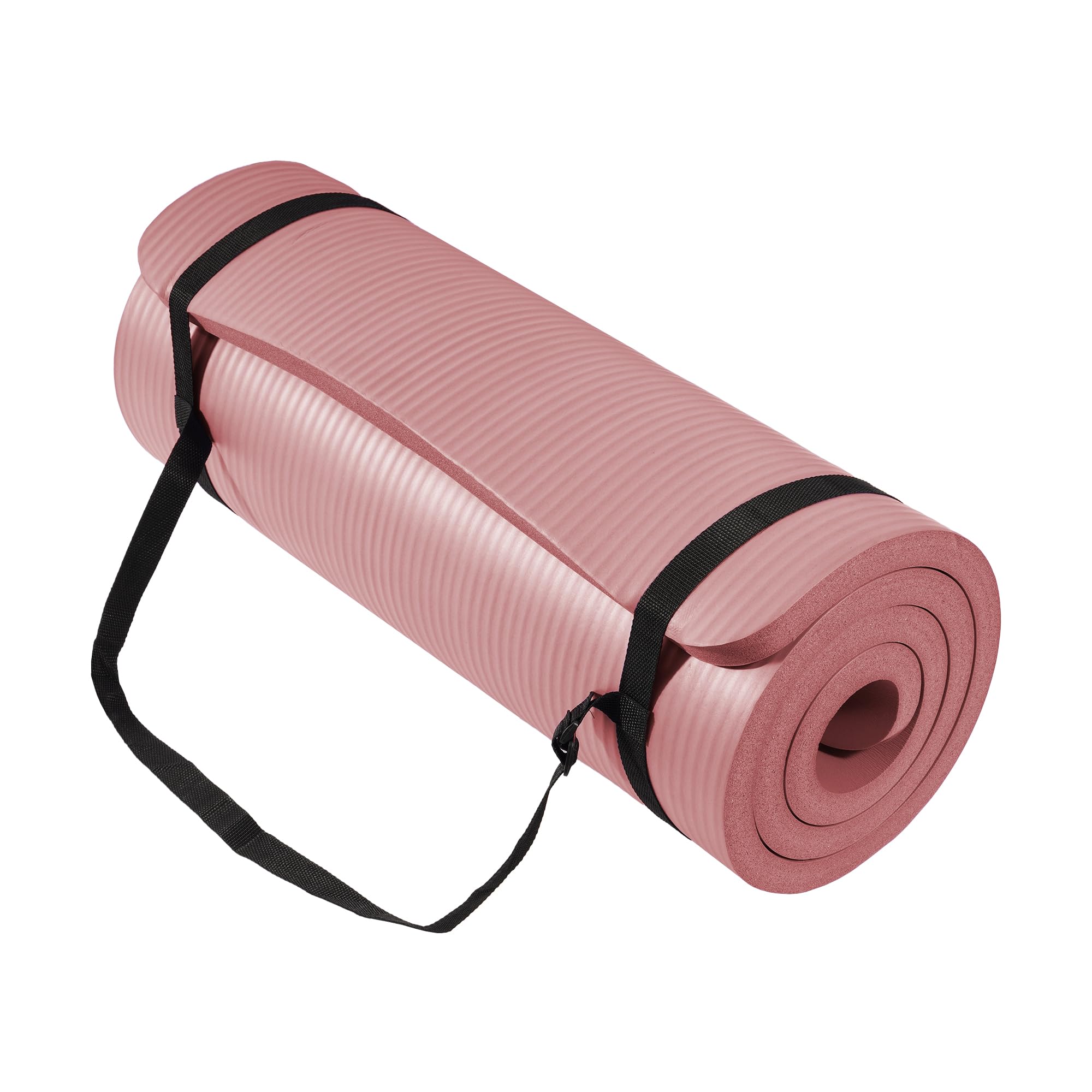
Two details we didn't expect to matter. The print — ours is a soft rose pattern — hides dust and scuffs between cleanings, which sounds trivial until you've owned a black mat for a year. And it lay flat within a day of unrolling, which is more than we can say for the inch-thick foam mats in this group.

Pros

  • 6mm cushions knees without wrecking balance
  • Textured PVC grips floors and dry hands
  • 6P-free PVC with a lifetime warranty
  • Prints hide scuffs between cleanings

Cons

  • Traction fades once hands and feet get damp
Our verdict

If you practice at home a few times a week and want one mat to cover it, we point you to this Gaiam: 6mm of cushion, a genuinely grippy dry surface, and a lifetime warranty.

Check Latest Price
2

Best Budget

Fitvids 1/2-Inch Yoga Mat

91 /100
Peggy's Score Outstanding

Key details

Size
71" x 24"
Weight
2.91 lb
Material
NBR foam
Thickness
0.5 inch
Check Details on Amazon

Cheapest of the half-inch mats in this group, and the one we hand to anyone fitting out a first practice on a tight budget. You get a full 71-by-24-inch surface, a strap in the box, and enough NBR foam that knees and elbows stop filing complaints against a wood floor — something the thinner PVC mats here can't manage.

Seventy-one inches is worth pointing out. Most mats here stop at 68, and those extra three inches are the difference between your heels resting on the mat and hovering past the end in a seated fold. At 1.32 kg it rolls tight and slings over a shoulder without dragging, which is why it's the one that left the house with us most often.

It's a foam mat, and foam has a temperament. Pressure from knees, hands, and folded feet can leave a mark, and after months of daily use the surface is the first thing to go; used a few times a week and stored rolled, ours has held up. Compared with the inch-thick BalanceFrom it's firmer and easier to balance on, and compared with the 10mm Gaiam it's longer and a touch heavier.

Pros

  • Half an inch of cushion for very little money
  • 71 inches long, three more than most here
  • Rolls tight with a strap for carrying

Cons

  • Slides on smooth floors when hands get damp
Our verdict

We keep this one on the shortlist for anyone furnishing a first home practice on a tight budget — half an inch of cushion, a strap in the box, and 71 inches of length.

Check Latest Price
3

Best for Aching Knees

Gaiam Thick 10mm Yoga Mat

93 /100
Peggy's Score Outstanding

Key details

Care
Hand wash
Weight
2.8 lb
Material
NBR foam
Thickness
10 mm
Check Details on Amazon

Ten millimeters is nearly double a standard mat, and it changes what the mat is for. Knee-down poses stop being a countdown — the foam is thick enough that a hardwood floor disappears underneath you — while standing balances get softer and less certain, because the surface gives under the standing leg instead of holding it.

At 1.27 kg it's barely heavier than the half-inch mats here, so the cushioning doesn't turn into a carrying problem; it rolls and straps like a normal mat. Comfort is the whole point: knees, hips, and tailbone stop noticing the floor, which is why ours gets used for stretching and Pilates as much as for yoga.

Where we landed is that this is a mat for the floor half of a practice, and its price makes it an easy second mat to keep in the room where you stretch. If you want one mat that handles standing sequences and floor work equally, the 6mm Gaiam is the better single purchase; if your knees are the thing that stops you practicing, this one removes that excuse.

Pros

  • 10mm cushions knees, hips, and tailbone
  • Light for its thickness at 1.27 kg
  • One of the lowest prices in this group
  • Rolls and straps like a standard mat

Cons

  • Foam can crack where knees and feet press
Our verdict

Buy it for knee-down poses on a hard floor; ten millimeters of foam is the closest thing here to kneeling on a cushion, and it costs less than most mats in this group.

Check Latest Price
4

Best for Tall Practitioners

CAMBIVO Extra Long Wide Yoga Mat

92 /100
Peggy's Score Outstanding

Key details

Size
84" x 30"
Weight
5 lb
Material
PVC
Thickness
6 mm
Check Details on Amazon

Eighty-four inches long and 30 wide — six inches more than a standard mat in both directions, and the only pick here built for bodies that don't fit a 68-inch mat. That extra room is the reason to buy it, and for a tall practitioner it's a bigger upgrade than any surface material.

The PVC is textured on top with a honeycomb base that holds the floor, and 6mm is thick enough to cushion a knee without the wobble of the inch-thick mats. At five pounds and 30 inches across, though, it's a mat you carry in both hands; it's happiest rolled out in a spare room rather than hauled to a studio three times a week.

We noticed the width most in wide-legged poses, where hands and feet stay on the mat instead of hanging off the edge, and the length at the end of a forward fold, where there's still mat in front of your fingertips. Those two gains are what you're paying the bulk and the weight for.

Pros

  • 84 by 30 inches of practice space
  • 6mm PVC cushions without excessive squish
  • Honeycomb base holds the floor
  • Carrying strap included

Cons

  • Slick under damp hands
  • Bulky to roll and carry at 30 inches wide
Our verdict

The pick for tall or broad practitioners: 84 by 30 inches means hands and feet stay on the mat, and nothing else here comes close on room.

Check Latest Price
5

Best for Beginners

NewMe Fitness Printed Pose Mat

95 /100
Peggy's Score Outstanding

Key details

Size
68" x 24"
Material
PVC
Thickness
5 mm
Printed Poses
70
Check Details on Amazon

The first week we had this mat, the phone stayed in the other room. Seventy line drawings of poses are printed directly on the surface, so a home session runs from one shape to the next without unlocking a screen, scrubbing a video back, or losing your breathing while you find your place.

What the drawings are is a cue sheet, not a teacher — you get the shape of each pose and nothing about alignment — but for the practical problem of remembering what comes next, that's enough. The surface is a standard 68 by 24 inches, and at 2.6 pounds it unrolls anywhere there's floor.

Five millimeters of PVC keeps it light and rolls tight, and it's firm enough that standing poses don't feel mushy underfoot. The surface is textured rather than sticky, so damp hands slide in a long sequence, and a beginner working through a printed flow tends to hold poses long enough to notice.

With a sequence in your head and no need for the drawings, the Gaiam Premium's tackier surface is the better mat for about the same money. With the drawings doing the teaching, this one is the reason the habit survives the first month.

Pros

  • 70 poses printed on the mat
  • 5mm PVC keeps it light at 2.6 pounds
  • BPA-, latex-, and phthalate-free

Cons

  • Thin under knees during floor work
Our verdict

Seventy poses printed on the surface make this the most useful mat here for anyone learning sequences without a teacher.

Check Latest Price
6

Floor Workouts

BalanceFrom 1-Inch Exercise Mat

95 /100
Peggy's Score Outstanding

Key details

Size
71" x 24"
Surface
Waterproof
Material
NBR foam
Thickness
1 inch
Check Details on Amazon

This is a mat for people whose practice happens sitting and kneeling rather than standing. An inch of high-density NBR foam is closer to a thin mattress than to a yoga mat, and that's exactly what makes it useful for Pilates, planks, crunches, stretching, and the exercises you get sent home with after a knee or a back problem.

The support is what sold us. Knees, hips, and tailbone stop registering a wood floor entirely, and the foam springs back instead of bottoming out the way the cheaper half-inch mats here do under a knee. Anyone who has ever folded a blanket under themselves mid-session will recognize what that's worth.

It rolls up fast with a reinforced nylon strap, the surface is waterproof and wipes clean, and 71 by 24 inches is a full-size footprint. Where it doesn't work is standing yoga: an inch of give under one foot makes balance poses feel like they're happening on a trampoline, and that isn't a small thing if you flow.

Pros

  • An inch of support for knees and hips
  • Springs back instead of flattening
  • Waterproof surface wipes clean
  • Rolls up fast with a nylon strap

Cons

  • Tears at pressure points over time
Our verdict

Our choice when the practice happens on the floor rather than on your feet — an inch of support for knees, hips, and tailbone, and it rolls away between sessions.

Check Latest Price
7

Cheap Spare Mat

CAP Barbell 1/2-Inch Yoga Mat

93 /100
Peggy's Score Outstanding

Key details

Size
68" x 24"
Weight
2.16 lb
Material
Latex-free NBR
Thickness
0.5 inch
Check Details on Amazon

Nothing about the CAP mat is trying to be clever — half an inch of NBR foam, 68 by 24 inches, a strap, black. That's the whole pitch, and at the lowest price in this group it's a fair one.

The number that surprised us is the weight: 0.98 kg, lighter than every other half-inch mat here, which makes it the one that goes into a gym bag without a second thought. The foam is latex-free, the textured surface holds a floor, and the strap does its job without a fight.

Where it lands is the mat for stretching in front of the TV, a round of floor exercises before work, or a spare kept at a partner's apartment. It does those jobs without complaint, and the light weight means it actually gets put away instead of living on the floor.

Pros

  • 0.98 kg, the lightest half-inch mat here
  • Lowest price in this group
  • Latex-free NBR foam
  • Strap included

Cons

  • Foam dents and tears with hard use
Our verdict

A plain, light, latex-free half-inch mat that costs less than anything else here; fine for stretching and weekend workouts, not the one for daily flows.

Check Latest Price
8

Carrying to Class

YOGATI Alignment Yoga Mat

91 /100
Peggy's Score Outstanding

Key details

Size
72" x 24"
Weight
1.81 lb
Material
TPE
Thickness
0.24 inch
Check Details on Amazon

Faint laser-etched lines run down the center of this mat, marking where palms and heels belong in the poses where symmetry is the whole point. It sounds like a gimmick until you're the person whose right hand is always three inches ahead of the left in downward dog.

At 820 grams it's the lightest mat in this group, and it rolls into the included shoulder harness small enough to sling over a bag. The TPE is reversible — warm sand on one face, caramel on the other — and YOGATI calls the material odor-free, which matched what we found: none of the factory smell the PVC mats here arrive with.

Six millimeters of TPE is denser than the foam mats here, so it feels firm underfoot rather than plush — steady in balance poses, less forgiving in a long kneeling sequence. And it lies flat and stays flat, without the curling corners we fought on the thicker foam.

Where it earns its place is the commute: this is the mat we grab when we're already carrying too much, and the lines make it the better choice for anyone practicing alone and guessing at their own form. It isn't the mat for a hot class, where the surface gives up as soon as you sweat.

Pros

  • 820 g, the lightest mat here
  • Laser-etched alignment lines
  • Reversible two-tone TPE
  • Shoulder harness included

Cons

  • Edges scuff and mark with rough handling
Our verdict

The lightest mat here, and the only one with alignment markings — the pick for carrying to class and checking your own symmetry.

Check Latest Price

How We Tested the Best Yoga Mats

We built the shortlist by scanning specs, materials, and return policies, then narrowing to mats that covered a range of thicknesses and price tiers without obvious red flags in owner reviews. The final field was 12 mats, and we rotated them through eight months of real practice rather than a single afternoon of posing. Every mat saw morning flows on a living-room hardwood floor, weekly studio classes, and at least a few heated sessions.

We unrolled each mat fresh out of the box and sniffed it at arm's length, then again after 48 hours of airing, because a mat that smells like a tire store will not magically improve your practice. Grip got tested with sun salutations and long holds in downward dog until hands and feet began to sweat; we watched for palms creeping forward, feet sliding wide, and the whole mat skating across the floor. For stability, we held tree pose and warrior III and noted whether the cushion squished under the standing foot or stayed firm. Comfort came down to low lunges and savasana—whether knees felt protected and whether the spine sank in or fought back.

Durability checks happened weekly: we looked for curled edges, surface pilling, compression marks, and any stretching after rolling and unrolling. Portability was measured with a luggage scale and a walk to class—did it fit in a tote, did the included strap hold, did it feel like carrying a rolled-up rug? At the end, we compared condition against cost, because value only counts if the mat still performs after months, not just on day one.

How to Choose Yoga Mats

Thickness Is a Trade-Off, Not an Upgrade

Under about 5mm, a mat keeps you close to the floor, which is what makes standing balances feel steady, but it does little for knees and hips in a lunge. Six millimeters is the compromise most home practitioners land on: enough padding for a hard floor, not enough give to make tree pose wobble. That's the reasoning behind our Gaiam Premium pick.

Ten millimeters and up flips the balance. Foam that deep is wonderful for kneeling and seated work and noticeably softer underfoot, which is why thick mats are the ones to buy when joint comfort is the reason you're shopping. Pick by the half of your practice you'd protect: stand and flow, stay near 6mm; kneel and stretch, go thick.

Grip: Dry Hands and Damp Hands Are Different Problems

Nearly every mat here calls itself non-slip, so the word tells you nothing. What matters is the material. Tacky closed-cell PVC, like the Gaiam Premium and the CAMBIVO, holds dry skin and hard floors well but gets slick once your hands are wet; softer NBR foam cushions more and grips less.

Test before you commit. Press a damp palm flat on the surface and try to slide it — if it moves when wet, it will move in a warm room twenty minutes into a class. For hot yoga, plan on a towel or a mat chosen specifically for sweat rather than assuming a textured surface will hold.

Material, Smell, and Cleaning

PVC is the sticky, hard-wearing choice and the one that arrives smelling of the factory; the Gaiam mats here ask for two or three days of airing before first use, and the smell fades from there. NBR foam is softer, cushions more, and tears sooner. TPE sits between them and is the lightest of the three.

Whatever you buy, skip the washing machine and the sunny patio. Heat and agitation break foam down, which is why every maker here says to wipe with a damp cloth and dry flat. A mat stored rolled and out of direct sun keeps its surface far longer than one left unrolled in a hot car.

Size and Weight: Who Needs More Mat

Most mats run 68 to 72 inches long and 24 inches wide, which suits most bodies. The tell is your seated forward fold: if your heels or fingertips hang past the edge, you want the 84-by-30 CAMBIVO instead of a standard mat.

Weight matters just as much once the mat leaves the house. The TPE and foam picks here run from 820 grams to 1.32 kg, and the oversized CAMBIVO is 5 pounds. If the mat lives in a bag by the door, weigh that against the cushioning you're buying.

Frequently Asked Questions

Final Verdict

The Gaiam Premium 6mm remains our default: it handles standing flows and floor work without asking you to choose between them, and the lifetime warranty softens a price that sits at the top of this group.

If your knees decide the purchase, the Gaiam Thick 10mm costs less and cushions more, and the BalanceFrom's inch of foam is the better surface for Pilates and weights. Tall practitioners should start with the CAMBIVO.