Best Wobble Boards of 2026

A wobble board is only doing its job when it feels like it might dump you — that's the point. The good ones are unstable on purpose and predictable about it: the deck tilts exactly as far as you push it, it doesn't skate across the living room floor, and your ankles aren't the only thing keeping you upright. Cheap ones miss that distinction. They slide, they spin, the grip tape peels, and what should be a five-minute balance drill becomes a game of catching yourself on the countertop.

My team and I have spent the past six months riding 12 of them — flat rockers, round 360-degree trainers, and a couple of padded ones — barefoot, in socks, and in sneakers. What separated the keepers was rarely the spec sheet. It was whether the surface held a sweaty foot, whether the deck was wide enough to stand on without panic, and whether the thing was still fun to pick up in week five. The picks below run that range, from slow rehab-style rockers to boards that will humble you in about ten seconds.

1

Best Overall

Amazon Basics Wood Wobble Board

93 /100
Peggy's Score Outstanding

Key details

Surface
Non-slip
Material
Solid wood
Deck Size
15.75 x 15.75 x 3.15 in
Weight Limit
265 lb
Check Details on Amazon

It costs the least of anything here, and it does the job most people are shopping for. The Amazon Basics board is a 15.75-inch square of solid wood on a rounded base, rated to 265 pounds, and it turns a phone call or an ad break into a few minutes of ankles and core working. No assembly, no settings, nothing to learn before you step on.

The deck wears a rough, sandpaper-like grit, which we noticed in two places. Under bare feet it is excellent, with no slipping even in socks, but flip the board over for planks and push-ups and the same texture is unkind to forearms. It genuinely works as both a balance board and a floor exercise platform; just put a towel under your elbows.

Difficulty changes without a dial. On carpet the rounded base digs in and everything slows down; on hardwood or tile the board moves noticeably faster. If it feels too tame, take it off the rug, and if it feels twitchy, put a mat underneath. That mat does a second job, because on smooth tile the board can slide rather than grip.

For a first board, a shared living-room toy, or something to stand on during calls, it is the sensible starting point. At under three pounds it disappears behind the sofa between sessions, which is more than the roller boards can claim.

Pros

  • Does the basics with nothing to set up
  • Rough grit holds bare feet and socks
  • Carpet slows it, hard floor speeds it up
  • Under three pounds and easy to stash

Cons

  • 265-pound weight limit is the lowest here
  • Outgrown quickly by experienced balancers
Our verdict

If you are buying your first balance board and do not want to think hard about it, this is the one: nothing else here costs as little or covers as many everyday jobs.

Check Latest Price
2

Best for Standing Desks

NALANDA Wobble Balance Board

92 /100
Peggy's Score Outstanding

Key details

Diameter
16.34 in
Material
PP and TPE
Rotation
360°
Weight Limit
660 lb
Check Details on Amazon

If your standing desk has become an hour of shifting from foot to foot, this is the board built for that. It is a 16.34-inch round deck with cut-out handles, and it rotates a full 360 degrees, so you drift in slow circles instead of committing to front-to-back or side-to-side.

We like it most for desk work for exactly that reason: there is no wrong direction to lean, and the movement is small enough to do while reading. The 660-pound rating is by far the highest here, which makes it the board to share with a partner or a teenager, and the PP-and-TPE build means no splinters, no finish to maintain, and a quick wipe with a damp cloth.

The deck is covered in raised bumps, a massage surface rather than a flat one, and the 24.5-degree section angle gives you a defined edge to lean into, so it never feels like standing on a dinner plate. The same bottom that holds on tile holds on carpet; we never found ourselves chasing it across the floor.

It is also the easiest board here to hand to someone else: no settings to explain, no setup, and a deck that takes shoes or bare feet. The trade is that it only does the one thing. If you want stoppers, tilt heights, and a difficulty curve, a roller board is the better buy.

Pros

  • 360-degree rotation suits desk fidgeting
  • 660-pound rating is the highest here
  • Cut-out handles make it easy to carry
  • Wipes clean and takes shoes or bare feet

Cons

  • Raised massage bumps are hard on bare feet
Our verdict

For anyone who stands at a desk all day, this is the board to get: the 360-degree deck, cut-out handles, and 660-pound rating make it the most forgiving option here.

Check Latest Price
3

Most Versatile

Sportneer Balance Board Set

95 /100
Peggy's Score Outstanding

Key details

Includes
Board, roller, and ball
Material
Birch
Deck Size
31.5 x 14.17 in
Weight Limit
450 lb
Check Details on Amazon

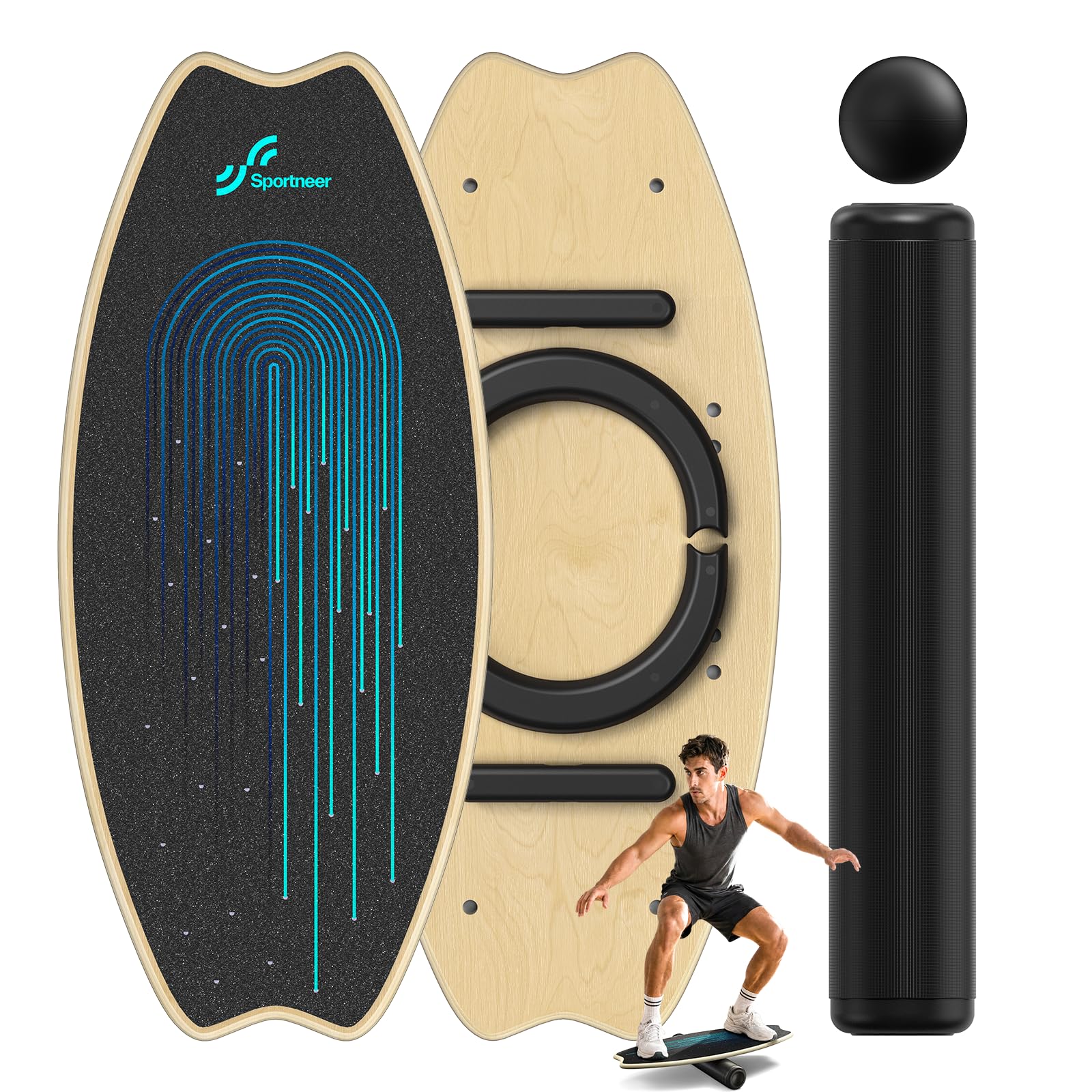
Think of this as the Indo Board's more elaborate cousin: the same deck-and-roller idea, plus a ball and adjustable stoppers, for considerably less money. The deck is 31.5 inches of birch rated to 450 pounds, and the kit arrives as three pieces: board, roller, and ball.

On the roller it is a surf trainer with a long, fast carve, and the 31.5-inch deck gives you room to move your stance the way you would on a board. Put the ball under the middle and the same deck becomes a much twitchier 360 trainer that punishes every shift of weight. The stoppers slide to change how far the roller travels, so one purchase covers a cautious beginner and someone training for a season.

Seven configurations sounds like a spec-sheet boast, and we were skeptical until the ball turned the same deck into a genuinely different, harder exercise. That variety is what earns this one a place: it keeps a household interested past the first week, and the matte surface holds shoes or bare feet without grip tape chewing at your soles.

Build quality is the quiet argument for it: a birch deck, a solid roller, and nothing to assemble. It is, though, the bulkiest thing here, with three pieces that want a permanent corner, so it suits a home gym or a spare room better than an apartment you tidy every evening.

Pros

  • Seven setups span beginner to advanced
  • 450-pound birch deck takes a whole family
  • Matte deck grips with or without shoes

Cons

  • Ball setting is unforgiving until your balance improves
Our verdict

Buy it if you want a roller board, a 360 trainer, and a ball in one purchase; the seven setups cover a beginner and a bored expert in the same house.

Check Latest Price
4

Best for Surf Training

Indo Board Original

96 /100
Peggy's Score Outstanding

Key details

Includes
Board and roller
Material
Maple
Deck Size
30 x 18 x 0.5 in
Weight Limit
350 lb
Check Details on Amazon

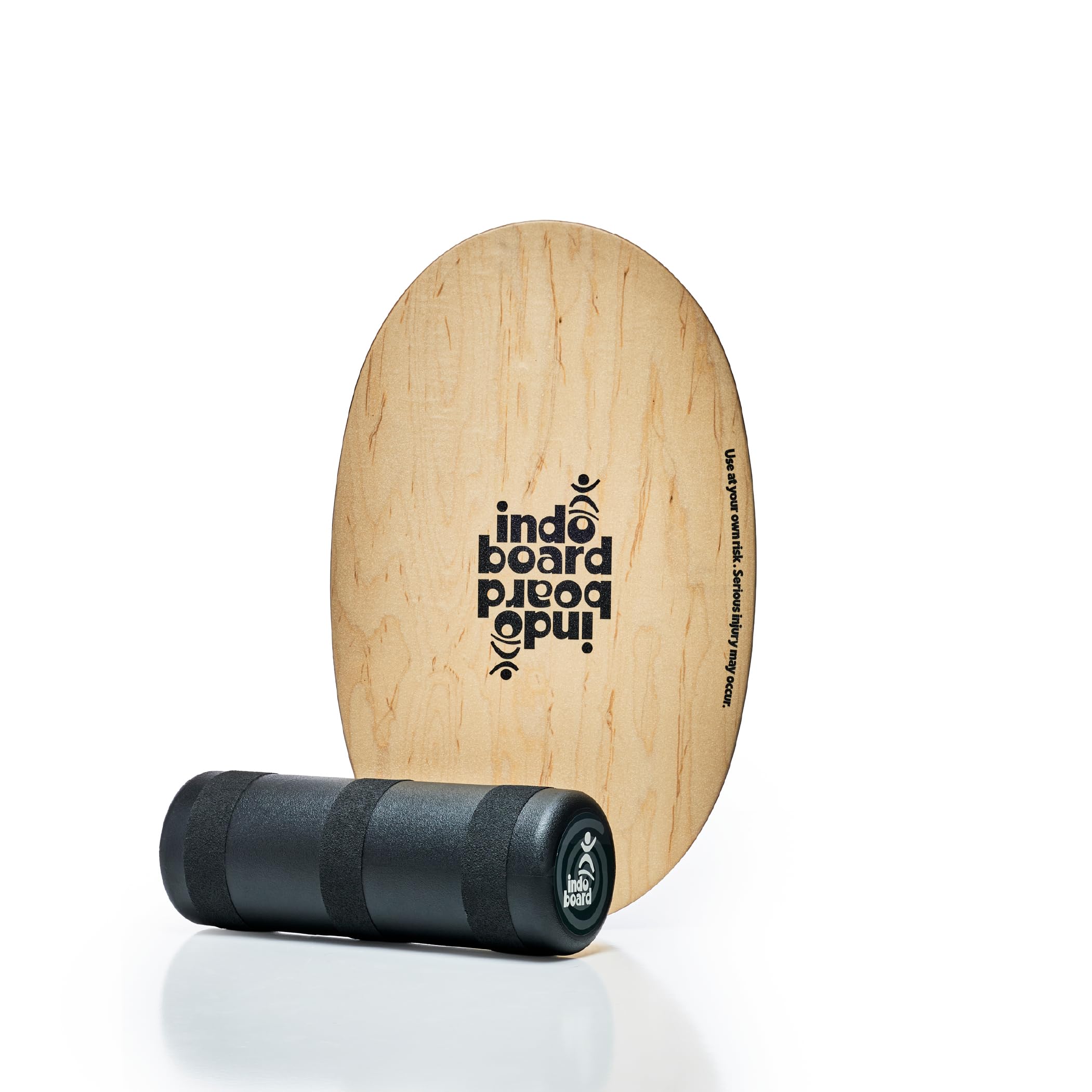
The first minute on the Indo Board is a negotiation with your own ankles. The roller is free under a 30-inch maple deck, nothing stops it, and the board goes wherever your weight tells it to. Then it clicks, and you understand why we rate this the purest trainer in the group.

The setup is deliberately minimal: deck, roller, nothing else. The 18-inch width gives you a stance wide enough to load properly, the free roller forces the hip and ankle corrections that transfer to a wave or a slope, and the 350-pound rating covers most adults. The deck is finished maple rather than a padded platform, so it rewards a solid stance.

Start it on carpet. The roller runs slower there than on hardwood, and a fall onto a rug is a different event from a fall onto tile. Past that, this is the board most likely to stay out in the room: a two-piece wooden object with very little to go wrong, and a shape that looks more like furniture than gym equipment.

It is also the one here that a whole household ends up using, from a teenager practicing kickflips indoors to an adult working on balance for paddleboarding. That is the case for spending up: a slab of maple and a cylinder do not go obsolete when your balance improves.

Pros

  • Free roller builds real board-sport balance
  • Wide 18-inch deck for a loaded stance
  • Two-piece build with little to go wrong
  • Holds up to a whole household

Cons

  • Most expensive board here
Our verdict

The pick for surfers, skaters, and snowboarders who will actually practice: a free roller and a wide maple deck reward the work, and the learning curve is the point.

Check Latest Price
5

Best Budget Roller Board

Yes4All Balance Board Trainer

93 /100
Peggy's Score Outstanding

Key details

Includes
Board and roller
Construction
15-ply pressed wood
Weight Limit
300 lb
Stopper Settings
11, 16, and 22 in
Check Details on Amazon

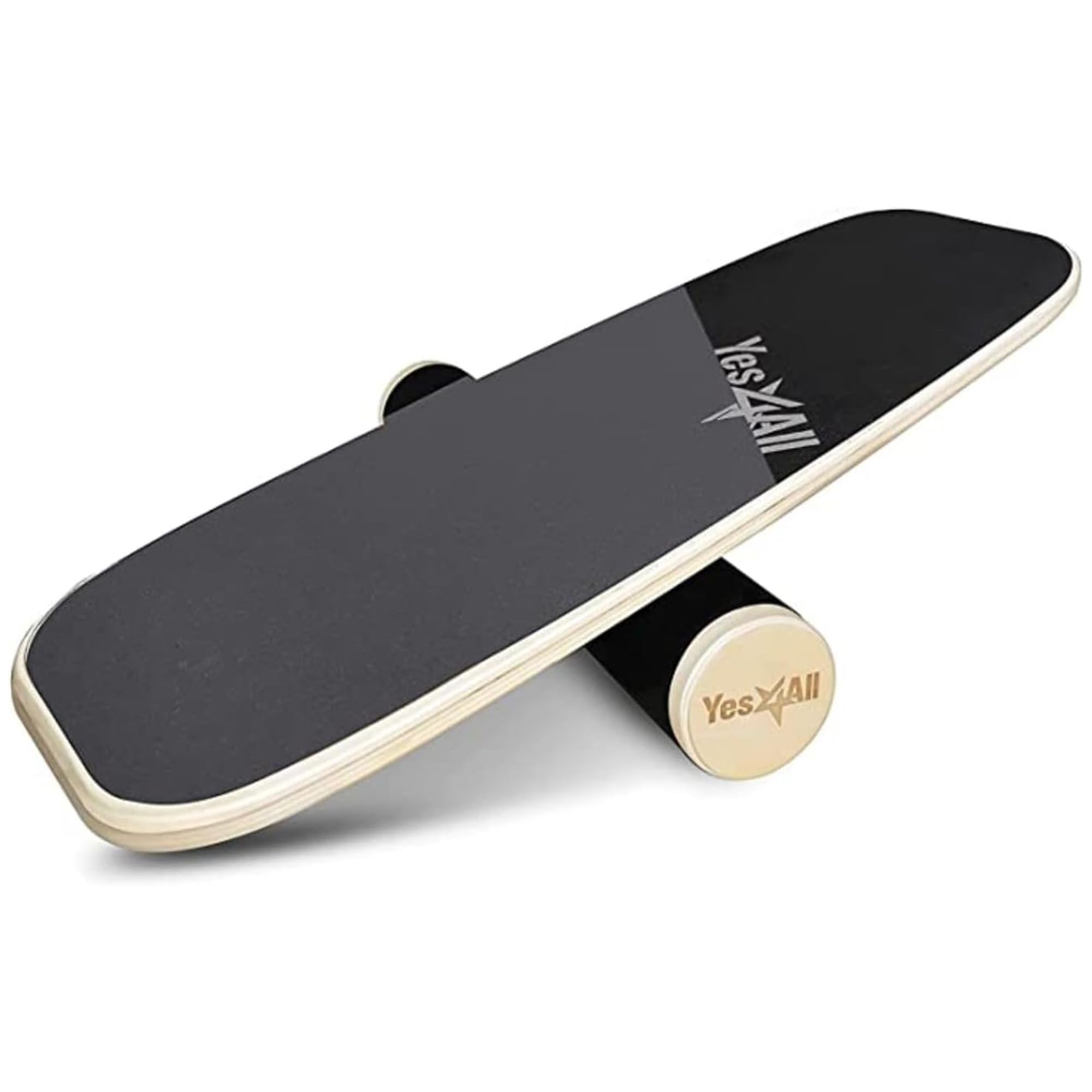
Two removable stoppers slide into the deck and set how far the roller can travel: 11, 16, or 22 inches. Close together, the board can barely move, which makes the first week survivable; out at 22 inches you get a long, fast carve that finds every weak muscle in your ankles.

We found the middle setting the honest place to start for most adults, and the adjustment is what makes this the better first roller board: you can hand it to a nervous beginner and to a teenager in the same afternoon. It is 15-ply pressed wood rated to 300 pounds, with an emery-paper deck that grips shoes and bare feet alike.

Compared with the Indo Board, it is the same motion with training wheels you can remove, and the gap in feel is smaller than the gap in price. The deck is plain rather than furniture-grade, which is part of why it costs less, and it stores flat behind a door or under a bed, so it works in a small apartment in a way the 31.5-inch kits do not. Give it a rug on hardwood; the base is happy on carpet and lively on tile.

Pros

  • Three stopper settings grow with you
  • Emery deck grips shoes or bare feet
  • Costs far less than the Indo Board
  • Stores flat in a small space

Cons

  • Roller covering can split or peel with use
  • 300-pound limit rules out heavier riders
Our verdict

A roller trainer for people who want the Indo Board's motion without the premium: set the stoppers wide for a long carve, close for the first week.

Check Latest Price
6

Best for Rehab

Fitterfirst Professional Rocker Board

94 /100
Peggy's Score Outstanding

Key details

Material
Baltic birch plywood
Deck Size
20 x 20 x 4 in
Weight Limit
350 lb
Tilt Settings
10, 12, and 15 degrees
Check Details on Amazon

It costs more than every board here except the Indo Board, and it is the most clinical thing in the guide: a 20-inch square of Baltic birch with two adjustable spheres underneath, built for the kind of balance work you do on prescription rather than for fun.

What the money buys is control. The spheres sit at three settings of 10, 12, and 15 degrees, and the deck tilts in a single plane, front to back. That is a narrower motion than a wobble board and a far more repeatable one: you can put it at the same angle every session and widen the range as an ankle or knee tolerates it. Nothing rotates and nothing slides sideways.

For anyone doing rehab homework between appointments, this is the board we point to. The 20-inch deck gives a wide, forgiving stance for two-foot work, and the same width lets you shift to a single-leg stand without feeling perched. It is rated to 350 pounds and needs no assembly.

The limits mirror the strengths. One plane of tilt means it will never teach you to rotate or to react sideways, so it is not a board-sport trainer. The deck is bare plywood rather than a grip surface, so plan on shoes or a mat. If you are rebuilding an ankle, neither matters much; if you want a toy for the living room, both do.

Pros

  • Three repeatable tilt settings
  • Wide 20-inch deck for two-foot work
  • 350-pound rating and no assembly

Cons

  • Tilts in one plane only, so no rotational work
Our verdict

For rebuilding an ankle, knee, or hip, this is the closest thing here to a clinic board: three repeatable tilt settings and a 20-inch stance that stays put.

Check Latest Price
7

Best Compact Rocker

StrongTek Wooden Balance Board

92 /100
Peggy's Score Outstanding

Key details

Base
Rubber pads
Material
Lauan hardwood plywood
Deck Size
17.5 x 13.5 x 3 in
Weight Limit
350 lb
Check Details on Amazon

Most boards here want a rug under them. This one does not: rubber pads on the underside hold it on hardwood and keep it from digging into carpet, so the StrongTek works wherever you happen to be standing.

The deck is 17.5 by 13.5 inches of Lauan hardwood plywood with a textured surface that is gentle under bare feet, noticeably kinder than the sandpaper grit on cheaper boards, and at 4.7 pounds it moves from office to living room between calls without a thought.

On the floor it behaves the way a good rocker should: a generous front-to-back roll and enough resistance that your ankles are working inside a minute. It is rated to 350 pounds, and it is stable enough that we stopped thinking about it while typing.

Where it gives ground to the Fitterfirst is progression: the tilt is fixed, so you advance by changing what you do on the board rather than by changing the board. For most homes that is a fair trade, and this is the rocker we reach for when there is no room for a 20-inch clinical platform. It also slides under a sofa, which is more than the roller boards can say.

Pros

  • Rubber pads hold on hardwood
  • Textured deck is kind to bare feet
  • Compact enough to slide under a sofa

Cons

  • Fixed tilt offers no way to add difficulty
  • Narrow deck leaves little room for a wide stance
Our verdict

The compact rocker for a home with no room for a clinic board: it holds on hardwood without a mat, and the fixed tilt keeps things simple.

Check Latest Price
8

Kids and Stretching

Gentle Monster Wooden Wobble Board

94 /100
Peggy's Score Outstanding

Key details

Material
Natural wood
Deck Size
35 x 11.8 x 0.66 in
Weight Limit
480 lb
Height At Peak
6 in
Check Details on Amazon

This is not a trainer in the sense the rest of this guide means. It is a 35-inch curved plank, 11.8 inches wide and 6 inches tall at the peak, that rocks, tips, and gets used as a ramp, a bridge, and a seat.

For adults it is a stretch aid and a slow, wide rocker: lie back over it to open the chest, sit on it to rock, stand on it for a balance challenge closer to a seesaw than to a wobble board. The 480-pound rating is higher than most of the dedicated trainers here, so it takes two adults or a room full of children without complaint.

Where it earns its place is a house with young kids. It is the one board here a toddler can use at floor level, and it grows with them: the same plank is a bridge for a three-year-old and a back stretcher for an adult. The listing rates it for ages 3 and up.

Buy it for play and stretching rather than training. There is no roller and no setting to change, so it will not build the progression a wobble board does. What it offers instead is the thing a trainer cannot: a board that lives in the room and gets picked up a dozen times a day without anyone calling it exercise.

Pros

  • 480-pound rating covers kids and adults
  • Doubles as a back stretcher and seat
  • One board that grows with a child
  • Looks like furniture, not gym gear

Cons

  • No roller or settings, so it cannot be made harder
  • Can arrive with dents, chips, or rough ends
Our verdict

Buy it for a playroom or a stretching habit rather than a workout; it is the board kids use daily and adults borrow for their backs.

Check Latest Price

How We Chose and Tested Wobble Boards

We started with roughly 40 boards on the market and narrowed by deck width, weight rating, material, and base design — whether the board rocks over a fixed fulcrum or spins freely through 360 degrees. Anything without a published weight limit, or with a deck narrower than about 12 inches, came off the list. That left 12 boards, which we bought at retail and lived with for six months.

Testing happened where these things actually live: on living room rugs, on hardwood, on tile in front of the kitchen sink, and beside a standing desk during work calls. Testers stood on each board barefoot, in socks, and in sneakers, holding timed single-leg and two-footed holds and noting how quickly the deck corrected underneath them. We watched whether a board stayed put on smooth floors or crept across the room, and whether the grip surface held a bare foot once things got sweaty.

Over the six months we looked for the slow failures: grip tape lifting at the corners, wooden decks flexing or delaminating, plastic bases developing flat spots, edges chipping. We sized each deck against a men's 10 and a women's 7 foot to see how much room there really was, and noted comfort — whether the surface ached after five minutes or was shaped to support the arch. The last check was the simplest: after a few weeks, which boards did testers reach for without being asked.

How to Choose Wobble Boards

Rocker, spinner, or roller

A rocker sits on a curved base or two spheres and tilts in one or two directions: controlled, repeatable, and the best choice for standing at a desk or working through a rehab protocol. A round spinner rotates 360 degrees on a central dome, which suits fidgeting and ankle mobility. A roller gives the deck free travel over a cylinder, which is the hardest to learn and the closest to surfing or snowboarding.

Check what is actually under the deck before anything else, because listings use wobble board for all three. If you want a board you can step onto without thinking, you want a rocker; if you want something to grow into, you want the roller.

Deck size, stance, and weight limit

Adults want roughly 15 inches of usable deck under a two-foot stance. The boards here run from 15.75-inch squares to a 20-inch clinical platform, and the roller decks are long and narrow by design. Wider is more forgiving for rehab and for sharing; narrower makes single-leg work more honest.

Then check the rating. These boards carry limits from 265 to 660 pounds, and a board the whole household will use should clear the heaviest person in the house with room to spare. Going over the limit is not a slow-wear problem, it is a fall.

Whether to pay for adjustable difficulty

Stoppers on a roller, three tilt heights on a rehab rocker, a ball under the deck: these let one board serve a beginner and someone further along. Pay for them if you are rehabbing an injury, sharing with kids, or likely to lose interest once the movement gets easy.

If you are one person with a fixed routine, a single-motion board is simpler and cheaper, and you can change difficulty for free by moving between carpet and hard floor. Carpet slows everything down; tile and hardwood speed it up.

Grip, floors, and what wears out

Two surfaces matter and only one gets advertised. On top, sandpaper grit and textured plastic hold bare feet but can be rough on skin and awkward to clean, while smooth wood and plastic want shoes. Underneath, look for rubber pads if you will use the board on hardwood, because a plain wooden base will skate.

The parts that fail first are the ones that touch the floor: roller coverings split, foam pads peel, and laminate chips. If your floor is tile or polished concrete, budget for a mat as part of the purchase.

Frequently Asked Questions

Final Verdict

Most people should start with the Amazon Basics board. It is the cheapest thing here, it needs no setup, and it covers desk breaks, core work, and PT homework well enough that you will know whether you want more.

If you stand at a desk all day, the NALANDA's 360-degree deck is the better fit. If you are training for a wave or a slope, skip both and buy the Indo Board, because that is the one that rewards practice.