Best Squat Wedge Blocks of 2026

For years my heel elevation during a squat was whatever sat within arm's reach — a folded mat, a pair of five-pound plates, once a hardcover I'm still annoyed about. A wedge was one of those quiet upgrades that stuck: heels down, knees tracking, and the work finally landing in my quads instead of my lower back. Most of us run out of ankle mobility before we run out of leg strength, and a modest lift buys that range back without a shoe change. I've leaned on them for calf stretches, split squats, and push-up drop sets too, which is where versatility starts earning its keep.

Over the past three and a half months, my team and I trained on 14 different wedge blocks, and the spread was wider than I expected. A couple skidded across hardwood mid-set, one flattened under a goblet squat, and two smelled so strongly of the factory that they spent a night out on the porch. Most lifters need less height than they think, by the way — steeper isn't automatically better. The picks below are the ones that stayed put, held their shape, and never left my gym bag.

1

Best Overall

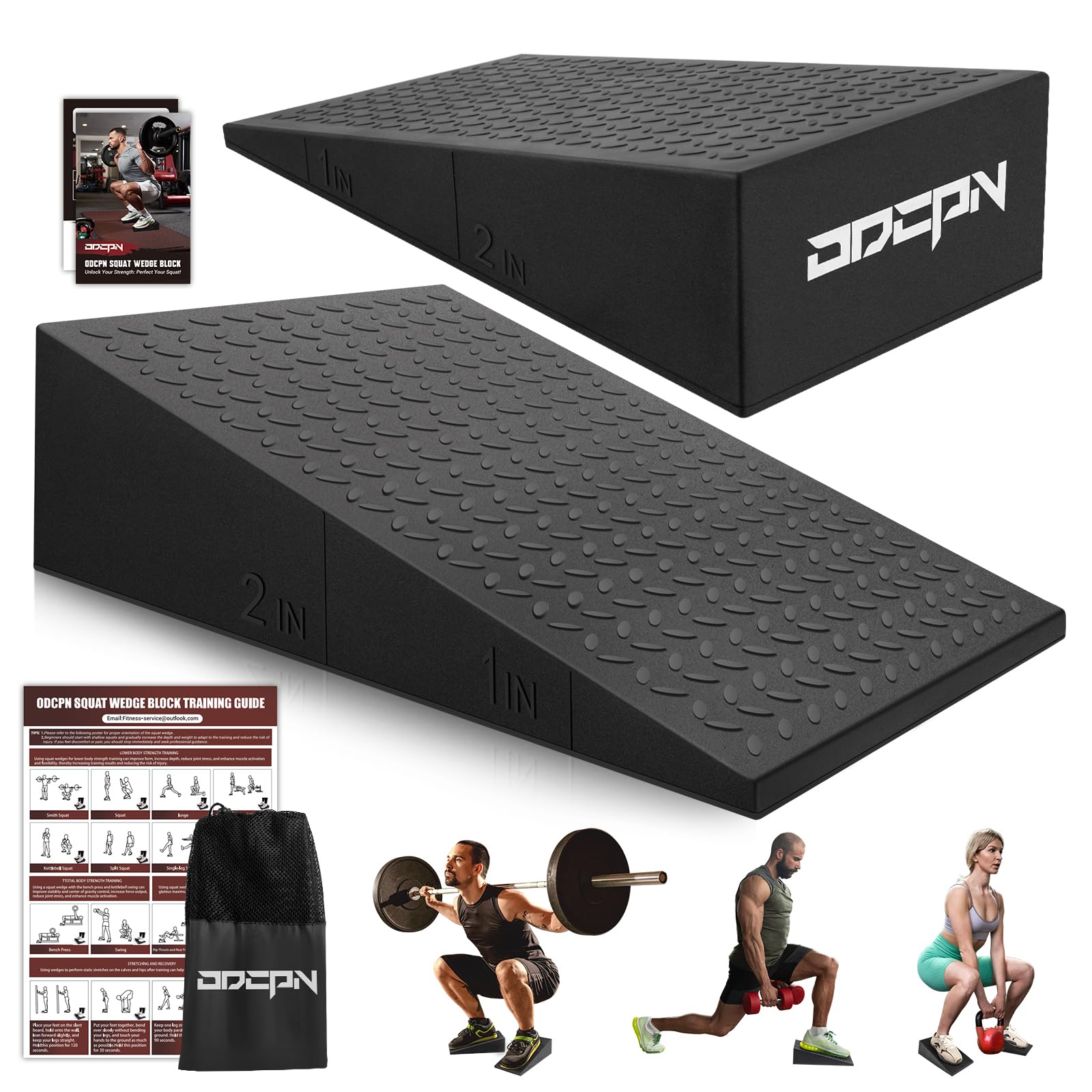
ODCPN Squat Wedge Block

93 /100
Peggy's Score Outstanding

Key details

Incline
15°
Load Rating
1500 lb
Set Includes
Two wedges, bag, poster
Platform Per Wedge
11.8 x 5.9 in
Check Details on Amazon

The first thing we check on a squat wedge is whether the whole foot fits, and this pair passes. Each block runs 11.8 inches long and 5.9 inches wide, so a size 10 shoe sits on it without overhanging the front edge, and the heel never hangs off the back. That platform, a rigid ABS core, and a 15-degree incline are the three reasons it is the pair we recommend first.

Rigid is the operative word. Foam wedges give a little underfoot, which is pleasant for stretching and much less so with a bar on your back; this one holds its shape. The textured top and base keep both the block and your foot where you put them, on hardwood and on a gym mat alike. The 15 degrees is the angle most of these picks share, and it is enough to let your knees travel forward over your toes when your ankles resist.

What you give up is stance width. The blocks are separate, so you place them where you like, but each top is 5.9 inches across and a very wide sumo stance pushes the outside of the foot past the edge. The set arrives with a bag and a drill poster, which is a nicer introduction than most here get and genuinely useful if you have never trained with a heel lift before.

Pros

  • Rigid ABS does not compress under load
  • Grippy top and base on floors and mats
  • Full-foot 11.8 x 5.9-inch platform
  • Storage bag and drill poster included

Cons

  • Fixed 15-degree angle, no shallower setting
Our verdict

We recommend this pair first: a rigid body that will not compress, grip on both faces, and a platform long enough for a full shoe.

Check Latest Price
2

Best for Wide Stances

Wolf Wedge Squat Wedge Block

91 /100
Peggy's Score Outstanding

Key details

Weight
1.5 lb
Incline
15°
Platform
26.6 in wide
Load Rating
1000 lb
Check Details on Amazon

A wide board solves the problem two separate blocks create. Every time you step up on a pair, you are re-checking the gap between them; with 26.6 inches of continuous platform, you set your feet once at whatever width your stance wants and the surface is already under both of them.

That is why this is the one we point wide-stance and taller lifters toward. The EVA is dense enough to hold its 15-degree shape under a heavy squat rather than flattening at the front edge, the non-slip top and base grip in shoes or bare feet, and at 1.5 pounds it slides under a bed or a couch between sessions instead of occupying floor space. It is the simplest thing here to live with.

The one-piece format does close a door: you get a single angle under both feet, so the staggered setups and per-side height changes the stackable sets allow are not on the table. Within a plain two-footed squat, though, nothing here is quicker to step onto.

Pros

  • One 26.6-inch platform covers any stance
  • Dense EVA holds its shape under weight
  • 1.5 lb and stows under furniture

Cons

  • Most expensive pick in this set
  • 26-inch board does not fit a gym bag
Our verdict

Our pick for wide stances: one 26.6-inch board that holds both feet where you put them, in a light slab that stows under furniture.

Check Latest Price
3

Best Budget

NOONCRAZY Slant Board Set

89 /100
Peggy's Score Excellent

Key details

Angles
Five adjustable
Weight
1 lb
Platform
12 x 6 in
Load Rating
960 lb
Check Details on Amazon

Two boards, about a pound, and five usable angle combinations: this is the cheapest way into adjustable heel height in this set. You change the angle by stacking one board on the other, which takes a second and gives you everything from a gentle stretch to a steep heel lift.

It is the most versatile pick here for ankle and calf work. The shallow setting is gentle enough to hold for a full minute, and the deep one gets a stretch the fixed 15-degree wedges cannot reach. At 12 by 6 inches the platforms take a whole foot, and both boards drop into a tote for the gym or a trip.

One practical note: on smooth hardwood the base slides when you step on. A textured mat under the boards ends it, and bare hardwood is the one surface we avoid. Otherwise, for the money, this set does more different jobs than anything else here: calf stretch, warm-up, goblet squats, calf raises.

Pros

  • Five angles from two stackable boards
  • About a pound, easy to travel with
  • Strong for calf and ankle stretching

Cons

  • Light foam feel under a heavy bar
Our verdict

We keep this one for stretching and lighter squats, since it is the least expensive route to several heel heights here.

Check Latest Price
4

Best for Heavy Lifting

HarderWill Adjustable Squat Wedge

91 /100
Peggy's Score Outstanding

Key details

Weight
5.6 lb
Heights
Three adjustable
Platform
7.5 x 4.7 in
Load Rating
2000 lb
Check Details on Amazon

Two and a half kilos of rubber does not move. You drop the HarderWill on a gym floor, step on, and it stays where you put it, which is exactly the property you want when there is a loaded bar across your shoulders and no spare attention for your feet.

Three interlocking sections give you three heights: stack them for a steep heel lift, split them for something gentler. The ridges between sections lock into each other, so a stack does not slide apart as you load it, and the 2,000-pound rating is the highest claimed by anything here. We rate it the most secure of the adjustable picks for heavy work.

The platform is the part to measure before you order. At 7.5 inches deep and 4.7 wide it is smaller than the two-block wedges on this page, so a size 12 shoe will overhang the front edge and a wide stance puts the block under the middle of the foot rather than the whole sole. For a narrow, heavy home setup, that is a fair trade.

Pros

  • Three heights from interlocking rubber
  • Heavy rubber base that does not shift
  • Highest load rating in this set

Cons

  • Heavy 5.6-lb set stays home
Our verdict

We rate this the most secure adjustable pick for loaded squats, as long as your foot fits the platform.

Check Latest Price
5

High Load Rating

Folaps Squat Wedge Block 2-Pack

91 /100
Peggy's Score Outstanding

Key details

Incline
15°
Load Rating
2200 lb
Set Includes
Two wedges, bag, guide
Platform Per Wedge
12.2 x 6.1 in
Check Details on Amazon

On paper this is our top pick's twin: two 15-degree blocks, a 12.2-inch platform, a higher 2,200-pound rating, and a bag. We still put the ODCPN pair first, because the top surface here is the weak link. The diamond pattern reads as traction but behaves more like decoration, and a socked or smooth-soled foot can slide forward on it during a set.

Everything else is solid. The blocks are wide enough for a full foot, the dense body does not flex under bodyweight or a moderate bar, and they sit flat on a mat without rocking. For split squats and lunges, where you are moving one foot at a time, they are easy to reposition and forgiving of a slightly uneven placement.

Wear rubber-soled training shoes and the traction question mostly disappears, which is how we use them. If grip is what you care about most, buy the ABS pair above; if you want the higher rating and a slightly longer platform, this one is a reasonable buy at a similar price.

Pros

  • Highest load rating here at 2,200 lb
  • 12.2 x 6.1-inch platforms fit a full foot
  • Light enough for a gym bag, bag included

Cons

No notable drawbacks to flag.

Our verdict

A sturdy, high-capacity pair that we rank below our top pick, because the textured top is slicker underfoot than it looks.

Check Latest Price
6

Calf and Achilles Stretching

OPTP PRO-Slant Foam Wedge

92 /100
Peggy's Score Outstanding

Key details

Width
11.75 in
Weight
14 oz
Incline
18°
Material
Closed-cell foam
Check Details on Amazon

The PRO-Slant is the odd one out here, deliberately so. It is an 18-degree closed-cell foam wedge sold as a pair, and the listing positions it as much for foot and ankle therapy as for squatting. That is the right way to read it: as a stretching tool that happens to work under a heel.

As a stretching board it is excellent. The 18 degrees gets a deeper calf and Achilles stretch than the 15-degree squat wedges, and at 14 ounces for the pair you can keep one in the living room and one by a desk without noticing either. The foam has a little give, which is kind to a bare or socked foot in a way that hard plastic never is, and it doubles as a foot rocker for plantar fasciitis and heel-spur work.

That same give is why we do not recommend it as a lifting wedge. Under a loaded squat the foam compresses and stops holding the angle you bought it for, and a firmer ABS or rubber pair costs no more. Buy this to loosen calves and ankles between sessions, which is where it earns its keep.

Pros

  • Steep 18-degree incline for calf work
  • 14-ounce pair keeps anywhere
  • Comfortable under a bare or socked foot

Cons

  • Pricier than the other foam options here
Our verdict

We reach for this one to stretch calves and ankles, not to squat heavy, because the 18-degree foam is the most comfortable board here under a bare foot.

Check Latest Price
7

Adjustable Home Setup

UNMERA 6-Piece Squat Wedge Set

88 /100
Peggy's Score Excellent

Key details

Pieces
Six stackable
Weight
5.2 lb
Load Rating
1400 lb
Platform Per Block
7.1 x 4.7 in
Check Details on Amazon

Open the box in the garage, not the living room. The six rubber blocks come out smelling strongly of tire, and while it fades, the first few days are pungent enough that leaving them outdoors for a while is worth the wait before bringing them inside.

What you get in exchange is the most adjustable system here: six pieces that lock together into several heights and angles, rated to 1,400 pounds, with a tire-tread texture on the top face that holds a shoe in place. The interlocking design keeps a stack together rather than letting pieces skate apart underfoot, and the rubber wipes clean after a session.

Two blocks side by side make a wider platform per foot, which is how we set them up for squats; a single piece is enough for calf raises and stretching. The set runs about five pounds, so it is a stay-at-home tool rather than something you carry to a commercial gym every week.

Judged as an adjustable home-gym kit, it earns its place: several usable configurations, a surface that grips in shoes, and a price in the middle of this group. Just budget a few days of airing out before the first indoor session.

Pros

  • Six blocks stack into several heights
  • Tire-tread top holds a shoe
  • 1,400 lb rubber construction

Cons

  • Small 7.1 x 4.7-inch blocks
Our verdict

Our most adjustable set, with a tire-tread top that grips, and a new-rubber smell you should plan to air out before indoor use.

Check Latest Price
8

Stretching and Warm-Ups

ZocoSquat 3-Piece Wedge Set

86 /100
Peggy's Score Excellent

Key details

Angles
8.5° and 17°
Pieces
Three
Weight
11 oz
Load Rating
960 lb
Check Details on Amazon

Three pieces, two angles: a pair of 8.5-degree blocks and one steeper 17-degree block that you use under both heels or stack for a bigger lift. It is a neat way to cover stretching and squatting with one kit, and at 11 ounces the whole set disappears onto a shelf when you are done.

For warm-ups and stretching it works well. The shallow blocks are gentle enough to stand on through a slow calf stretch, and the 17-degree piece gives the deeper heel lift when you want a squat to feel more upright. The 960-pound rating is generous for something this light, and the set is easy to travel with.

The base is where it loses ground. On a smooth floor or a foam mat the set can slide when you step on it. Carpet or a textured mat fixes that, and it is how we use the shallow blocks for stretching. On bare hardwood, keep your weight off it until you have checked that it holds.

Judged as a cheap, light kit for mobility work, it earns its place at the budget end of this group. What it is not is a platform for a heavy barbell, and for that job we reach for the rubber picks instead.

Pros

  • Three pieces cover 8.5 and 17 degrees
  • 11-ounce set stores anywhere
  • Useful for calf and ankle stretching

Cons

  • EPP feels like dense foam, not solid
Our verdict

A light, inexpensive kit we keep for stretching and warm-ups; loaded squats call for the rubber or ABS picks here.

Check Latest Price

How We Tested the Best Squat Wedge Blocks

We started by gathering every wedge block we could find — dense foam, cork, rubber-coated, and a few rigid plastic models — then filtered that list by stated incline angle, footprint, weight, and whether it shipped as a single or a pair. Anything that wouldn't publish its angle, or that looked flimsy on paper, got cut. Fourteen made the final list, and each one went through three and a half months of real training: garage sessions before work, living-room stretching at night, and a stretch on rubber gym flooring.

Every wedge was used barefoot and in lifting shoes for bodyweight, goblet, and split squats, and I wrote down whether it slid, rocked, or held firm when I drove through my heels — and whether my heels actually stayed down at the bottom. I stood on the outer edge to see how much the surface sank under load, measured the footprint against a shoulder-width stance, and weighed each one on a kitchen scale to check the lightweight claims. Traction got the hardest look on smooth hardwood with slightly damp feet, since that's where nearly all the slipping happened.

Material and odor were judged on day one and again a week later: a sniff straight out of the box, then a second one once each block had aired out, plus a thumb-and-nail check for crumbling edges or slick, worn-down corners after months of use. We flipped each wedge to its shallower side, stretched calves against a wall, and generally tried to abuse them. Value came down to one question — did it still look and perform the same at the end as it did on day one.

How to Choose Squat Wedge Blocks

Grip, Top and Bottom

Two surfaces have to hold: the base against the floor and the top against your foot. Smooth hardwood and soft foam mats are where both give up, and a wedge that creeps sideways as you descend is worse than no wedge at all.

Look for a rubber or silicone base rather than a plain plastic edge, and a top with a real raised texture rather than a molded pattern. Then test it unloaded, in the shoes you actually squat in, before you add weight. If it walks, put a textured mat underneath or send it back.

Fixed Angle or Adjustable Height

Most wedges here sit at 15 degrees, which is enough for most people to keep their heels down and let their knees travel forward. Stiff ankles want more lift; mobile ankles want less, and standing on a steeper ramp than you need will push you backward.

Adjustable sets solve that: stackable pieces give a shallow setting for warm-ups and a steep one for stretching. Every joint in a stack is one more place for movement, though, so favour interlocking pieces with ridges over loose boards that just sit on top of each other.

Platform Size and Stance Width

Two blocks let you set your own stance; a single board sets it for you. Either way, length matters most: 11 to 12 inches covers a whole shoe, while a 7-inch block leaves a big foot hanging over the front edge and shifts your weight onto the ball of the foot.

If you squat wide, measure your stance before you order. Two blocks set apart cover far more width than any single wedge, but a 26-inch board covers both feet with no lining up and no chance of placing one block an inch forward of the other.

What the Wedge Is Made Of

Rigid ABS and dense rubber hold their angle under a loaded bar and feel planted underfoot. EPP foam is light and cheap, with a springy, hollow feel. Closed-cell foam and cork are kinder to a bare foot and excellent for stretching, though cork can crumble at the edges with hard use and foam compresses.

For squatting with weight, buy rigid. For stretching, foam is comfortable and usually costs less. Rubber often smells of tire for the first few days, so plan on airing a new set out before you use it indoors.

Carrying It and Storing It

Two wedges and a drawstring bag drop into a gym bag; a 26-inch board does not. Weight tells you where the product will live: a one-pound foam set travels, and a five-pound rubber stack stays in the garage or the spare room.

If you train at a commercial gym, buy the pair you can carry and use their mats. If your squat rack is at home, the heavier set is the better long-term buy because it never needs repositioning mid-session.

Frequently Asked Questions

Final Verdict

Start with the ODCPN pair. It is the combination most home lifters need: a rigid body that will not compress, grip on both faces, and a platform long enough for a full shoe, all at a midrange price.

Two requirements send you elsewhere. A wide stance or a dislike of lining up two blocks points to the Wolf Wedge, whose 27-inch board holds both feet in one piece. A tight budget plus a need for several angles for stretching and warm-ups points to the NOONCRAZY set.