Best Multi-Loop Stretching Straps of 2026

There's a hard limit to how far you can pull your own leg into a hamstring stretch, and it usually arrives when your arms quit, not your hamstrings. That's the premise behind a multi-loop stretching strap: a firmly woven band with grab points stitched at intervals, so you can hold a stretch at the distance your body actually needs instead of wrapping a single strap around your hand three times and hoping. It fixes the awkwardness of stretching alone, with no partner, no slipping towel, and no burning grip.

I keep one in the living room and one in my gym bag, and I've handed them to friends who insist they're just not flexible. Over four months, my team and I put 14 of these straps through daily use, and the differences show up about 30 seconds into a hold: whether the loops land where a bare foot actually sits, whether the webbing bites into your arch, and whether the strap quietly gives under load, because a stretchy strap defeats the entire purpose. Loop count gets all the attention, but spacing matters more, and five well-placed loops beat eight crowded ones every time.

1

Best Overall

OPTP Stretch Out Strap

95 /100
Peggy's Score Outstanding

Key details

Made In
USA
Includes
Illustrated exercise book
Material
Nylon
Item Weight
4 oz
Check Details on Amazon

The booklet is the part we did not expect to matter. It ships with the strap, it is slim enough to leave in the bag, and it shows each position alongside the muscles that stretch is meant to reach, so a beginner can start without a class or a video. That pairing, a stiff non-elastic nylon strap plus instructions telling you what to do with it, is why this is the one we recommend before anything else on this list.

The strap itself is deliberately plain: thick green nylon webbing, loops running its length, and a 4-ounce weight that adds nothing to a gym bag. We found the loop layout does the work a handle would, since pulling from a loop rather than gripping the tail keeps your shoulder relaxed when your hands are weak or your hamstrings are tight.

It is the least adorned strap in this group. Where the CTRL Sports and the Gradient Fitness add padded grips and a carry bag, this one is webbing, loops and a booklet, and the booklet's page layout is dated enough that the drawings, not the design, are doing the teaching. The layout has not stopped us using it.

What settles it for us is day one: you are following a printed program instead of guessing, and the design has barely changed since 1993 because it did not need to. If you already know your routine and only want webbing, the Trideer is cheaper. If you want the instructions that come with it, this is the strap that ends the search.

Pros

  • Booklet shows positions and target muscles
  • Non-elastic nylon holds a set distance
  • 4 ounces, so it travels unnoticed
  • Thick webbing that keeps its shape

Cons

  • Thick webbing starts out stiff
Our verdict

This is the strap we tell people to buy first: the original, with a booklet that teaches the stretches and 4 ounces of nylon that goes anywhere.

Check Latest Price
2

Best Value

Trideer Stretching Strap

95 /100
Peggy's Score Outstanding

Key details

Width
1 inch
Length
75 inches
Material
Polypropylene
Item Weight
3.2 oz
Check Details on Amazon

You can spend a good deal more on a strap that does the same thing. The Trideer is 75 inches of 1-inch polypropylene webbing with loops spaced from end to end, reinforced stitching where the loops meet the body, and a non-elastic construction that holds whatever distance you set. At 3.2 ounces it is the lightest strap in this group, and it rolls down to roughly the size of a rolled sock.

Where it earns its place is as the second strap: the one for the car, the office drawer, or the gym bag you do not want to think about. Mechanically it does everything our top pick does, and for a strap you are going to leave somewhere and forget about, that is the right trade.

Pros

  • Lightest strap here at 3.2 ounces
  • Loops spaced along the full length
  • Reinforced stitching at each loop

Cons

  • Narrow 1-inch webbing presses into palms
  • Included guide is a leaflet, not a booklet
Our verdict

Our value pick: it does the same mechanical job as our top pick for less money, and at 3.2 ounces it is the lightest strap here.

Check Latest Price
3

Best for Tall Users

SANKUU 12-Loop Strap

95 /100
Peggy's Score Outstanding

Key details

Loops
12
Width
1.57 inches
Length
8 feet
Includes
Workout poster
Check Details on Amazon

Eight feet of strap is the whole point. If you are tall, long-legged, or working with hamstrings that stop you well short of your toes, the extra reach over the 75-inch straps is the difference between holding a stretch and losing your grip on it. That length is why this is our pick for taller bodies.

The 1.57-inch webbing is the widest in this group, which spreads the pull across your arch instead of cutting into it, and 12 loops mean smaller jumps between positions when you are close to your limit. The nylon is stiff enough to push back against, and just over 6 ounces still rolls up small enough to live in a gym bag.

If you are shorter, you will be gathering the extra webbing for seated stretches, which is a small annoyance rather than a problem. Where it stops making sense is if you only ever stretch lying down with your knee already bent, because you would be paying for reach you never use. For anyone who has run out of strap mid-stretch, it ends the problem.

Pros

  • Longest strap here at 8 feet
  • 12 loops for finer adjustment
  • Widest webbing at 1.57 inches
  • Nylon holds its shape under load

Cons

  • Poster is a wall chart, not a floor guide
Our verdict

If you are tall or your hamstrings are stubborn, start here: 8 feet of webbing and 12 loops mean there is always another inch to grab.

Check Latest Price
4

Best for Bare Feet

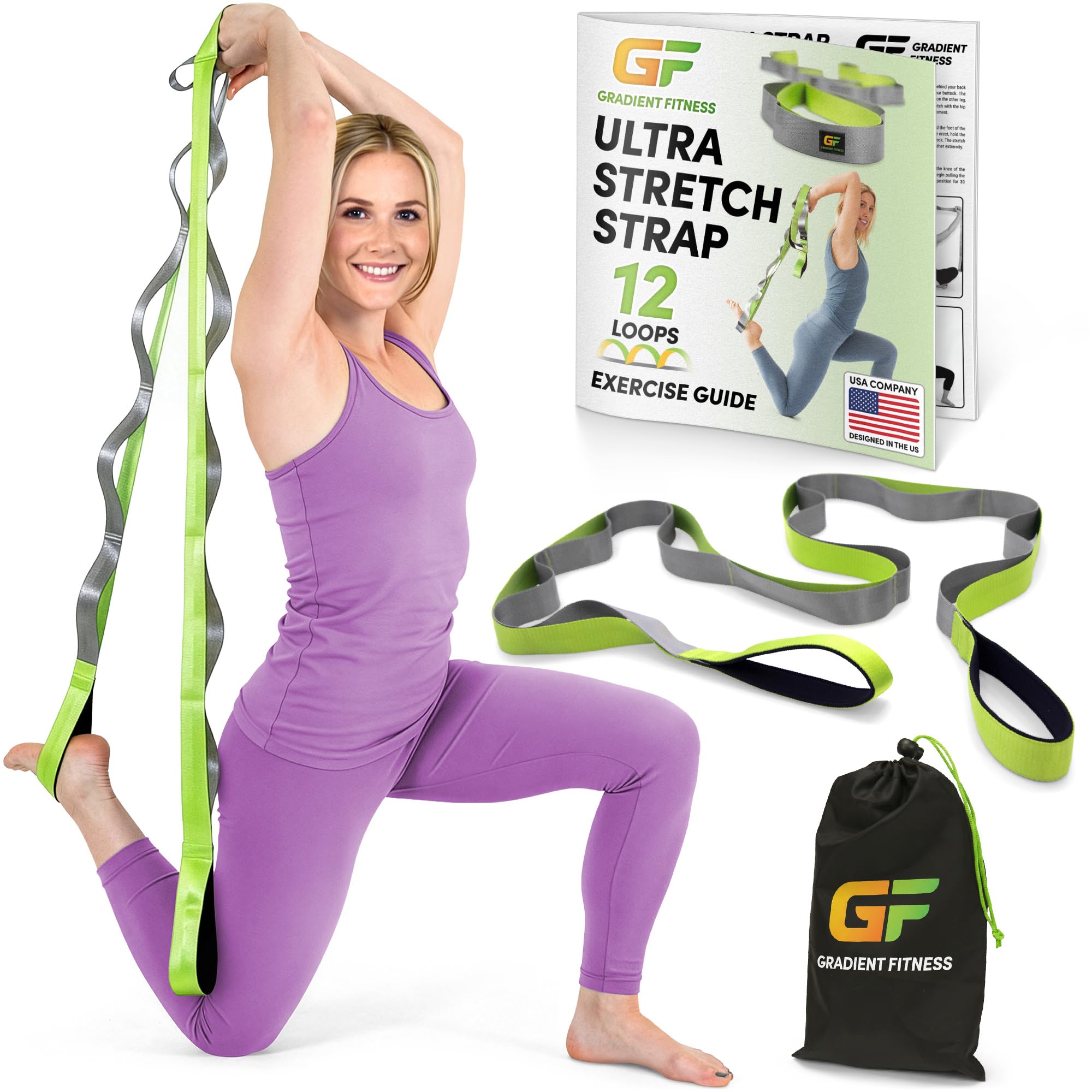
Gradient Fitness 12-Loop Strap

95 /100
Peggy's Score Outstanding

Key details

Loops
12
Width
1.5 inches
Length
8 feet
Includes
Storage bag and manual
Check Details on Amazon

The 1.5-inch webbing is what you notice first, and then the padding. Most straps here are a strip of nylon and nothing else; the Gradient Fitness is 8 feet of wide webbing with 12 reinforced loops and end loops lined in neoprene exactly where a bare foot or a palm sits. That is the contact point on most floor stretches, and it is the first place a cheap strap starts to feel like work.

The rest of the package is sensible: a storage bag so it does not live loose at the bottom of a gym bag, an instruction manual with positions, and enough length that tall users are not stuck. Eight feet is more strap than a shorter user needs, but the extra loops absorb the slack, so it stays a mild annoyance rather than a dealbreaker.

Where it earns its slot is comfort at the contact points. If bare feet on plain webbing is the reason you quit a hold early, this fixes it for roughly what the budget straps cost, and the length is a bonus rather than the headline.

Pros

  • Neoprene-lined end loops for bare feet
  • 12 loops along 8 feet of strap
  • 1.5-inch webbing spreads the pull
  • Storage bag included

Cons

  • Heavier than the plain 75-inch straps
Our verdict

The one we hand to anyone with tender feet: neoprene-lined end loops and a 1.5-inch width make long holds a lot more bearable.

Check Latest Price
5

Best for Sensitive Hands

CTRL Sports 10-Loop Strap

95 /100
Peggy's Score Outstanding

Key details

Loops
10
Width
1.5 inches
Length
78 inches
Includes
Carry bag and stretch guide
Check Details on Amazon

The padding is the difference. Where most loop straps are bare webbing, the CTRL Sports puts neoprene grips where your hands and feet land, and over a few long holds you notice it, because your palms stop getting that hot, chafed feeling that has you letting go a repetition early. It is a small thing that decides whether you finish the second side.

The rest is solid: 78 inches of 1.5-inch nylon, 10 loops, a drawstring carry bag, a printed stretching guide, and video exercises alongside it. At 200 grams it sits in the middle of this group by weight and still rolls into its own bag without a fight.

Stitching is where straps usually fail, and this one is sewn heavily at every loop. In the time we have spent with it the webbing has stayed flat rather than curling at the edges, and it rolls up the same way each time, which sounds trivial until you own a strap that will not.

It suits anyone whose hands give out before their hamstrings do, and the bag means it travels without collecting lint from the bottom of a duffel. The 78-inch length is a quietly good number too: enough strap for floor work, not so much that you are managing a coil between positions.

Pros

  • Neoprene-padded grips at contact points
  • 78 inches of 1.5-inch nylon
  • Carry bag and video exercises

Cons

  • Most expensive strap in this group
Our verdict

Our comfort pick, and the one to choose if bare hands on webbing is what stops you stretching: padded grips and a bag to carry it in.

Check Latest Price
6

Long on a Budget

Acozycoo 86-Inch Strap

91 /100
Peggy's Score Outstanding

Key details

Loops
10 numbered
Width
1.5 inches
Length
86 inches
Includes
Carry pouch and exercise guide
Check Details on Amazon

Two different straps share this listing, and it is worth knowing which one you are buying. The 86-inch style is the one to want: 10 numbered loops on 1.5-inch nylon webbing, a carry pouch and an exercise guide. The other style is a plain 75-inch strap with no numbering, so check the style selector before you order rather than after.

At 86 inches it splits the difference between the 75-inch straps and the 8-foot ones, which is enough for supine hamstring work even if you are on the tall side. We were surprised how much the numbering changed the way we used it: last month you held loop six, this month it is loop seven, and that is a more honest record than a note that says you stretched. You give up the padded grips of the CTRL Sports and keep the length and the numbers, for considerably less.

Pros

  • 86 inches suits taller users
  • 10 numbered loops track progress
  • 1.5-inch webbing at a budget price

Cons

  • Two styles under one listing invite mix-ups
Our verdict

A lot of strap for the money: 86 inches, 1.5-inch width and numbered loops, as long as you order the 86-inch style and not the 75-inch one.

Check Latest Price
7

Hot Classes

Abiarst 10-Loop Strap

94 /100
Peggy's Score Outstanding

Key details

Care
Washable
Loops
10
Width
1 inch
Length
75 inches
Check Details on Amazon

We wash our straps more often than we expected to, and this is the one in the group sold as washable, made from a tight-knit fabric with a skin-friendly dye. That matters if the strap lives in a hot yoga bag, gets handed around a class, or spends the summer on a car seat between sessions.

The working specification is familiar: 75 inches long, 1 inch wide, 10 loops along its length, non-elastic, and about 3.5 ounces. It is the same shape as the Trideer and roughly as light, and the fabric feels softer in the hand than the polypropylene straps here, which is the kind of difference you only notice after a few long holds.

It is the least expensive strap in this group, which makes it the easy answer for a first strap, a spare for the studio, or the one that goes in the wash every week. Nothing about it feels disposable, and that is the part we did not expect at this end of the price range.

Pros

  • Washable, skin-friendly fabric
  • 10 loops across 75 inches
  • Light at about 3.5 ounces

Cons

  • 1-inch webbing is firmer underfoot
Our verdict

The one we point to for hot classes and daily home use: a washable 75-inch strap with 10 loops, at the bottom of the price range here.

Check Latest Price

How We Tested Multi-Loop Stretching Straps

We started by pulling every multi-loop strap we could find and narrowing the field by the specs that decide whether one is usable: loop count and spacing, webbing width, material, overall length, bar-tack stitching, and whether the hardware was a plain loop, a D-ring, or a door anchor. Anything made of elastic webbing or with fewer than four grab points got cut early, since those are the two things that make the format pointless.

Then we lived with 14 of them for four months. Straps went into morning floor routines in the living room, post-run cooldowns in the driveway, physical therapy homework for a cranky shoulder, and gym sessions where they got stuffed damp into a bag afterward. Each one was hooked over a bare foot, a socked foot, and a sneaker to see which end loops slipped off the arch and which webbing cut in during a 60-second hold. Two testers with very different bodies used them throughout: one in her sixties with tight hips, one a college athlete rehabbing a shoulder.

Durability got its own pass. We marked each strap with tape at 60 inches, then re-measured after repeated maximum-effort pulls to catch the ones that stretched out of shape, and we hung a 25-pound dumbbell from the end loop to watch for stitching strain. Straps were machine washed, left in a hot car, and checked for fraying at the loop bar tacks. The ones that held their length, kept their shape, and stayed comfortable under a real foot are the ones that made the list.

How to Choose Multi-Loop Stretching Straps

Start With Non-Elastic

A stretching strap works like a rigid lever: you set a distance, hold it, and next week the same loop gets you a little further. Elastic webbing undoes that, because it gives as you pull, so the distance you are actually holding changes mid-stretch and you cannot tell whether you improved. Every strap in this guide is woven, non-elastic webbing.

The trap is in the wording. If a listing mentions a stretch factor or a percentage of elasticity, it is a band rather than a strap, and it belongs in a different purchase. Want resistance work as well as stretching? Buy a band for it and keep this one rigid.

Match the Length to Your Body and Your Floor Work

Seventy-five inches, a little over six feet, is the standard, and it covers most people for supine hamstring and calf stretches. Add length if you are tall, if your hamstrings are tight enough that you hold the strap at arm's length, or if you stretch with both hands overhead. The straps here run from 75 to 98 inches.

Here is what buyers get wrong: the listed figure is reach, not package size, so a short strap described as compact will leave a tall user short at the worst moment. Short users can gather the slack, so err long if you are near six feet.

Count the Loops, Then Look at the Spacing

Loops are gears. Ten to twelve is the range here, and the more of them there are, the smaller the step between one hand position and the next, which is exactly what you want when you are an inch from your end range. Numbered loops do a second job: they let you record where you stopped and compare it with last week.

Look at loop size as well as count. If you plan to hook a foot in, a loop that only fits bare toes is a nuisance with a sock on, and some straps have no centre opening at all. Check the loop against the foot or hand that will actually be pulling.

Weigh Width and Padding Against Weight

One-inch webbing is lighter, rolls smaller and costs less. At 1.5 inches the pull spreads across the palm and the arch, which you feel on long holds and bare feet. Padding at the contact points, whether neoprene grips or lined end loops, is the next step up and adds a little bulk to the roll.

Thicker webbing is more durable but starts stiff, and a stiff strap takes a few sessions to soften. If you stretch barefoot for twenty minutes a day, pay for width and padding. If the strap lives in a bag for occasional use, an inch is plenty.

Take the Included Guide Seriously

An instruction booklet is not filler. The best one here shows each position alongside the muscle group it targets, which is the difference between a routine and a guess, and after surgery a printed sequence is easier to follow than remembering what your therapist showed you.

If you already know your positions, do not pay for guidance you will not read; that money is better spent on width. If you are starting from nothing, the booklet is worth more than an extra half inch of webbing.

Frequently Asked Questions

Final Verdict

The OPTP Stretch Out Strap is the one we point people to. It is the only strap here that teaches the stretches while you are holding them, the nylon is stiff enough to trust under a real pull, and at 4 ounces it lives in the gym bag instead of the closet.

Two requirements change the answer. If your hands give out before your hamstrings do, the padded grips on the CTRL Sports are worth the premium. If you are tall or long-legged, go straight to 8 feet with the SANKUU, because the 75-inch straps run out of reach just when you need them most.