Best Interlocking Gym Floor Tiles for Home Gyms of 2026

Rubber tiles grip like a tire but punish your knees; foam is kind to your joints and then skates across the concrete the first time you sweat on it. That trade-off is the whole ballgame with gym flooring, and most sets land hard on one side of it. What you want is a surface that stays put under a squat rack, wipes clean after a session, and still feels fine under a push-up — the difference between a real floor and a puzzle lying on top of one. Over the past eight months, my team and I have laid out 12 sets, and the gaps in fit, grip, and durability are wider than the photos suggest.

Nobody warns you that thickness does most of the work: a quarter-inch tile and a half-inch tile from the same lineup feel like different products, and only one shrugs off a dropped dumbbell. I also learned to leave breathing room at the walls, since tiles pushed tight against all four sides buckle a month in. Every set got the sweaty-hands test and at least one full teardown. The picks below are the ones that stayed flat and stayed put.

1

Best Overall

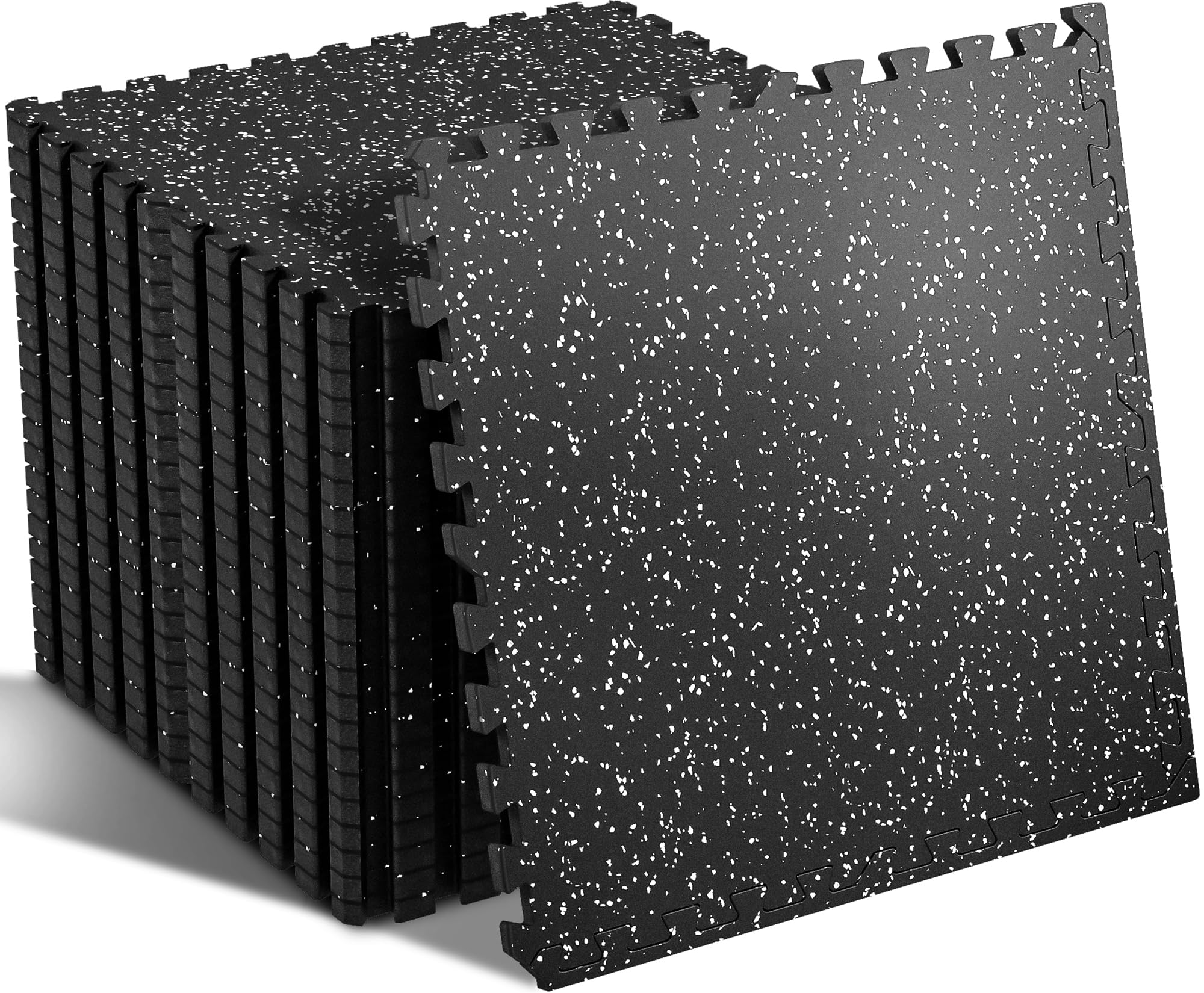
AIRHOP Rubber-Top Gym Tiles

91 /100
Peggy's Score Outstanding

Key details

Coverage
48 sq ft (12 tiles)
Thickness
0.56 in
Construction
Rubber top over EVA foam
Check Details on Amazon

Socks are the tell. Half the foam tiles we laid felt fine barefoot and turned slick the moment we pulled a sock on, and that one detail is what makes a cheap gym floor feel cheap. The AIRHOP set deals with it at the surface: each 24-inch tile is an EVA core with a recycled rubber face bonded on top, so the part your foot meets behaves like a gym floor rather than a play mat.

The rest of the build holds up its end. At 0.56 inches it is dense rather than squishy, so a loaded rack sits on it without the floor seeming to give way underneath, and the rubber skin spreads point loads instead of letting a bench foot punch a crater. Twelve tiles make 48 square feet — an 8-by-6 floor, enough for a rack and a bench, or a bike and a mat — and the larger locks keep seams closed when you drag something heavy across them.

Assembly is the usual puzzle routine and cleaning is a damp cloth. The thing to plan for is the smell: it arrives rubbery, and ours spent a couple of days airing out on the driveway before it went into a spare room. Do that first and odor stops being part of the story.

What we keep coming back to is how little you give up here for a room where actual weight gets moved. It is not a competition platform and does not claim to be; it is a floor you stop noticing mid-workout, which is the best thing a gym floor can do.

Pros

  • Rubber face grips in socks and shoes
  • Firm 0.56-inch core under a loaded rack
  • 48 sq ft from twelve 24-inch tiles
  • Quiets plates and dumbbells indoors

Cons

  • Last row can need coaxing into line
Our verdict

For most home gyms this is the one we point to: the rubber face grips in socks, and the dense foam core keeps a rack from feeling like it is on a sponge.

Check Latest Price
2

Best Value

BalanceFrom Puzzle Exercise Mat

93 /100
Peggy's Score Outstanding

Key details

Coverage
48 sq ft (12 tiles)
Material
EVA foam
Thickness
0.5 in
Edge Pieces
24 border strips
Check Details on Amazon

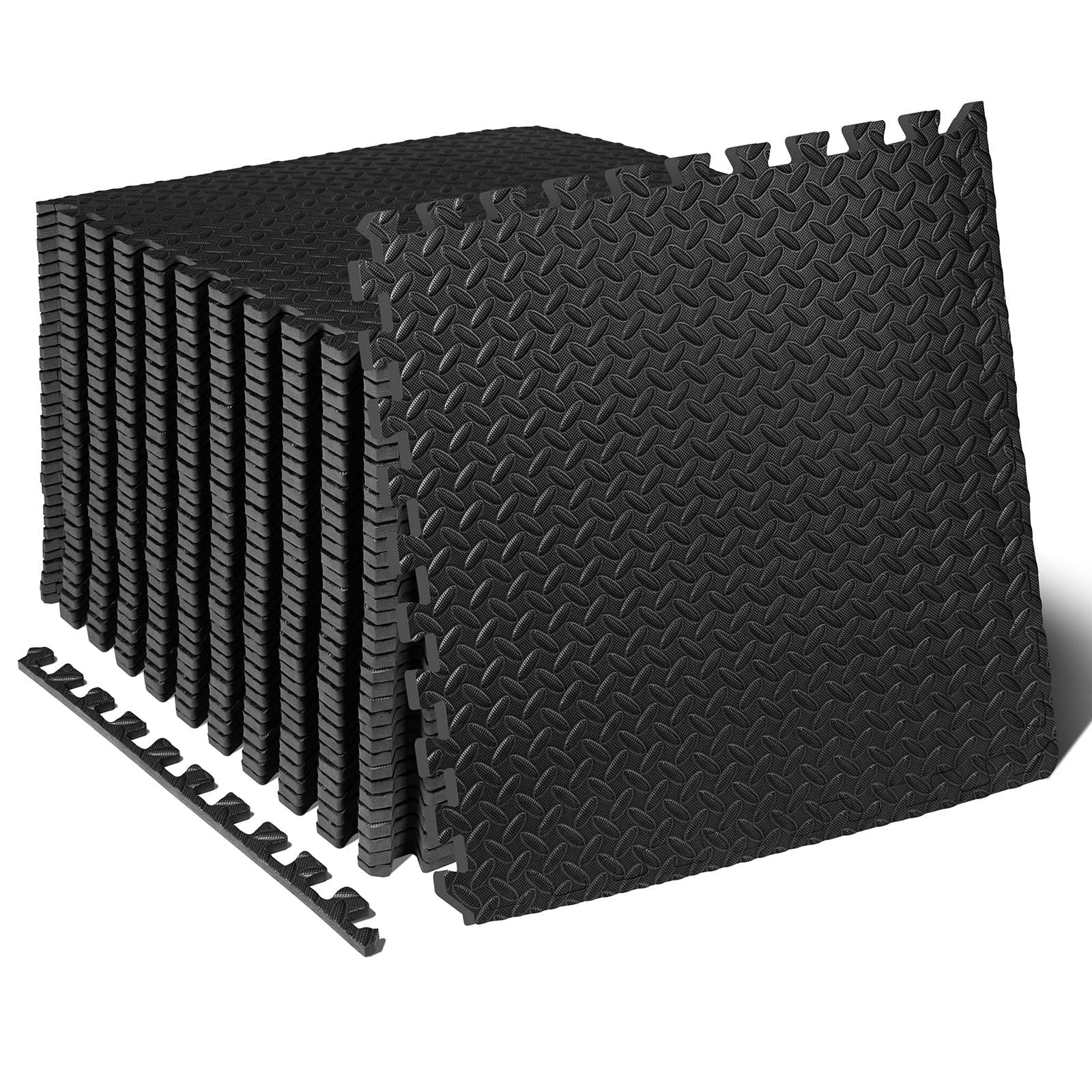
Twelve tiles and 24 border strips make an 8-by-6-foot floor, which is the size most home gyms actually need: room for a bench, a dumbbell rack, or a bike with space to step around it. That is the calculation this set wins on — a complete workout area without moving into rubber-topped territory.

Putting it down is genuinely quick. The puzzle edges seat with a push, and the border strips give a finished edge against a wall or a doorway instead of a row of teeth. We cut one tile around a door frame with a utility knife and the edge stayed square, which is not a given with foam at this price.

Half an inch of EVA is the right depth for floor work: kind to knees and elbows, warmer than concrete, and quiet enough that the people downstairs stop noticing your workouts. It is not a lifting platform — a loaded rack presses into it over time — but for stretching, cardio, and bodyweight sessions in a spare room, it is the sensible place to start.

Pros

  • Low cost for a full 48-square-foot floor
  • 24 border strips finish the perimeter
  • Half-inch foam is kind to knees and elbows
  • Snaps together and pulls apart for storage

Cons

  • Slick under socks on smooth hard floors
Our verdict

Our budget pick: 48 square feet of half-inch foam with border strips included, quick to lay and comfortable for floor work.

Check Latest Price
3

Best for Whole-Garage Floors

ProsourceFit Puzzle Mat, 144 Sq Ft

93 /100
Peggy's Score Outstanding

Key details

Coverage
144 sq ft (36 tiles)
Material
EVA foam
Thickness
0.5 in
Check Details on Amazon

A hundred and forty-four square feet is a two-car garage bay or a 12-by-12 basement corner, and thirty-six tiles plus end borders get you there in one order. That is the real argument for buying at this size: one color, one texture, one delivery, and no matching a second batch months later — which is exactly how people end up with two slightly different blacks under the same rack.

Half an inch of EVA does what this material should: supportive underfoot, forgiving on knees during floor work, and much quieter than bare concrete. We treat it as an equipment floor rather than a mat — a rack, a bench, a bike, or a turf strip all have somewhere to sit on it, and that is where the coverage pays off.

Assembly is quick, the borders dress the exposed sides, and a utility knife handles posts and door frames. ProsourceFit backs the tiles with a limited lifetime warranty against manufacturer defects, which is more than most of this group offers.

Pros

  • 144 sq ft covers a garage bay in one order
  • One color and texture across the whole room
  • Limited lifetime warranty on defects

Cons

  • Smooth EVA is slick in socks
  • Seams can creep open around heavy equipment
Our verdict

When the whole garage is the gym, this order floors it in one go: 144 square feet of half-inch foam with borders, and one consistent color across the room.

Check Latest Price
4

Best for Floor Work

ProsourceFit Weaved Puzzle Mat

95 /100
Peggy's Score Outstanding

Key details

Coverage
72 sq ft (18 tiles)
Material
EVA foam
Thickness
1 in
Set Weight
28.6 lb
Check Details on Amazon

An inch of foam is a different product from half an inch. Laid down, these tiles sit visibly higher than everything else here, and we felt the difference the moment we knelt: hips, elbows, and sit bones stop complaining partway through a long stretching session. If your gym is a mat and a set of dumbbells rather than a rack, that depth is the feature worth paying for.

Depth is also the trade. Soft foam does not hold a heavy rack level, and it skates when you push off it — ProsourceFit's own instructions suggest double-sided tape for maximum floor grip, which is the most honest line on the packaging. Tape a large floor down at the edges or accept that the tiles will wander.

Everything that happens on the floor is where it earns its keep: yoga, mobility work, stretching, a toddler, a guest bed for the weekend. Eighteen tiles cover 72 square feet with twelve borders for the exposed edges, the pieces come apart as fast as they go down, and the water-resistant surface wipes clean. The set is heavy in the box, though, so this is a floor you lay once and leave.

Pros

  • Full inch of cushioning for floor work
  • 72 sq ft with twelve border pieces
  • Comes apart quickly for storage
  • Water-resistant surface wipes clean

Cons

  • Dents under heavy equipment
Our verdict

If your gym is a mat rather than a rack, this is the one: an inch of foam that makes long floor sessions kind to hips, knees, and elbows.

Check Latest Price
5

Best Large Rubber-Top Set

SUPERJARE Rubber-Top Gym Flooring

90 /100
Peggy's Score Outstanding

Key details

Coverage
96 sq ft (24 tiles)
Thickness
0.56 in
Construction
EPDM rubber over EVA foam
Check Details on Amazon

Same idea as our top pick, at nearly double the size. Twenty-four tiles and 96 square feet — an 8-by-12 floor — mean a rack, a rower, and the walkway between them fit without a seam running through the middle of your setup. For a garage gym, that is the difference between a mat and a floor.

The build is a foam base with a speckled EPDM rubber skin bonded over it. Underfoot we found it firm rather than bouncy, with a little give when you are standing on it, and the speckle hides chalk and dust far better than solid black. It also takes the ring out of a dropped plate in a way concrete never will.

The part to watch is the bond between rubber and foam. That join is where this style of tile eventually fails, so unwrap and inspect every tile as you lay it and keep the flattest ones for the highest-traffic spot in the room. Assembly is straightforward, the interlock is secure once it is seated, and a damp cloth deals with sweat.

Pros

  • 96 sq ft covers a full garage bay
  • Speckled rubber top hides dust and chalk
  • Firm underfoot without a spongy feel
  • Deadens noise and vibration

Cons

  • Tiles can shift under quick footwork
Our verdict

The rubber-topped floor for a whole room: 96 square feet that turns a garage into somewhere you can walk in shoes and set a rack down.

Check Latest Price
6

Best Small Pack

CAP Interlocking Puzzle Mat

91 /100
Peggy's Score Outstanding

Key details

Surface
Diamond texture
Coverage
24 sq ft (6 tiles)
Material
EVA foam
Thickness
0.5 in
Check Details on Amazon

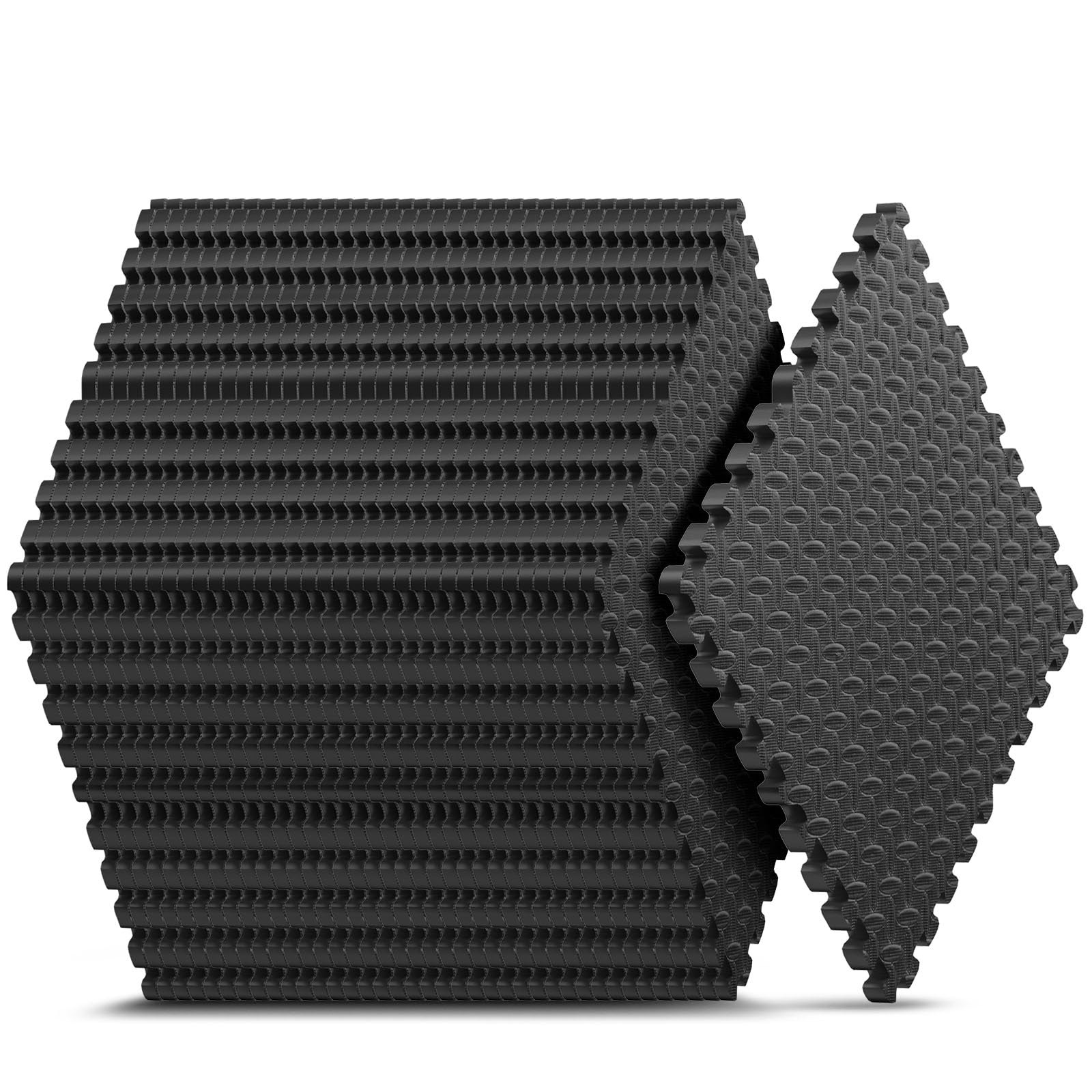
Not every gym is a room. Six 24-inch tiles give you a 4-by-6 pad — under a bench, in front of a bike, along the wall where the kettlebells live — and it is the smallest pack here that still ships with finishing strips for the edges you can see.

Half an inch of EVA with a diamond texture on the face is comfortable for floor work — we have knelt on worse — light enough to pick up and shake out, and easy to break down when the room needs to be something else. For a first apartment setup, or for finding out whether you will actually use a home gym before you give up a whole room to one, that is a low-risk way in.

Measure before you cut. Tiles do not always land exactly on the printed 24 inches and half inch, which does not matter in the middle of a floor and matters a lot against a wall, a door frame, or a rack footprint. Dry-fit the layout first, then trim from the back of the tile so the face edge stays clean.

Pros

  • Small pack suits corners and tight rooms
  • Finishing strips for clean edges
  • Light enough to shake out and store

Cons

  • Feet can slip when barefoot
  • Foam dents under equipment feet
Our verdict

Six tiles for the corner of a room: the low-risk way to floor a bench, a bike, or a first small setup without buying a whole gym's worth.

Check Latest Price
7

Garage Gyms

Nazhura Puzzle Exercise Mat

91 /100
Peggy's Score Outstanding

Key details

Surface
Textured pattern
Coverage
48 sq ft (12 tiles)
Material
EVA foam
Thickness
0.5 in
Check Details on Amazon

There is not much to say about a black foam tile until you put it down, and that is close to the pitch here: twelve 24-inch tiles, 48 square feet, borders included, textured face up. It is the set we hand someone who wants a gym floor and does not want to spend a weekend thinking about one.

The texture is the one detail that separates it from the smoother foam sets. The molded pattern hides scuffs from shoes and equipment feet better than a flat face, and it breaks up the light so a black floor does not read as a black hole in a dim garage. Over a concrete slab it takes the chill off and gives a bench something to sit on that is not stone.

Snapping it together is the easy part, and the tiles hold their layout once weight is on them — a bench, a rack, a bike. Cutting is simple with a sharp knife: score the face, then finish from the back so the edge stays clean. Cleanup is a vacuum and a damp cloth.

Where it lands in this group is the sensible middle. It is better finished than the cheapest sets, less specialized than the rubber-topped tiles, and nowhere near as deep as the inch-thick mat. For shoes-on training with equipment that stays in one spot, that is a good place to be.

Pros

  • 48 sq ft with borders for tidy edges
  • Easy to assemble and cut to fit
  • Cushioning well reviewed for the price

Cons

  • Slick under bare feet and socks
Our verdict

A plain 48-square-foot set that snaps flat, cushions well, and looks tidy in a garage gym — the no-drama choice.

Check Latest Price
8

Playroom Crossover

Stalwart EVA Foam Mat Tiles

90 /100
Peggy's Score Outstanding

Key details

Color
Multicolor
Coverage
32 sq ft (8 tiles)
Material
EVA foam
Thickness
0.5 in
Check Details on Amazon

Most gym tiles come in black, grey, or black. This set does not — eight tiles arrive in mixed bright colors, and we were struck by how much difference that makes in a basement corner with no natural light. If the workout space is also the kids' corner, it is not a small thing.

Underfoot the EVA is soft and lightly textured, and it is one of the friendlier surfaces here for bare feet: socks do not slide the way they do on smooth foam, which makes it a decent pick for yoga, stretching, and bodyweight circuits. Thirty-two square feet is a 4-by-8 strip or a generous corner.

Sixteen straight edge pieces mean all four sides can finish cleanly, and upkeep is a vacuum and a damp cloth. The tiles are light enough to lift a section out and shake it off after a sweaty session, which is more than you can say for the rubber-topped sets.

What it is not is a weight-room floor, and it does not pretend to be one. It is a mat-work and playroom surface that happens to live in a gym corner, and for that job the colors do as much work as the foam does — a floor you do not mind leaving down is a floor that gets used.

Pros

  • Bright multicolor tiles lift a dim room
  • Socks do not slide on the textured face
  • Sixteen edge pieces finish all four sides
  • Light enough to lift out and shake clean

Cons

  • Pieces separate under high-impact work
Our verdict

The set for a floor that does double duty: bright enough for a playroom, grippy enough for yoga, light enough to move when the room changes jobs.

Check Latest Price

How We Tested a Dozen Interlocking Tile Sets

We started by pulling every set we could find that listed a material, a thickness, and a tile size — the three numbers that actually predict how a floor will behave — plus a price per square foot low enough to make sense for a corner of a room. Anything with a pattern of complaints about curled edges or connectors that snapped on a second install got cut. That left 12 sets, from thin foam to dense rubber, which we laid in the same garage corner over eight months.

We timed assembly solo with a stopwatch: how long it took to square up the first row, whether tiles needed a mallet or clicked together by hand, and whether the finished field was genuinely flat or had high spots you could feel through a sock. Seams got measured after a week and again after a month, and we checked whether the floor had crept away from the wall we deliberately left room at.

Then we used them. Dumbbells came down from waist height, kettlebells swung, a jump rope skipped, a bike sat on one set for weeks. Grip was judged the honest way, with sweaty bare feet and damp socks mid-session, and stability by whether a loaded rack left dents or the tiles shifted under a hard lateral push. Every set was torn down and re-laid at least once to see if the connectors survived a move.

Cleanup came last: a mop, a mild cleaner, and a look at staining and lingering smell. The sets that made the list held their seams, wiped up without a fight, and still felt solid underfoot after months of use.

How to Choose Interlocking Gym Floor Tiles for Home Gyms

Foam or rubber-topped?

Almost everything here is EVA foam, and EVA earns its popularity: it is light, warm underfoot, and it cushions a knee or an elbow better than any hard surface. What it does not do well is grip. Smooth foam goes slick under socks and bare feet, and it compresses where a rack foot or a bench leg concentrates weight.

A rubber-topped tile — foam underneath, a rubber skin bonded on top — answers both problems at a price. The rubber face grips in shoes, shrugs off dragged benches, and spreads load across the foam beneath. If anything heavier than a kettlebell lives on your floor, or you train in shoes on concrete, that is the upgrade worth making. For yoga, stretching, and bodyweight work, plain foam is fine and costs less.

How thick should the tiles be?

Thickness buys comfort and costs stability. Half an inch is the default for good reason: it takes the edge off concrete, protects the slab beneath, and stays flat enough that a bench or a rack sits level. Three-eighths keeps a low profile under equipment; three-quarters to a full inch is what you want if the floor is where you spend your sessions, because a one-inch tile is noticeably kinder to knees, hips, and elbows.

The trap is buying depth for a weight room. A thick, soft tile under a rack is a wobbly rack. If a room has to do both jobs, buy a dense half-inch for the equipment zone and a deeper mat for the spot where you stretch.

Work out how much floor you need

Every 24-inch tile covers 4 square feet, so the arithmetic is simple: 12 tiles make 48 square feet, an 8-by-6 floor, and 36 tiles make 144. Measure the footprint of the equipment and add a foot of walk-around on every open side — that strip is where you actually stand, and it is the area people forget to order.

Buy the whole floor at once. A second order months later can come from a different production run with a slightly different shade, and a floor with a visible patch is a floor you notice every session. Smaller 12-inch tiles look cheaper per pack but multiply seams, and seams are what creep apart. Plan borders for every exposed edge, and score cuts from the back of the tile so the face edge stays clean.

Grip, in both directions

Non-slip in a listing usually means one of two things and rarely says which. Surface grip is your foot on the tile, and you check it in socks, since that is where smooth foam fails. Floor grip is the tile on your substrate, and that is the one buyers forget: on sealed concrete or hardwood, a light interlocking floor can drift, opening seams as it goes.

The fixes are cheap — carpet tape at the perimeter, weights at the corners, a rubber underlay beneath. If you pivot, as in martial arts, dance, or a flow-heavy practice, prioritise a textured or rubber-topped surface over extra depth. If you lift, prioritise the rubber top and stop worrying about cushion thickness.

Frequently Asked Questions

Final Verdict

For most home gyms, the AIRHOP set is the one to buy. The rubber face is what stops the sock-sliding that makes foam tiles feel like a compromise, and 48 square feet covers a rack, a bench, or a bike with room to move around it.

Stretch in either direction from there: the BalanceFrom set covers the same floor for less if the budget is tight, ProsourceFit's 144-square-foot set floors a whole garage in one order, and the inch-thick ProsourceFit Weaved is the kinder surface if your training happens on the floor rather than over it.