Best Gymnastics Mats of 2026

Thicker sounds safer, right up until you try to balance on it. A gymnastics mat has to do two opposing jobs at once: absorb a landing and stay firm enough that your hands and feet don't sink in when you hold a position. Buy too soft and every cartwheel feels like it's happening in sand; buy too firm and you've basically put a rug over the hardwood. What you're really buying is a floor that forgives a bad landing without turning a handstand into a workout.

The other decision most shoppers don't see coming is format: folding foam mats stack flat in a closet, while inflatable air mats roll up smaller and feel noticeably bouncier underfoot. I've spent recent winters watching cartwheels migrate from the backyard into my living room, and over the past six months my team and I have put 12 mats through daily use. Foldability, thickness, and cushioning get all the attention, but the hinge and the valve are what decide how long a mat actually lasts. The picks below are the ones we'd keep on our own floors.

1

Best Overall

We Sell Mats 4x8 Folding Mat

96 /100
Peggy's Score Outstanding

Key details

Weight
14 lb
Surface
Vinyl
Dimensions
96"L x 48"W x 2"Th
Check Details on Amazon

A four-by-eight footprint is the reason this mat wins. That's a genuine tumbling lane — wide enough for a cartwheel to finish where it started, long enough for a round-off into a back handspring — and it's one of only two mats here that doesn't reduce practice to a two-foot strip. The difference shows up the first time a kid links two skills and doesn't have to aim.

The foam is cross-linked and firm, so you get support on a landing instead of sinking through to the floor, and two inches is the same working thickness as everything else here, just spread over far more area. Fourteen pounds is heavy for a mat but manageable for one adult, and it folds into four sections with carrying handles, so it can live against a basement wall or flat under a bed.

The vinyl cover wipes down with soap and water, and the hook-and-loop edging grips carpet hard enough that the mat doesn't creep during a routine. On a deep-pile rug that same grip turns into a wrestling match when you want to reposition it; on hardwood it simply sits there without sliding.

What that buys costs both money and floor space, and neither is imaginary. If the mat has to go back in a closet every night, the three-pound BalanceFrom is the better fit. If you have a spare wall in a garage or a cleared corner of a basement, this is the mat that will still be the right size when the gymnast has outgrown the beginners' class.

Pros

  • Four-by-eight surface allows real tumbling
  • Firm two-inch foam supports landings
  • Folds in sections with carrying handles
  • Wipe-clean vinyl with strong edge grip

Cons

  • Fourteen pounds wants a semi-permanent spot
  • Velcro grabs deep-pile carpet
Our verdict

The best default for a family practicing real tumbling at home: four feet wide, eight feet long, and firm enough to land on.

Check Latest Price
2

Best Budget

BalanceFrom 2x6 Folding Mat

95 /100
Peggy's Score Outstanding

Key details

Weight
3 lb
Surface
Double-sided vinyl
Dimensions
6 ft x 2 ft x 2 in
Folded Size
2 ft x 2 ft x 6 in
Check Details on Amazon

Six feet long, two feet wide, three pounds, and a two-foot square once folded — this is the mat that lives in a closet and comes out for twenty minutes. It's also the least expensive route to two-inch foam in this group, which is why it's the one we point first-time buyers toward when the practice space doubles as a living room.

The foam is firm rather than squishy: knees and sit bones stay supported and don't bottom out, and the double-sided vinyl wipes clean after bare feet and chalk. Where it stops is width. Two feet is a body-width strip, fine for bridges, handstands, planks, and stretching, but a cartwheel or a round-off runs straight off the side. If someone in the house is working tumbling rather than conditioning, this isn't the mat for them.

For a toddler's first forward roll, a second mat laid alongside a bigger one, or a dorm room, it's hard to argue with. The handles are sewn into the fold, so a small kid can carry it and put it away alone, which matters more than it sounds when the mat's whole job is being easy to take out and easy to put back.

Pros

  • Light enough for a child to carry
  • Firm two-inch foam at the lowest price here
  • Folds to a two-foot square with handles
  • Double-sided vinyl wipes clean

Cons

  • Two-foot width rules out traveling tumbling
Our verdict

Buy it for drills, stretching, and small spaces — the lightest and least expensive way into two-inch foam, as long as nobody is tumbling across it.

Check Latest Price
3

Best for Small Spaces

RitFit 3x6 Folding Mat

93 /100
Peggy's Score Outstanding

Key details

Weight
10.6 lb
Surface
PU leather
Thickness
2 in
Dimensions
72"L x 36"W
Check Details on Amazon

Three feet of width is the difference between a mat you lie on and a mat you can land on. That extra foot over the budget two-foot mats is why we kept coming back to this one for cartwheels and round-offs in a room that isn't a gym — you get a landing zone without surrendering a wall of floor space.

The padding is a tridensity foam, firm through the middle with a little more give at the surface, and it holds up under knees and hands without bottoming out. The PU leather cover is sweat-resistant and wipes clean, with enough texture that bare feet don't skate. At 10.6 pounds it's a one-arm carry, and because it folds with the working surface inside, the top stays clean while it's stored.

Six feet of length is the limit. That's plenty for bridges, walkovers drilled in place, handstands, and conditioning, and not enough for a pass with a run into it — for that you need the ten-foot Polar Aurora or the 4x8 We Sell Mats. As the middle option here, it's the one we hand to a gymnast who is serious about practice but doesn't have a spare room.

Pros

  • Three-foot width lets cartwheels land
  • Firm tridensity foam that holds up
  • Sweat-resistant PU cover wipes clean
  • 10.6 pounds with built-in handles

Cons

  • Six-foot length won't hold a running pass
Our verdict

The sweet spot for apartment practice: three feet wide, two inches thick, and light enough to stand against a wall between sessions.

Check Latest Price
4

Best for Long Passes

Polar Aurora 4x10 Folding Mat

94 /100
Peggy's Score Outstanding

Key details

Foam
EPE foam
Weight
17.6 lb
Surface
PU leather
Dimensions
115"L x 47"W x 2"Th
Check Details on Amazon

Ten feet is a runway. That length is what separates this mat from everything else on the page: a gymnast can take a step, hurdle, and land a round-off with room left for the back handspring, which is the drill most home mats are too short to allow.

At 47 inches wide there's lateral room too, and the EPE foam is dense — firm enough that a fall doesn't bottom out, soft enough that it isn't a floor. The PU leather cover wipes clean, and the four panels fold with two handles sewn at the ends, so it moves as a stack rather than a flop.

For the money, this is the most floor you can put down, and the density holds up to repeated landings without carving a valley where the feet land. The seams along the fold lines are where a mat like this gives out first, so check the stitching when it arrives and leave it unfolded when the room allows.

The honest cost is real estate. Ten feet of mat defines the room it lives in — it's the thing you step around rather than tuck away — and at 17.6 pounds it's a two-hand carry when it does move. Between this and the 4x8 We Sell Mats, choose this one when length matters more than width.

Pros

  • Ten feet of length for full passes
  • Dense EPE foam holds up to landings
  • Folds in four panels with end handles

Cons

  • 17.6 pounds is a two-hand carry
  • Ten feet claims a whole room
Our verdict

The most floor for the money here: a ten-foot runway for tumbling passes, provided you check the fold seams and have somewhere to keep it.

Check Latest Price
5

Best Air Track

FBSPORT Inflatable Air Mat

94 /100
Peggy's Score Outstanding

Key details

Included
Electric air pump
Material
1000D PVC tarpaulin
Inflation
Under 1 minute with pump
Dimensions
118"L x 39"W x 3.9"Th
Check Details on Amazon

An air track doesn't behave like a mat. Step onto this one and it gives, then pushes back, and that rebound is the whole point: a gymnast can land a round-off and carry the momentum into a back handspring instead of stopping dead between skills. Nothing else in this roundup does that.

Ten feet long and 39 inches wide is a workable home setup, and the 1000D PVC tarpaulin is the material gyms use rather than the thin vinyl on a pool toy. The included electric pump takes it from rolled up to firm in about a minute by the listing's count, and deflating and rolling it into the bag takes only a little longer, which is why it gets used on a weeknight when a foam mat might not.

Ten feet is a training length, not a runway: it's enough for standing tumbling and connected skills started from a step, and short of what a full running pass needs. Treat it as a home training tool rather than a substitute for a gym floor, and it earns its space.

Pros

  • Rebound lets skills connect
  • Inflates in about a minute with the pump
  • Rolls into a carry bag
  • 3.9-inch surface cushions landings

Cons

  • Air loss can develop at the valve or a seam
Our verdict

Pick it if you want bounce rather than padding — a ten-foot air track that lets a gymnast connect skills, with air loss as the thing to watch.

Check Latest Price
6

Best for Skill Building

We Sell Mats Incline Wedge

94 /100
Peggy's Score Outstanding

Key details

Sizes
3 sizes
Weight
12 lb
Surface
Vinyl
Dimensions
60"L x 30"W x 15"Th
Check Details on Amazon

This isn't a mat you sit on. A 15-inch wedge exists to teach one thing — the shape of a backward skill — so a gymnast can feel where the hips go on a back walkover or a back handspring before trying it on a flat surface. If nobody in the house is working backward tumbling, you don't need it.

The medium is 60 inches long and 30 wide, sloping to 15 inches, which suits the five-to-nine-year-old crowd it's built for. Twelve pounds with two handles means a kid can drag it out and put it back without help, and the vinyl cover wipes clean after bare feet and chalk.

The foam is dense — closer to the wedge at a gym than to a sofa cushion — and a light gymnast may find it hard under the knees for the first few sessions, which is also what keeps it from collapsing when they push off it. This is a tool for a specific stage: it earns its floor space while a kid is learning backward shapes, then gets outgrown, and the three available sizes exist because that stage arrives at different heights.

Pros

  • Teaches backward skill shapes safely
  • Twelve pounds with two carrying handles
  • Vinyl cover wipes clean

Cons

  • Medium wedge runs short for taller kids
  • Dense foam feels hard at first
Our verdict

A specialist tool, and a good one: it teaches the shape of backward skills in a way a flat mat can't, for kids roughly five to nine.

Check Latest Price
7

Full Air Setup

AWSUM Inflatable Mat with Roller

91 /100
Peggy's Score Outstanding

Key details

Weight
18.8 lb
Included
Mat, roller, 600W pump
Material
1000D drop-stitch PVC
Dimensions
118.1"L x 39.4"W x 4"Th
Check Details on Amazon

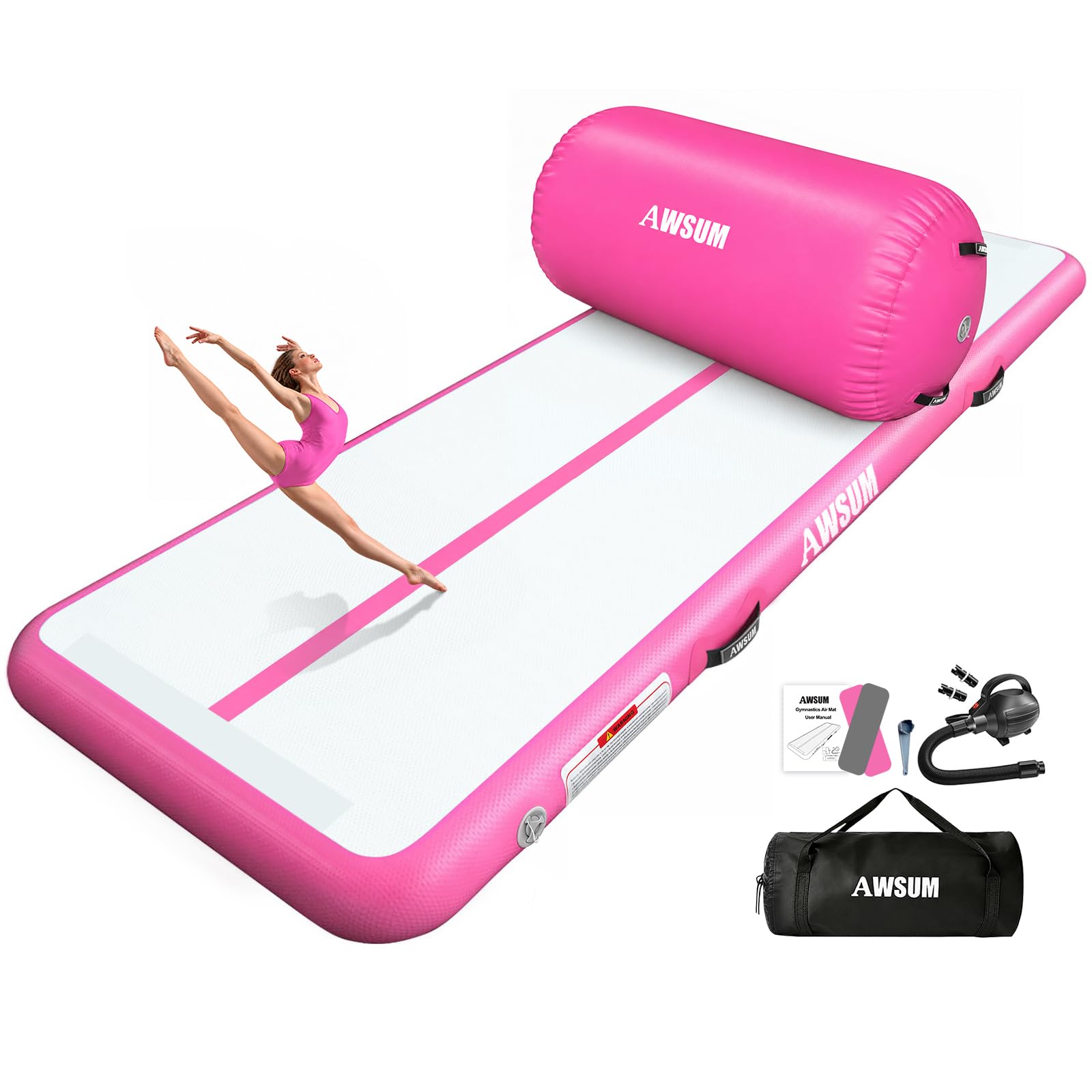
Two pieces arrive in the box, and the second one is the reason to look at this set: a ten-foot track plus a roller. The roller is the piece most home setups never buy and the one a coach reaches for during warm-up, so the set covers drill work and tumbling in a single purchase instead of two.

The track is 118 inches by 39, four inches thick, in 1000D drop-stitch PVC — the heavier, more rigid construction rather than pool-toy vinyl, and it feels like it. A 600W dual-function pump inflates or deflates each piece in about a minute by the listing's count, and everything is meant to go back into the included bag.

Pressure is the quiet advantage of an air mat: firm for standing skills and tumbling, softer for landing drills, and a gymnast can feel the difference inside one session. At 18.8 pounds the whole set is a two-trip carry rather than a one-hand drag, so it wants a spot where it can mostly stay.

What you're paying for is completeness and heavier construction, and this is the setup we point to for a gymnast practicing several times a week rather than a kid burning off energy. The storage bag is the weak link — the handles are the first thing to give — so plan on a shelf or a bin and treat the bag as a dust cover.

Pros

  • Roller included for warm-up and drills
  • 1000D drop-stitch PVC construction
  • Adjustable pressure for different skills

Cons

  • Needs air topped up between sessions
  • Storage bag handles tear
Our verdict

The most complete air setup here, with the roller most home gyms lack — worth it for a gymnast practicing several times a week.

Check Latest Price
8

Kids' Playrooms

Antsy Pants Tumbling Mat

93 /100
Peggy's Score Outstanding

Key details

Folds
Trifold with handle
Weight
4 lb
Material
Foam
Dimensions
77"L x 30"W x 1"Th
Check Details on Amazon

One inch of foam is the number to start with. This is a mat for playrooms, sleepovers, and the first wobbly cartwheel in the living room — not a landing surface for tumbling, and it doesn't pretend to be one.

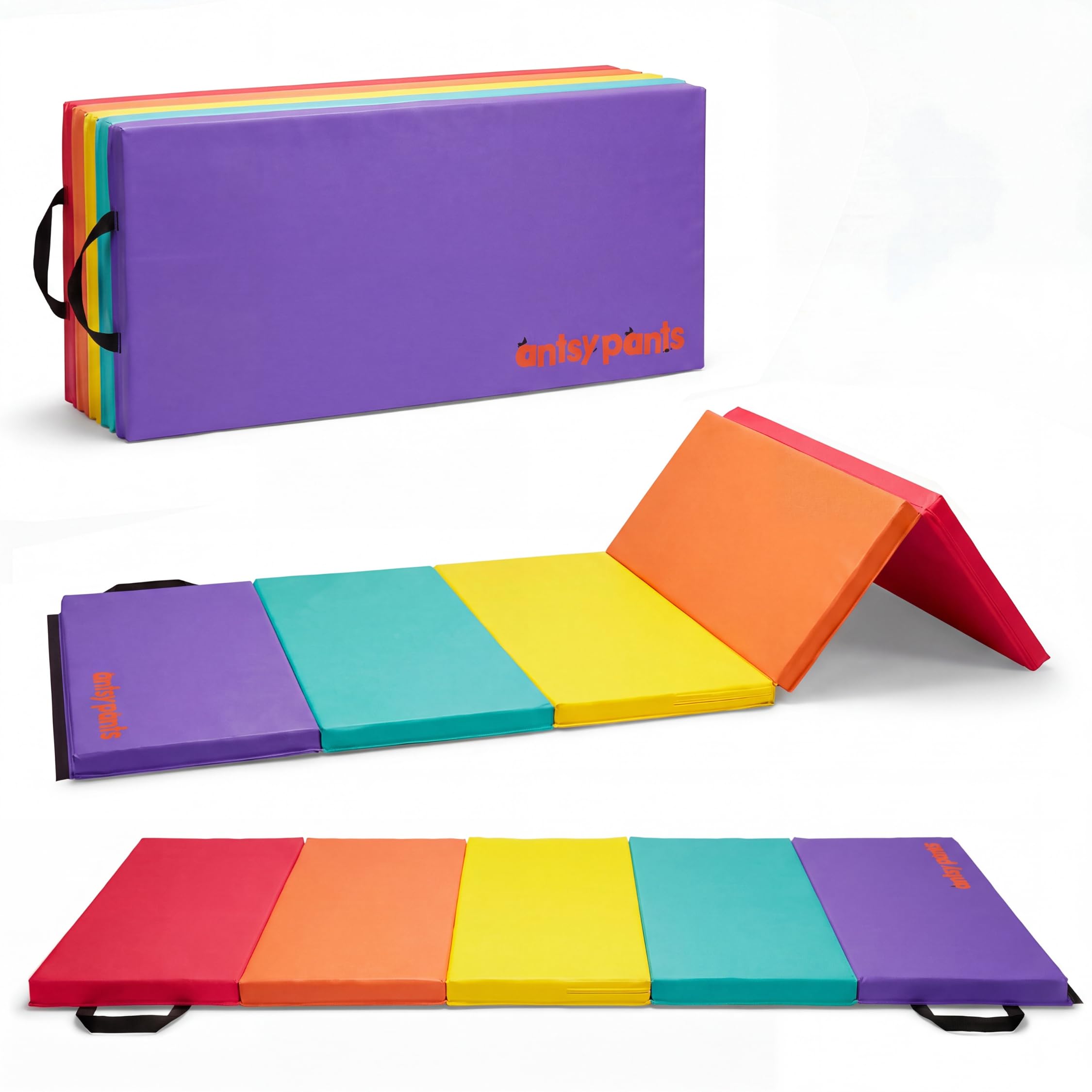
At 77 inches by 30 it's longer than most kids' play mats, and the trifold design with an easy-grip handle means a seven-year-old can carry it from the playroom to the den and set it up alone. The wipe-clean cover shrugs off juice and marker, and the colors are bright enough that it doesn't read as gym equipment parked in a family room.

Where it runs out is landings. One inch takes the sting out of a tumble off a couch but won't protect wrists and ankles in a back handspring, and an older kid will feel the floor through it. Grip is the other thing to know: on hardwood it slides, and it's the hook-and-loop edges that hold it in place once it's on carpet.

For what it is, it's well made — the cover resists tears, the folds stay put after a few weeks of daily use, and it stores behind a door. That's a real recommendation for a four-to-eight-year-old who wants a soft place to roll around, and a real reason to keep shopping once they start landing on their hands.

Pros

  • Four pounds, folds and carries easily
  • Wipe-clean cover resists tears
  • Longer than most kids' play mats

Cons

  • One inch won't cushion tumbling landings
  • Slides on hardwood floors
Our verdict

A playroom mat rather than a landing mat: bright, light, and easy for a kid to fold, with one inch of foam that won't cushion tumbling.

Check Latest Price

How We Tested Gymnastics Mats

We started by gathering the mats people actually buy for a home rather than a gym floor: sizes running from roughly 2 by 6 feet up to 4 by 10, mostly in 2-inch foam, plus a few inflatables since they solve the storage problem differently. From there we narrowed by construction — how the cover attaches at the seams, whether hinge lines are stitched or heat-sealed, whether the long edges carry hook-and-loop strips so two mats can be joined, and whether an inflatable shipped with a pump worth using. That left 12 mats, which we used for six months.

Testing happened where mats actually live: hardwood in a living room, a concrete basement floor, a driveway, and a kids' playroom. Each mat was folded and unfolded dozens of times, and we checked the hinge lines for cracking, stretched covers, and foam that stayed pinched flat after a week of being stored folded. We dropped a 10-pound medicine ball from shoulder height to see which ones bottomed out, and we did barefoot cartwheels, handstands, and kneeling stretches to judge how much hard floor came through.

To judge size honestly, we walked the perimeter of each mat and stood on the outer edges to see how much of the listed surface was actually usable. Mats with joining strips got paired up and tumbled across so we could see whether the seam held. Inflatables were timed from box to full pressure with the included pump, then left up for a week to check air retention, and every mat was carried up a flight of stairs by its handle or strap and wiped down with a damp cloth afterward.

How to Choose a Gymnastics Mat

Start With the Kind of Mat

Folding foam mats are the default, and for most homes they're the right first purchase: a padded floor that stays where you put it and needs no inflation. Inflatable air tracks add rebound, which is what lets a gymnast link one skill into the next instead of resetting between them, and they ask more upkeep in return. Incline wedges teach the shape of a backward skill and can't replace a flat mat.

Buy the flat mat first, then add the specialist piece when a specific skill calls for it. A house with a kid in a recreational class rarely needs both at once.

Length and Width Decide What You Can Practice

A two-foot-wide mat is a body-width strip: fine for stretching, bridges, and handstands, useless for anything that travels sideways. As a rule of thumb, three feet is the minimum width for a cartwheel to finish on the mat, and four feet lets a beginner relax. For a pass with a run into it, look for 10 feet of length, which is where the Polar Aurora 4x10 and the We Sell Mats 4x8 sit.

No amount of thickness rescues a mat that's too short. Measure the longest skill the gymnast can already do, then buy a mat longer than that.

Thickness Is the Floor; Density Is What You Land On

Two inches is the working thickness for tumbling, and it's the first number to check in any listing. Below that you're buying a play mat, however the marketing reads. At and above two inches, density matters more than the figure: high-density foam supports a landing while soft foam compresses toward the floor and feels worse than its measurement suggests.

Firmness is also personal. A dense mat or wedge can feel hard to a light gymnast for the first few sessions, and that same density is what stops them sinking when they push off it.

Covers, Seams, and the Floor Underneath

Vinyl and PU leather both wipe clean, so the stitching is what separates one mat from another. Fold lines and the edges where panels meet take all the stress of a mat being folded and unfolded, so run a thumb along the seams when it arrives and keep an eye on those lines afterward.

Grip matters as much. On hardwood and tile a vinyl mat can skate under a landing, and the hook-and-loop edging that holds it on carpet will grab a deep-pile rug hard enough to fight you when you move it.

Air Mats Need a Different Kind of Upkeep

An inflatable track is a pressure vessel, not a cushion. How firm it feels depends on how much air you put in, and the same mat can be springy for tumbling and flat enough for landing drills. Plan on topping it up now and then, keep the repair kit that ships with it, and check the valve first when it starts losing pressure.

A pump that quits is an annoyance you can replace. A mat that won't hold air is the problem worth returning.

Frequently Asked Questions

Final Verdict

The We Sell Mats 4x8 is the mat we recommend to most families: four feet of width so a cartwheel finishes on the mat, eight feet of length to work with, and firm two-inch foam that holds up under a landing. It's the one that stays the right size as skills improve, which is why it earns the top spot over cheaper and lighter mats.

If the mat has to disappear into a closet every night, take the three-pound BalanceFrom and accept the narrow width. If someone is specifically working backward skills, add the incline wedge to whichever flat mat you choose.