Best Hip Flexor Stretchers of 2026

I've learned that the hip flexor is a sneaky muscle: it tightens through long days at a desk, then announces itself on a run or when you stand. A stretcher takes the guesswork out of lengthening it — you lie back, let the device hold your leg in extension, and breathe instead of wobbling through a lunge. But the difference between a useful one and a doorstop comes down to how it fits your body, how stable it feels, and whether you can get into position without wincing. The right one makes a daily stretch something you'll do; the wrong one collects dust.

For the past six months, my team and I have been living with 12 stretchers — in living rooms, a small home gym, and a physical therapist's studio. We paid attention to the things that matter when your hip is already angry: padding that doesn't dig in, a frame that holds steady, and adjustments you can make alone. Value matters, but not as much as whether you'll keep coming back to it. The ones that did are below.

1

Best Overall

PSO-RITE Psoas Release Tool

89 /100
Peggy's Score Excellent

Key details

Weight
1.15 lb
Dimensions
10.7 x 5 x 5.3 inches
Peak Spacing
6.3 inches
Check Details on Amazon

Two peaks sit 6.3 inches apart on the PSO-RITE, and that gap is the number that decides whether the tool works for you. Set across the front of the hip, the peaks either drop inside the hip bones and sink toward the psoas, or they land on bone and do nothing but hurt. The shape is molded to feel like the heel of a hand with the hardness of an elbow, and it's used one peak at a time, one side at a time.

The plastic has no give at all, so intensity is entirely a matter of how much weight you pour into it and where you plant your feet. That is the honest trade: nothing to break, nothing to adjust, and nothing between you and very direct pressure. Early sessions feel sharper than most people expect, and backing off is the way in rather than pushing through. The surface is also slick — on a smooth floor the tool slides out of position mid-hold, and a mat or a rug changes that completely.

At 1.15 pounds and about 10.7 inches long it drops into a gym bag and comes out at the office. We also got more from the included guide than we expected: it covers placements beyond the hip, and the same peaks work on the glutes and the piriformis, where the shape does much the same job.

What it can't do is fit everyone. The shape and the spacing are fixed, so a smaller frame or a sensitive patch of tissue gets the same tool as everybody else. That's the gap the Wave below exists to fill, and it's the one thing we'd want a second version of.

Pros

  • Hand-shaped peaks find the psoas with no setup
  • 1.15 pounds, so it lives in a gym bag
  • Guide covers placements beyond the hip

Cons

  • Unyielding plastic with no give or padding
  • Shape and peak spacing are fixed
Our verdict

The simplest way to get direct pressure on the psoas: one molded shape, no setup, and a weight that disappears into a gym bag. Go lighter than you think at first.

Check Latest Price
2

Best Adjustable

Thrival Wave Psoas Release Tool

85 /100
Peggy's Score Excellent

Key details

Weight
1.6 lb
Adjustment
Five positions per side
Dimensions
17.28 x 7.05 x 6.34 inches
Attachments
Multiple heads included
Check Details on Amazon

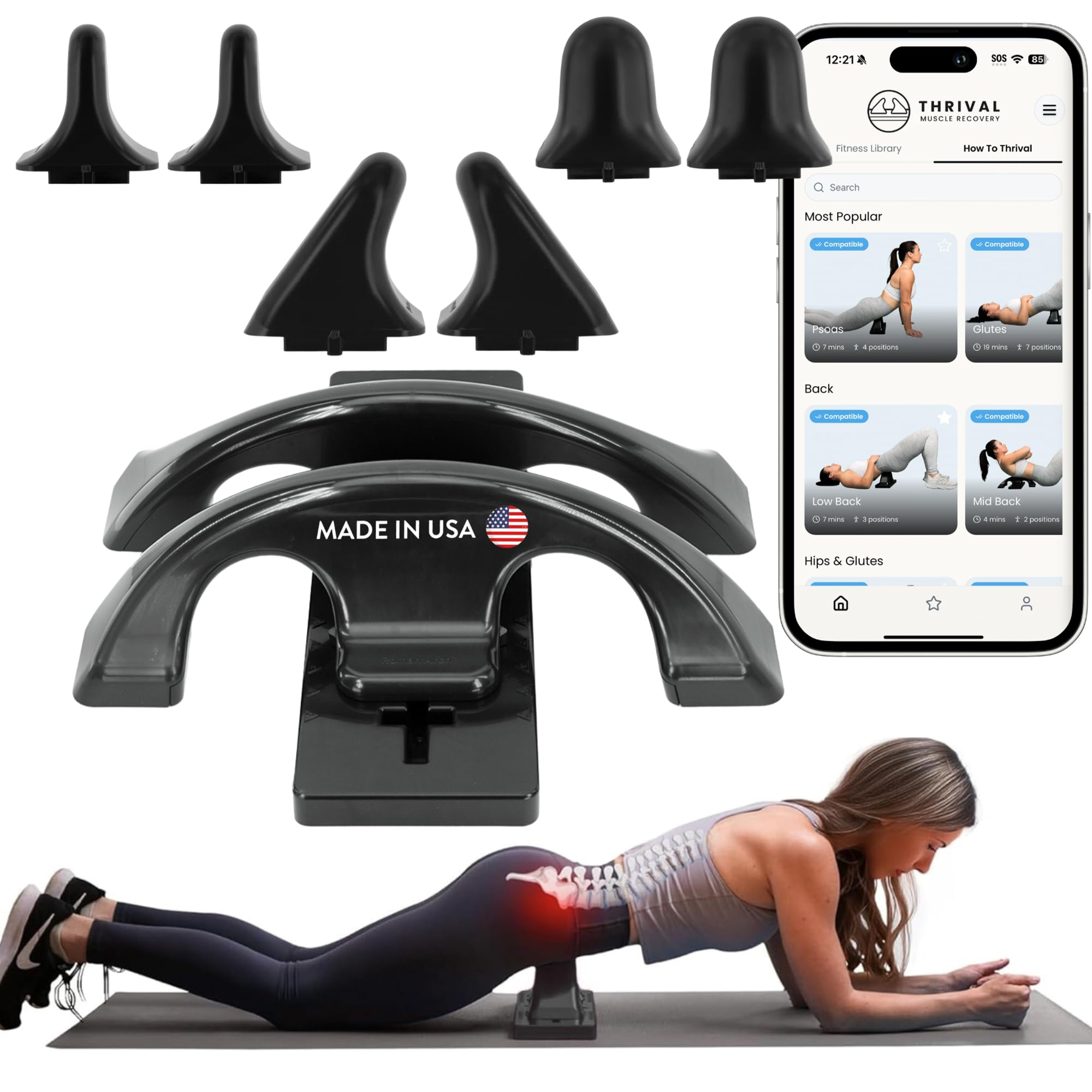
Fit is the thing that quietly sinks a psoas tool: the peaks land inside your hip bones or they press bone, and you find out only after it arrives. The Wave answers that directly. Each head locks into the board in one of five positions per side, and the heads themselves swap out for different shapes, so you can slide the contact points inward or outward until they land where you want them.

We found the adjustment genuinely useful rather than decorative. Set wide, the heads sit outside the hip bones; set narrow, they drop in toward the psoas, and once a head is seated it stays seated under body weight instead of twisting out mid-session. The heads are rigid, molded to mimic a hand, an elbow, or a thumb, so the pressure is as direct as the top pick's — it's just movable.

At 1.6 pounds and a little over 17 inches long, it's the bulkier of the two pressure tools here and takes more shelf space than a single molded piece. It costs less than the PSO-RITE, which is a strange sentence to write about a tool with more parts, and the manual is the most thorough of the ones we read.

Where it gives ground is simplicity. Five positions and a handful of heads mean something to store and something to decide each time you get on the floor, and if you want to lie down and get on with it, that's friction the top pick doesn't have.

Pros

  • Five positions per side for a custom fit
  • Swappable heads change shape and feel
  • Manual walks through placements
  • Costs less than our top pick

Cons

  • Bulkier to store and carry than a one-piece tool
  • More setup to think about each session
Our verdict

Buy this one when you don't know how a fixed shape will sit on your hips — five positions a side let you move the pressure instead of living with it.

Check Latest Price
3

Best for Travel

Aletha Hip Flexor Release Ball

88 /100
Peggy's Score Excellent

Key details

Weight
1 oz
Diameter
4 inches
Construction
Inflated, firm
Check Details on Amazon

Four inches across, an ounce in weight, gone into a corner of a carry-on — the Aletha ball is the one that leaves the house with us. It's made by the inventor behind the Hip Hook, and the design brief shows: it's an inflated ball with a firmness tuned for leaning into the front of the hip rather than rolling around on the floor.

That firmness is the whole case for it over a generic ball. It's softer than a lacrosse ball, so it presses into the hip without feeling like punishment, and noticeably bigger than a tennis ball, so one placement covers more of the iliacus and the tissue around the front of the hip. You supply the pressure by leaning or lying on it, and the little placement booklet takes most of the guesswork out of where to start.

There's one real limit and it's inherent to the shape: nothing holds it in place but you. A ball rolls, so holding a spot takes more attention than lying across a fixed tool, and the pressure eases the moment you shift your weight. Set against that is something you can use in a hotel room without unpacking anything, which is more than we can say for the boards.

Pros

  • One ounce and four inches
  • Firmness between a lacrosse ball and a tennis ball
  • Placement booklet shortens the hunt

Cons

  • Rolls out of position without constant attention
Our verdict

Four inches and an ounce, and it still reaches the hip: our pick for travel, small spaces, and anyone testing whether release work suits them at all.

Check Latest Price
4

Hamstring and Calf

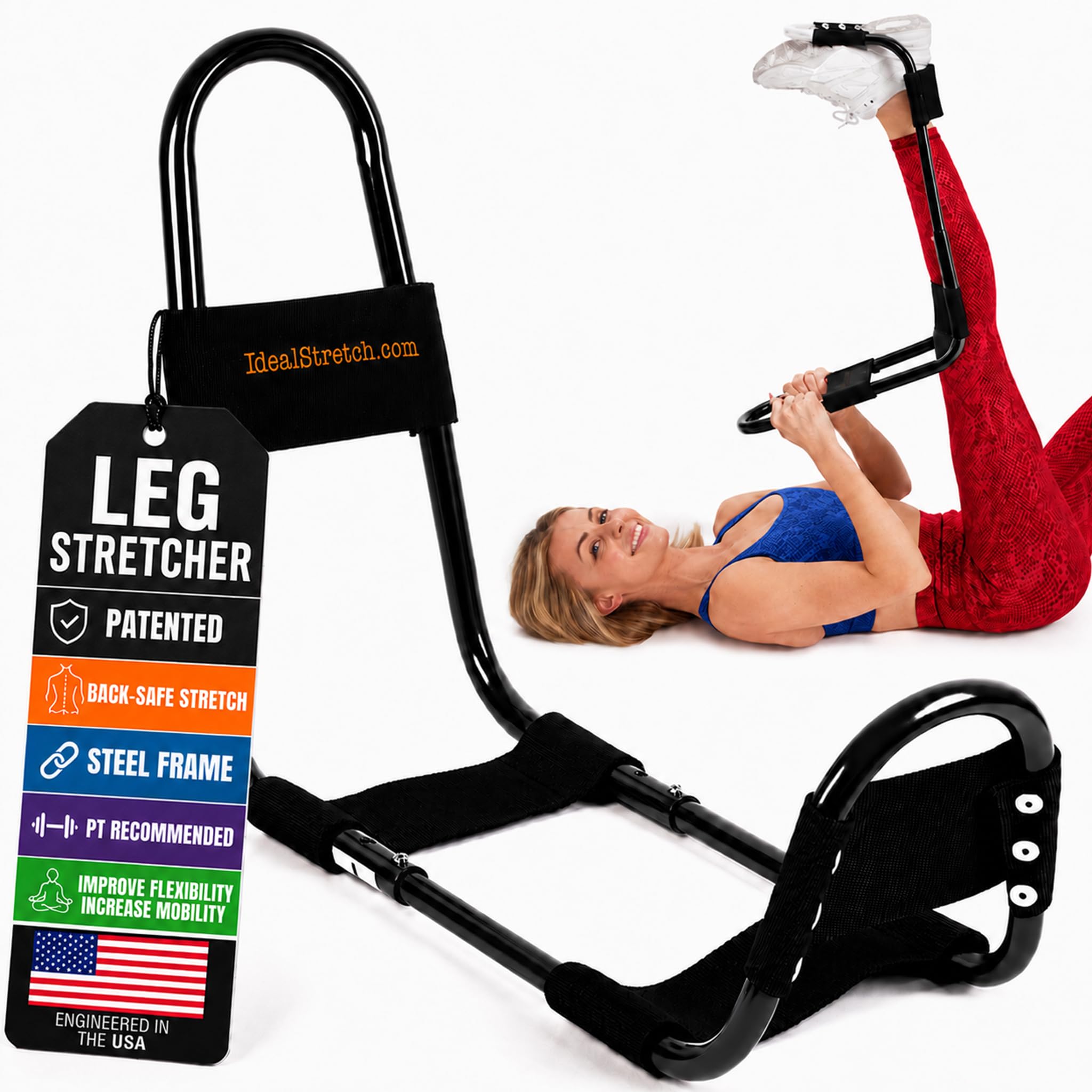
IdealStretch Leg Stretcher

90 /100
Peggy's Score Outstanding

Key details

Frame
Alloy steel
Weight
2.3 lb
Dimensions
16 x 8 x 7 inches
Max User Weight
220 lb
Check Details on Amazon

Hip stretcher is in the name, and the IdealStretch does stretch the hips — just not the front of them, where the psoas lives. What it does, it does well: the steel frame holds a straight leg so the hamstring and calf lengthen without a partner pushing on you, and it's near the top of this set for posterior-chain work for exactly that reason.

It's also the most forgiving tool here to get into position on. The push-button adjustment sets the frame, you lie back, and the stretch is passive — no balancing, no holding your own leg up, no body weight grinding into a pressure point. The frame is alloy steel, weighs 2.3 pounds, and is rated to 220 pounds, so it moves between rooms without being a production.

The catch, beyond the direction of the stretch, is reach. On its longest setting the frame can stop below the knee for taller users, so the muscles behind the knee don't get the stretch the listing describes — long-legged buyers should check that before assuming. What it does deliver, it delivers identically every time, which is close to what a partner's hand does and considerably more repeatable.

Pros

  • Holds a hamstring stretch with no partner
  • Rated to 220 pounds on a steel frame
  • Light enough to move room to room

Cons

  • Stretches the back of the hip, not the psoas
  • Frame tops out below the knee for tall users
Our verdict

A well-built tool for hamstrings, calves, and lower back — just understand it stretches behind the hip, not the hip flexor itself.

Check Latest Price
5

Full-Body Sessions

Thrival Relief Pro Psoas Tool

85 /100
Peggy's Score Excellent

Key details

Weight
4.6 lb
Adjustment
Five positions per side
Dimensions
18.22 x 14.65 x 8.98 inches
Attachments
Multiple heads included
Check Details on Amazon

Eighteen inches long and nearly fifteen wide, the Relief Pro is a board you lie on rather than a tool you tuck under one hip. That footprint is the point: with both contact points set, you work the psoas and the tissue around it from a stable surface instead of balancing on something the size of your palm.

Like the Wave, each head locks into one of five positions per side and the heads swap for different shapes. The difference is weight and reach — 4.6 pounds, wide enough to cover glutes, upper back, and shoulders in the same session, and heavy enough that it doesn't skate when you shift onto it. The manual links out to video walkthroughs, which we found more useful than the printed pages for the attachments that aren't obvious.

We think the extra surface pays off only if you'll use it. It's the priciest thing here, and the width that makes it versatile is the same width that puts a contact point on the hip bone for smaller frames — a 5-foot-2 user may find the narrowest setting still too wide, and there's no shrink ray. Ours lives assembled against a wall, which is the only reason it gets reached for as often as it does.

Pros

  • Wide board works glutes and back, not just the psoas
  • Five positions per side on each head
  • 4.6 pounds stays put under body weight
  • Manual links to video walkthroughs

Cons

  • Bulky to store and travel with
  • Width can land on the hip bone for smaller frames
Our verdict

For a household that wants one board for hips, glutes, and back, this earns its footprint; for a single tight hip flexor it's more than you need.

Check Latest Price
6

Pelvic Mobility

Pelvic Clock Exercise Device

82 /100
Peggy's Score Excellent

Key details

Weight
12 oz
Includes
Illustrated exercise manual
Dimensions
6.5 x 6.5 x 2 inches
Check Details on Amazon

There's no peak and nothing to lean on. The Pelvic Clock is a two-inch-thick disc you rock your pelvis over, following a printed sequence of tilts, and it works the hip flexors through controlled movement rather than pressure. At 6.5 inches across and 12 ounces it's the smallest thing here that isn't a ball.

That makes it a different purchase from everything else on this page, and we think it earns a place for one specific reason: some tight hips are a control problem, not a release problem. The disc fits under the sacrum, the illustrated manual lays out the tilts, and the downloadable protocols cover SI joint and low-back routines. It asks for a few minutes a day of deliberate movement, which is a habit rather than a session.

Be clear about what you're getting. It won't press into the psoas the way a peak or a ball does, and it won't hold a stretch, and the printed manual is awkward to read while you're lying on your back following it. Expect the first few sessions to leave you sore in a way that has more to do with unfamiliar movement than with a released muscle — a different sensation from the deep ache a pressure tool leaves.

Pros

  • Trains pelvic motion instead of pressing tissue
  • 12 ounces, so it travels easily
  • Illustrated manual plus downloadable protocols

Cons

  • No direct pressure on the psoas
  • Printed manual is hard to follow mid-exercise
Our verdict

Worth it if your hips are stiff from poor control rather than a muscle that won't let go — it teaches movement, it doesn't press on tissue.

Check Latest Price

How We Chose and Tested the Best Hip Flexor Stretchers

We started with a list of about 40 hip flexor stretchers sold by specialty fitness retailers and mainstream home-goods sites, then narrowed it by reading specs — height and angle adjustments, weight capacity, padding material, footprint — and by skipping anything with a return rate that suggested it wouldn't survive a week. That left 12 units, which we tested over six months.

Testing happened where people actually stretch: on living room rugs and hardwood, in a small home gym, and at a physical therapist's studio. I used each one for a five-minute session in the morning and again after a run, and three colleagues — a cyclist, a desk worker, and a retired teacher — rotated them for two weeks at a time. We noted how long it took to get into position alone, whether the device shifted on the floor, and whether the stretch landed in the front of the hip or migrated to the lower back.

Comfort and pain got separate notes. We checked whether padding bottomed out under a thigh, whether edges dug into the shin or knee, and whether the angle could be dialed back far enough to avoid a pinch. Build quality meant looking for wobble at the joints, feeling for burrs or seams, and noticing any smell. Ease of use came down to setup and storage — could one person unfold, adjust, and put it away without instructions? Functionality meant the leg stayed where the device promised.

Effectiveness was the slowest read. Testers logged how the hip felt right after, the next morning, and after a week of daily use; we favored stretchers that produced a repeatable pull over a brutal one. Value was the final filter: did the materials and adjustability justify the cost next to a simple foam wedge?

How to Choose Hip Flexor Stretchers

Pressure tools, stretch frames, and movement trainers

Three kinds of device turn up in this category and they do different jobs. Contoured tools like the PSO-RITE and the Wave put two hard peaks under your body weight so the psoas gets compressed from the front; a ball does the same with less structure and far more portability. Stretch frames like the IdealStretch hold a straight leg in a position you can't hold yourself, which lengthens the hamstring and calf — the back of the hip, not the psoas. Movement trainers like the Pelvic Clock work on control instead of pressure.

Decide which of those you actually need before you compare shapes. If you want direct release on the front of the hip, you're shopping pressure tools. If your tightness shows up as a hamstring or lower-back problem, a frame does more for you.

Fit matters more than force

The measurement that decides a contoured tool is the distance between its contact points. Set too wide, the peaks land on the front of the hip bones and press bone; set too narrow, they slide past the muscle entirely. There's no universal number, because hip width varies, which is exactly why an adjustable tool like the Wave is worth the extra parts if you've never used one of these.

Judge a tool by whether the peaks sit inside your hip bones when you lie down over it, not by how aggressive it looks in a photo. A smaller, less intimidating shape that lands correctly beats a big one that doesn't.

How much give you want in the surface

Hard plastic transmits force efficiently and gives nothing back, so intensity is controlled entirely by how much body weight you pour in and where your feet are. That's why these tools work, and it's also why first sessions surprise people who expected something softer.

Work at a pressure you could hold and breathe through rather than the hardest you can stand, and expect to feel the area the next day. If you already know you want cushioning, look for a model with swappable heads, because the hardest tools in this set have no give at all.

Where you'll actually do it

These are floor tools. A soft mattress or a couch absorbs the pressure you're trying to apply, so plan on a mat over a hard floor with enough clear room to lie down and roll to one side — a patch about the size of a yoga mat. If getting down to the floor is the obstacle, a ball used against a wall is the workaround.

Travel changes the math. A four-inch ball disappears into a bag, while the full-size boards run close to 18 inches and several pounds — worth it at home, a commitment on the road.

The learning curve is real

Buying the tool is the easy part; placing it is the skill. Expect a couple of weeks of hunting for the spot, working one side at a time, and adjusting by small increments. Tools that ship with a manual and video support, like the two Thrival boards and the PSO-RITE, shorten that phase considerably.

None of them substitutes for an assessment if the pain is sharp, radiating down the leg, or getting worse rather than better.

Frequently Asked Questions

Final Verdict

Most people should start with the PSO-RITE. One molded shape, no assembly, a little over a pound of plastic that fits in a gym bag, and a pair of peaks that put pressure exactly where a therapist's hand would. It asks you to regulate the intensity yourself, and that is the price of the simplicity.

If you can't predict how a fixed shape will sit on your hips, buy the Thrival Wave instead: five positions a side, swappable heads, and less money. If the tool only ever leaves the house with you, the Aletha ball covers the same ground at a fraction of the size.