Best Exercise Equipment Mats of 2026

An exercise mat looks like the simplest thing you'll buy for a home gym, but it's quietly doing two opposite jobs. Under a treadmill or a rower, you want enough thickness to swallow vibration and keep sweat off your floors; under a bike or a balance trainer, that same squish lets the machine rock every time you shift your weight. Go too thin and your hardwood takes the beating, too thick and you spend every session feeling like you're pedaling on a sponge. The right mat does both at once — it protects the floor, keeps the equipment planted, and stays put under your feet instead of creeping across the room mid-set.

I learned that the hard way with a cheap roll-up mat that slid halfway across a living room during a set of lunges, and I've been fussy about grip and flatness ever since. We've now lived with 14 mats over the past six months, hauling them under treadmills, bikes, and dumbbell racks, and one thing nobody tells a first-time buyer: the smell matters as much as the thickness. Foam mats fresh off the truck can perfume a whole room for a week, and a mat that ships rolled tight may keep curling at the corners long after you've laid it out. The picks below are the ones that flattened out, stayed put, and earned their spot.

1

Best Overall

Fitvids High Density Equipment Mat

95 /100
Peggy's Score Outstanding

Key details

Weight
6.5 lb
Material
Rubber (PVC-free)
Thickness
0.25 in
Dimensions
78 x 36 in
Check Details on Amazon

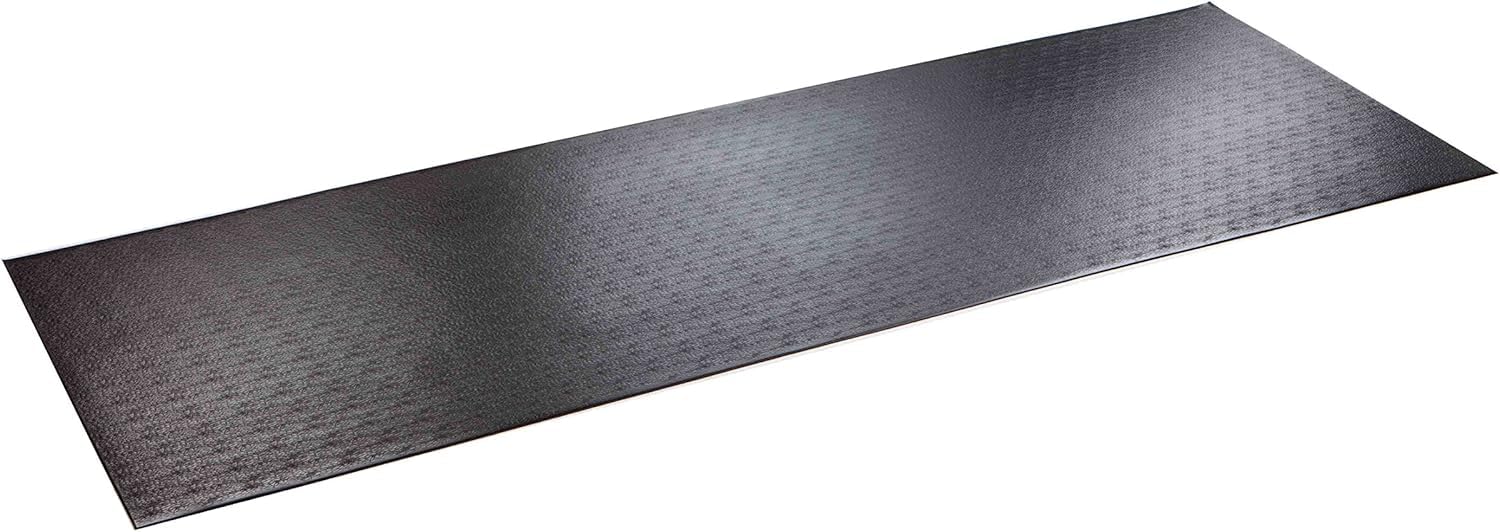
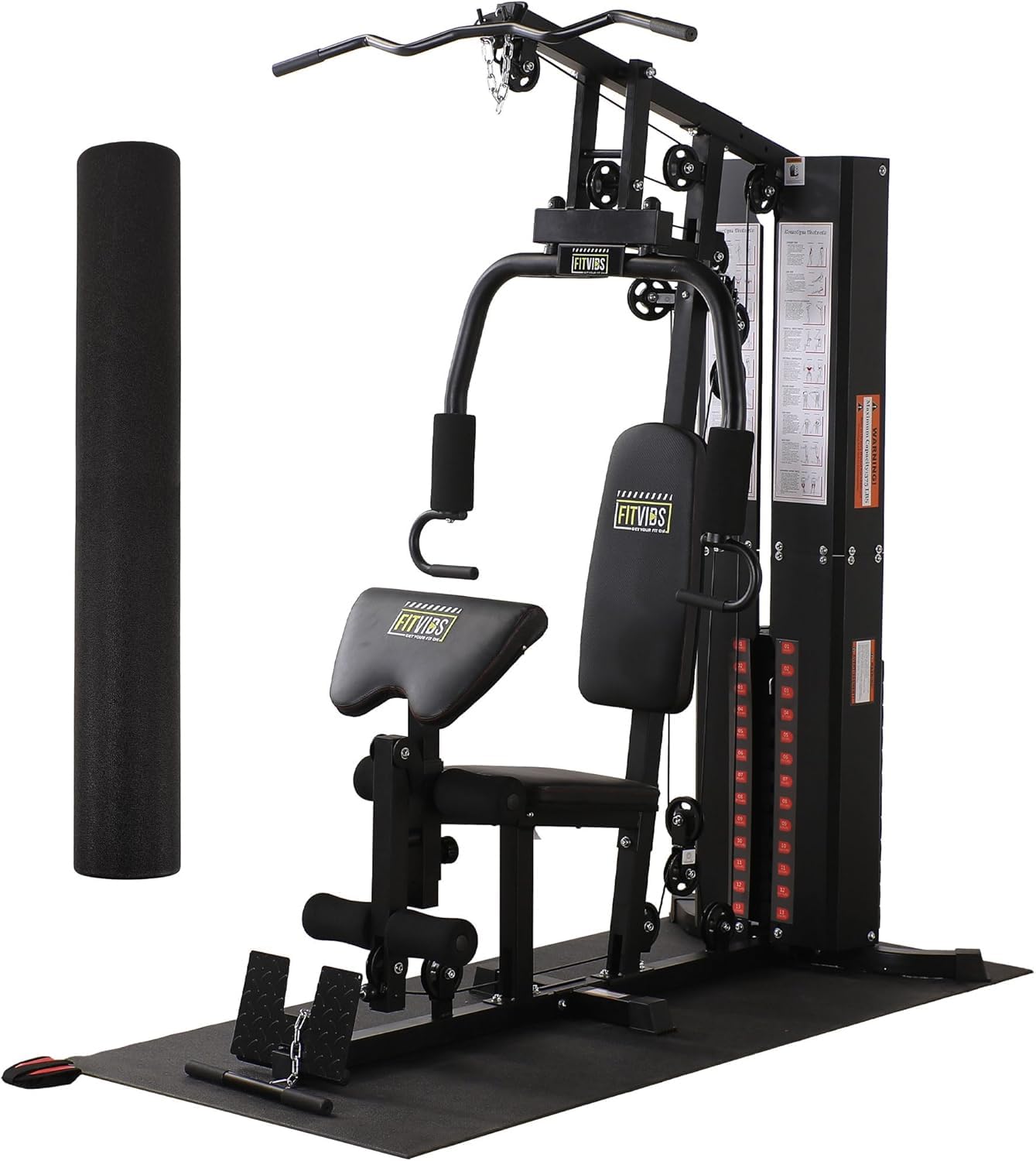
Most of the mats in this guide are a sheet of PVC. The Fitvids is quarter-inch rubber, PVC-free, and that one difference is why it's our default. Rubber grips a hardwood floor without needing a tacky backing, and it takes some of the drum out of a treadmill belt instead of passing it straight into the floor. At 78 by 36 inches it covers a standard treadmill with a couple of inches of margin on each side, and at 6.5 pounds it stays where you drop it rather than creeping out from under the machine.

The molded pattern on the surface earns its keep over weeks rather than minutes: the machine settles onto it and stays, and the whole thing wipes down with a damp cloth when sweat and dust collect. It's also the mat we stopped thinking about, which is the highest compliment a floor protector can be paid.

Ignore the suggestion that it doubles as a yoga mat. A 36-inch-wide, quarter-inch sheet of dense rubber is a floor protector, not something to flow on — pleasant for a few stretches before you rack the weights, grim for a full session. What keeps us coming back is the weight of it: heavy enough to lie down and stay down, light enough that one person can drag it into place before the machine goes on top.

Pros

  • Dense quarter-inch rubber, not a PVC sheet
  • 78 by 36 inches covers a full treadmill
  • Textured top keeps machines from creeping
  • Wipes clean with a damp cloth

Cons

  • Rubber smell lingers for a few days
Our verdict

Our default recommendation: dense quarter-inch rubber, a full 78 by 36 inches, and enough grip that a treadmill stays exactly where you set it.

Check Latest Price
2

Best for Heavy Treadmills

Amazon Basics Treadmill Mat

94 /100
Peggy's Score Outstanding

Key details

Weight
7.7 lb
Material
PVC
Thickness
0.3 in
Dimensions
72 x 30 in
Check Details on Amazon

Three-tenths of an inch is the thickest sheet in this group, and that number decides what this mat is for. Under a treadmill in a basement, the extra material is what stands between the frame and the concrete; on a suspended wood floor in an apartment, it's a little more separation between the belt and the room below.

What earns it a place near the top is that it's firm rather than spongy. A thick mat that gives under load compresses into divots at the machine's feet and stays that way; this one is dense enough to hold its shape, so the treadmill sits level run after run. The 72 by 30-inch footprint covers a standard deck, and the smooth surface wipes clean instead of collecting dust in a texture.

Coverage per dollar, it's one of the better buys here, which is why it survives the comparison even without the rubber grip of our top pick. Under a bike rather than a treadmill, though, you're carrying thickness you don't need — that's where a smaller bike mat earns its keep.

Pros

  • Thickest mat here at 0.3 inch
  • Firm surface holds its shape under a machine
  • 72 by 30 inches fits a standard deck
  • Wipe-clean non-slip surface

Cons

  • Narrower at 30 inches than the 36-inch mats here
Our verdict

For a heavy treadmill we point you here: the thickest mat in this group, firm rather than spongy, and sized to a standard deck.

Check Latest Price
3

Best for Spin Bikes

Crostice Bike Mat

95 /100
Peggy's Score Outstanding

Key details

Material
ECO PVC
Warranty
2 years
Thickness
6 mm
Dimensions
30 x 60 in
Check Details on Amazon

A spin bike puts two small patches of metal on the floor and then rains on them. That's the problem the Crostice solves: 30 by 60 inches of sealed PVC, 6 mm thick, cut to sit under a Bike or Bike+ with a couple of inches of margin on each side and enough length to catch what drips off the handlebars.

Both faces are textured, so the mat holds the floor and the bike holds the mat. We noticed that most during hard out-of-the-saddle efforts, where a smooth mat lets the frame rotate a few degrees with every push. The surface is sealed rather than porous, so sweat beads on top and comes off in one pass, and the two-year warranty is the longest in this group.

It also suits a folding walking pad in a bedroom, where a 72-inch mat would swallow the floor. What you're buying is a bike-sized mat that behaves like a bigger one: sealed, textured, and heavy enough at 4.7 pounds to stay down while you roll the bike on and off.

Pros

  • 6 mm sealed mat sized 30 by 60 inches
  • Textured on both faces so nothing slides
  • Sweat and spills wipe off the waterproof surface
  • Two-year manufacturer warranty

Cons

  • No larger size for a full treadmill
Our verdict

We recommend the Crostice for any spin bike: 6 mm of sealed, textured mat that catches sweat and stops the bike walking across the floor.

Check Latest Price
4

Best for Large Machines

SuperMats 29GS Equipment Mat

95 /100
Peggy's Score Outstanding

Key details

Origin
Made in USA
Material
Vinyl
Thickness
0.13 in
Dimensions
36 x 102 in
Check Details on Amazon

Thirty-six by a hundred and two inches is a lot of mat, and it exists for one buyer: the person whose elliptical, water rower, or recumbent bike overhangs everything else on this page. Machines like that set their feet wide and far apart, so a standard 72-inch mat leaves a rear stabilizer hanging off the back — which is precisely where a floor gets gouged.

The surface is textured on both faces, so it holds position on hardwood and keeps the machine from walking, and the vinyl is dense enough to block scuffs, dust, and the fine black marks a rower's feet leave. It's also the only mat here made in the USA, which some shoppers care about and which we don't mind noting.

Coverage is the whole point, and you pay for it: this is the priciest mat in the group, and everything else here does the same job in a smaller rectangle for less. If your machine needs eight and a half feet of floor, that's the trade. If it doesn't, it isn't.

Pros

  • 36 by 102 inches covers oversized machines
  • Textured surface holds equipment on hard floors
  • Vinyl wipes clean
  • Made in the USA

Cons

  • Only 0.13 inch thick, a barrier not a cushion
Our verdict

We keep this one on the list for machines that overhang everything else: 36 by 102 inches of textured vinyl, made for big ellipticals and rowers.

Check Latest Price
5

Best Foldable

Stepwaver Walking Pad Mat

91 /100
Peggy's Score Outstanding

Key details

Material
PVC
Thickness
0.24 in
Dimensions
55 x 23.6 in
Folded Size
7.9 x 11.8 in
Check Details on Amazon

Folded, the Stepwaver is 7.9 by 11.8 inches — smaller than a laptop — and it weighs about 2 pounds. That's the whole pitch: a mat that goes in a closet, under a bed, or in the car between sessions, so a living room can be a gym for forty minutes and a living room again afterward.

Unfolded it's 55 by 23.6 inches and a quarter-inch thick, with a textured, sealed surface that wipes down after a sweaty session. The creases relax once it's down, and at 2.1 pounds, moving it isn't a decision you have to plan around.

The fold has one cost that isn't obvious until you've done it a few times: the mat has to dry before it goes back in the closet, or it comes out smelling like a gym bag. Wipe it, give it ten minutes, then fold. That small routine is the difference between this being useful and becoming a nuisance.

Pros

  • Folds to 7.9 by 11.8 inches for storage
  • Quarter-inch thick at just 2.1 pounds
  • Waterproof, wipe-clean surface

Cons

  • 55 by 23.6 inches won't cover a full treadmill
Our verdict

The Stepwaver is our pick when the mat has to disappear between workouts: it folds to shoebox size and weighs about as much as a hardcover.

Check Latest Price
6

Best Cushioned Foam

Marcy Fitness Equipment Mat

93 /100
Peggy's Score Outstanding

Key details

Weight
6.4 lb
Material
EVA foam
Thickness
0.25 in
Dimensions
78 x 36 in
Check Details on Amazon

EVA foam is the reason to look at this one. Every other mat here is rubber or PVC, and foam does something different: it's softer underfoot, gentler on knees during floor work, and it doesn't have the cold, hard feel of a rubber sheet in a garage in January.

At 78 by 36 inches it covers a treadmill-sized footprint, and it turned up without the plastic smell that hangs around new PVC for days. The matte surface wipes clean with a damp cloth, so dust and belt residue don't turn it grey within a month.

We kept the Marcy on the list because there's a real use for a soft mat: a bench, a bike, a set of dumbbells, and a body doing floor work on the same rectangle, in a room where you're barefoot half the time. That's the mat's job, and it does it better than the firmer sheets here.

Pros

  • EVA foam is soft underfoot
  • 78 by 36 inches covers a treadmill footprint
  • No plastic smell out of the box

Cons

  • Foam keeps impressions from heavy equipment
  • Slides on smooth tile
Our verdict

We like the Marcy for lighter machines and barefoot work between sets: EVA foam cushions where a rubber sheet just feels hard.

Check Latest Price
7

Under-Desk Treadmills

Sunny Health & Fitness Equipment Mat

93 /100
Peggy's Score Outstanding

Key details

Weight
5.1 lb
Material
PVC
Thickness
0.16 in
Dimensions
79 x 35.5 in
Check Details on Amazon

At 79 by 35.5 inches, the Sunny hands you more mat than almost anything else in this group for midrange money. That's the whole argument: 5.1 pounds of PVC, wide enough for a bike or a desk treadmill with room to spare, and priced so you don't agonize over it.

The thinness that keeps the cost down is also what makes it useful in one specific setup. At 0.16 inches it barely raises the machine, which matters under a standing desk where a walking pad already uses most of the clearance. The glossy surface wipes clean and doesn't hold onto dust the way a textured mat does.

Thin PVC has a failure mode worth knowing. Under a heavy machine, the sheet can tear at the corners and bunch where the frame's feet sit — at 0.16 inches there simply isn't much material to spread the load. A walking pad or a light bike doesn't put that kind of stress on it; a treadmill that gets folded and rolled around does.

So this is the mat we recommend for the under-desk setup and the spare-room bike, where a big cheap sheet does the job and the extra width genuinely helps. Light, easy to move, and easy to replace: for those two jobs, that's the whole case.

Pros

  • Large 79 by 35.5 inch footprint
  • Thin 0.16 inch barely raises a machine
  • Waterproof and wipes clean

Cons

  • Slides on smooth, polished floors
Our verdict

We recommend this one for a walking pad or a light bike that needs coverage on a budget, not for anything heavy enough to tear it.

Check Latest Price
8

Peloton Bikes

Peloton Bike Mat

94 /100
Peggy's Score Outstanding

Key details

Weight
4.3 lb
Warranty
1 year
Thickness
4 mm
Dimensions
72 x 36 in
Check Details on Amazon

If you bought the bike, the matching mat is a question worth answering rather than dismissing. Peloton's own is 72 by 36 inches and 4 mm thick — big enough that both the front stabilizers and the rear feet land on it, which is more than a 60-inch bike mat can manage.

The surface is sealed against sweat and salt, wipes down with a damp cloth, and carries a one-year limited warranty. It's the same idea as every other bike mat here, executed cleanly and cut to the machine's footprint.

What you pay for is the fit and the name. The Crostice does everything this mat does — it's thicker, sealed the same way, and its warranty runs longer — and it costs less. What the Peloton buys you is a mat shaped for the bike and a logo that matches the frame in a room you look at every day.

We suggest it for the owner who wants the matched setup and doesn't mind paying for it. If all you want is a barrier between the bike and the floor, a cheaper bike mat does the same job, and your floor won't know the difference.

Pros

  • 72 by 36 inches fits Bike and Bike+
  • Sweat and salt resistant surface
  • One-year limited warranty

Cons

  • Can bunch on deep carpet
Our verdict

We suggest the Peloton mat for the owner who wants the matched setup and the bike maker's warranty behind it.

Check Latest Price

How We Tested the Best Exercise Equipment Mats

We started by pulling together every mat we could find that was actually sized for equipment rather than for yoga — long and wide enough for a treadmill or rower footprint, sold in more than one dimension, and with the material and thickness spelled out rather than buried in a photo. From that pool we bought 14 mats across foam, rubber, TPE, PVC, and cork constructions, then used them for six months in a spare-room gym over hardwood, on a basement concrete slab, and in a garage where the floor gets cold and gritty.

The first week was mostly about set-down. We unrolled each mat fresh out of the box and checked the corners at 24 hours, 48 hours, and again after a week, noting which ones relaxed and which kept a memory of the roll. We measured thickness ourselves instead of trusting the listing, and we sniffed each one at unpacking and again after seven days of airing out. Mats that still smelled like a tire fire after a week got marked down no matter how well they performed.

After that came the real work: loaded each mat under a treadmill, a stationary bike, a rower, and a set of dumbbells, then ran and lifted on them for weeks at a time. We watched for machines that walked out of position during a hard session, mats that bunched under a foot during lunges, and cushioning that turned into wobble under the bike. At the end of each stint we rolled the mat back and inspected the floor underneath for scuffs, dents, and trapped moisture, then wiped it down to see how easily sweat came off. Six months in, we compared the edges and surfaces against our first-day photos to see which ones were pitting, flaking, or going slick where hands and shoes land most.

How to Choose Exercise Equipment Mats

Measure the machine, then the room

Measure where the machine touches the floor, not at the widest handrail, then add two inches on each side so every foot sits fully on the mat. Length is the number people get wrong: a 30 by 60 mat suits a spin bike or a walking pad, a treadmill wants 72 to 78 inches, and a big elliptical or rower needs something like the 36 by 102 SuperMats. A mat much larger than the machine is just something to trip over in a small room.

Choose thickness for the machine, not for comfort

Quarter-inch is the useful middle for most home equipment: enough material to separate a machine from a hard floor, firm enough that the frame doesn't wallow. Thin sheets, from about 0.1 to 0.16 inch, barely raise the machine, which is exactly what you want under a walking pad at a standing desk. Go thicker than 0.3 inch and a heavy treadmill can start to rock on the extra give. Cushion isn't the goal here; stability is.

Rubber, PVC, or foam

Rubber is what we prefer under anything heavy: it grips without a tacky backing and damps sound better than a plastic sheet. PVC costs less, wipes clean, and shrugs off sweat, but it can be slick when new and it often arrives with a smell that takes days to leave. EVA foam, like the Marcy mat, is softest underfoot and the most likely to keep an impression of a machine's feet. Barefoot work on the mat points to foam; a few hundred pounds of steel points to rubber.

Hard floor or carpet

On hardwood or tile, the mat's job is to stop scratches, sweat, and the grit that grinds under a stabilizer. On carpet it changes: the mat keeps the machine from chewing the fibers and gives it a flat base, but a soft mat on deep pile lets the frame rock. A thin, firm mat beats a thick spongy one on carpet, and if the machine still wobbles, a sheet of plywood under the mat is the old fix that works. Low-pile carpet is the easy case.

The first week: curl, smell, and settling

Almost every mat arrives rolled, and the memory of that roll lasts longer than the delivery. Unroll it in a warm room, weight the corners, and don't put the machine on until the edges lie flat — a curled corner is a trip hazard and a place for the mat to bunch. Plastic smell fades faster with air moving through the room. If it still won't settle after a few days, weight the corners again rather than fighting it.

Frequently Asked Questions

Final Verdict

The Fitvids is the mat we point most people to, for a simple reason: quarter-inch rubber in a size that fits a treadmill, at money thinner PVC mats also ask. It grips, it stays, and it doesn't ask anything of you afterward.

If your machine is heavy and your floor is hard, the Amazon Basics adds thickness for about the same outlay. If it's a spin bike in a spare bedroom, the Crostice is the tidier, sweat-proof answer — and if the mat has to vanish between workouts, the foldable Stepwaver is the one that actually gets put away.