Best Foot Massage Balls of 2026

For years my version of foot care was a tennis ball under the desk — roll it around during calls, tell myself it counted. It did, a little. But a tennis ball is soft, it skates across hardwood, and it goes flat. Swapping it for a real massage ball was a small upgrade I felt immediately: the right firmness under the arch does more in thirty seconds than ten minutes of vague rolling. What a good one fixes is specific — steady, controllable pressure where the soreness actually lives, whether that's the heel, the arch, or the ball of the foot.

We've spent the past three months with 14 of them — rubber, cork, spiked, smooth, and one that looked like a dog toy. What surprised me most is that material and size matter more than any feature list: a ball that's too hard feels like a bruise waiting to happen, and a soft one gives you nothing to push against. The picks below are the ones we kept reaching for long after the notes were filed.

1

Best Overall

TriggerPoint MobiPoint Massage Ball

92 /100
Peggy's Score Outstanding

Key details

Pack
1 ball
Surface
Raised grip tips
Diameter
2 inches
Construction
Solid, wipe-clean
Check Details on Amazon

Two inches across is the whole argument for this ball. A standard lacrosse ball runs half an inch wider, and that extra width rides up into the middle of the sole instead of settling into the hollow of the arch, which is usually where a sore foot wants pressure. The MobiPoint drops into that hollow, and the raised tips give your skin something to catch on, so it rolls where you put it instead of sliding away.

That combination is why it is our top pick. We worked it standing at the kitchen counter, heel to ball of the foot, and the tips are firm but rounded — direct pressure without the stinging you get from a hard spiked ball. It is a solid moulded piece with no seam or hollow shell, so there is nothing to split, and it wipes clean with a damp cloth after a barefoot session.

Where it gives ground is on quantity. It ships as a single ball, so a second one for the office is a second purchase, and it costs more than a plain rubber ball of the same size. Neither is a dealbreaker; both are worth knowing before you click.

We think the shape earns the difference. A ball you actually keep using under the arch is worth more than two that hurt too much to roll, and this one is sized for feet first and everything else second. If you also want something for calves and shoulders, the pair below is the better buy.

Pros

  • Two-inch size settles into the arch
  • Raised tips grip instead of sliding
  • Solid one-piece ball wipes clean

Cons

  • Sold as a single ball
  • Costs more than a plain rubber ball
Our verdict

The one we reach for when an arch is sore — 2 inches of textured ball that sits in the hollow of the foot and stays there.

Check Latest Price
2

Best for Deep Pressure

Kieba Massage Lacrosse Balls

95 /100
Peggy's Score Outstanding

Key details

Pack
2 balls
Diameter
2.5 inches
Material
Solid rubber
Check Details on Amazon

The least expensive way to find out whether firm pressure is what your foot wants is this pair of solid rubber balls, and it is the pair we recommend for anyone who has already been rolling with something softer. At two and a half inches they match a lacrosse ball, which is to say they do not give: put your weight on one and it pushes back with everything you have got.

Firmness is the whole story with a ball like this. On a tight arch that will not budge, the lack of give is exactly the point, and the same density works a calf or a glute without denting. On a fresh flare-up it is too much, so work through a thick sock or a folded towel until the tissue loosens rather than forcing bare skin on day one.

Two in every pack means one can live in a gym bag and one by the sofa, and the rubber does not carry the tire-store smell that hangs around cheaper balls. The matte finish does grab dust and pet hair, so give it a rinse before it goes back in a drawer.

Pros

  • Two balls in every pack
  • Solid rubber holds its shape
  • Low-odor rubber that will not stain walls

Cons

  • Matte rubber collects dust and pet hair
Our verdict

Our pick for deep, uncompromising pressure: two dense rubber balls that take everything you can put on them.

Check Latest Price
3

Best for Sensitive Feet

Yoga Tune Up Therapy Balls

95 /100
Peggy's Score Outstanding

Key details

Surface
Tacky grip
Diameter
2.5 inches
Includes
2 balls and mesh tote
Material
Natural latex core
Check Details on Amazon

If a lacrosse ball made you wince, start here. These are the same two-and-a-half-inch diameter, but they are built around a pliable interior with a tacky shell, so they compress under your weight instead of refusing to. That give is the difference between working a sore arch for a minute and giving up after a few rolls.

The tacky surface earns its keep on hard floors. A smooth rubber ball can slide out from under your foot mid-roll; these stay where you put them, and the same grip lets you park one against a wall for a knot in your shoulder without it sliding down. The mesh tote is a small thing we ended up liking more than expected — the pair stays together in a gym bag instead of rolling loose among your keys.

The trade-off is intensity. Even leaning in, these will not dig into a stubborn knot the way a solid rubber ball does, so if you want deep work and can take it, one of the firmer picks here does more per minute. If you flinch, this is the pair that keeps you rolling, and that is worth more than brute force.

Pros

  • Pliable core gives under body weight
  • Tacky shell stays put on hard floors
  • Mesh tote keeps the pair together

Cons

  • Too soft for deep, firm work
Our verdict

The pick for tender feet: softer, grippy therapy balls that let you keep rolling instead of bracing against the pressure.

Check Latest Price
4

Best Spiked Ball

Due North Foot Rubz

92 /100
Peggy's Score Outstanding

Key details

Pack
1 ball
Surface
Flat-topped spikes
Diameter
1.9 inches
Material
Dense rubber
Check Details on Amazon

The first roll on this one is a surprise. Instead of a smooth surface you get a ring of flat-topped rubber spikes, and they find the tight band running along the arch in a way a plain ball does not. The surprise passes quickly; what is left is a much more targeted kind of pressure.

It is the best spiked ball here for spot work, and the reason is the base underneath the spikes. Dense rubber with a little give means it does not mark a wood floor or skate across it the way the hard plastic spiky balls in this group do. Set it down and roll from the heel forward and it stays where you put it, which is not something every spiked ball manages.

The catch is size. At just under two inches it fits into the arch and the heel cup beautifully, and it also takes a lot of passes to cover a wide, flat sole — one more reason to treat it as a spot tool rather than the ball you roll the whole foot with. It is small enough for a desk drawer, which is where ours lives.

Pros

  • Flat-topped spikes reach the arch band
  • Dense rubber base grips the floor
  • Small enough for a desk drawer

Cons

  • Under two inches, so slow going on a wide sole
Our verdict

The spiked ball we recommend: small, dense, and cheap enough to keep one at home and one at work.

Check Latest Price
5

Best Graduated Set

Octorox Spiky Massage Balls

90 /100
Peggy's Score Outstanding

Key details

Pack
3 balls
Surface
Spiked
Diameter
3 inches
Densities
Firm, medium, soft
Check Details on Amazon

Three spiked balls arrive in one bag — a soft one, a medium, and a firm one. The point of that is not decoration: the day after a long run, the firm ball is too much and the soft one gets you moving; a week later you have moved up without buying anything else.

All three are three inches across, bigger than most of what is here, and the size is what makes them easy to use standing up. There is more surface under your foot to balance on, and you can roll the whole sole instead of chasing one spot. The spikes are rounded rather than sharp, so the pressure is broad rather than prickly.

Our reservation sits at the soft end. The softest ball has a lot of squash, and anyone chasing real trigger-point pressure will skip it and go straight to the firm one. The other two have held up well, wash clean, and do not hold a smell, which counts for something in a ball that lives on the floor.

Pros

  • Three densities to progress through
  • Three-inch size is easy to balance on
  • Washable and odor-free

Cons

  • Softest ball is too squishy for deep work
Our verdict

A good set if you want to build pressure gradually: three spiked balls, though the softest one will not see much use.

Check Latest Price
6

Travel Kit

RAD Rounds Massage Ball Set

92 /100
Peggy's Score Outstanding

Key details

Pack
3 balls
Sizes
Green 2.2-inch soft, blue 1.6-inch medium, black 0.75-inch firm
Material
Silicone
Check Details on Amazon

The three balls here run from 2.2 inches down to three-quarters of an inch, and the spread tells you what the set is for. Only the largest is really a foot tool; the other two are for jaw, forearm, wrist, and the gaps around the shoulder blade.

The big one is good. Soft green silicone with a smooth surface that glides over skin rather than dragging, which makes it the one we reach for when an arch is irritated but not angry. Each density has its own color, so you can tell them apart in a bag without looking.

The small firm ball is the sleeper. At three-quarters of an inch it gets into the spot just above the heel and along the top of the foot, places a two-and-a-half-inch ball simply cannot reach. That is a narrow job, but nothing else in this group does it.

So it is a travel kit first and a foot ball second. If feet are the only thing you are shopping for, a single larger ball gives you more of what you need. If you want one small bag that covers a sore jaw and a tight arch on a work trip, this is the one we pack.

Pros

  • Three sizes reach spots a big ball cannot
  • Smooth silicone glides on skin
  • Packs smaller than a pair of socks

Cons

  • Premium price for a three-ball kit
Our verdict

Buy this set for travel and small spots — three sizes in one bag, with only the largest doing real foot work.

Check Latest Price
7

Whole-Body Kit

Plyopic Massage Ball Set

92 /100
Peggy's Score Outstanding

Key details

Includes
3 balls and a carry bag
Ball Types
Smooth, textured, and spiked
Largest Ball
2.6 inches
Check Details on Amazon

This is the kit for someone who wants one bag to cover feet, calves, and shoulders, and on that brief it delivers: three different ball types plus a carry bag, with the largest a 2.6-inch rubber ball that handles an arch comfortably.

We used the rubber ball on feet and the textured one on a tight calf, and both did what they should. The spiked grey ball is the odd one out — hard plastic rather than rubber, and on a hardwood floor it skids instead of gripping. On carpet it is fine, which is where ours ended up.

The rest of the kit is sensible. Three balls and a bag for about what a good pair of plain therapy balls costs, and the bag means they do not scatter through a suitcase. If you want a single ball for feet, buy one of the simpler picks; if you want a starter kit for the whole body, this is a reasonable place to begin.

Pros

  • Three ball types plus a carry bag
  • 2.6-inch rubber ball suits the arch
  • Covers calves and shoulders as well as feet

Cons

  • Spiked ball skids on hardwood floors
Our verdict

A sensible whole-body starter kit for someone who wants feet, calves, and shoulders covered from one bag.

Check Latest Price
8

Two-Ball Value

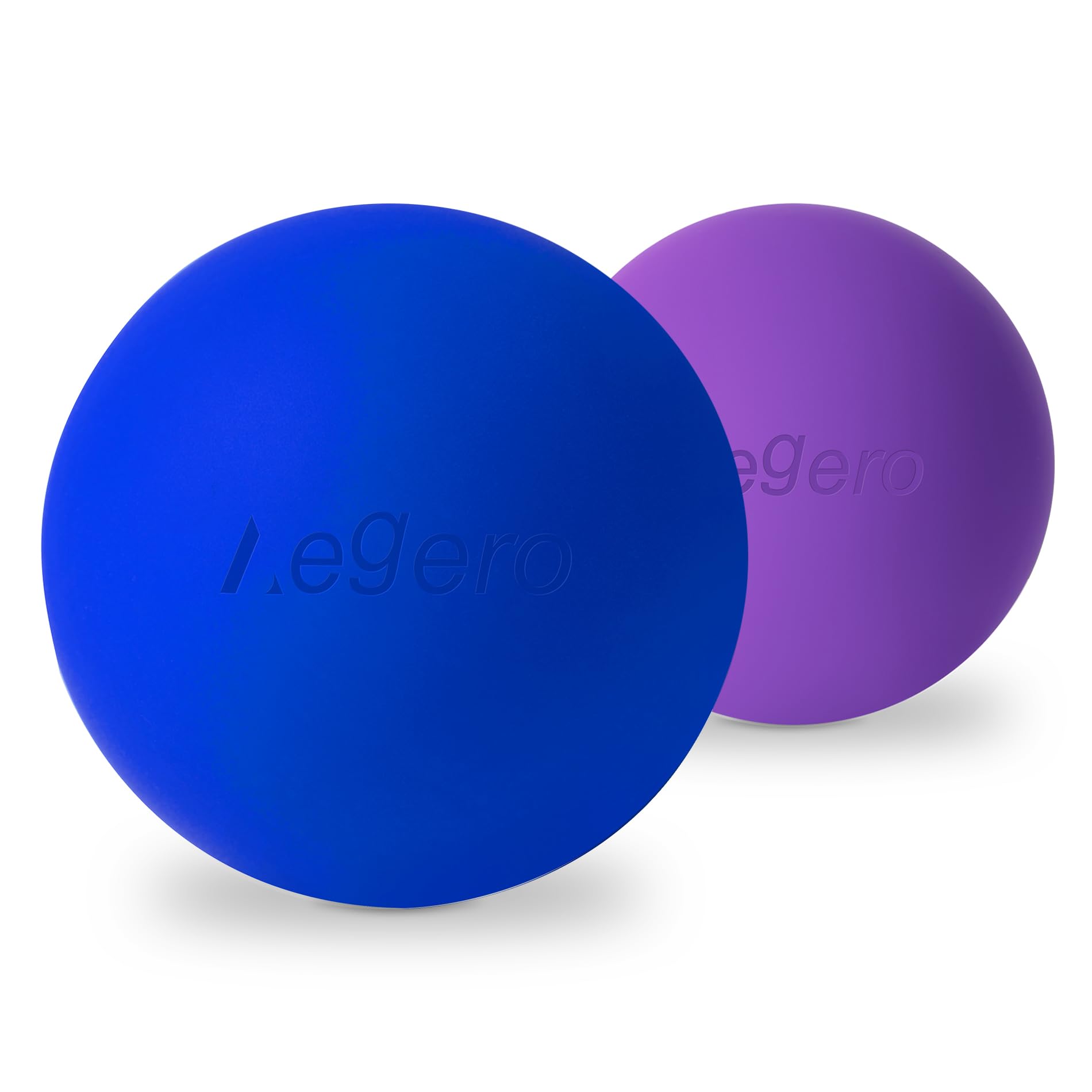
Aegero Massage Lacrosse Balls

93 /100
Peggy's Score Outstanding

Key details

Pack
2 balls
Diameter
2.5 inches
Material
Solid rubber
Check Details on Amazon

Same idea as our firmest pick, with a little more manners. These are 2.5-inch solid rubber balls, but they land just short of rock-hard — firm enough to work the fascia along the arch, forgiving enough that you can start on bare skin rather than through a sock.

Two to a pack, in deep blue and purple, so one goes in the gym bag and one stays by the sofa. At 5.3 ounces each they do not collapse under a heel the way a tennis ball does, and the solid rubber wipes clean after a barefoot session.

The limit is the one every dense ball shares — a really sore arch will let you know about it. Roll over a folded towel for the first few sessions and build up; that is a workaround, not a reason to skip it.

What tips it for us is the pair. Two balls at the low end of the price range here means you can leave one where you actually take your shoes off, which is the difference between a good intention and a daily habit.

Pros

  • Firm with a little give
  • Two balls in every pack
  • Wipes clean after bare feet

Cons

No notable drawbacks to flag.

Our verdict

Our value pick: lacrosse-ball firmness with a touch of give, and two balls so one lives wherever you take your shoes off.

Check Latest Price

How We Tested the Best Foot Massage Balls

We pulled a shortlist of roughly 40 massage balls from retailer listings, physio suppliers, and the ones physical therapists keep mentioning, then narrowed it by size, material, and price to 14 that covered the range: firm rubber, cork, spiked, textured, smooth, hollow, and solid. There was no break-in period — each ball went into rotation the day it arrived.

Testing happened barefoot, on hardwood, tile, carpet, and a thin yoga mat, in the places feet actually hurt: under the desk during calls, on the kitchen floor while the kettle boiled, and on the rug after a run. We pressed a thumb into each ball to rank firmness from stress ball to hockey puck, then stood on it and noted whether the arch sank in or the ball held its ground. Diameter got measured, but the more useful test was under a high arch and a flat one — a ball that fits one foot can feel like a sharp point under the other — plus whether it stayed put or shot across the room.

Each session ran ten minutes per foot, and we wrote down where the pressure landed and how the foot felt afterward: looser, or just sore, and whether we wanted to keep going or check the clock. Material got checked against the floor, for slip on tile, squeak on hardwood, and lint pickup. Quality showed up in the third month, in bent spikes, hollow balls that lost their shape, and seams that started to give. We read every insert, noting which ones explained pressure and placement and which just showed a picture of a foot. Utility counted too: whether a ball earned a spot in a desk drawer or a gym bag, and whether it worked on calves and hands as well.

How to Choose Foot Massage Balls

Density Decides Whether You Will Actually Use It

A solid rubber ball does not compress, so every pound you put through your foot goes straight into the tissue. A latex or silicone therapy ball gives a little and spreads that load. Neither is better in the abstract: a tight, stubborn arch often wants the firm ball, while a flare-up wants the soft one. The mistake is buying the hardest thing you can find because it feels like it must be doing something.

There is a quick test you can run in your hand. If you cannot press a dent into the ball with your thumb, plan to use it through a thick sock for the first week. Our firmest pick, the Kieba pair, is that ball; the Yoga Tune Up pair is where to start if you already know you flinch.

Diameter Decides Which Part of the Foot You Can Reach

Two inches or less drops into the hollow of the arch and works the inside edge of the heel. Two and a half to three inches covers more of the sole at once and is easier to balance on standing up, which matters if you roll at the kitchen counter rather than sitting down.

High arches usually want the smaller ball, because a wide one bridges the hollow instead of pressing into it. Broad, flat feet tend to prefer the larger size — a small ball under a wide sole takes a lot of passes. Our top pick sits at 2 inches for exactly this reason.

Texture, Grip, and Your Floor

A smooth rubber ball on hardwood or tile will slide, and a ball that shoots out from under you is worse than no ball at all. Textured and spiked surfaces grip, and they add intensity on top of the density, so a firm spiked ball is a lot of pressure concentrated in one place.

The workaround costs nothing: roll on a yoga mat or a folded towel, or in socks on carpet. Check the material too. Hard plastic spikes can mark a finished floor, while dense rubber tends to sit still and leave no damage.

One Ball, a Pair, or a Three-Density Set

A single ball does the job if you only roll at home in one spot. A pair earns its small premium if you would use one at work and one at home, or if you want both feet going at once. A set with three densities makes sense if you also work calves, glutes and shoulders, or if you want to move from soft to firm as your tolerance builds.

Whichever you choose, buy for the place you will use it. A ball that ends up in a drawer because it lives in the wrong room is the only genuinely bad purchase here.

Frequently Asked Questions

Final Verdict

Start with the TriggerPoint MobiPoint. Two inches across, textured enough to stay under your foot, and shaped for the arch rather than borrowed from a lacrosse field — it is the ball most people will still be using past the first week.

If you want more force for less money, the Kieba pair gives you two dense rubber balls that also work on calves and shoulders. And if you have already tried a lacrosse ball and winced, go straight to the Yoga Tune Up pair; softer is the difference between a habit and a bruise.