Best Peanut Massage Balls of 2026

A peanut massage ball is two spheres fused at the waist, and that notch is the entire point — it cradles your spine while the balls work the muscle on either side. What separates a good one from a frustrating one isn't the shape; it's how much give the rubber has, whether the halves are molded as one piece or glued, and how much of a vibrating model's buzz actually reaches deep tissue instead of rattling your skin. Get those right and a knot in your calf or at the base of your neck lets go in a few minutes; get them wrong and you're wincing on the living room floor wondering why you didn't just use a tennis ball.

We've spent the past four months putting 16 of them through post-run calf work, long days at a desk, and one genuinely angry lower back, and the gap between the best and the rest is wider than the prices suggest. Some went slick and skittered across the floor mid-roll; a couple of vibrating versions ran warm or quit after a few charges. The ones that earned a permanent spot on my floor were firm without being punishing, small enough to live in a gym bag, and easy enough to reach for without thinking. Here's how they sorted out.

1

Best Overall

5BILLION Peanut Massage Ball

90 /100
Peggy's Score Outstanding

Key details

Weight
12.6 oz
Included
Carry bag and workout guide
Material
Natural rubber
Dimensions
5 x 2.5 x 2.5 inches
Check Details on Amazon

The shape is the whole argument: two 2.5-inch rubber balls joined by a waist that clears your spine, so your body weight lands on the muscles either side of the vertebrae instead of on bone. Of everything here, this is the one we point a first-time buyer to. The natural rubber has a little give at the surface — noticeably firmer than a tennis ball, nowhere near the hard knobby plastic tools — and that small amount of compressibility is what lets you lean in and stay for a minute rather than flinching off.

At just over 12 ounces it behaves the way a ball should: heavy enough not to skitter down a doorframe, light enough to disappear into a gym bag, and it arrives with a carry pouch and a short workout guide. The guide is more useful than most, because the suggested positions give someone who has never chased a trigger point a reasonable map to start from. We got our best results going slowly, an inch at a time down either side of the spine, rather than rolling fast.

The surface does have a downside: it grips fabric, so a loose cotton T-shirt rolls up under it, and long hair needs tying back. Tuck your shirt in or work on bare skin and the same tackiness turns into the reason the ball stays exactly where you put it. That's a small tax on an otherwise uncomplicated tool, and it's why this one keeps ending up in our hands rather than in the drawer.

Pros

  • Natural rubber with just enough surface give
  • Waist clears the spine for back work
  • Stays put against a wall at just over 12 ounces
  • Carry pouch and a usable workout guide

Cons

  • Tennis-ball size covers little ground on glutes and quads
Our verdict

We recommend it first because the natural rubber gives just enough to stay on a knot, and at just over 12 ounces it holds a wall without fuss.

Check Latest Price
2

Best Silicone Grip

RAD Original Peanut Massage Ball

90 /100
Peggy's Score Outstanding

Key details

Weight
12 oz
Material
Medium-density silicone
Dimensions
6 x 2.5 x 2.5 inches
Check Details on Amazon

Silicone instead of rubber is the difference that matters here, and it changes the feel more than any dimension on the page. Where the rubber balls slide a little against skin, this one grabs, which is exactly what you want when you're leaning into a doorframe and don't want to chase the thing back into position every few seconds.

At 6 inches and 12 ounces it runs a touch longer and a touch lighter than the standard 5-inch ball, so each pass down the spine covers a slightly wider strip of muscle. Medium density, so it doesn't feel like a rock, but the surface gives just enough that you can work a knot for a minute or two without bracing. What we paid close attention to is whether the grip justifies spending more than the rubber balls cost, and against a wall the answer is yes: you can let pressure build instead of resetting.

On a mat on the floor that advantage shrinks, and the ball is slower to reposition in one smooth stroke than a rubber one; it takes a few sessions before you stop fighting it. It does wipe clean easily, which counts for something in a tool that lives in a gym bag. If your routine is lying down on a rug, save the money and take a rubber ball; if it's two minutes standing at a doorframe after work, this is the one we pick up.

Pros

  • Grippy silicone holds against a wall
  • Longer body covers more spine per pass
  • Wipes clean easily

Cons

  • Costs more than the rubber balls here
Our verdict

We reach for this one when we're working against a doorframe: the silicone holds where rubber slides, and the longer body covers more spine.

Check Latest Price
3

Best Vibrating

Rolling With It Vibrating Peanut

90 /100
Peggy's Score Outstanding

Key details

Weight
2 lb
Battery
Rechargeable lithium-ion
Vibration
4 speeds
Dimensions
3.75 x 3.75 x 6.75 inches
Check Details on Amazon

The odd thing about a powered peanut is how little you do. You set it against your shoulder, thumb the button, and the work happens without you rolling anything. That sounds like a gimmick until you have spent a day with your shoulders up around your ears; on those days this is the tool we want, and it's why we rate it the better of the two vibrating balls here.

At 3.75 x 3.75 x 6.75 inches and 2 pounds it's the heaviest thing in this group, and that weight is doing real work: it keeps the ball planted on a shoulder blade while the motor runs. Four speeds climb from a gentle pulse to a fast, hard buzz, and the top setting generates enough force to make a tight quad let go in a way a manual ball won't when your arms are already tired. It is the closest thing here to having someone else's hands on you.

It runs on a rechargeable lithium-ion battery with an AC charger in the box, and living with it is uncomplicated. Where it's the wrong tool is fine, slow work: the motor does broad and forceful rather than precise, and a manual ball gives you better control of one stubborn inch of muscle. It also costs a lot more than a rubber peanut, so the real question is whether you'll use vibration or just like the idea of it.

Pros

  • Motor delivers force without effort
  • Four speeds from gentle pulse to hard buzz
  • Stays planted at 2 pounds
  • Recharges from an AC adapter

Cons

  • Two pounds is heavy to hold against the neck
Our verdict

Our pick if you want the motor to do the work: four speeds and 2 pounds of planted pressure for shoulders that won't let you lean in.

Check Latest Price
4

Best for Large Muscles

TriggerPoint Universal 8-Inch

88 /100
Peggy's Score Excellent

Key details

Weight
11.8 oz
Surface
Textured
Diameter
8 inches
Material
EVA foam
Check Details on Amazon

Eight inches is the number that separates this one from everything else here. Where the small balls work the strip beside your spine, this is built for the big sheets — glutes, hamstrings, quads — and the textured foam covers a wider area in a single pass than a 2.5-inch ball ever will.

The foam shell is why it's also the most forgiving thing here to lie on: EVA gives under a hip bone in a way solid rubber doesn't, and it's water-resistant and wipes clean. It is also the slickest surface in this group, and on a bare wood floor it can skate out from under you; put a mat or a rug under it and it behaves. A one-year manufacturer's warranty is included, which is more than most of these come with.

Where it earns its spot: if your problem is between the shoulder blades or at the base of your neck, this is more ball than you need and eight inches gets unwieldy up there. If it's your hips, your thighs or the length of your back, it's the only one here shaped for the job, and it's what we hand people coming off a hard leg day.

Pros

  • Wide foam surface for glutes and quads
  • Textured pattern covers more area per pass
  • More forgiving to lie on than solid rubber

Cons

  • Foam compresses under weight, so less bite than rubber
Our verdict

We recommend it for glutes, hamstrings and quads, where an eight-inch foam surface covers in one pass what a small ball needs ten.

Check Latest Price
5

Best Budget

SIMPLECOOL Hard Peanut Ball

86 /100
Peggy's Score Excellent

Key details

Length
4.7 inches
Weight
4.94 oz
Material
TPR
Check Details on Amazon

Cheapest here and hardest here, and both facts point at the same buyer: someone who has been working on their back for a while and wants a tool that doesn't flinch. It's the best budget pick in this group for real deep pressure. The TPR body is solid — it doesn't bend or squish — and at 4.7 inches it's small enough to work a calf or a glute without asking much of your own body weight. Lean into it and a little goes a long way.

Weight tells the rest of the story: at under 5 ounces it's the lightest solid ball in this group, which makes it the easiest to carry and the easiest to misplace. The hardness is the trade. On a tight IT band or a sore glute you'll be grateful for the lack of give; on a neck that's been tight for a decade, it can be too much in the first session and you'll end up working through a towel. Start with less of your weight than you think you need.

Pros

  • Hard TPR that won't flex under load
  • Under 5 ounces, easy to carry
  • Lowest price of the balls here

Cons

  • Very hard, so a rough first ball for tight muscles
Our verdict

The best budget ball here for deep work: hard TPR that won't flex, priced like an experiment and built like a tool.

Check Latest Price
6

Budget Travel Ball

AllPlay Peanut Massage Ball Roller

88 /100
Peggy's Score Excellent

Key details

Weight
9.59 oz
Material
Thermoplastic rubber
Dimensions
5.51 x 2.36 x 2.36 inches
Check Details on Amazon

Under 10 ounces, this is the lightest unpowered ball here, and that number tells you who it's for: someone who keeps a ball in a work bag or a carry-on and doesn't want to notice it's there. Two 2.36-inch balls on a 5-inch body, a hair smaller than the 2.5-inch standard.

Thermoplastic rubber rather than natural rubber means no rubbery smell straight out of the package, and the surface is smoother than the gum-textured balls. It slides more than it grips, which is kinder to a T-shirt and less helpful if you want the ball to stay put on a wall.

Density is the middle ground: firmer than foam, softer than a true lacrosse ball, and that middle is exactly where a peanut ball divides people. If what you want is to sink into a knot without white-knuckling, this is a density that lets you stay on it. If you want the ball to do the work while you lie still, it will feel vague.

What it gives away is bite: the density that makes it comfortable is slower to release a deep knot than the hard TPR balls. Against the 5-inch rubber ball it's the easier first purchase and the easier one to pack. Ours lives in the gym bag, and it's the one that gets lent out.

Pros

  • Lightest unpowered ball here
  • No rubber smell out of the bag
  • Smooth surface won't grab clothing

Cons

  • Firmness sits between foam and lacrosse rubber
Our verdict

Our pick for the bag: under 10 ounces, no rubber smell, and a density that lets you stay on a knot instead of flinching off.

Check Latest Price
7

Arches and Feet

Sports Medica Peanut Massage Ball

91 /100
Peggy's Score Outstanding

Key details

Weight
8 oz
Included
Workout guide
Material
High-density, latex-free
Check Details on Amazon

Arches are where this one earns its keep. The compact balls fit under a foot in a way a bigger roller doesn't, and rolling from heel to ball of the foot is the most convincing demonstration of what a peanut ball can do that a foam roller can't.

It's high-density and latex-free, which matters if rubber against your skin is a problem, and at 8 ounces it's one of the easiest here to pack. A printed workout guide comes in the box, which we appreciate more than an app, and the surface wipes down without fuss after a session on bare feet.

Where it lands for us: as an all-rounder it sits behind the 5-inch rubber ball, because the density is on the firm side and the body is compact, so it covers less ground across a broad back. As a second ball for feet and calves, or for anyone avoiding latex, it's an easy yes — and it's the one we hand to people who spend all day on their feet.

Pros

  • Fits under an arch for foot work
  • Latex-free high-density material
  • Light enough to pack, guide included

Cons

  • On the hard side for a first massage ball
Our verdict

We recommend it as a second ball for arches, calves and anyone who needs latex-free: light, firm and easy to wipe down.

Check Latest Price
8

Portable Vibration

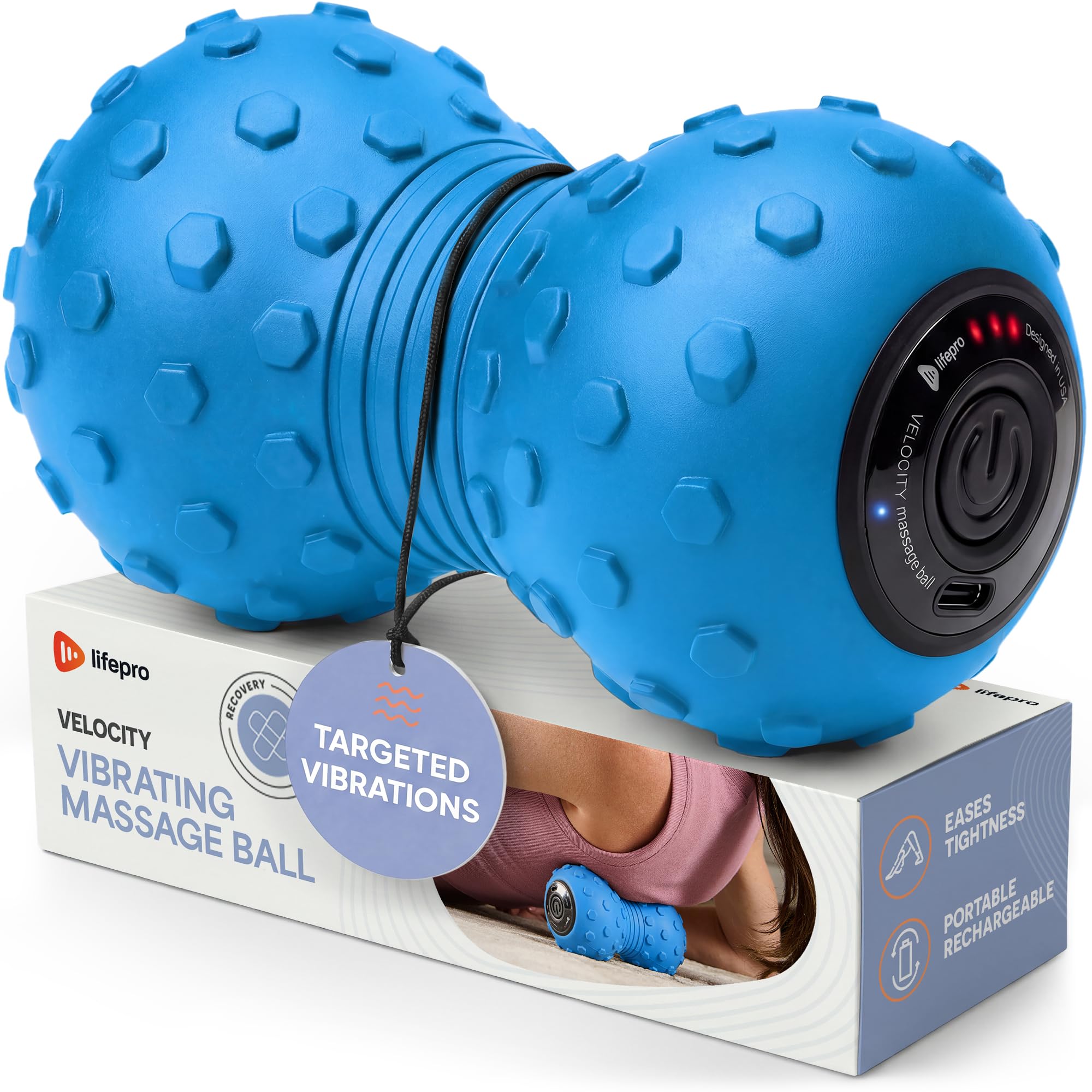
LifePro Velocity Vibrating Peanut

87 /100
Peggy's Score Excellent

Key details

Weight
1.5 lb
Battery
Up to 2-4 hours
Vibration
4 levels
Dimensions
6.5 x 3.7 x 3.7 inches
Check Details on Amazon

Against the other powered ball here, this one is smaller and a pound lighter at 1.5 pounds, and that's the whole case for it: at 6.5 x 3.7 x 3.7 inches you can hold it one-handed against a hamstring or a calf, which you can't say about the 2-pound version.

Four levels — pulse, low, medium and high — cover more ground than the spec suggests, because the low settings are genuinely usable on a neck while the top setting is a fast, hard buzz for a quad. The ridged silicone adds texture at the contact points, which is either the point or an irritation depending on how tender the area is that day.

It's easy to charge and easy to carry, and the purchase includes access to online workout videos. Those aren't a reason to buy on their own, but they're a reasonable starting point if you've never used a vibrating tool. The size is the real advantage: small enough for a gym bag, big enough to stay put under a calf.

Where we come out: this is the powered ball for someone who wants the motor in a bag, and the Rolling With It is the one for maximum force at home. Against the manual balls it's a different purchase — you're paying for the motor rather than the rubber, and that's the only real fork in this road.

Pros

  • 1.5 pounds, easy to hold one-handed
  • Four levels from pulse to hard buzz
  • Online workout videos included
  • Simple to charge and carry

Cons

  • Battery can stop holding a charge
Our verdict

Our pick when vibration has to travel: 1.5 pounds, four speeds, and small enough to hold one-handed against a calf.

Check Latest Price

How We Tested 16 Peanut Massage Balls Over Four Months

We started by gathering every peanut ball we could find that was actually in stock and shipping in the U.S., from plain rubber models to rechargeable vibrating ones, then cut the list to 16 based on material, dimensions, and whether buyer feedback suggested the thing would survive more than a month. Anything with a glued seam that people reported splitting got dropped, as did balls so large they couldn't sit between a pair of shoulder blades.

Testing ran four months. Each ball went into a rotation that mirrored a normal week: ten minutes on calves and hamstrings after runs, five minutes along the upper back and the muscles flanking the spine at the end of a workday, and a slower session on the glutes and IT bands after leg day. I also passed several along to a friend working through a frozen shoulder in physical therapy and to a colleague who sits at a desk nine hours a day.

What we watched for: whether the surface gripped a wood floor or slid out from under a sock; whether the rubber gave enough at the center to be comfortable against the spine without bottoming out under a hip; whether the size let us get into the trapezius without pinching. A few were so hard we couldn't stay on them for 30 seconds, which is its own kind of failure. On vibrating models we timed battery life from a full charge to dead at both the lowest and highest settings, and noted how much of the vibration landed in the muscle versus in the hand holding the ball.

Value came down to one question: did we reach for it a second time without being reminded?

How to Choose Peanut Massage Balls

Density decides who the ball is for

Every ball here sits somewhere between a tennis ball and a lacrosse ball, and that position matters more than the shape. Rubber with a little surface give lets you lean in and stay a while; hard TPR takes the same load without flexing, which is better for glutes and feet and worse for a tender neck on day one. Press your thumb into a candidate: a shallow dent means a starter, almost none means a tool for someone already comfortable with deep pressure. Density isn't a quality ranking, it's a fit.

Size and the gap between the balls

A 2.4 to 2.5 inch ball on a 5-inch body brackets most adult spines: the balls ride either side of the vertebrae and the waist keeps pressure off bone. Longer bodies, like the 6-inch silicone ball or the 8-inch foam roller, cover more ground per pass and suit glutes, quads and hamstrings; short, compact ones get into necks, forearms and arches. If a ball grinds on bone rather than muscle, it's the wrong size for that spot. None of these are adjustable, so this is the measurement to get right before you order.

Manual or powered

Vibration buys force without effort, and it costs weight and a charging routine. The powered balls here run 1.5 to 2 pounds against 5 to 12 ounces for the manual ones, so they live on the floor or a chair rather than in a jacket pocket. It's worth the money if your tight spots sit in your shoulders or lower back and your arms give out before the muscle does. A manual ball gives finer control of a single inch of pressure, and it never needs a cable.

Surface, weight and upkeep

Surface decides whether the ball stays where you put it. Rubber grips skin and grabs fabric, so tuck your shirt in; silicone grips harder still; TPR is smooth and slides; EVA foam skates on bare wood, so put a mat under it. Weight tells you where a ball works: 5 to 10 ounces travels, 12 ounces stays on a wall, 2 pounds is a floor tool. Rubber and TPR wipe clean with a damp cloth, and the tackiness that collects lint fades when you do.

Frequently Asked Questions

Final Verdict

Start with the natural-rubber 5BILLION. It's the ball we hand a first-time buyer because the slight surface give lets you stay on a knot instead of flinching off it, and at just over 12 ounces it holds a doorframe without fuss. It handles the strip beside your spine, your neck and your arches, which is most of what anyone buys one of these for.

Change the requirement and the answer changes. Working standing up at a doorframe? The RAD's silicone holds where rubber slides. Targeting glutes and thighs? The eight-inch TriggerPoint covers in one pass what a small ball needs ten. Already know you like it hard? The SIMPLECOOL costs very little and never flexes. And if you want the motor to do the work, the Rolling With It is the powerful one, with the LifePro as its packable twin.