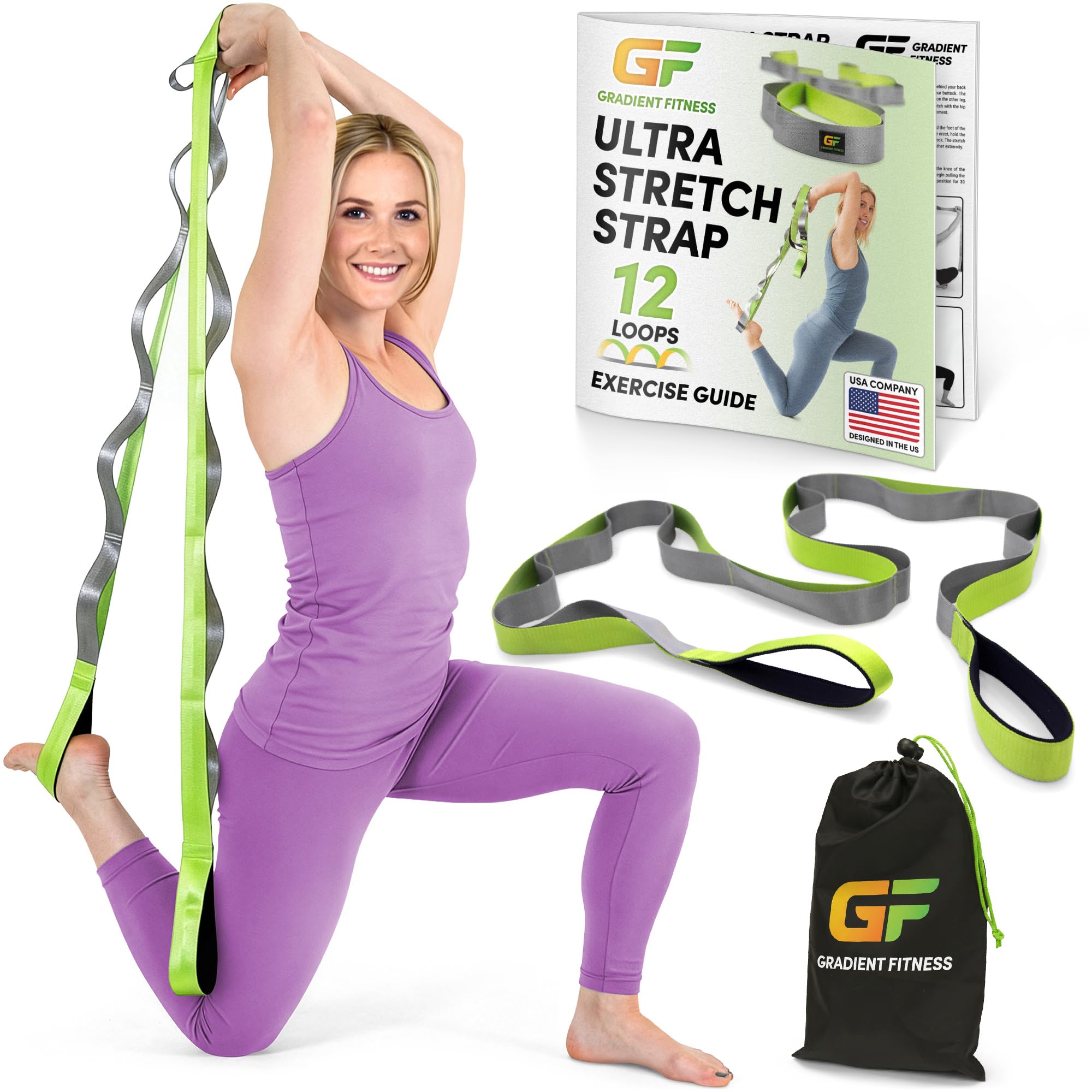
Best Overall

OPTP Stretch Out Strap
Key details
- Design
- Multiple sewn loops
- Weight
- 4 oz
- Includes
- Illustrated exercise book
- Material
- Nylon
Every other looped strap on this page has something to recommend it, and we still reach for the OPTP first. The webbing is thick, stiff nylon that holds its shape under a hard pull, the loops sit close enough together that there's always a grip point within reach of a tight hamstring, and the whole strap weighs 4 ounces, so it disappears into a mat bag.
What makes it our default is the pairing: a strap tough enough to take a hard pull, plus a booklet that shows you where to put it. Loop straps usually assume you already know the drill; this one has shipped with an illustrated exercise book since 1993, and it maps stretches to body areas, which matters most in the first month, when the difference between a useful stretch and a sore back is where the strap sits on your foot.
The nylon is the trade-off. It's firm and slightly stiff rather than supple, so it doesn't drape around a bare foot the way the cotton Tumaz does, and if your practice is mostly quiet seated work, that softness is worth more than the toughness. For home stretching and therapy exercises, we take the stiffness: the strap holds its shape while you slide a foot in, instead of folding in half.
It's also the strap that stays out rather than rolled into a drawer. You can grab a loop one-handed, there's no buckle to rethread, and nothing about it needs two hands before you're already stretching.
Pros
- Grip point at every hand position
- Illustrated exercise book included
- Thick nylon that holds a hard pull
- Light at 4 ounces
Cons
- Costs more than the basic looped straps
If you want one strap for stretching, yoga, and the exercises your physical therapist hands you, this is the one we recommend first.