Best Yoga Prop Sets of 2026

The first time a teacher handed me two foam blocks from the studio bin, I thought she was giving me packing material — slick, faintly grimy, and too thin to do much of anything. Then I put them under my hips in bridge and felt my lower back finally let go. That's the quiet job a prop set does: it makes the pose fit your body instead of the other way around, with a block under the hand in triangle, a strap around the foot in a forward fold, and a blanket under the knee in pigeon.

Bundles are where shoppers get burned. Every set looks complete in the product photo, but a strap too short to loop around your foot or a block that dents the first time you kneel on it will sour a practice fast. My team and I have spent the past six months working through 12 sets with beginners and longtime practitioners alike, and one thing I'd tell any first-time buyer: thickness matters more than anything else on the label, because a block that's an inch too short changes which poses it can actually support. The ones below earned their place.

1

Best Overall

BalanceFrom 7-Piece Yoga Set

93 /100
Peggy's Score Outstanding

Key details

Weight
3 lb
Mat Size
71 x 24 x 0.5 in
Block Size
9 x 6 x 4 in
Set Contents
Mat, 2 blocks, strap, knee pad, 2 towels
Check Details on Amazon

Half an inch of foam is why this set took the top spot, and it is the first thing you notice when you unroll it. The mat runs 71 by 24 inches at 0.5 inch thick, which is a lot of give under knees, wrists, and tailbone, and it is the piece that makes floor work tolerable for anyone who finds a standard mat too thin.

What we appreciate most is that nothing in the box needs upgrading right away. The two blocks are 9 by 6 by 4 inches, an inch taller than the blocks in the TTolbi and Overmont cork sets, and that extra inch does real work in a seated forward fold or with your hands under your hips in a lunge. The knee pad, essentially a small mat at 24 by 10 inches, is the piece we reached for most outside of standing poses, and the strap and sling mean the whole thing travels in one hand.

The microfiber towels are the least essential part. The hand towel is small at 24 by 15 inches, and a mat towel is a nice extra rather than a reason to buy. The foam blocks are light but bulkier in a tote than the slim three-inch blocks elsewhere in this group. Coverage is the argument here, though: mat, blocks, strap, padding, and a two-year warranty, with no other kit in this set putting all of that in one box.

Pros

  • Half-inch mat cushions knees and wrists
  • Four-inch blocks give more lift than 3-inch sets
  • Knee pad and strap cover the extras
  • Two-year warranty backs the set

Cons

  • Mat surface can tear with heavy use
Our verdict

Starting from nothing? This is the set we hand people: a half-inch mat, two four-inch blocks, a strap, and knee padding in one box.
Check Latest Price
2

Best for a Mat You Already Own

TTolbi Yoga Block Kit

93 /100
Peggy's Score Outstanding

Key details

Materials
EVA foam and cotton blend
Block Size
9 x 6 x 3 in
Set Contents
2 blocks, strap, 2 knee pads, guide
Check Details on Amazon

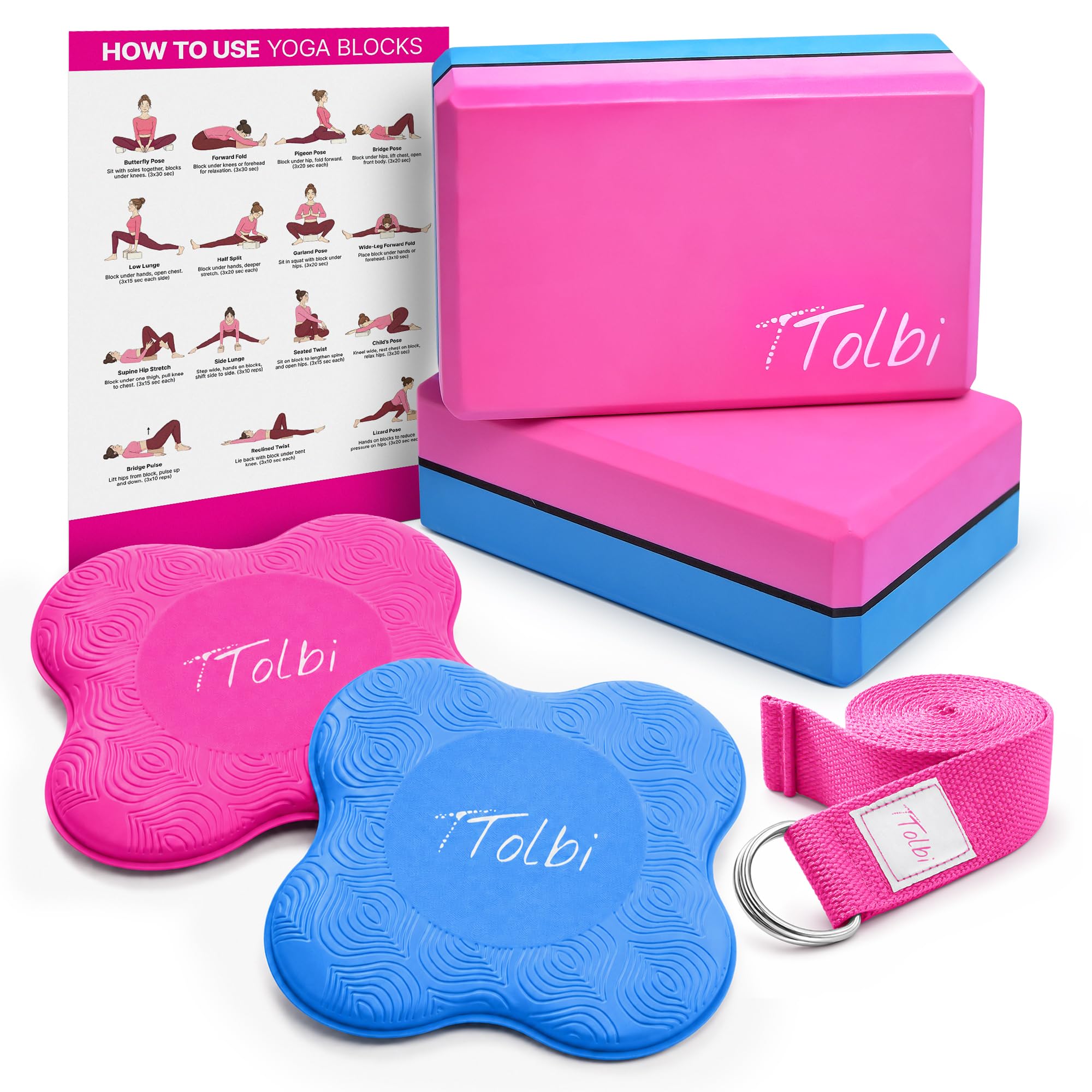
If you already own a mat you like, buying a second one to get two blocks and a strap is backwards, and this is the kit we point those readers to. Five pieces: two EVA foam blocks, an adjustable cotton strap with metal D-rings, two knee pads, and an illustrated guide. The pads are what most block-and-strap bundles leave out, and they are the piece that makes kneeling lunges bearable on a hardwood floor.

The strap is the good kind, woven cotton with D-rings rather than a buckle you thread one-handed mid-pose. The guide matters more than it sounds, too: if nobody has ever shown you what to do with a block under your hip, a card with pictures gets you using it in the first session instead of the fifth. This set also carries the highest buyer rating in the group.

What you give up is height and reach. Three-inch blocks are the studio standard, but an inch less lift means a tight forward fold puts your hands closer to the floor than you might want, and the kit stops at props, so your mat, your towels, and your knee padding outside class are all still on you. For something that disappears into a tote bag and comes out at every class, that is the trade we keep making.

Pros

  • Knee pads included where most kits skip them
  • Cotton strap with metal D-rings
  • Illustrated guide helps first-time prop users

Cons

  • Three-inch blocks give less lift than 4-inch sets
Our verdict

We recommend this to anyone who already owns a mat and just wants the props: blocks, cotton strap, and knee pads, plus a guide to use them.

Check Latest Price
3

Best for Wrist Sensitivity

Deep-Zen Wrist-Friendly Set

91 /100
Peggy's Score Outstanding

Key details

Block Size
9 x 6 x 4 in
Block Design
Wrist cutouts, two hand positions
Set Contents
2 blocks, strap, 2 knee pads
Check Details on Amazon

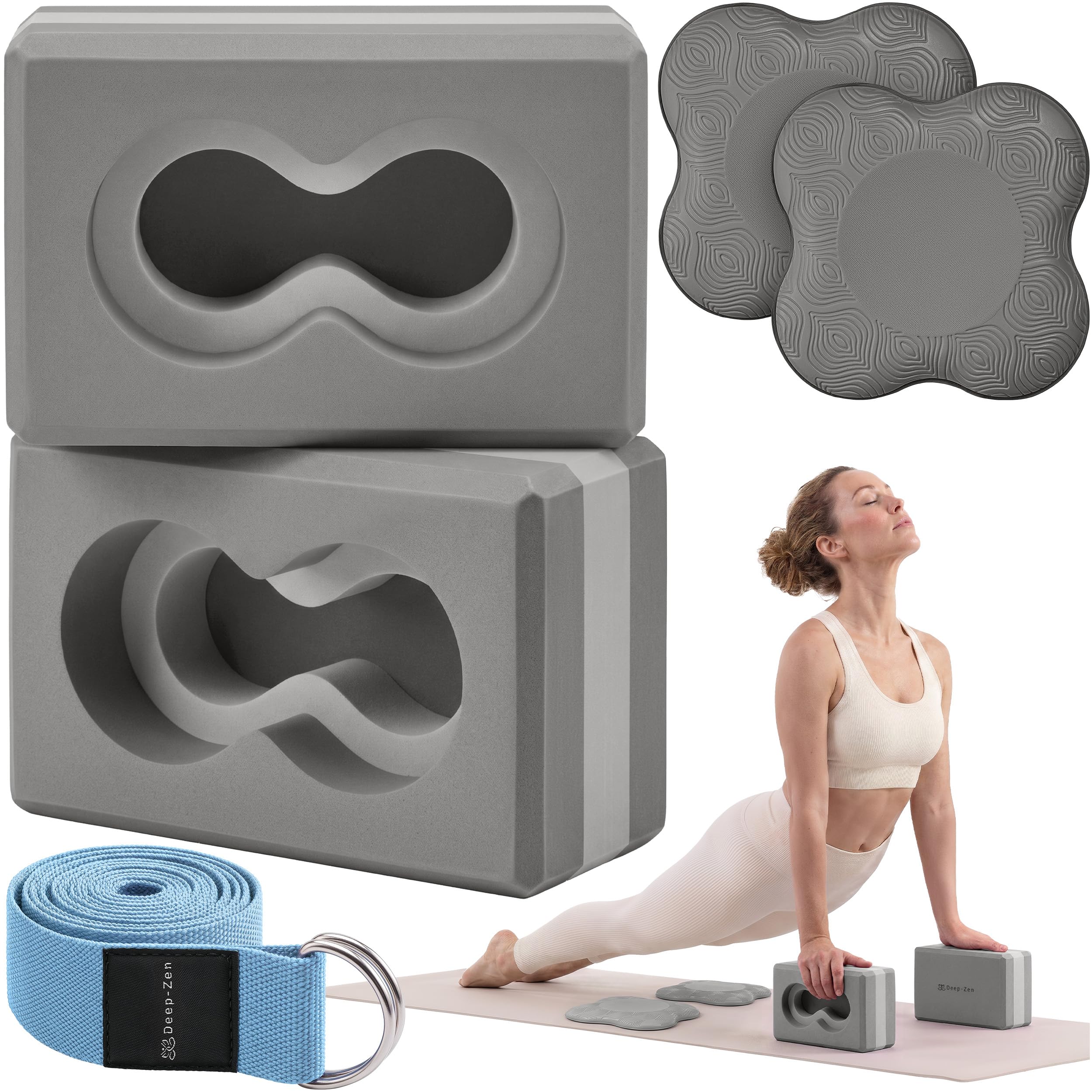
Wrist pressure is what ends most planks early, and these are the only blocks in this group designed around it. Each block has a cutout along one edge plus two hand positions, so your fingers wrap the front instead of the whole palm pressing flat on top. Two blocks, two knee pads, and a strap make five pieces, with no mat in the box.

The height is the other half of the story. At 9 by 6 by 4 inches these match the BalanceFrom blocks and stand an inch taller than the TTolbi and Overmont cork blocks, so there is real lift under your hands in a lunge or a standing forward fold. The foam is dense rather than squishy, the edges are rounded, and the surface has enough texture that the blocks stay where you press them.

This is a set for a specific problem, sore wrists, arthritic hands, a practice where weight-bearing poses are the sticking point, rather than a first kit for someone starting from nothing. If that is not your issue, the BalanceFrom set covers more ground. If it is, the cutouts are the difference between a pose you can hold and one you come out of early, and nothing else here offers that.

Pros

  • Cutouts take pressure off the wrists
  • Two hand positions per block
  • Four-inch height gives generous lift

Cons

No notable drawbacks to flag.

Our verdict

If wrist pressure is what limits your practice, buy these: the cutouts let your fingers wrap the block instead of the whole palm flattening into it.

Check Latest Price
4

Best with a Wheel

Pete's Choice Yoga Wheel Kit

92 /100
Peggy's Score Outstanding

Key details

Weight
3.31 lb
Package Size
13.1 x 13 x 5.5 in
Set Contents
Wheel, 2 blocks, strap, guide
Check Details on Amazon

Every other set here is blocks and a strap. This one adds the prop that changes what your upper back can do: a cushioned wheel, two foam blocks, a strap, and a guide, all in one kit.

Rolling out the upper back on a wheel is the closest thing to a reset after a day at a desk, and it is the reason we keep one within reach at home. Blocks and straps deepen poses you already have; a wheel adds a category, backbends, chest openers, and supported reclining work. This is the only way to get one in this group, and the surrounding pieces mean you are not buying blocks separately the same week.

It is also the prop that asks the most of you. Wheel work goes better slowly, with the arch spread through the upper back rather than dumped into the low back, so plan a few weeks of short sessions instead of one ambitious evening. And it does not stow like the rest: the box runs 13.1 by 13 by 5.5 inches and the kit weighs 3.31 pounds, so this is the set that lives at home rather than riding in a tote. If backbends are why you are shopping, none of that will bother you.

Pros

  • Wheel adds backbends and chest openers
  • Includes blocks, strap, and a guide
  • Sturdy enough to take full body weight

Cons

  • Bulky to store next to flat props
Our verdict

Our pick when you want to work on backbends: the wheel is the prop the other kits here do not include, and it earns the space it takes up.

Check Latest Price
5

Grip in a Warm Room

Overmont Cork Block Set

91 /100
Peggy's Score Outstanding

Key details

Weight
1.01 lb
Material
Natural cork
Block Size
9 x 6 x 3 in
Set Contents
2 cork blocks, 8 ft strap
Check Details on Amazon

Cork behaves differently from foam the moment your hands get damp: instead of turning slick, it gets grippier. That is what makes these two blocks the ones we reach for in a warm room or halfway through a long hold, when a foam block starts to feel like a bar of soap.

The strap is an 8-foot one, the longest specified in this group, which is enough for a shoulder opener with slack to spare and for taller bodies who find shorter straps run out of reach. The lotus print is a small thing we ended up liking more than expected: these are props that can sit out in a living room without looking like gym equipment. Under a palm they feel denser and more solid than EVA, and the laser-etched surface has a texture foam does not.

The blocks measure 3 inches deep, so they sit lower than the four-inch blocks in the BalanceFrom and Deep-Zen kits. If maximum lift under your hands is the goal, that matters. For balance work, where you want the floor close and the support wide, the lower profile is the better fit, and the cork will still be the same block in a few years.

Pros

  • Cork grip improves as hands sweat
  • Eight-foot strap, the longest specified here
  • Denser and more stable under a palm than foam

Cons

  • Heavier than foam to carry to class
Our verdict

For a warm room or props that can stay out on the floor, we reach for this cork pair and its long strap ahead of any foam set here.

Check Latest Price

How We Tested the Yoga Prop Sets

We started by gathering every set we could find that included at least two blocks and a strap, then filtered out anything listing a strap under six feet or blocks with no stated thickness. That left 12 sets, from basic foam bundles to cork-and-cotton kits, which four of us used for six months — two longtime teachers, one occasional student, and one person who had never taken a class.

Each set went to at least four studio classes, a weekly session at home, and one restorative evening a week. We measured every block with a ruler and logged where it landed against our hip bones in seated poses, since a half inch is the difference between support and a block you quietly set aside. To judge stability we held a single-leg balance on each block, on hardwood and on a sticky mat, and noted which ones shifted. Comfort got tested the slow way: two minutes of kneeling in pigeon on each block, checking whether we were shifting weight off the knee before the timer ran out.

Durability came from a mix of abuse and routine — weekly wipe-downs with disinfecting wipes, one block from each set left in a hot car for an afternoon, straps yanked and buckled hundreds of times. We also washed every strap and blanket and watched for color bleeding, then compared the blocks to their listing photos after a few weeks of use to see how much the shade drifted. Size got judged by whether a tote actually swallowed a mat, two blocks, and a strap, and by how the whole thing felt carried to class on foot.

How to Choose Yoga Prop Sets

Start With What You Already Own

Prop sets come in two shapes: complete kits that include a mat, and bundles of blocks, a strap, and padding. With no mat at home, a complete kit is the simpler purchase, and the BalanceFrom set pairs a half-inch mat with blocks, a strap, and a knee pad so nothing arrives missing. If your mat is still good, a prop-only kit costs less and skips the duplicate.

The trap is paying for a second mat you will never unroll, or buying a prop-only set and discovering you have nothing comfortable to put under it. Decide which of those two you are before you compare anything else.

Block Height and Material

Blocks come in 3-inch and 4-inch heights, and that inch changes what a pose feels like. Taller blocks give more lift under the hands in a forward fold, under the hips when seated, or under a shoulder in a restorative twist. Shorter blocks suit balance work and anyone who wants the floor close, and every block offers three heights depending on which face it stands on.

Material matters as much. Cork grips better as hands get damp and feels denser under a palm, while EVA foam is lighter to carry and softer at the edges, though it nicks and chips more readily. Choose cork for a warm room or a shared living space, foam for a bag that goes to class.

Padding for Knees and Wrists

Two joints decide whether a set earns its keep. If kneeling poses leave you sore, look for knee pads or a mat at least a half inch thick; the pads are the more portable fix and work on carpet as well as hardwood. If your wrists complain in plank or side plank, cutout blocks do far more than a thicker mat, which barely changes the angle of the hand.

Buy for the joint that actually stops you rather than for the longest list of pieces. A kit with eight items you never unroll helps less than three that let you hold a pose.

Straps, Bulk, and How It Wears

Strap length matters more the taller you are. An 8-foot strap reaches around a foot for a hamstring stretch and still leaves room for a shoulder opener, as the Overmont cork set does, while shorter straps run out before your leg is straight. Think about storage before you buy a wheel, too: it is a 13-inch circle that will not fold into a tote the way flat props do.

On wear, soft foam mats can tear under heavy use and EVA blocks pick up fingernail nicks. Wipe blocks with a damp cloth rather than scrubbing, and expect cork to outlast foam without ever feeling quite as light.

Frequently Asked Questions

Final Verdict

If you are building a practice from nothing, the BalanceFrom 7-Piece set is the one to order. The half-inch mat and the four-inch blocks do the most work for the money, and the knee pad, strap, and towels mean you are not shopping again in a month.

Already own a mat you like? Take the TTolbi kit and skip the duplicate. And if your wrists are the joint that complains through every plank, the Deep-Zen blocks are the only ones here shaped to do something about it.