Best Yoga Paddle Boards of 2026

Yoga on a paddle board looks peaceful until you actually stand up: every ripple arrives as a wobble, and a soft or sluggish board makes the whole idea feel like extra work. The right yoga paddle board turns flat water into a stable mat—firm underfoot, wide enough to move between poses, and easy enough to inflate and carry that you'll actually use it. The wrong one feels like a pool toy with ambitions.

I've spent the past 10 months testing seven inflatable yoga paddle boards, from calm morning lake sessions to quick after-work paddles, and the differences showed up fast: deck stiffness, construction quality, how long inflation really took, packed weight on the walk to the water, whether the surface stayed grippy once wet, and how stable the board felt when I shifted into a lunge. Portability mattered more than I expected—a board that's a hassle to haul stays in the garage. The picks below are the ones that made yoga feel fun rather than fussy, and that held up to real use.

1

Best Overall

Roc Inflatable Stand Up Paddle Board 10'6"

96 /100
Peggy's Score Outstanding

Key details

Max Load
350 lb
Warranty
3 years
Deck Size
10'6" x 33"
Thickness
6 inches
Check Details on Amazon

Thirty-three inches is the number that decides whether a paddle board doubles as a yoga mat, and it's the first thing that made us look twice at the Roc. The deck runs 10 feet 6 inches by 33 inches and 6 inches thick — enough platform to stand with your feet wider than hip width, and enough nose-to-tail room to step back into a lunge without your heel finding the tail.

This is the board here we're most confident putting under a standing pose. The 350-pound rating, the 6-inch drop-stitch deck and a three-year manufacturer warranty come together at a midrange price, and that combination is what a session actually rests on: a deck that doesn't dish under a knee, and rails that don't dip when you shift your weight onto one foot.

Pumping it up is the part nobody enjoys. The included hand pump does the job, but the last stretch toward full pressure is where your arms find out what they signed up for, and the gauge on a kit pump like this is the piece we trust least. Check pressure with a separate gauge the first few times, until you know how yours reads.

What seals it is the bag. Board, three-piece paddle, pump, leash and fins all roll into one backpack, and that's the difference between a board that lives in a garage and one you'll take out for an hour after work. The pad underfoot is the soft, grippy type that's comfortable barefoot, which matters more here than it does on a touring board.

Pros

  • 33-inch deck with a comfortable non-slip pad
  • 350-pound rating with 6-inch drop-stitch thickness
  • Three-year manufacturer warranty
  • Whole kit rolls into one backpack

Cons

No notable drawbacks to flag.

Our verdict

If you want one board for flat-water yoga and easy paddling, this is the one we point you to: a 33-inch deck, a three-year warranty and a 350-pound rating at a midrange price.
Check Latest Price
2

Best for Extra-Wide Stability

ATPROSS Inflatable Paddle Board 11'6" x 35"

92 /100
Peggy's Score Outstanding

Key details

Max Load
450 lb
Deck Size
11'6" x 35"
Thickness
6 inches
Board Weight
32.7 lb
Check Details on Amazon

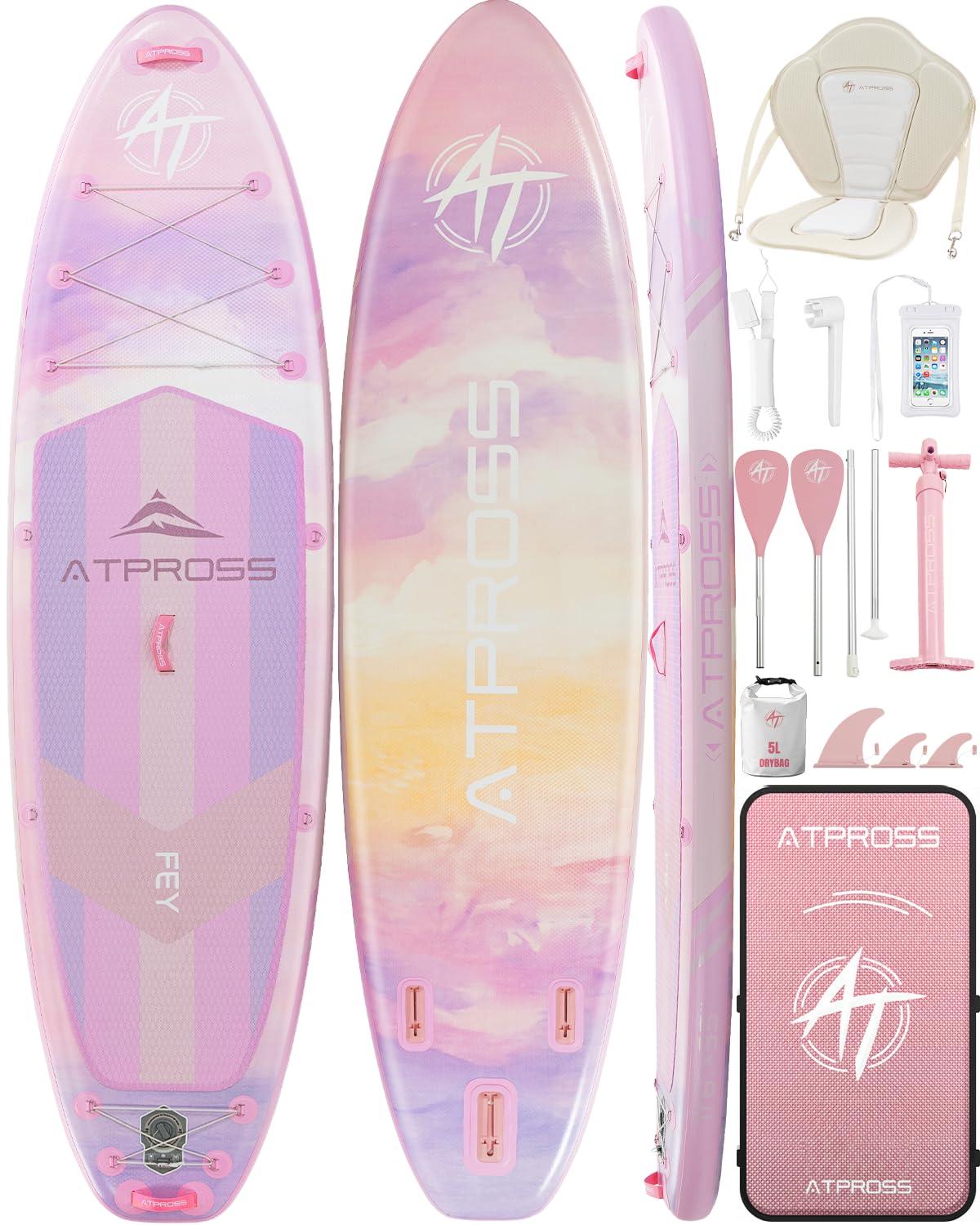
At 32.7 pounds this is the heaviest board in the set, and that's the honest starting point. What the weight buys is a platform 11 feet 6 inches long and 35 inches wide, 6 inches thick, with a 450-pound load rating — the widest deck here alongside the iTAOSTAR, and the most deck between your foot and the edge when a pose goes sideways.

Three inches of extra width doesn't sound like much until you're standing on it. Where the 33-inch boards here ask you to keep your weight centred, this one lets you spread out, bring a knee down, and wobble a little without swimming. The 450-pound rating is the other half of that: room for a paddler, a cooler and a dog without the deck going soft.

This is the board for the heavier paddler, the nervous beginner, or anyone whose idea of yoga on the water includes a friend sitting cross-legged at the nose. The catch is inflation — a platform this wide and this thick is a long pull on a hand pump, and the pump in the box is the weakest link in the package. Add an electric pump and the rest of ownership is easy.

Pros

  • 35-inch deck, the widest standing margin here
  • 450-pound load rating
  • Inflatable seat and full accessory kit included

Cons

  • Premium price for the extra width
Our verdict

Buy it when maximum standing margin matters more than the carry: 35 inches of deck, a 450-pound rating, and the heaviest haul in this group.

Check Latest Price
3

Best for a Firm Deck

Niphean Inflatable Paddle Board 10'6"

93 /100
Peggy's Score Outstanding

Key details

Max Load
450 lb
Deck Size
10'6" x 33"
Board Weight
19 lb
Max Pressure
20 psi
Check Details on Amazon

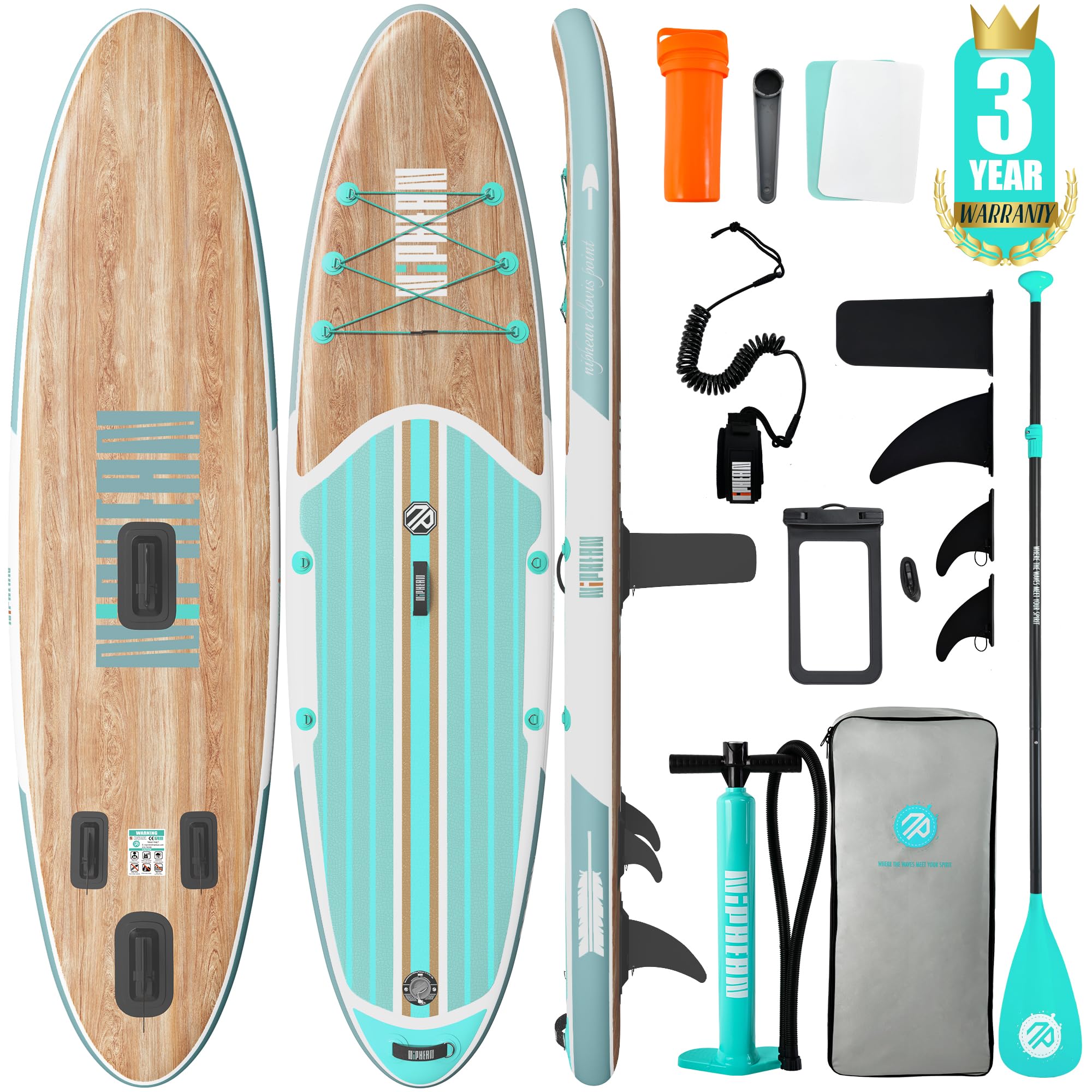
Twenty psi is the highest pressure ceiling in this group, and for yoga that figure does real work: the firmer a drop-stitch deck, the less it dishes under a knee or a planted hand. Around that ceiling Niphean has built a 10-foot-6 by 33-inch board rated to 450 pounds, backed by a three-year warranty and priced in the middle of the range — which is why it's the one we suggest when the session is more practice than paddle.

It also packs smaller than the long boards. The board itself is listed at 19 pounds, and the kit covers the usual ground: three detachable fins, leash, backpack, waterproof phone bag and a repair kit. Pump it to the top of its range rather than to what feels firm, and check the pressure with a separate gauge if the one on the pump reads oddly — a soft deck is almost always an under-inflation problem, not a board problem.

Pros

  • Highest pressure ceiling here at 20 psi
  • 450-pound rating on a 33-inch deck
  • 19-pound board packs into one bag
  • Three-year manufacturer warranty

Cons

  • Deck is 33 inches, not the 35 of the widest here
Our verdict

The firmest deck in this set, thanks to a 20 psi ceiling and a 450-pound rating — the pick when your session is mostly practice, not distance.

Check Latest Price
4

Best for Touring

ZLX Inflatable Paddle Board 11'6" x 33"

91 /100
Peggy's Score Outstanding

Key details

Max Load
550 lb
Deck Size
11'6" x 33"
Max Pressure
15 psi
Weight With Accessories
28.2 lb
Check Details on Amazon

The StabilTrac fin is the odd piece of hardware here: a removable center fin that sits ahead of the main tracking fin, meant to add balance for a beginner and to come out when you want to go faster. On an 11-foot-6, 33-inch board rated to 550 pounds — the highest load rating in this set — it's a sensible bit of tuning rather than a gimmick.

Where this board earns its place is the paddle out to the quiet water. A longer waterline tracks straighter and needs fewer corrections, so if your routine is a paddle to a cove followed by a sequence, this is the shape you want. It's a more directional board than the Roc: less of an all-rounder, better company on open water.

The cost is in the carry. Twenty-eight pounds with the accessories in the bag is a genuine load from the car to the launch, and it's the number that decides whether the board goes out on a Tuesday evening or only on a planned Saturday. Once it's floating, the length is doing exactly what you paid it to do.

Pros

  • 550-pound rating, the highest here
  • 11'6 touring length tracks straighter
  • Removable center balance fin
  • Three-year warranty

Cons

  • Slow to turn in tight water
Our verdict

For paddling to your practice spot rather than unrolling beside the car: a long, straight-tracking deck with the highest load rating here.

Check Latest Price
5

Best Budget

SereneLife Inflatable Stand Up Paddle Board

93 /100
Peggy's Score Outstanding

Key details

Max Load
275 lb
Deck Size
10' x 32"
Thickness
6 inches
Max Pressure
15 psi
Check Details on Amazon

This is the least expensive board in the set, and it's the one we point a first-timer toward when money is the deciding factor. The trade is capacity: the listed maximum is 275 pounds, the lowest here, which rules out bigger paddlers, a paddler plus a dog, or two people sharing. For a solo adult under that limit, the 10-foot by 32-inch deck and 6-inch thickness are enough to kneel, sit and stand on flat water.

The kit is complete — pump, three-piece aluminum paddle, ankle leash, removable fin, repair kit, backpack — and the board is rated to 15 psi, with double-layer drop-stitch construction and a non-slip EVA pad running the length of the standing area. Nothing about it feels stripped down; the savings went into the dimensions rather than into the bag.

Pros

  • Least expensive board in this set
  • Complete kit including pump, paddle and bag
  • 6 inches thick with a non-slip EVA deck

Cons

  • 32-inch deck leaves less margin for balance work
Our verdict

The cheapest way onto the water here, and a good first board for a solo paddler who stays under its 275-pound limit.

Check Latest Price
6

Best for Taller Paddlers

Highpi Inflatable Paddle Board 11' Wood Grain

92 /100
Peggy's Score Outstanding

Key details

Max Load
350 lb
Deck Size
11' x 33"
Board Weight
20 lb
Max Pressure
15 psi
Check Details on Amazon

Eleven feet of deck at 33 inches wide is a lot of room for the money, and it's the reason this Highpi suits taller paddlers: there's space to walk your hands forward through a flow and to step back without your heel finding the tail. The length also gives it a longer, straighter glide than the 10-foot-6 boards here.

Construction is familiar ground — double-layer military-grade PVC over drop-stitch, 6 inches thick, rated to 15 psi and 350 pounds, listed at 20 pounds. The differences sit in the details: a dual-chamber high-pressure pump with a gauge in the box, and a wood-grain finish that looks a good deal richer than most of the graphics in this group.

The seams and the fin box are the two places to inspect before your first trip: inflate it at home, leave it overnight, and run a hand along every seam. Anything wrong is far easier to sort inside a return window than after a season.

That caveat aside, the deck length is the reason to choose it over the 10-foot-6 boards, and it's the better buy for a tall paddler who wants a full-length platform without paying the premium end of this group.

Pros

  • Full 11 feet of deck at 33 inches wide
  • 20 pounds for a board this size
  • Dual-chamber pump with gauge included
  • Wood-grain finish stands out from the graphics here

Cons

No notable drawbacks to flag.

Our verdict

For taller paddlers who want an 11-foot deck without the premium tier, this is the pick — inflate it overnight and check the seams before your first outing.

Check Latest Price
7

Budget Long Deck

FBSPORT 11' Stand Up Paddle Board

92 /100
Peggy's Score Outstanding

Key details

Max Load
280 lb
Deck Size
11' x 33"
Thickness
6 inches
Max Pressure
15 psi
Check Details on Amazon

Two hundred eighty pounds is the listed maximum, the tightest rating in this group after the SereneLife. For a solo paddler under it, the FBSPORT offers something the other budget board doesn't: a full 11 feet of deck at 33 inches wide for very little money.

The kit is the usual — paddle, pump, leash, backpack, three fins with one removable — and the board is rated to 15 psi with the same 6-inch thickness as the rest of this group. There's nothing exotic here, and for a first board that's mostly a virtue: fewer parts to lose, and a deck that behaves like the others underfoot.

As a first board for a lighter solo paddler who wants length without spending much, it does the job, and the extra foot of deck over the 10-foot-6 boards is worth having for a sequence. It isn't the kit we point to when a board is going to be used hard and hauled around every weekend.

Pros

  • 11-foot deck at a budget price
  • Same 6-inch, 15 psi construction as the rest
  • Full kit with pump, paddle and backpack

Cons

  • Bag seams and pump are the weak parts
Our verdict

A genuine 11-foot deck for budget money — best for lighter paddlers who can live with a bag and pump that may need replacing.

Check Latest Price
8

Family Kit

iTAOSTAR Daisy 11'6" x 35" Paddle Board

89 /100
Peggy's Score Excellent

Key details

Max Load
450 lb
Deck Size
11'6" x 35"
Max Pressure
15 psi
Removable Fins
5
Check Details on Amazon

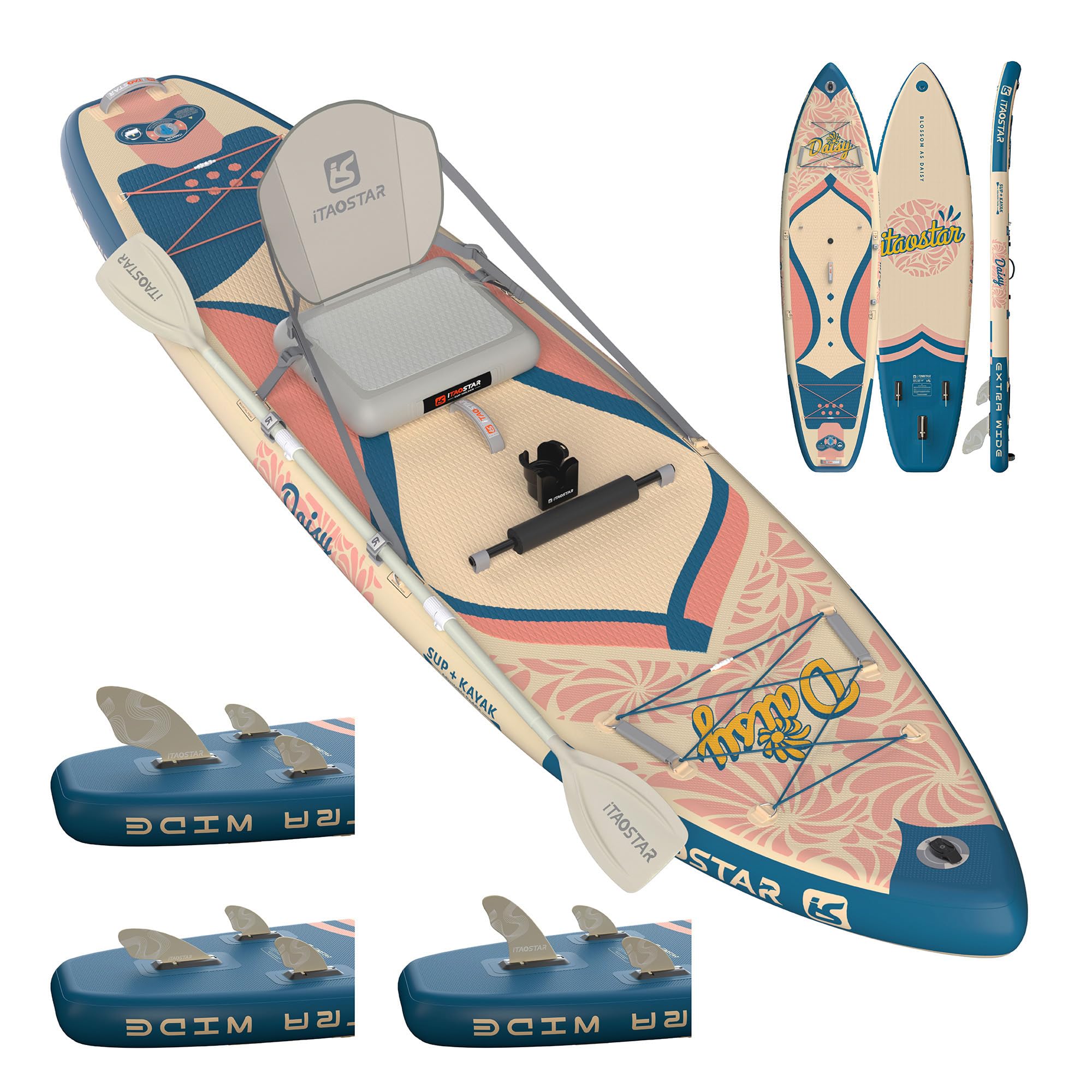
The box is the pitch here: a board, a paddle with a kayak conversion kit, an inflatable seat and footrest, five removable fins, a 10-liter dry bag, a waterproof waist bag, a cup holder, a flag, a whistle and a pump. It's the most complete package in this set by a wide margin.

Underneath it all is an 11-foot-6 by 35-inch platform rated to 450 pounds and 15 psi — the same width as the ATPROSS, and the widest deck among these picks. At roughly 20 pounds it's also a far easier carry than the ATPROSS's 32.7, which for a board this size is the more impressive of the two numbers.

Where the extras earn their keep is family use. The seat turns it into a sit-on-top for a passenger or a tired paddler, the five fins let you tune it for river or lake, and the 35-inch deck is wide enough for a dog or a child to ride along on the way to your practice spot.

For a family that wants one board to paddle, sit on, fish from and lay a mat out on, this is the most capable package here, and the width gives a beginner somewhere to stand from the first outing.

Pros

  • 35-inch deck, the widest here
  • 450-pound load rating
  • Five removable fins plus kayak conversion
  • Seat, dry bag and phone cases included

Cons

  • Premium price for accessories a yogi won't use
Our verdict

The widest deck here, wrapped in the most complete kit in this set — worth it when the board doubles as the family's water toy.

Check Latest Price

How We Tested Yoga Paddle Boards on Real Water

We started by comparing inflatable boards sold for yoga and fitness, filtering by dimensions, stated weight capacity, packed size, pump setup, and construction details. That left seven boards, which I used for 10 months alongside my team on lakes, a calm bay, and a mellow river put-in. Each board came out of the bag at least a dozen times.

For inflation, I unrolled each board on a dock or tailgate, attached the included pump, and timed the job from flat to the maker's recommended pressure. I noted how much work the final strokes took, whether the gauge was readable, and if the valve stayed put when I swapped the pump for a cap. For portability, I carried every packed board from car to water—sometimes a quarter mile—and checked shoulder strain, bag comfort, and whether it slid easily into a hatchback.

On the water, I paddled out first, then worked through downward dog, warrior II, and a seated savasana while a friend paddled past to send small wakes. I watched for edge dip, deck flex, and whether the pad stayed grippy with wet hands and feet; stability got another test when I shifted weight into a lunge or knelt near one rail.

Durability revealed itself between sessions: boards lived inflated in a garage for weeks, were rolled and stuffed back into bags, and got launched from docks and gravel. I kept an eye out for lifting seams, valve leaks, wobbly fin boxes, and soft spots. The final question was simple: which board did I reach for when I had 45 minutes and wanted a quick session? That answer told me more about fun than any spec sheet.

How to Choose Yoga Paddle Boards

Width and length: the platform you'll practice on

We treat 33 inches as the practical floor for standing poses. At 32 inches, as on the SereneLife, sitting and kneeling work fine but a wide stance starts to feel like a balancing act; at 35 inches, which is where the ATPROSS and the iTAOSTAR sit, you get real margin between your foot and the rail.

Length is a separate decision. A 10-foot-6 board turns more easily and packs smaller, while 11 feet and up tracks straighter and puts more deck in front of your feet for a full sequence. Work out which one your water demands before you fall for a graphic.

Pressure, firmness and what's under your feet

A drop-stitch board is only as good as the air in it. Most of these are rated to 15 psi and the Niphean goes to 20; at 10 psi the deck feels spongy under a knee, and at the rated maximum it feels close to a hard board. Pump to the top of the range rather than to what seems firm enough, and use a separate gauge if the one on the pump reads oddly.

Then think about the surface. A soft EVA pad grips bare, wet feet better than a smooth one, which is why most people end up practising without a mat. The trap is the center carry handle: it sits exactly where a mat or a knee wants to go, so plan your stance around it rather than discovering it mid-flow.

Weight and the walk to the water

The board weight on the page is only half of what you carry; add the bag, pump and paddle. A 19- or 20-pound board, like the Niphean or the Highpi, is a one-person carry from the car to the shore, while the ATPROSS at 32.7 pounds turns into two trips if you're also hauling a cooler.

If you launch a short walk from the parking lot, this barely matters. If you hike in, or if the board has to come up a flight of stairs at the end of every session, weight is the whole decision and worth more than an extra inch of deck.

Load ratings and who else is coming

Capacity figures in this group run from 275 to 550 pounds, and they mean more than a solo paddler's weight: they cover you, your gear and anything else on the deck. The SereneLife's 275 rules out bigger paddlers and most passengers; 450 and up, as on the ATPROSS, Niphean and iTAOSTAR, leaves room for a dog, a cooler or a child at the nose.

If yoga is a solo ritual, 350 pounds is plenty. If the board is going to be the family's toy, buy the capacity and accept the extra weight that usually comes with it.

What's in the box, and what it's really worth

Every board here ships with a pump, paddle, leash, fins and a bag, so the contents of the box separate these picks far less than the marketing implies. What does separate them is the warranty: the Roc, Niphean and ZLX each carry three years, and on a board that gets folded, dragged and stored in a garage, that's worth more than a cup holder or a waterproof phone bag.

Buy the deck you want and treat the accessories as a starter set you'll upgrade piece by piece.

Frequently Asked Questions

Final Verdict

The Roc is the board we recommend to most people shopping for yoga: a 33-inch deck, a 350-pound rating, a three-year warranty and the most convincing stability in this group, all at a midrange price. It's the one that makes a standing sequence feel like a reasonable idea rather than a dare.

If you want more margin underfoot, the ATPROSS's 35-inch platform is the upgrade, and it costs you 32.7 pounds of carrying. If you paddle to your practice spot rather than unrolling beside the car, the ZLX's longer waterline is the better shape.