Best Yoga Knee Pads of 2026

Knees were not built for a hardwood floor, and a folded towel only trades one problem for another — it bunches, slides, and has you shifting your weight in camel pose instead of breathing into it. A good yoga knee pad gives you real cushioning and support without turning your practice into a balance exercise. I've spent the past four months testing 14 pairs on my living-room floor, in studio classes, and through long kneeling sequences. The differences are not cosmetic: thickness changes how much pressure you feel, firmness decides whether you sink or stay stable, and grip determines whether the pad is still under you after a transition.

The pairs that earned a place in my bag were the ones I forgot about mid-practice: comfortable, supportive, and steady enough to stay put. I noted which ones were light enough to toss in a tote, which Velcro straps still held after repeated fastening, and which surfaces showed wear by the end. A knee pad is a small purchase, but the wrong one makes every floor feel harder. Below are the pairs that got the basics right — support, cushioning, and grip — without making you think about them.

1

Best Overall

ProsourceFit Yoga Knee Pad

91 /100
Peggy's Score Outstanding

Key details

Weight
5.6 oz
Surface
Non-slip texture
Material
NBR foam
Dimensions
24"L x 10"W x 0.63"Th
Check Details on Amazon

At 24 by 10 inches, the ProsourceFit pad spans the width of a standard mat, so we can set it once and move through cat-cow, low lunges, and seated poses without chasing two separate cushions. That mat-width shape is the main reason it is our top pick. The 15mm high-density NBR foam gives knees a firm barrier against a studio floor, and the non-slip texture held its place on our mat. At 5.6 ounces, it adds almost nothing to a mat bag.

We appreciate the closed-cell foam most after a sweaty class. Moisture sits on the surface instead of soaking in, so a damp cloth is usually enough, and the pad air-dries quickly. The 10-inch width is generous for one knee, an elbow, or sit bones. The 15mm foam is dense and supportive rather than pillowy, which keeps balance poses from feeling mushy. For most knees, that firmness is the useful part.

The pad rolls tightly and slips into a bag without a separate case, which is the quiet advantage of a strip over a pair of spot pads. Check the edges after months of use, because foam can start to crumble when it is dragged across rough floors. For a first dedicated knee pad, a replacement for a folded towel, or a leave-in-the-gym accessory, this is the one we recommend most often. Its 24-inch length also makes a useful cushion under the forearms in a long plank, so it earns its place beyond knee poses.

Pros

  • Mat-width coverage for smoother transitions
  • Light 5.6-ounce pad rolls into a bag
  • Firm 15mm support for everyday practice
  • Closed-cell foam wipes clean

Cons

  • Ten-inch width is tight for broad floor work
  • Less cushioning than the 1-inch picks
Our verdict

The ProsourceFit pad is our everyday default: a light, mat-width strip with enough firm cushioning for most knees and a grip that behaves on a mat.

Check Latest Price
2

Best for Travel

Heathyoga Yoga Knee Pad

92 /100
Peggy's Score Outstanding

Key details

Carry
Included strap
Weight
8.11 oz
Material
TPE
Dimensions
26"L x 10"W x 0.5"Th
Check Details on Amazon

A knee pad only helps if it makes it to class. The Heathyoga pad comes with a carrying strap that keeps the roll tight, and at 0.23 kg it is easy to clip onto a mat bag or drop into a tote. That travel-friendly shape is the first thing we noticed, and it is the reason this is the pad we prefer for studio sessions and hotel-room practice.

The 26-by-10-inch TPE surface is longer than the square spot pads here, so you can shift between poses without landing half off the cushion. It is a half-inch thick, which keeps balance poses stable while taking the edge off a hard floor. The closed-cell material resists sweat and wipes clean with a damp cloth. We also like that it lies flat quickly; a pad that curls at the ends is a small annoyance that becomes a big one in a forward fold.

The strap cinches the roll small enough to slide into the side pocket of a mat bag, which is why it comes home with us more often than the thicker pads. That packability is the whole point: a pad you actually bring beats a plusher one that stays in the closet. For a studio bag or a carry-on, this is the one we reach for.

Pros

  • Carry strap keeps the roll compact
  • 26-inch mat-width surface
  • Closed-cell TPE resists sweat

Cons

  • Half-inch thickness may be too thin for tender knees
  • Ten-inch width limits elbow coverage
Our verdict

Choose the Heathyoga if the pad needs to leave the house; its strap, light roll, and half-inch cushion make it the easiest travel companion here.

Check Latest Price
3

Best Extra-Thick

Kinesis Yoga Knee Pad

92 /100
Peggy's Score Outstanding

Key details

Carry
Mesh bag
Weight
8 oz
Material
NBR foam
Dimensions
24"L x 12.2"W x 1"Th
Check Details on Amazon

One full inch of foam is more than most yoga pads offer, and it changes how knee-down poses feel. The Kinesis pad uses that depth to keep the kneecap off hard studio floors, with a 24-by-12.2-inch surface that gives you room to shift. At 8 ounces, it is still light enough to carry by the included mesh bag.

The NBR foam has a dense, supportive feel rather than a sinking-into-gel feel. We appreciate that for lunges and kneeling stretches, where too much squish can make the joint feel unstable. The surface grips a mat well, and the closed-cell material wipes clean after sweaty practice. The 12.2-inch width is also useful under forearms or sit bones, so it is not a one-pose accessory.

For anyone whose knees are the reason they stopped doing floor work, this is the extra-thick pad we point to first. The 24-inch length is meant for kneeling and targeted support rather than full-mat coverage, so it will not replace the mat under a whole flow. Where cushioning matters more than packability, it earns the space.

Pros

  • Full inch of dense cushioning
  • Wide 12.2-inch surface
  • Wipe-clean NBR foam

Cons

  • Snug mesh bag takes patience to repack
Our verdict

For knees that need real relief, the Kinesis delivers a full inch of dense support and a wide surface without becoming a full-size mat.

Check Latest Price
4

Best Compact Pair

Gaiam Yoga Knee Pads

92 /100
Peggy's Score Outstanding

Key details

Weight
6.88 oz
Material
PU foam
Dimensions
7.6"L x 7.6"W x 0.79"Th
Set Contents
2 pads
Check Details on Amazon

These are spot pads, not a mat replacement. The Gaiam set gives you two hex-shaped cushions roughly 7.6 inches across, each about 0.79 inch thick, so you can put one under a knee and keep the other under a wrist or elbow. That two-pad flexibility is the reason we keep a set in a gym bag; it solves the small, specific aches that a mat does not.

The polyurethane foam is firmer than the plush pads here, which we like for balance because the cushion does not swallow the joint. The hex shape also fits neatly under the hands in tabletop or under a hip in a seated pose. At 6.88 ounces for the pair, they disappear into a pocket. On a mat, they stayed where we put them, which is the main thing.

The small footprint is the thing to accept: you will move each pad between poses, and there is no continuous strip to catch a wayward knee. Still, as a compact pair for wrists, elbows, and one knee at a time, they are a useful addition to a mat bag. We reach for them when a pose puts pressure on a wrist or a single knee, not when the whole practice is knee-heavy.

Pros

  • Two pads for knees, wrists, and elbows
  • Firm support without sinking
  • Compact and light for a bag

Cons

  • Can slide on polished floors
Our verdict

The Gaiam set is the one for targeted joint support: two firm little pads for a knee, wrist, or elbow when a full strip is more than you need.

Check Latest Price
5

Best Budget Two-Pack

MBKHFLL Yoga Knee Pads

90 /100
Peggy's Score Outstanding

Key details

Weight
4.59 oz
Material
High-density foam
Dimensions
7.8"L x 7.8"W x 0.78"Th
Set Contents
2 pads
Check Details on Amazon

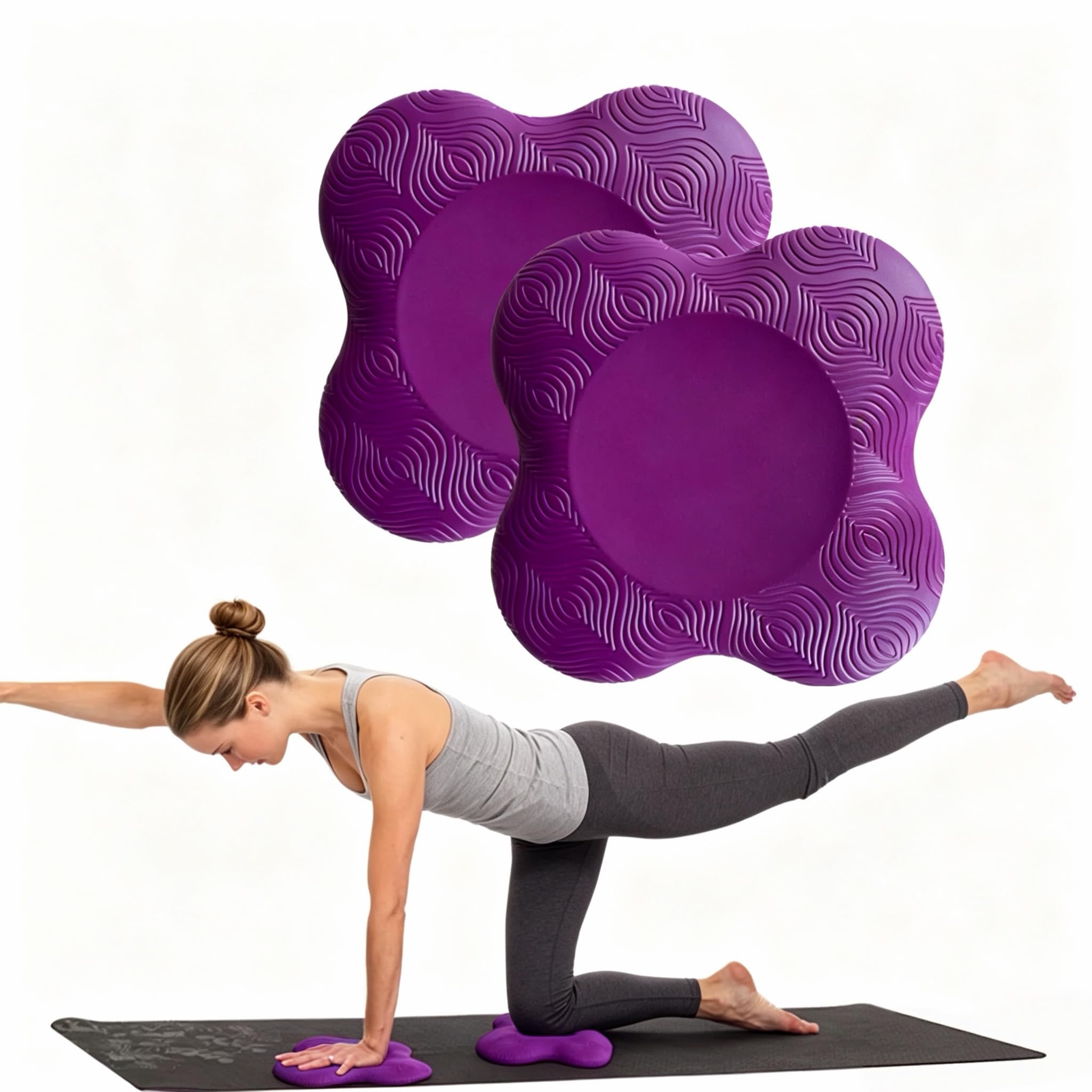
A two-pack makes sense for a practice where you want one pad under each knee, and the MBKHFLL set designs each cushion rather than just cutting a mat into squares. Each pad is 7.8 inches across and 0.78 inch thick, with a concave center that gives the kneecap somewhere to sit instead of pressing against a flat slab. That shape is why they feel more like a small piece of equipment than a pair of scraps.

The high-density foam is firm enough to take weight without bottoming out, and the textured surface stayed put on a mat during lunges and kneeling poses. Because there are two, you can use one under each knee, or put one under a wrist in side plank and keep the other for the knee. At 130 grams for the pair, they are easy to toss in a bag and forget about.

The 0.78-inch thickness is closer to a firm support than a deep cushion, which suits balance but will not satisfy knees that want a plush landing. For a hot class or a home practice where you want two small pads that do not take up space, that is a fair exchange. The pads are also easy to wipe clean, so sweat does not linger on the surface.

We reach for this set when we want a dedicated pad under each knee without committing to a long mat-width strip, and it is an easy recommendation for a first yoga bag. The concave center is the detail that keeps paying off: it holds the kneecap in place and makes a simple lunge feel less like balancing on a hard floor. The second pad is the quiet advantage—keep one by the mat and one in your bag, and you stop negotiating with a folded towel.

Pros

  • Concave center cradles the kneecap
  • Two pads for both knees or wrist support
  • Light 130-gram pair

Cons

  • Spot coverage needs repositioning between poses
Our verdict

This budget pair earns its place with a concave shape that cradles each knee and a light, packable design, as long as you want spot coverage.

Check Latest Price
6

Wide Floor Work

Impulse Yoga Knee Pad

90 /100
Peggy's Score Outstanding

Key details

Carry
Mesh bag
Weight
11.7 oz
Material
NBR foam
Dimensions
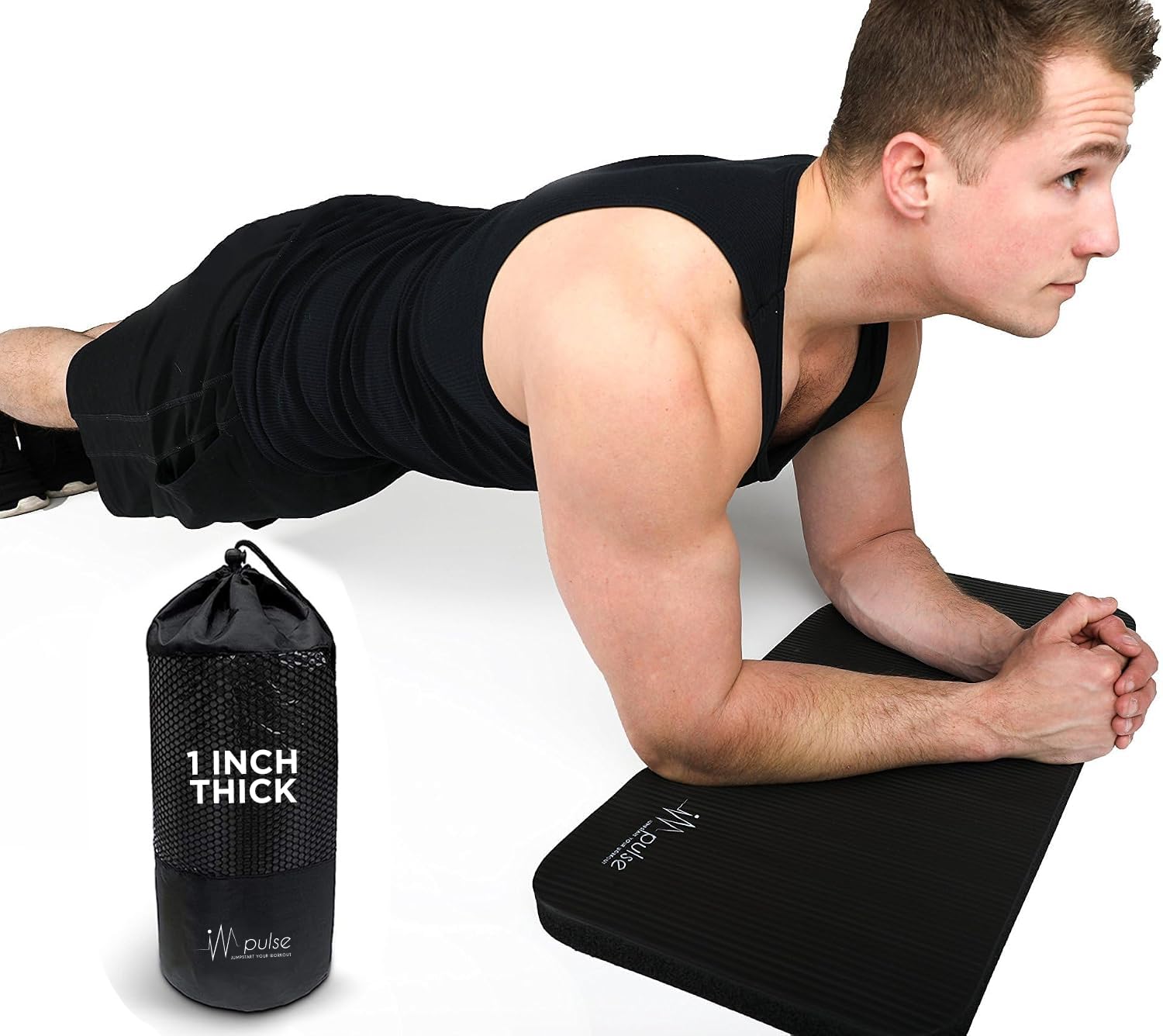
24"L x 12"W x 1"Th
Check Details on Amazon

The Impulse pad is 24 inches long and 12 inches wide, which makes it feel less like a knee spot and more like a small floor mat. We like that extra width for planks, forearm work, and kneeling poses where a hand and a knee need padding at the same time. A full inch of NBR foam gives it a substantial, protective feel, and the current version comes with a mesh bag instead of the old Velcro strap.

The surface has a useful non-slip texture, and the 11.68-ounce weight helps it sit still when you move. It is heavier than the thinner mat-width pads here, though still easy to carry by the bag. We also appreciate that the closed-cell foam wipes clean rather than holding sweat, which matters in a hot room.

This is the pad for someone who wants one generous surface for floor workouts, not the lightest possible class accessory. The 1-inch depth is more support than some people want under a knee, and the wide format takes up more bag space than a strip. For yoga alone, the ProsourceFit is the more balanced choice; for planks, ab work, and mixed training, the Impulse makes more sense.

Pros

  • Wide 24 x 12-inch surface
  • Full inch of NBR cushioning
  • Mesh bag and wipe-clean foam

Cons

  • Edges can show wear with heavy use
Our verdict

The Impulse is the wide, thick pad for planks and mixed floor work; it gives you a generous surface, though it is more to carry than a strip.

Check Latest Price
7

Thick Mat-Width Pad

HASSLICKIT Yoga Knee Pad

89 /100
Peggy's Score Excellent

Key details

Weight
9.6 oz
Surface
Dual-sided
Material
NBR foam
Dimensions
24"L x 9.8"W x 0.8"Th
Check Details on Amazon

The first thing to understand about the HASSLICKIT pad is that it is two surfaces in one: a smooth side and a textured side. We like that because it lets you choose the grip based on the floor—textured side down on a slick studio floor, smooth side down when you want the cushion to sit still on a mat. At 24 by 9.8 inches and 0.8 inch thick, it splits the difference between a thin mat-width strip and a plush pad.

The NBR foam is firm and supportive rather than squishy, which we prefer for balance and for keeping the kneecap from sinking into the floor. It is light at 9.6 ounces and rolls around its own strap, so it fits in a mat bag without much fuss. The 0.8-inch depth gives more clearance than the half-inch pads here without becoming a cumbersome roll.

Grip is the area to watch. On a textured mat the pad stayed put in our practice, but on a smooth floor it could slide when we shifted weight quickly. That makes orientation important: start with the textured side down, and check the pad before you settle into a long lunge. Still, for a dedicated knee pad that can handle travel and a variety of floors, it is a smart middle choice.

Pros

  • Dual-sided surface adapts to floors
  • 0.8-inch cushioning without bulk
  • Carry strap keeps it rolled

Cons

  • Narrower than the 12-inch pads here
Our verdict

Pick the HASSLICKIT for a mat-width pad with a little more depth and a reversible face that lets you tune grip to the floor.

Check Latest Price
8

Compact Knee Coverage

Zealtop Yoga Knee Pads

92 /100
Peggy's Score Outstanding

Key details

Surface
Textured
Material
Foam
Dimensions
7.87"L x 7.87"W x 1"Th
Set Contents
2 pads
Check Details on Amazon

The Zealtop pads are not going to replace a mat-width strip. They are two small square cushions, each about 7.87 inches across with a textured surface and thick foam, and their job is to sit under a knee, wrist, or elbow when you need a little lift off a hard floor. That is a narrow brief, but it is one they handle without fuss.

We like the pair for the way they stay contained in a bag: each pad is light, the foam is dense enough to take weight, and the non-slip texture grips a mat reasonably well. The central sag is meant to relieve pressure on the joint, and in a kneel it does feel more cradling than a flat square.

The foam is dense rather than spongy, so it holds up under a knee without collapsing. Cleaning is simple with a damp cloth, and the pad dries quickly enough to pack away after class. The textured top gives a little grip against skin or clothing, though it is not the softest surface under bare knees.

We keep coming back to the pair for its versatility: two pads, two knees, and no need to wrestle a long roll into a small bag. The surprising part is how often the second pad ends up under a wrist in tabletop or a hip in a seated stretch. That is the sort of small rescue that makes them worth carrying even if you already own a mat.

Pros

  • Two compact pads for targeted support
  • Dense foam with a cradling center
  • Easy to wipe clean

Cons

  • Spot coverage only
  • Can slide on very smooth floors
Our verdict

The Zealtop pair is a compact, low-cost way to add cushion under one knee or wrist, provided you do not need continuous mat-width coverage.

Check Latest Price

How We Tested 14 Pairs of Yoga Knee Pads

We built the shortlist by comparing thickness, materials, strap style, size options, and care instructions, then narrowed it to pads that were sold in pairs or as singles with clear dimensions. Price mattered, but only as a filter: we skipped anything that looked disposable and anything priced like a specialty medical device. From there, 14 pairs went into four months of real practice — daily home sessions on hardwood and carpet, weekly studio classes, and restorative sequences where I stayed kneeling for ten minutes at a time.

For support and cushioning, I pressed the heel of my hand into each pad and then held camel pose for a full minute, noting whether my knees felt pressure points or quiet support. I measured thickness with a ruler, but trusted the feel more: some thick pads compressed to nothing, while a few thinner ones stayed firm. Comfort showed up in the long holds, and functionality showed up in transitions — if I had to reach down and reposition the pad between poses, it lost points. On hardwood, I did cat-cow and low lunge and watched whether the pad scooted, curled, or stayed put.

Portability was simple: I weighed each pair and stuffed it into my yoga bag and a small tote, checking whether it fit a pocket or became a bulky item. For strap-style pads, I fastened and unfastened the Velcro 30 times and checked whether the hooks stayed crisp or filled with fuzz. After each wipe-down or wash, I looked at seams, edges, and top surfaces for flattening, cracking, or curling — the construction quality told the story. The pads that survived still felt supportive at the end of four months; the ones that flattened or curled didn't make the cut.

How to Choose Yoga Knee Pads

Start With Coverage: Strip or Spot Pad

Coverage is the first fork. A 24-to-26-inch strip spans most mats and stays under both knees through transitions, which is why we default to one for a home or studio practice. A pair of 8-inch pads is smaller and more useful for wrists and elbows, but you have to move each one between poses. Pick the strip if your practice is knee-heavy; pick the pair if you want targeted support that fits in a pocket or a small bag. The ProsourceFit and Heathyoga pads take the strip route; the Gaiam and MBKHFLL sets take the spot route.

Match Thickness to Your Knees

A half-inch pad takes the edge off a hard floor and keeps balance poses stable. Move to 0.8 or 1 inch when the kneecap still feels bruised through a mat, or when you spend long holds in child's pose and low lunge. Thicker foam adds clearance but also bulk and a less grounded feel. We suggest starting around 0.5 to 0.6 inch for general yoga and going to 1 inch only if you know you need it; the Kinesis is the extra-thick choice here, while the Heathyoga stays easier to balance on.

Test Grip on the Floor You Actually Use

Non-slip is not a yes-or-no property. A textured underside can hold on a yoga mat and still skate on polished concrete or a smooth studio floor. Before you load a knee, put the pad down and press it sideways with your hand; if it glides, turn it over or move it onto a mat. A dual-sided pad such as the HASSLICKIT gives you a textured face for slick floors and a smooth face for mats. Spot pads are the most likely to shift, so place them deliberately.

Weigh Portability, Cleaning, and Wear

Closed-cell NBR or TPE foam resists sweat and wipes clean; open-cell foam can hold moisture and odor. If the pad will travel, look for a strap or mesh bag and a roll that disappears into your existing bag. The Heathyoga's strap and the Kinesis's bag both make a difference, though a snug bag can be fussy. Check the edges every few months: foam that has torn or gone slick is no longer doing its job.

Frequently Asked Questions

Final Verdict

The ProsourceFit Yoga Knee Pad is the one we recommend first because it gets the everyday balance right: mat-width coverage, 15mm of firm support, light weight, and a surface that stays put on a mat. If you need more cushion, choose the Kinesis; if you need a pad that packs neatly for class, the Heathyoga's strap and shape make more sense. Start with the ProsourceFit unless one of those requirements clearly describes your practice.