Best Yoga Hand Grips of 2026

A grip trainer is about as low-tech as fitness gear gets: a spring between two handles that resists your fingers closing around it. What separates a good one from a drawer clogger shows up in week two, when the resistance either moves in useful increments or jumps straight from too easy to unusable. Grip is what quietly gives out first in a long arm balance, a slow chaturanga, or a heavy bag of groceries, and building it is mostly small, boring, repeatable squeezes. The right tool makes them easy to fit into a day.

Over four months, my team and I worked through 16 of them, from feather-light rehab models to dial-adjusted trainers. I kept one in my desk drawer and squeezed between meetings, which turned out to be the most honest test of all — the ones I reached for without thinking had handles that didn't dig in and a tension setting I could change one-handed. Something first-time buyers don't know: pound ratings on the box aren't standardized, so one brand's 40 pounds can feel nothing like another's. The picks below are sorted by who each one suits.

1

Best Overall

NIYIKOW Grip Strength Trainer

93 /100
Peggy's Score Outstanding

Key details

Materials
Metal and plastic
Item Weight
4.94 oz
Adjustability
Adjustable resistance
Resistance Range
22–132 lbs
Check Details on Amazon

The NIYIKOW is the one we reach for first because a single small gripper covers the range most people actually need. The resistance dial runs from 22 to 132 pounds, so a beginner can start light and the same tool still has room for heavier work later. At 140 grams and about 6 inches long, it disappears into a yoga bag or a desk drawer.

We like the adjustable resistance for shared households, too: someone easing back into grip work can use the low end while a stronger partner works closer to the top. The handle is comfortable for repeat sets, and the compact shape makes it easy to use while watching TV or waiting for a class to start. The tension markings are not as clear as they could be, though; the scale gives you a starting point rather than an exact readout.

The spring is the part to watch. It's a metal coil under load, and a failed spring can snap, so inspect it for bends or cracks before each session and retire the unit at the first sign of trouble. That caveat is worth accepting because the alternative is usually a fixed-resistance gripper that only suits one strength level. We treat the NIYIKOW as supplementary hand and forearm work for yoga, not as a prop for weight-bearing poses; a few short sets after practice are enough to make it earn its place.

Pros

  • One adjustable unit spans 22–132 lbs
  • Compact and light enough for a yoga bag
  • Low starting resistance suits beginners

Cons

  • Tension markings are hard to read
Our verdict

We recommend the NIYIKOW as the best first grip trainer for most people because one adjustable unit covers a useful range without taking up space.

Check Latest Price
2

Best Progressive Set

Hozzen 6-Pack Grip Set

89 /100
Peggy's Score Excellent

Key details

Set Includes
6 grip trainers and grip tape
Handle Material
Aluminum
Item Dimensions
5.1"L x 3.9"W
Resistance Levels
50, 100, 125, 150, 175, 200 LBS
Check Details on Amazon

Six grippers in a row look like overkill until you realize the jump from 50 to 200 pounds is the point. The Hozzen set gives you fixed levels rather than a dial, so you can grab the next weight when the current one gets easy and keep the progression honest. For a healthy adult who wants a clear ladder, that is easier to read at a glance than a numbered dial.

The aluminum handles feel solid in the palm, and the engraved pattern keeps the grip from sliding when your hands get damp. We also appreciate the six rolls of grip tape: they let you soften the knurling while your hands adapt, then peel it off when you want more bite. The color coding makes it easy to grab the right level without squinting at a small scale.

The 50-pound starting point is the main catch. It is too heavy for delicate rehab, small hands, or anyone who has not done grip work before, and there is no way to dial it down. We see the Hozzen as a progression tool for people who already know they can close a moderate gripper and want a simple path upward. If you need a gentle entry point, choose an adjustable model instead.

Pros

  • Six fixed levels from 50 to 200 lbs
  • Aluminum handles feel solid
  • Grip tape tames aggressive knurling

Cons

  • Six tools need more storage
Our verdict

Choose the Hozzen set if you want a clear ladder of fixed resistance levels and already know you can close a moderate gripper.

Check Latest Price
3

Best for Tracking

Hiyoga Counter Grip Trainer

87 /100
Peggy's Score Excellent

Key details

Tracking
Automatic grip counter
Item Weight
6.56 oz
Handle Material
TPR
Resistance Range
5–100 kg
Check Details on Amazon

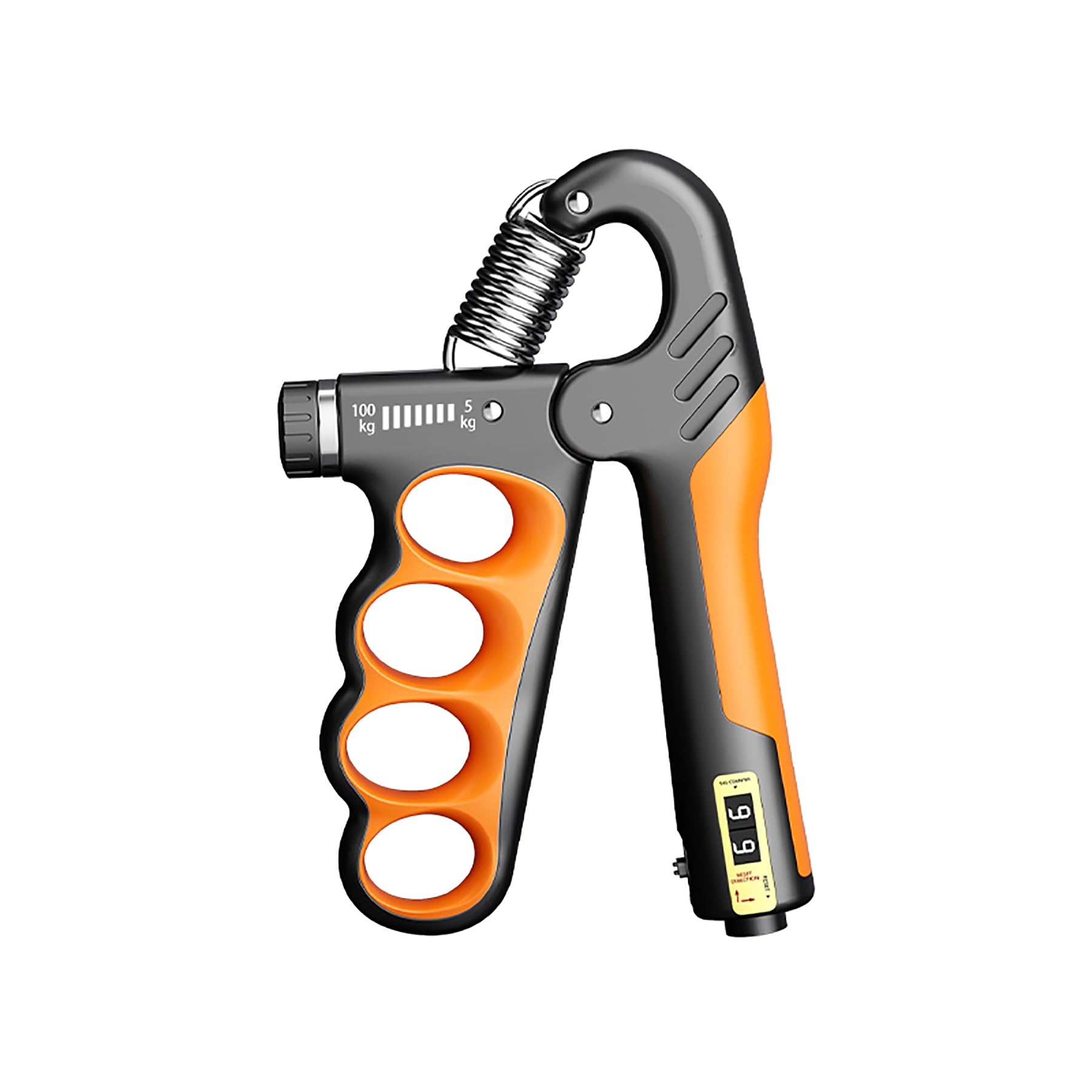
The Hiyoga's built-in counter is the reason to pick it: it records each squeeze and resets with a twist, so you can finish a set without counting in your head. That sounds like a small thing until you are three sets in and lose track. For anyone who likes a rep target, it is the most tracking-friendly trainer here.

Resistance runs from 5 to 100 kilograms, a broad range, and the TPR handle has a knuckle-duster shape that keeps your fingers from slipping. The adjustment is easy to change between sets, which makes the Hiyoga a good shared tool for a beginner and a stronger lifter. The top end runs lighter than the 100-kilogram label suggests, so treat the highest settings as a guide rather than a precise load.

The spring is the part we watch. It is under load at the top end, and a failed coil can let go, so check it for bends or cracks before each session. We still think the counter earns the Hiyoga a place for people who track reps, especially at the low and middle settings where the resistance feels smooth. If you only want a simple gripper and never look at a rep count, save the complexity for something else.

Pros

  • Built-in counter tracks reps
  • Adjustable from 5 to 100 kg
  • TPR handle resists slipping

Cons

  • Top resistance runs lighter than labeled
Our verdict

The Hiyoga is the pick for anyone who tracks reps, with a built-in counter and a broad resistance range in one compact trainer.

Check Latest Price
4

Best Light-Grip Pair

LIUSM Hand Grip 2-Pack

87 /100
Peggy's Score Excellent

Key details

Tension
Medium
Materials
Foam
Pack Count
2 hand grips
Item Weight
3.2 oz
Check Details on Amazon

The LIUSM pair is a gentle, compact option, and that is exactly why it earns a place. The foam handles are comfortable, the tension is medium, and two grippers mean you can keep one in the car and one by the desk. At 3.2 ounces, it is the one we toss in a bag without thinking about it.

Two grippers also solve the lost-in-one-room problem: keep one where you practice and one where you work, and you are more likely to use them. The foam is easy to wipe down after a sweaty practice, and the oval shape sits comfortably in the hand. We reach for the LIUSM on recovery days and leave the heavier grippers for strength work.

The medium tension is light enough to use for a few minutes without a warm-up, which makes it a good fidget substitute. It is not the tool for a max-effort session, but it is an easy one to live with. The pair format also means you are less likely to misplace the only gripper you own.

Pros

  • Two grippers in the pack
  • Light tension suits gentle rehab
  • Foam handles are comfortable

Cons

  • Too light for experienced lifters
  • Small size suits smaller hands only
Our verdict

The LIUSM pair is our gentle, low-cost choice for smaller hands and light rehab, not for heavy strength work.

Check Latest Price
5

Finger Mobility

QeeHeng Finger Exerciser Ball

87 /100
Peggy's Score Excellent

Key details

Design
Four-finger separated ball
Tension
Moderate to heavy
Material
Silicone
Item Dimensions
4.72"L x 3.94"W
Check Details on Amazon

The QeeHeng's four-finger ball shape is not a conventional gripper design. It is an oval ball with separated finger channels and a spiky surface, so you squeeze with individual fingers rather than wrapping your whole hand around a spring. The shape is meant to keep the fingers from sliding together, and it does that well.

We used it as a finger-mobility and stress-relief tool rather than a load-bearing strength trainer. The separated channels give each finger its own place to press, and the nubs add sensory feedback when you are working through a few minutes of tension. The silicone surface wipes clean with a damp cloth, which matters if it lives on a desk.

The texture is the thing to know before you buy: the nubs are firm, and they feel more like a sensory squeeze than a soft stress ball. We think it is a good fit for anyone who wants to work finger positioning without loading a spring. If you want a precise resistance trainer, choose one of the spring grippers instead.

Pros

  • Four separated finger channels
  • Textured surface adds sensory feedback
  • Works for stress relief and light mobility

Cons

  • Too large for smaller hands
Our verdict

The QeeHeng is a good finger-mobility and stress-relief tool for larger hands, but it is not a precise resistance trainer.

Check Latest Price
6

Therapy and Recovery

YPCBYNBS Hand Exerciser

86 /100
Peggy's Score Excellent

Key details

Materials
Plastic and rubber
Adjustability
Sliding clip and bands
Included Bands
8 resistance bands
Resistance Range
5–60 lbs
Check Details on Amazon

The YPCBYNBS uses rubber bands instead of a spring, which changes the feel and the failure point. You clip bands into a plastic frame and add or remove them to set resistance from 5 to 60 pounds; the sliding clip also adjusts the frame to your hand size. The kit includes eight bands, four yellow and four red, and they are latex-free.

We like it for therapy-style work because the pull is smooth and the starting tension is genuinely light. The frame is easy to set up, and the adjustable hand size makes it more forgiving than a one-size spring gripper. It is also the better choice if you want to add resistance in small steps rather than jump to the next fixed level.

The trade-off is bulk and upkeep. At 8.85 by 6 inches, the frame is larger than a pocket gripper, so it lives in a drawer rather than a yoga bag. The bands are replaceable, and the kit includes spares, but they are the part that wears out; check them for nicks before each use and swap them when the pull changes. For anyone rebuilding finger flexion after an injury, the light starting point and smooth pull make it easier to follow a graded plan than a stiff spring.

Pros

  • Band-based resistance starts at 5 lbs
  • Sliding clip adjusts to hand size
  • Latex-free bands
  • Includes eight replacement bands

Cons

  • Bands wear out and need replacing
  • Frame is bulky for a pocket
Our verdict

The YPCBYNBS is a smart therapy-style pick if you want smooth, graded band resistance and a frame that adjusts to your hand.

Check Latest Price

What Four Months With 16 Grip Trainers Taught Us

To build the shortlist, I started with the grip trainers sold by the major fitness and yoga retailers, added the adjustable ones that turn up in physical therapy recommendations, and cut anything that didn't state a resistance range or came in only one fixed tension. That left 16, which we used for four months.

Each trainer lived where you'd actually use it: one in a desk drawer for between meetings, one in a mat bag for warmups before class, one on the kitchen counter for the two minutes while the kettle boils. Two testers with noticeably different hand sizes did three sets of ten per hand most days, and logged whether the handles fit without the thumb sliding off the end or the pivot pinching skin.

We counted the turns or clicks it took to get from the lightest setting to the heaviest and noted whether the resistance jumped past useful in between. Each one was dropped onto a wood floor from waist height to see if the adjuster slipped or the housing cracked, and squeezed again a month later to check the spring hadn't gone soft. We also watched whether handles turned slick once hands got sweaty, and whether tension could be changed one-handed, mid-set, without hunting for instructions.

For value, we weighed what came in the box against the number of genuinely different resistance levels, since a three-setting trainer and a ten-setting one at the same price aren't the same purchase.

How to Choose Yoga Hand Grips

Start with the resistance range, not the biggest number

A gripper that starts too heavy is hard to use for rehab, warm-ups, or shared households. We prefer an adjustable model for a first purchase because it lets you begin light and add tension as your hands adapt. The NIYIKOW's 22-to-132-pound range covers the middle ground most people use; the Hiyoga runs lower and higher, but with more going on. A fixed set like the Hozzen, which starts at 50 pounds, is better for healthy adults who want a clear ladder.

Check the spring, handle, and band

Metal springs can snap, aluminum handles can work loose, and rubber bands wear out. Those are the failure points to check before you load a new tool. Look for a clean coil, secure handle pins, and spare bands if you choose a band-based exerciser. A little maintenance beats a surprise failure mid-set.

Fit your hand before you chase features

A gripper should sit in your palm without forcing your fingers into a cramped curl. Foam and TPR handles are kinder for high-rep sets, while knurled aluminum gives more traction when your hands get sweaty. Small hands do better with a compact pair like the LIUSM; larger hands may find the QeeHeng ball too broad. If you can, compare the handle length and the gap between grips to a tool you already own.

Match the tool to the job

A spring gripper is the straightforward choice for hand and forearm strength. A band-based frame gives smoother, lighter resistance for therapy-style work, and a finger-separated ball is better for mobility and stress relief than for heavy loading. A counter is worth paying for only if you actually track reps; otherwise it is one more thing to reset. Buy for the work you do most, not the feature list.

Frequently Asked Questions

Final Verdict

The NIYIKOW is the one we recommend first because it gives most people a useful range in a small package. Start light, add resistance as your hands adapt, and keep it in your yoga bag.

If you prefer a fixed ladder and don't need to share one tool, the Hozzen set is the cleaner progression; if you want to track reps, the Hiyoga counter is the better fit. The LIUSM pair is the gentle choice for smaller hands and light rehab.