Best Workout Sandbags of 2026

A sandbag is the cheapest way to add genuinely awkward weight to a workout — and the quickest way to end up with a pile of sand in the corner of your garage. The good ones hold their shape when you shoulder them, don't spit filler out of the seams, and let you go from 25 pounds to 60 without buying a second bag. The bad ones blow a zipper in week two. What you're actually paying for is a shell that survives being dropped, dragged, and thrown, filled with something that stays where you put it.

I've kept one in my garage for years, mostly because it's the piece of gear that punishes me for going too light. Over four months my team and I loaded, carried, and dropped 12 of them, and the gap between good and bad showed up fast. Here's what first-timers get wrong: the filler matters as much as the shell. Pea gravel is quieter and less dusty than play sand, but it shifts under you in a way sand doesn't. The bags below are the ones we kept reaching for.

1

Best Overall

Elite Sports Workout Sandbag

90 /100
Peggy's Score Outstanding

Key details

Fill Bags
Three inner bags
Weight Range
25 to 50 lbs
Shell Material
Ballistic nylon
Empty Dimensions
10 x 9 x 5.5 in
Check Details on Amazon

Load a bag to 45 pounds, carry it across a room, and you find out quickly whether the handles were placed by someone who has done it. On this Elite Sports bag they were. The webbing loops sit at the balance point and at both ends, so a shoulder carry settles instead of sliding, and there's a grab point for rows and deadlifts without hunting for one.

That layout is what put it at the top of our list. The shell is ballistic nylon with reinforced stitching and a zipper plus hook-and-loop closure over the top, and the sand rides in three separate inner bags rather than loose inside the shell. We loaded ours, carried it, squatted with it, and rowed with it, and nothing worked its way into the outer bag or out through the closure.

It ships empty, so add a bag of play sand to your cart. Filling is a scoop-and-funnel job rather than an afternoon, and the inner bags are sized so you can run 25 pounds for a light day and add the rest later. Empty, the shell measures about 10 by 9 by 5.5 inches and folds flat enough to live on a shelf, which matters if the bag isn't on permanent display.

The 50-pound ceiling is the one thing we'd change if we could. Below it, 50 pounds of shifting sand is more than enough to make a set of squats memorable, and the bag is small enough to put away afterward. Above it, you need a different shell entirely.

Pros

  • Handles placed for carries, rows, and squats
  • Three inner fill bags keep sand out of the shell
  • Reinforced seams with a double closure
  • Packs down small on a shelf

Cons

  • Caps out at 50 pounds
Our verdict

The bag we hand people first: the sand stays put, the handles land where your hands need them, and 25 to 50 pounds covers most home strength work.

Check Latest Price
2

Best for Heavy Loads

IronMind Tough-As-Nails Sandbag

90 /100
Peggy's Score Outstanding

Key details

Capacity
300 lbs fully loaded
Included
Two liners and training course
Dimensions
24 x 36 in
Shell Material
Cordura
Check Details on Amazon

A 300-pound sandbag is a different animal from a 50-pound one, and this IronMind bag is built for that end of the scale: a 24-by-36-inch Cordura shell, two inner liners, and enough room for 300 pounds of sand fully loaded.

We've loaded ours heavy enough that moving it takes two people and dropped it from shoulder height; the shell shrugs it off. The blue Cordura is the plain, tough stuff — no foam, no shaping — so the bag takes whatever form the sand inside gives it. It ships with a training course, which is more useful than it sounds if you've never handled an awkward load before.

Where it earns its place is the work you can't do with anything smaller: shouldering, heavy carries, lapping, over-the-shoulder throws. Below about 100 pounds the big shell slumps and you'll fight it on cleans, so this isn't the bag to grow into from scratch. It's the one you move to when a 100-pound bag has stopped being a challenge.

Pros

  • Holds up to 300 pounds of sand
  • Tough Cordura shell survives drops
  • Ships with two liners and a training course
  • Made in the USA by a long-running strength brand

Cons

  • Takes a large sand purchase to reach capacity
  • Two liners add steps to every fill
Our verdict

We point strongman and heavy-carries trainees here: 300 pounds of capacity in a plain, tough Cordura shell that takes drops without complaint.

Check Latest Price
3

Best for Progression

Polyfit Classic Sandbag

88 /100
Peggy's Score Excellent

Key details

Handles
8
Capacity
50 to 125 lbs
Dimensions
28 x 12.8 in
Shell Material
Nylon
Check Details on Amazon

Polyfit sells this bag in three sizes, and that choice matters more than any other decision here: small tops out at 50 pounds, medium at 75, large at 125. Our advice is to buy the large. The range is the whole point — you start with a couple of filler bags, add sand as you get stronger, and never outgrow the shell.

Eight webbing handles is one more than most bags in this guide, and they're arranged for carries, rows, and squats rather than dotted around for the photo. The fillers use a double hook-and-loop closure, and in our sessions the sand stayed inside them where it belongs. The outer bag is plain nylon, which means it grips a shoulder well but won't take the same punishment as heavier Cordura.

What you give up is backup. Polyfit doesn't list a warranty on this bag, which is a real difference from the Elite Sports and the IronMind, both of which carry one, and it tells you how the company views wear and tear. Treat this as an indoor bag that lives in the garage or the corner of a room and it will serve you for a long stretch of training.

Pros

  • Adjustable from 50 to 125 pounds
  • Eight handles in useful positions
  • Double hook-and-loop filler closure

Cons

  • No manufacturer warranty
Our verdict

The bag for someone who wants to buy once: 50 to 125 pounds of range, eight handles, and filler bags that seal properly.

Check Latest Price
4

Best Single Heavy Bag

Wolf Tactical Sandbag

89 /100
Peggy's Score Excellent

Key details

Capacity
100 lb
Packed Size
12 x 9.5 x 2.6 in
Shell Material
1000D coated Cordura nylon
Check Details on Amazon

Between this and the IronMind sits a simpler question: how much bag do you actually want to load? Wolf's shell is rated for 100 pounds, the heaviest single-bag load here short of the 300-pound IronMind, and it's made from 1000D coated Cordura of the sort that turns up on military pouches. It's the one we reach for when the session is carries and cleans rather than maximum weight.

Packed, it measures about 12 by 9.5 by 2.5 inches and weighs almost nothing, so it disappears into a duffel for a weekend or onto a garage shelf. In our sessions the fabric has scuffed less than the nylon bags here and the seams have stayed put through drops, which says more about the coated Cordura than about any clever design. Filling is straightforward: one big opening, seal it, and start loading.

The catch is the number on the label. A 100-pound rating assumes dense, dry fill, and lighter sand or gravel won't get you there — the shell fills short and the bag stays floppy. If you're comparing it with the Polyfit, that bag gives you a 125-pound ceiling for less money and more adjustability; choose the Wolf for the heavier fabric and the simplicity of one bag, one fill.

Pros

  • 1000D coated Cordura shell
  • Takes drops and daily abuse
  • Packs flat for travel and storage
  • Easy to fill

Cons

  • Lighter fill falls short of the 100-pound rating
Our verdict

For carries, cleans, and throwing a heavy single bag around, this 100-pound coated Cordura shell is the one to load — just buy dense fill.

Check Latest Price
5

Best All-In-One Kit

Meister Elite Fitness Sandbag

89 /100
Peggy's Score Excellent

Key details

Shell
PVC with foam core
Handles
8
Bag Capacity
50 lb
Included Kettlebells
10, 15, and 20 lbs
Check Details on Amazon

Three sand kettlebells — 10, 15, and 20 pounds — ship inside the Meister bag, which sounds like the kind of idea that turns into a gimmick and doesn't. Pull them out and you have three separate implements for presses and swings; leave them in and the bag carries 50 pounds in a firmer, more stable shape than a duffel full of loose sand.

That rigidity is the reason we like it. The PVC shell has a thick foam core, so it holds a form instead of slumping around your shoulders on a clean — you get something closer to a stone than a sack, and the surface doesn't dig in the way webbing can. Eight handles, including angled ones and thick rubber grips, give you more ways to hold it than almost anything else in this guide.

The trade-offs are real. It's the most expensive route to 50 pounds on this page, sand isn't included, and the fill lines printed inside exist because you're expected to top it up yourself to hit an exact weight. The removable kettlebells only go to 20 pounds, so they're a warm-up and accessory tool. The bag is the reason to buy; the kettlebells are the bonus that keeps it in rotation.

Pros

  • Holds its shape better than a duffel
  • Three removable sand kettlebells included
  • Eight handles, including angled grips
  • Fill lines make weights repeatable

Cons

  • Costliest way to reach 50 pounds
Our verdict

If you want a bag that keeps its shape and doubles as a small kettlebell set, this is the one — you pay once and get both.

Check Latest Price
6

Budget Adjustable

Yes4All Adjustable Sandbag

88 /100
Peggy's Score Excellent

Key details

Handles
7 rubber
Capacity
25 to 75 lbs
Included
Outer bag with two inner bags
Shell Material
1000D Cordura nylon
Check Details on Amazon

This is the cheapest adjustable bag in this guide and, on paper, one of the most complete: a 1000D Cordura outer shell, seven rubber handles, two inner filler bags, and a stated range of 25 to 75 pounds. That combination is why it turns up in so many home gyms.

We filled ours and trained with it, and the handles do what the layout promises — different angles for rows, carries, and squats, with enough room to get both hands on for a goblet hold. The outer shell is genuinely tough. The zipper is short, though, so getting the second filler bag seated takes patience and a bit of rolling and shoving before the flap closes.

Containment is where it slips. The filler bags are the weak point: sand works loose through the inner seams and ends up rattling around inside the outer shell. That's manageable if you treat the fillers as the disposable part — line each one with a heavy trash bag before it goes in and the mess stays contained. Don't count on hitting 75 pounds with ordinary play sand either; most fills come up short.

What you're buying here is capacity and handle count at the lowest entry point, and what you're accepting is a bag you'll maintain. If lining bags isn't how you want to spend a Sunday afternoon, the Elite Sports pick costs more and hasn't given us that trouble.

Pros

  • Lowest-cost adjustable bag here
  • Seven handles at different angles
  • 1000D Cordura outer shell
  • Two filler bags included

Cons

  • Filler bag seams can split and spill sand
  • Rated 75-pound capacity is optimistic
Our verdict

A lot of bag for the money if you'll line the filler bags and don't need the full 75 pounds.

Check Latest Price
7

Slams and Floor Work

Hyperwear SandBell

94 /100
Peggy's Score Outstanding

Key details

Fill
Pre-filled and sealed
Weight
10 lb
Warranty
2 years
Shell Material
Neoprene
Check Details on Amazon

The first time you drop a sandbag on a wood floor, you hear what you paid for. The SandBell is the one here designed to be slammed on hardwood or tile without wrecking either the floor or the bag: a sealed neoprene disc filled with USA sand, no zipper, no hook-and-loop, nothing to burst open mid-set.

It arrives filled, which removes the sand-buying chore entirely, and the shell is thick and slightly stretchy, so grip becomes part of the workout as the sand shifts under your hand. At 10 pounds ours is a conditioning and warm-up tool — good for tosses, rotational throws, and dead bugs — not a strength implement.

The fixed weight is the whole limitation. A 10-pound bell doesn't grow with you, and the heavier sizes in the line cost more than a sack of sand and a filler. What it does better than anything else in this guide is move fast and land softly, and the two-year limited warranty is more coverage than several of the bags on this page offer.

Pros

  • Sealed shell can't leak sand
  • Arrives pre-filled with USA sand
  • Safe to slam on hard floors
  • Two-year limited warranty

Cons

  • Single fixed weight, no adjustability
Our verdict

Buy it for slams, throws, and fast conditioning anywhere — not as your only loaded bag.

Check Latest Price
8

Swing and Rotation

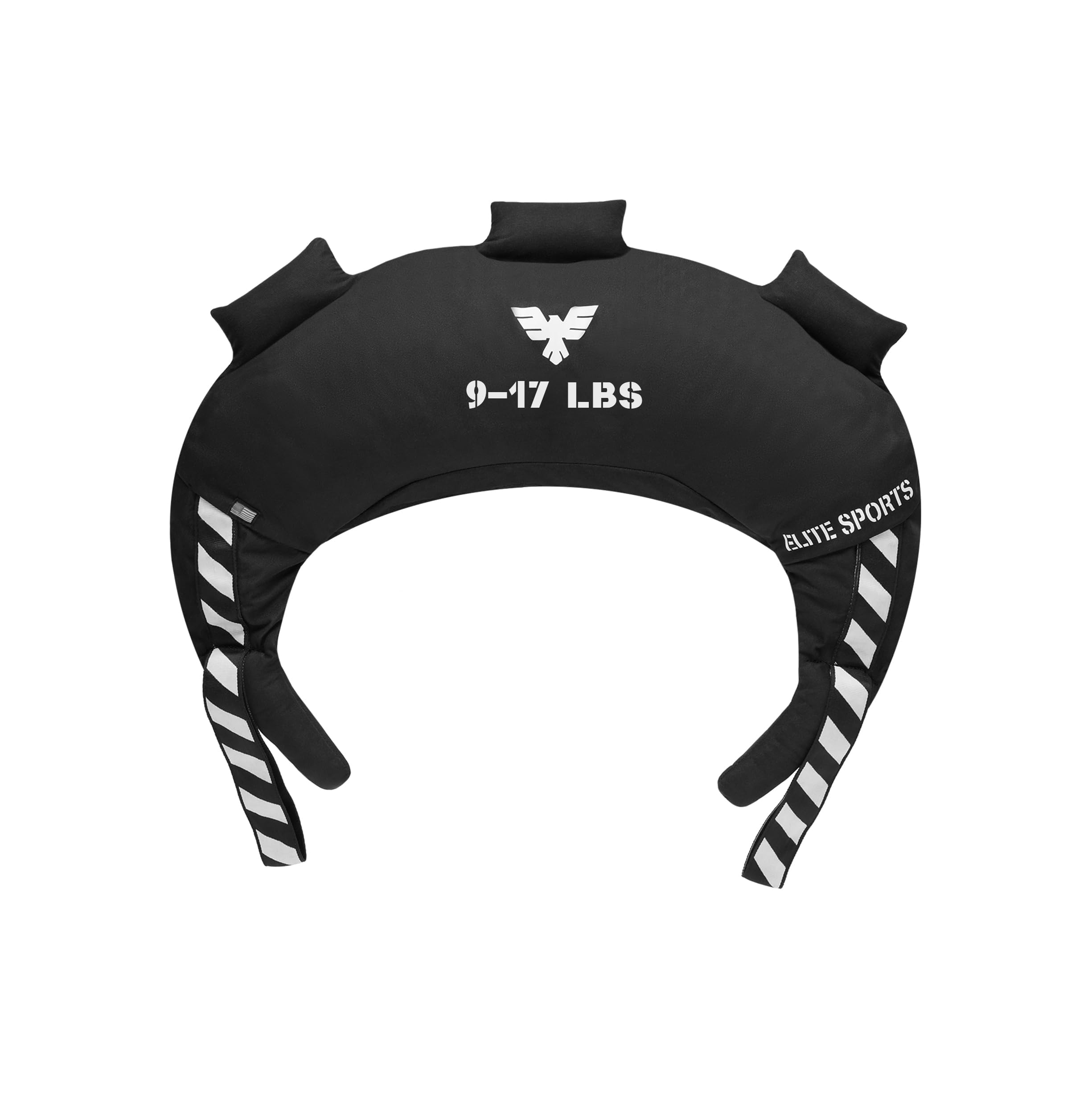
Elite Sports Bulgarian Bag

90 /100
Peggy's Score Outstanding

Key details

Weight
17 lb
Dimensions
33 x 10 in
Shell Material
Cordura
Programs Included
3
Check Details on Amazon

A Bulgarian bag is not a duffel of sand with handles, even though it looks like one. The 33-by-10-inch shape and the grips running along its length are built for swings, rotations, and good mornings — the movements where a long bag traveling around your head does the work, rather than the slow grind of a loaded carry.

We filled the 17-pound version and swung it, and the bottom grips are the detail that sells it: they sit where a lapel or a collar would, so grip-and-turn work feels natural instead of improvised. The Cordura shell and reinforced stitching have taken everything we've thrown at it, and three workout programs come in the box for anyone who hasn't trained this way before.

It ships empty with an inner liner, and the weight is the boundary. Seventeen pounds is a light starting point, fine for rotation and conditioning and nowhere near enough to load a squat. It also carries no warranty, which is worth knowing if it's going to live outdoors.

So this is a specialist's tool rather than a first sandbag. If your programming already includes rotational work, or you came to lifting from wrestling or MMA and want that movement pattern back, nothing else here does the job. If you want one bag for carries and cleans, start elsewhere and come back when the training calls for it.

Pros

  • Long shape built for swings and rotations
  • Lapel-style grips along the length
  • Cordura shell with reinforced stitching
  • Three workout programs included

Cons

  • Light 17-pound ceiling for loaded strength work
  • No warranty
Our verdict

A purpose-built swing and rotation tool that's well made — worth it once your training calls for that pattern, not before.

Check Latest Price

How We Tested (and Beat Up) a Dozen Workout Sandbags

We started by pulling every option actually sold as fitness equipment rather than a contractor's fill bag, then narrowed by shell material, closure style, handle layout, and whether filler was included. Stated capacities ran from 10 to 70 pounds, so we bought 12 bags across that spread — a mix of pre-filled and empty shells — and weighed cost against pounds of usable capacity, since a cheap bag that needs $40 of sand isn't cheap.

Testing ran four months, mostly on a garage floor and a concrete driveway, plus a few sessions in a low-ceilinged basement. We filled every bag to its stated maximum on a luggage scale to see whether the claimed capacity was real, using play sand for some and pea gravel for others, and noted how each filler behaved in a shouldered carry, how bulky the shell felt against the chest at full load, and whether the whole thing sagged in the middle. Then we trained with them: heavy carries, over-the-shoulder tosses, front-loaded squats, presses, drags, and slams. Closures got opened and closed 50 times each, with and without gloves, because a zipper you can't work with chalky hands is one you'll stop using.

For durability, we dropped each bag from shoulder height onto concrete 20 times and dragged it 50 feet across the driveway, then checked seams, handles, and the ground underneath for stretching, fraying, and leaked dust. What separated the top picks was unglamorous and consistent: double-stitched seams, a closure that stayed shut under a full load, and a shell that scuffed without tearing.

How to Choose Workout Sandbags

Match Capacity to the Weight You'll Lift

The common mistake is buying the biggest shell available and filling it halfway. A large bag holding 60 pounds of sand slumps in the middle, swings its weight away from you on a clean, and feels worse than a smaller bag filled properly. A bag loaded to roughly 80 percent of its rating keeps its shape and moves the way it should.

If you're new to loaded carries, a 25-to-75-pound range gives you somewhere to grow without an unmanageable bag at the bottom. If you're already shouldering 200 pounds, buy a big shell built for it rather than cramming a mid-size bag past its rating.

Plan for the Fill, Because Sand Isn't in the Box

Almost every bag here ships empty, so your budget is a bag plus sand, and your Sunday is a filling session. Dry play sand is the default and the cheapest route. Pea gravel is denser, so you reach a given weight in a smaller, firmer bag; rubber mulch is lighter and quieter but won't get you to the printed number.

Keep whatever you use bone dry — damp sand clumps, smells, and is miserable to empty. Buy a little more than you think you need, since shells rarely hit their rating exactly, and decide where the leftovers live before you open the first bag.

Check the Closure and the Seams First

Sandbags fail in the same three places: the seam where a handle attaches, the zipper, and the inner filler bag. Reinforced or double stitching at the handle roots and a closure that pairs a zipper with a hook-and-loop flap are the baseline, not a premium.

The filler is what actually holds the sand, so it deserves the closest look. Double-sealed fillers, a generous opening, and replacement bags you can buy separately all extend the life of the shell. A heavy trash bag used as a liner costs almost nothing and catches a split filler before it reaches your floor.

Handles and Shape Decide Which Lifts You Get

Handles aren't decoration. End loops make carries and cleans possible, side loops make rows and squats comfortable, and a bag with three or four of them limits you to bear-hug work. Seven or eight is the useful range in this group, and flat webbing is gentler on the hands over a long set than thick rubber.

Shape matters just as much. A compact duffel loads and carries like a stone, a long Bulgarian bag is built for swings and rotations, and a big square shell is for slow, heavy work. Picture the movements you actually do, then check where the loops sit before you buy.

Frequently Asked Questions

Final Verdict

Buy the Elite Sports bag. It holds 25 to 50 pounds, keeps the sand in the fillers where it belongs, and puts handles where your hands go — that covers squats, cleans, carries, and presses for most people training at home.

When 50 pounds stops being enough, move up to the Polyfit for 125 pounds of adjustable range, or to the IronMind if you're loading past 200. And if you want to slam something on a hardwood floor tomorrow, the SandBell shows up filled and ready.