Best Weighted Vests of 2026

A weighted vest is a simple idea: load your torso, and every walk, squat, and stair climb gets harder. The tricky part is building one you'll actually keep wearing. The more weight a vest carries, the more it has to hug your body, and that's where most of them struggle — bouncing against your chest mid-stride, digging into your collarbones, or smelling like a tire fire after two weeks. The good ones vanish once you strap them on, and the only thing you notice is the work.

Over the past six months, my team and I have worn 12 vests through dog walks, treadmill sessions, weekend hikes, and living-room circuits. The thing nobody tells a first-timer: the number on the box matters far less than where the weight sits and whether you can take some of it out. Twenty pounds loaded in the wrong place feels worse than 10 pounds placed well, and a vest you can't dial down is one you'll quit on in three weeks. Below are the ones we kept reaching for, and who each one suits best.

1

Best Overall

RUNmax Pro Weighted Vest

93 /100
Peggy's Score Outstanding

Key details

Load
20 lb, removable
Extras
Phone and bottle holders
Closure
Hook-and-loop flap
Warranty
Lifetime
Check Details on Amazon

The weights come out, and that single fact is why this vest tops our list. You can wear the shell nearly empty for a first week of walks, drop a couple of weight packets back in when your shoulders settle, and keep adding until it is carrying 20 pounds. Compare that with the sealed vests here, which arrive at one fixed weight and stay there for as long as you own them. We think it is the most useful thing you can buy at this price.

The shoulder pads are the other half of the argument. Twenty pounds across two padded straps sits very differently from the same load on bare webbing, and this is one of the few vests in this set where the padding comes as part of the vest rather than an afterthought. A pocket at the front takes a phone, there is a holder for a bottle, and the whole thing closes with a hook-and-loop flap across the chest plus straps at the waist.

Running is not its strongest suit: at a jog it bounces until you pull the waist strap down tight, which is the fix. The lifetime warranty is the last thing worth knowing, and it matters more than it sounds — seams and stitching are what fail on a loaded vest, and this one is covered for as long as you own it.

Pros

  • Removable weights let you build load gradually
  • Padded shoulders make 20 pounds comfortable
  • Phone pocket and bottle holder built in
  • Adjustable load at a fixed-weight price

Cons

  • Hook-and-loop closure can lose grip with age
Our verdict

Our default pick: the weights lift out so you can start light and add load, the shoulder pads keep 20 pounds wearable, and it costs about what a fixed-weight vest does.
Check Latest Price
2

Best for Heavy Loads

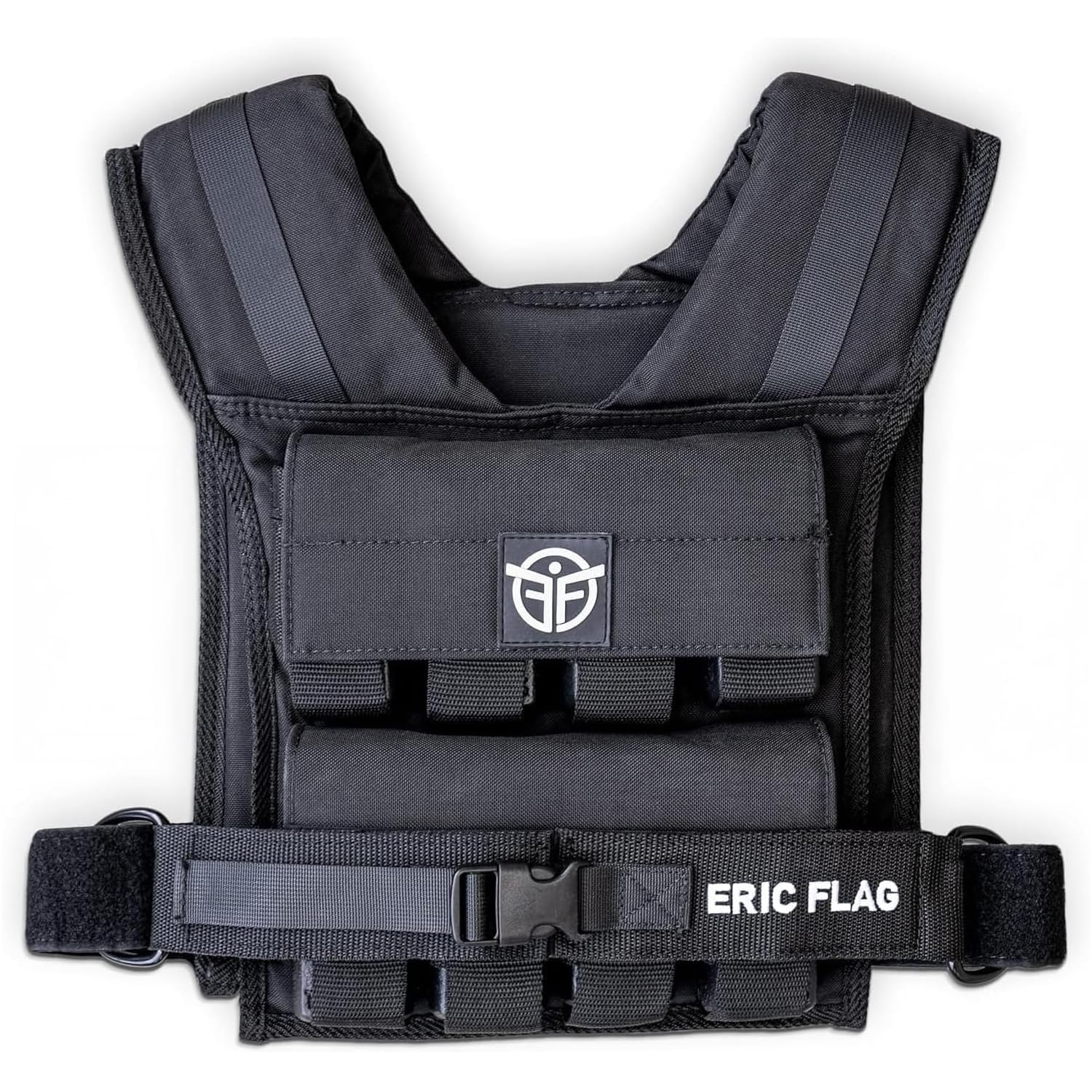
ERIC FLAG 40 lb Weighted Vest

93 /100
Peggy's Score Outstanding

Key details

Shell
1000D Oxford nylon
Max Load
40 lb
Empty Weight
1.6 lb
Weight Increments
16 × 2.4 lb iron weights
Check Details on Amazon

The person this vest is built for already has a training routine and wants one vest to carry it for years. Sixteen iron blocks at 2.4 pounds each sit in eight front pockets and eight back ones, so the ceiling is 40 pounds and the load spreads across your torso instead of hanging off your shoulders.

That layout is what makes it worth the money, and it is the most expensive vest in this set by a wide margin. What you are buying is a shell rather than a garment: 1000D Oxford nylon, a buckle closure, and a vest that weighs 1.6 pounds empty, which means you can put it on with nothing in it and load up as a session demands. We think that is the right trade for anyone lifting past 20 pounds and the wrong one for a walker who wants a single fixed weight.

Movement is where the price shows up. The adjustable strap pulls it snug across a range of body shapes, including bigger chests, and it stays put through pull-ups, dips and jumping squats rather than swinging away from your chest. Nothing about the cut restricts your arms, which is the difference between training in it and enduring it.

The one thing to weigh: if your idea of a weighted vest is an evening loop around the block, 40 pounds and a tactical cut are more vest than you need, and the neoprene options here cost a fraction as much.

Pros

  • Sixteen removable iron weights in 2.4-pound steps
  • Stays put during dynamic, fast movement
  • 1000D Oxford shell built for hard use
  • Fits a range of shapes, including larger frames

Cons

  • The most expensive vest in this set
  • More load and bulk than a walker needs
Our verdict

The vest for someone whose training is already the point: forty pounds in small iron steps and a shell that does not shift when you move fast.

Check Latest Price
3

Best for Beginners

Sportneer Adjustable Weighted Vest

91 /100
Peggy's Score Outstanding

Key details

Care
Weights removable for washing
Load
2 to 18 lb
Closure
Zip front, waist and shoulder locks
Weight Packs
8 × 2 lb and 1 × 1 lb
Check Details on Amazon

Nine weight packs — eight at two pounds and one at a single pound — are what make this the friendliest vest here to begin with. You zip it on, then add or pull packs until the load feels right, so you creep up two pounds at a time rather than committing to a number at checkout.

The zip front and the double locks at the waist and shoulders are the second reason we like it. The vest goes on like a jacket, the shoulder straps stay where you set them instead of gapping under the full 18 pounds, and the whole thing comes off in one motion when you are done.

We think this is the best vest here for someone who has never trained with load. The packs pull out for washing, which matters more than it sounds on a garment you sweat into several times a week, and the reflective strips front and back earn their keep on dark morning walks. The limit is the ceiling: 18 pounds feels like plenty in week one and may not in month six, so buy it knowing a heavier vest may follow.

Pros

  • Eight 2-pound packs plus a 1-pound pack
  • Weights come out so the shell can be washed
  • Zip front with waist and shoulder locks
  • Reflective strips front and back

Cons

  • Tops out at 18 pounds
Our verdict

Start light and add two pounds at a time: the zip front, the washable packs, and the waist-and-shoulder locks make this the easiest first vest to live with.

Check Latest Price
4

Best Weight Range

ZELUS Weighted Vest

91 /100
Peggy's Score Outstanding

Key details

Shell
Spandex over iron sand
Extras
Reflective stripe, armband pouch, rear pocket
Chest Fit
35 to 45 in
Weights Available
6 to 30 lb
Check Details on Amazon

Seven weights, from 6 pounds up to 30, and buckled straps that run from a 35- to 45-inch chest: the Zelus is the sealed vest here that fits the most people in the most sizes. Order it as an 8 for daily walks, a 16 for a made-over route, or a 25 if you are already strong and want the vest to be the hard part.

That spread is what makes it a sensible first buy. The straps cinch it down over a t-shirt or a light jacket, the shoulder padding is generous enough that an hour of walking does not leave you sore, and the spandex shell wipes clean with a damp cloth instead of going near a machine.

The reflective stripe runs across the front, there is a detachable armband pouch for a phone and a key, and a mesh pocket at the back takes the rest. For early-morning walks and evening dog routes, that is the difference between a vest you wear and one that sits by the door.

We rate it the best fixed-weight option in this set for walking and light jogging — more sizes, more padding and more usable pockets than the cheaper sealed vests. It is the one to buy if you have already decided you do not need to change the load.

Pros

  • Seven weight options from 6 to 30 pounds
  • Wide 35- to 45-inch chest range
  • Reflective stripe plus two pockets

Cons

  • Sealed fill
  • Chemical smell that can linger
Our verdict

The fixed-weight vest we point walkers to: seven loads to choose from, a chest range that covers most adults, and pockets that make it practical.

Check Latest Price
5

Best Women's Fit

BAGAIL Weighted Vest for Women

93 /100
Peggy's Score Outstanding

Key details

Care
Wipe clean, air dry
Shell
Neoprene over iron sand
Extras
Detachable phone pouch, reflective strips
Weights Available
5 to 30 lb
Check Details on Amazon

Most weighted vests are cut like a box, which is why they gape at the chest and dig under the arms on a narrower frame. BAGAIL shapes this one over the bust and in at the waist, and the result is a vest that sits like a piece of clothing rather than something strapped to you.

That shaping is why we recommend it to women first. The chest and waist straps adjust independently, so you can get it snug without compressing anything, and the clip holds through a full walk instead of popping open halfway round. The detachable phone pouch is a small thing that turns out to matter: it comes off for wiping down and goes back on for errands.

The catch is the same one that applies to every sealed vest: the 10 pounds you order is the 10 pounds you get. The line runs from 5 to 30 pounds, so pick a weight you can grow into rather than the heaviest one you can lift today — and accept that an easy recovery walk means a different vest.

Pros

  • Shaped over the chest and in at the waist
  • Chest and waist straps adjust independently
  • Detachable phone pouch and reflective strips

Cons

  • Sealed fill
Our verdict

The one we hand to women first: shaped over the chest and in at the waist, so it sits like a layer rather than a sack with straps.

Check Latest Price
6

Best Budget

Henkelion Weighted Vest

91 /100
Peggy's Score Outstanding

Key details

Fill
Iron pellets and metal rock
Pocket
Rear mesh pocket
Weight
12 lb
Closure
Single buckle strap
Check Details on Amazon

One buckle, one strap, worn across the collarbone, and no hardware at the shoulders. That is the whole retention system on the Henkelion, and it makes the vest about as quick to put on as a daypack — grab it on the way out, clip, done.

For the money there is a lot here. The 12-pound fill is iron pellets and metal rock rather than cheap sand, the neoprene is soft enough that it does not bite into your shoulders, and the mesh pocket at the back gives you somewhere to put a set of keys or a folded layer. It also disappears under a jacket, which most vests this thick cannot manage.

Where it earns its place in this guide is as the low-cost experiment: if you are not certain weighted walking will stick, this is the least you can spend to find out, and a 12-pound loop around the block will not leave you sore. It is a walking vest, though — pick up to a jog and the single collar strap lets the whole thing lift and settle with every step.

Pros

  • Soft neoprene that does not dig in
  • Slim enough to wear under a jacket
  • Rear mesh pocket for keys or a layer
  • Costs less than any other vest here

Cons

  • Chemical smell can linger after airing
Our verdict

The cheap experiment worth taking: soft neoprene, a 12-pound load, and enough comfort to find out whether weighted walking sticks.

Check Latest Price
7

Long Sessions

Zeerun Weighted Vest

91 /100
Peggy's Score Outstanding

Key details

Seams
Double-stitched
Closure
Elastic band and buckle
Shoulders
Thickened padding
Weights Available
6 to 30 lb
Check Details on Amazon

Thick shoulder padding is the first thing we noticed, and it is the reason this vest is still comfortable in the back half of a long session. Zeerun builds up the straps over the shoulders and double-stitches the seams, so the load rides on foam rather than on the trapezius.

The rest is straightforward: iron particle fill sealed in neoprene, an elastic band with an adjustable buckle, reflective stripes, and a menu that runs from 6 to 30 pounds. It is also one of the few vests here that does not arrive reeking of the factory, which is worth more than it should be.

The problem is the cut. It runs small through the chest and the arms, and the straps are narrow enough that a broad-shouldered wearer will feel them on a heavy load. Buy by your measurements rather than the size you wear in a jacket — and if you are on the larger side, the Zikopomi or the ERIC FLAG will serve you better.

Pros

  • Thick padding for long sessions
  • Double-stitched seams
  • Eight weight options from 6 to 30 pounds

Cons

  • Cut runs small through the chest and arms
Our verdict

The padding is the reason to look here — thick shoulder straps that stay comfortable into a second hour, in a cut that runs small.

Check Latest Price
8

Bigger Frames

Zikopomi Weighted Vest

92 /100
Peggy's Score Outstanding

Key details

Fill
Iron sand
Straps
Two adjustable elastic straps
Visibility
Reflective strips front and back
Weights Available
6 to 30 lb
Check Details on Amazon

Two elastic straps run down the sides and pull the vest in against your ribs, which feels different from the single chest buckle on most inexpensive vests. On a bigger frame that hug is exactly what keeps the load from swinging out at the corners.

The weight is iron sand split between front and back panels, and the reflective strips run across both, so it works for a dark evening walk as well as a session in the garage. It is also one of the least expensive vests in this set, which is the honest reason it made the page.

What it does well is room. The cut is generous enough that a 3XL frame can wear it over a shirt without fighting the straps, and the elastic sides take up the slack rather than leaving a gap under the arms.

Our reservation sits at the other end of the size range. On a medium or small frame the straps run out of adjustment before the vest is snug, and a loose vest bounces no matter how good the padding is. Below a medium, the BAGAIL or the Sportneer will fit you properly; above an XL, this is the value pick here.

Pros

  • Elastic side straps pull it snug against the ribs
  • Weight split evenly between front and back
  • Reflective strips on both panels
  • Roomy enough for larger frames

Cons

  • Too roomy for small and medium frames
Our verdict

A roomy, low-cost vest that suits bigger frames well, as long as you are not relying on the straps to cinch down small.

Check Latest Price

How We Tested 12 Weighted Vests Over Six Months

We started by finding every weighted vest that listed its loaded weight and came in more than one size, then narrowed the field to 12 — plate-loaded, sandbag, and fixed-weight designs, from budget neoprene to vests that cost as much as a good pair of running shoes. Each one hit a kitchen scale before it hit a body, because claimed weights run optimistic. Then we wore each for at least two weeks.

Testers ranged from 5-foot-2 to 6-foot-1, and everyone walked, jogged, and did circuits in the same vest to see how the fit changed with the frame. Forty-five-minute dog walks and incline treadmill sessions exposed bounce and shoulder dig, short intervals showed what stayed put at speed, and squats, lunges, and push-ups revealed whether the load crept forward or rode up toward the chin. We noted where straps pinched and how hot each vest got after 20 minutes of wear.

Durability was less glamorous. Hundreds of strap-and-release cycles told us whether the hook-and-loop still grabbed and how loud the rip was at 6 a.m. in a quiet house. We loaded and unloaded plate pockets until we trusted the stitching, then sealed each vest in a gym bag overnight after a sweaty session to judge odor honestly. We also asked whether the price included the weights, and whether one vest could cover walking, lifting, and bodyweight work without a second purchase.

How to Choose Weighted Vests

Fixed or Adjustable Weight

Sealed vests are filled with iron sand or pellets at the factory, so you pick a number at checkout and live with it. Removable-weight vests carry pouches or iron blocks you can pull out, which costs more and buys progression. We lean adjustable for anyone in the first year: the RUNmax strips 20 pounds back to almost nothing, the Sportneer moves in 2-pound steps, and the ERIC FLAG climbs to 40 in 2.4-pound increments.

The trap is buying the heaviest vest you can lift on day one. A vest you cannot lighten becomes a vest you avoid on the days you feel tired, and those are the days you most need the habit.

Fit, Straps, and Bounce

Bounce is a fit problem far more often than a design flaw. Measure your chest at the widest point and check it against the stated range — the ZELUS lists 35 to 45 inches, which covers most adults but not all of them. A waist strap or elastic side panels stop the load swinging; a single buckle at the collarbone is fine for walking and not enough for running.

If you are between sizes, choose the vest with more adjustment rather than the smaller shell. Women's cuts such as the BAGAIL sit over the chest instead of compressing it, and a roomy cut like the Zikopomi suits broader frames where a unisex vest runs out of strap.

How Much Weight to Start With

Five to ten percent of body weight is the usual starting point, and RUNmax builds its own sizing advice around that range. The vest shell itself adds roughly a pound or two before any load goes in, which matters if you are close to the line.

Add weight when your current load has felt ordinary for a week of sessions, not when it stops being uncomfortable for one. If rucking is the goal, buy capacity above what you can carry now so the vest is not the thing that caps you.

Smell, Sweat, and Upkeep

Neoprene shells and sealed filler off-gas when new. Unbox the vest, hang it somewhere airy for a few days, and do not store it folded in a gym bag between sessions. Wipe a neoprene shell with a damp cloth after you sweat in it; if you sweat heavily, a vest with removable packs such as the Sportneer lets you wash the shell itself.

Seams are what fail on a loaded vest. Run a thumb along the stitching around the weight pockets before you load up heavy, and treat filler leaking through a seam as the end of that vest's useful life rather than something to patch.

Frequently Asked Questions

Final Verdict

Buy the RUNmax Pro. It lets you start at a weight you can actually walk with, add load as your shoulders adapt, and wear padded straps while you do it — and it costs about what the sealed, single-weight vests here do.

If your training already runs past 20 pounds, spend up for the ERIC FLAG and its 40 pounds of iron. If you are buying a first vest for a teenager or a cautious beginner, the Sportneer's 2-pound steps and washable packs are easier to live with.