Best Thick Yoga Mats of 2026

Thickness is the whole point of a mat like this, until it isn't. The extra foam is exactly what your knees want in a low lunge and what your spine wants in savasana, but it also makes standing balances wobblier, adds a pound or two to your bag, and can turn a fast flow into a game of catching yourself. The mats worth buying pick a side of that tradeoff on purpose: dense enough to protect a kneecap, firm enough that your standing leg doesn't sink in, light enough that you'll actually carry it to class.

Here's what no one tells a first-time buyer: thickness is measured before your body weight is on it. Under a hip in a deep lunge, a spongy half-inch mat compresses to almost nothing, which is how a denser 6mm can feel more supportive than a 10mm. My team and I spent eight months on 12 of these — studio floors, a basement slab, one memorably hot room — and the good ones disappeared underfoot. The picks below are the ones that did.

1

Best Overall

BalanceFrom All Purpose 1-Inch Mat

95 /100
Peggy's Score Outstanding

Key details

Surface
Textured, waterproof
Included
Carrying strap
Material
Nitrile Butadiene Rubber
Dimensions
71"L x 24"W x 1"Th
Check Details on Amazon

An inch of foam is the whole argument. Put this mat down on hardwood and kneeling, planking, and sitting cross-legged stop being a negotiation with your kneecaps — the depth is roughly double the half-inch mats most people call thick, and you feel all of it in the joints that usually complain. It's the plushest surface in this group, and the foam is dense enough to push back instead of collapsing into a puddle.

What surprised us is how little that depth interferes with everything else. The high-density NBR rebounds rather than bottoming out, so planks and lunges don't feel like standing on a marshmallow, and the textured, waterproof top wipes clean with a damp cloth after a sweaty session — a real advantage over porous foam that soaks up sweat and lint and never quite comes clean.

Standing balance is where you pay for it. On a full inch, tree pose and any one-legged work feel less planted than they do on a 6mm mat, because the foam gives under the outer edge of your foot. If your practice is mostly standing sequences, the Manduka below is the better tool; for Pilates, stretching, core work, and a knee-friendly home practice, this is the one we reach for.

The nylon strap cinches a tight roll and holds it, and the mat rolls quickly enough that putting it away isn't a chore. At 71 by 24 inches it's a standard footprint, so anyone much over six feet should look at the CAMBIVO instead.

Pros

  • Full inch of cushioning for knees and hips
  • Dense foam rebounds under planks and lunges
  • Waterproof surface wipes clean
  • Rolls fast and straps tight

Cons

  • Foam can tear at nail catches and rough edges
Our verdict

If your knees are the reason you're shopping for a thick mat, buy this one: an inch of dense foam cushions floor work better than anything else here, at a mid-range price.
Check Latest Price
2

Best for Serious Practice

Manduka PRO Yoga Mat

91 /100
Peggy's Score Outstanding

Key details

Weight
7.5 lb
Material
Polyvinyl Chloride
Dimensions
71"L x 26"W x 0.24"Th
Certification
OEKO-TEX certified
Check Details on Amazon

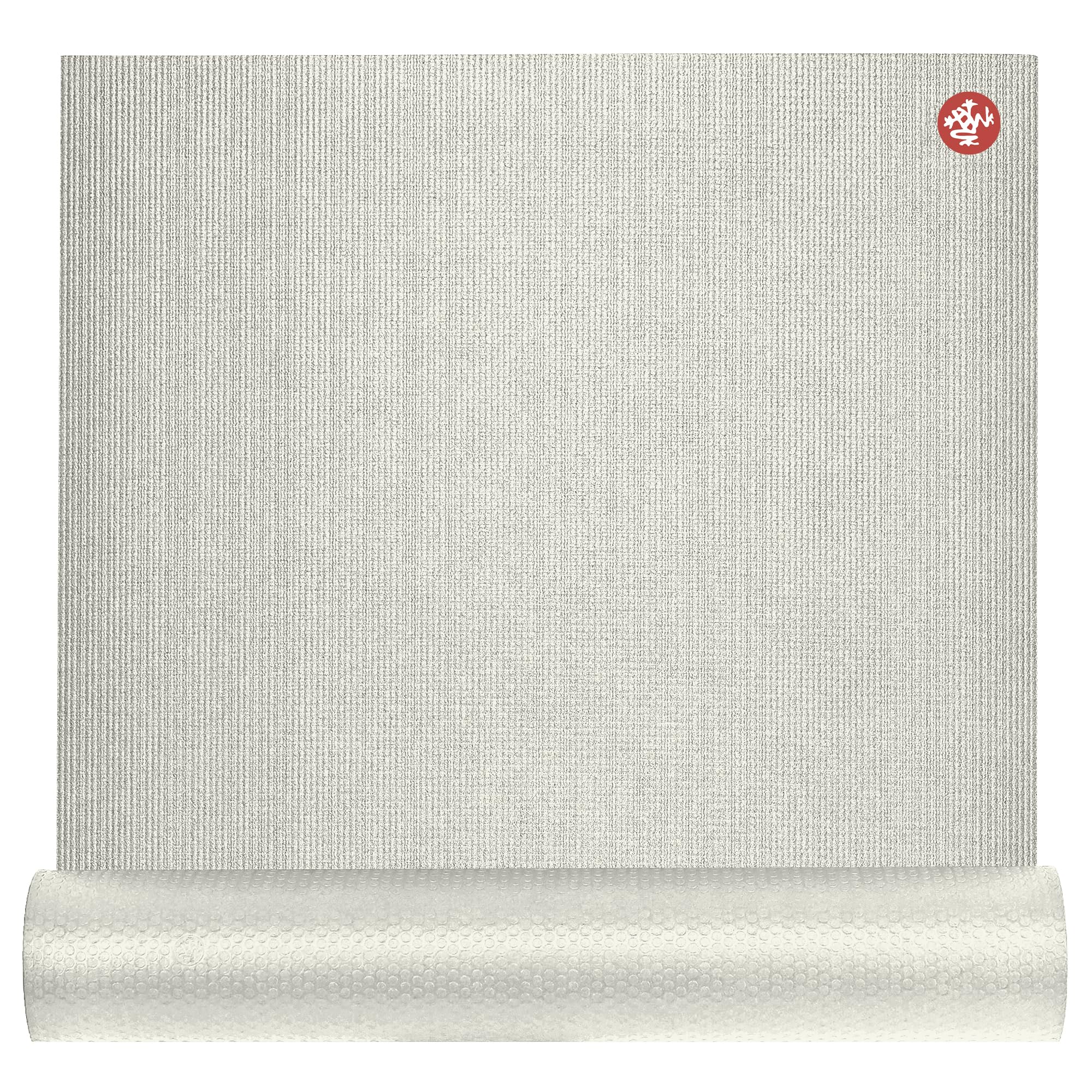
Six millimeters doesn't sound like much beside the one-inch mats here, and that is the point: the PRO is dense rather than deep. Press a palm into it and almost nothing gives. Stand in Warrior II and it feels like floor with a cushion on it, not a cushion pretending to be floor — which is why this is the mat we hand to anyone whose practice is mostly standing poses.

The 71-by-26-inch surface is wider than most, so hands land inside the mat in a wide-legged fold, and the closed-cell PVC doesn't drink sweat — wipe it down and it's ready for the next session. It's also the only mat here with a stated lifetime guarantee, and the build backs the claim up: at 7.5 pounds this is equipment, not a consumable.

Grip needs patience. Fresh off the roll the surface is slick, and it takes a stretch of regular practice plus a wipe-down after each session before hands settle in. The weight is the other honest cost — carry it to a studio three times a week and you'll feel it on the walk.

Pros

  • Dense 6mm that steadies standing poses
  • Wider 26-inch surface for broad stances
  • Closed-cell PVC resists sweat
  • Stated lifetime guarantee

Cons

  • 7.5 pounds to carry to and from class
Our verdict

Worth the splurge if you practice standing poses several times a week and want one mat to keep for a decade — just accept the break-in and the 7.5 pounds.

Check Latest Price
3

Best Budget

Fitvids 1/2-Inch Yoga Mat

91 /100
Peggy's Score Outstanding

Key details

Included
Carrying strap
Material
Nitrile Butadiene Rubber
Dimensions
71"L x 24"W x 0.5"Th
Check Details on Amazon

This is the mat we point budget shoppers to first: a half-inch NBR mat, 71 by 24 inches, with a strap, sitting at the low end of this group's prices. It does the basic job without fuss — knees and hips stop aching on a hardwood floor, and the depth is enough for seated folds and supine twists without the wobble that comes with a full inch.

Grip is better than the money suggests. On a dry day hands stayed put through a standing sequence, and the textured underside didn't slide on a wood floor. Add sweat and it gets greasy, which is true of nearly every foam mat here and the reason a towel at the top of the mat is worth the trouble.

Longevity is the trade. The foam is soft, and soft foam is what tears — the surface scuffs where feet plant and can split along a crease if it's stored folded or dragged over grit. We treat this as a mat to replace when it wears rather than one to hand down.

Pros

  • Half-inch cushioning at a low price
  • Grip holds on dry floors
  • Strap included for carrying
  • 71-inch length suits most heights

Cons

  • Soft foam scuffs and tears with heavy use
Our verdict

The smart buy if you want real cushioning without spending much: half an inch of foam, dependable dry grip, and a strap in the box.

Check Latest Price
4

Best for Tall Practitioners

CAMBIVO Extra Long Wide Mat

92 /100
Peggy's Score Outstanding

Key details

Weight
5 lb
Material
Polyvinyl Chloride
Dimensions
84"L x 30"W x 0.24"Th
Check Details on Amazon

If you're over six feet and your hands keep landing off the end of the mat in downward dog, size is the whole reason to buy this one. At 84 by 30 inches it's the biggest surface in this group — a foot longer and six inches wider than a standard mat — and lying in savasana with your arms out, nothing hangs off.

The 6mm PVC feels firmer and more planted than the NBR foams here, closer to a studio mat than a sponge, and the honeycomb underside bites into carpet and hardwood alike. We noticed the extra width most in wide-legged folds, where hands land inside the mat instead of pawing at the floor beside it.

Sweat is the catch. The top surface is textured rather than sticky, and once hands and feet get damp it turns slick — noticeably so in a warm room. A towel at the top of the mat handles it, and for cool home practice you may never think about it.

Pros

  • 84 by 30 inches of coverage
  • Firm 6mm PVC feels planted
  • Honeycomb base grips floors
  • Roomy for tall practitioners

Cons

  • Five pounds and a long roll to carry
Our verdict

Buy it if standard mats leave your hands or feet hanging off the edge; the extra six inches of width is the difference between a cramped practice and a roomy one.

Check Latest Price
5

Best Design

Gaiam Premium 6mm Print Mat

95 /100
Peggy's Score Outstanding

Key details

Weight
3.1 lb
Material
Polyvinyl Chloride
Warranty
Lifetime
Dimensions
68"L x 24"W x 0.23"Th
Check Details on Amazon

The print is the reason people pick this mat, and it earns the attention: the Athenian Rose colorway reads more like a textile than gym equipment, and the pattern came through weekly wipe-downs without fading. If your mat lives on the living-room floor rather than in a closet, that counts for more than another millimeter of foam.

Under the pattern it's a serious mat — 6mm of firm PVC that cushions a lunge without turning tree pose into a balancing act, a textured surface that grips a wood floor, and a stated lifetime warranty. At 3.1 pounds it's light enough to carry to class and rolls tight enough for a standard bag.

One thing to know before the first session: new, it smells like a fresh shower curtain, so unroll it in a spare room for a few days before you practice on it. That fades, and what's left is a mat you won't mind leaving out.

Pros

  • Prints that hold up to cleaning
  • Firm 6mm cushioning for knees
  • Stated lifetime warranty
  • Light enough to carry to class

Cons

  • Gets slick once hands and feet get damp
Our verdict

For the yogi who wants a mat that looks as good as it cushions, this is our pick — air it out first and keep a towel within reach.

Check Latest Price
6

Best with a Carry Bag

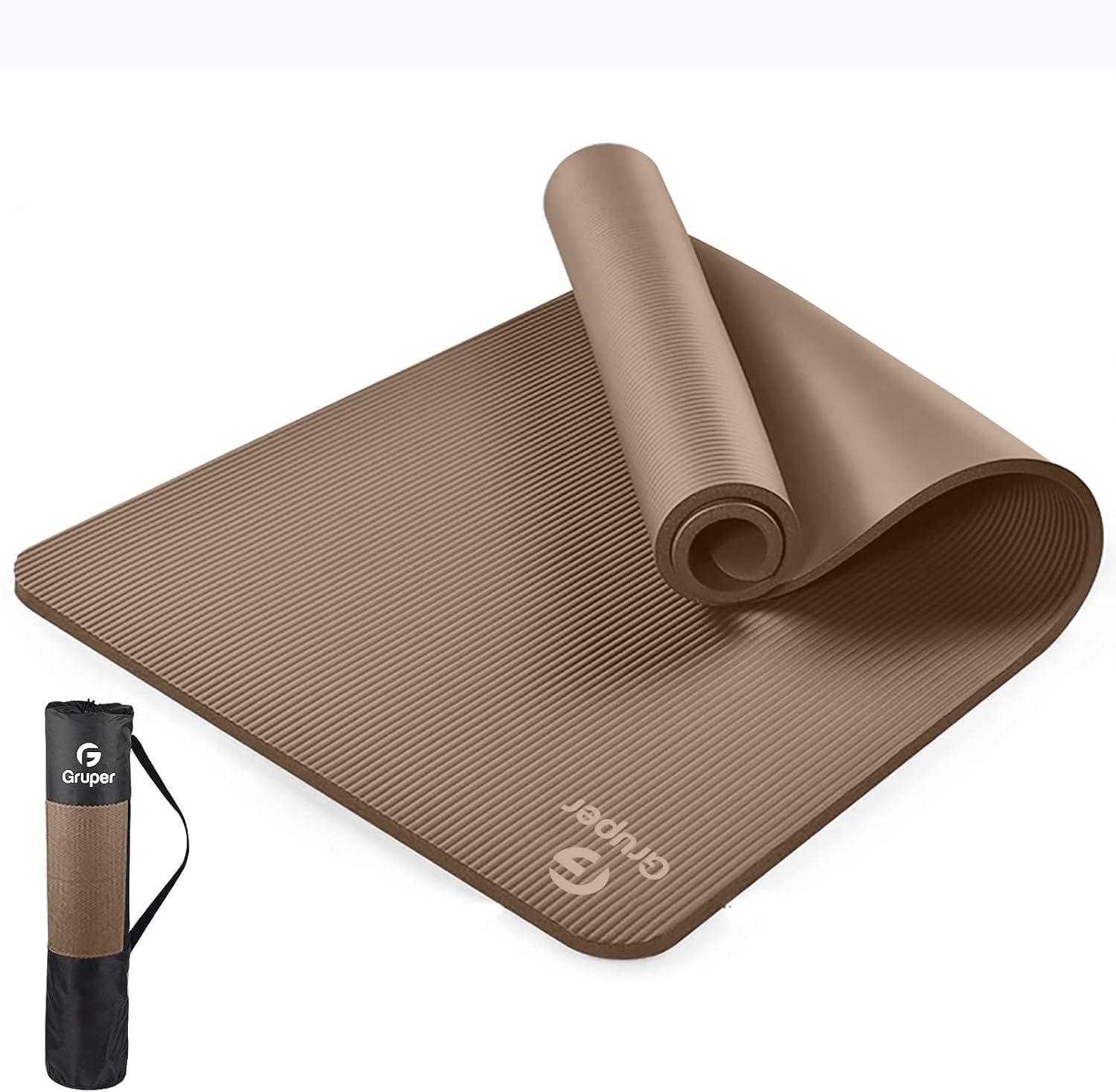
Gruper 10mm Yoga Mat

91 /100
Peggy's Score Outstanding

Key details

Weight
1.8 lb
Included
Carrying strap and bag
Material
Nitrile Butadiene Rubber
Dimensions
72"L x 24"W x 0.4"Th
Check Details on Amazon

The bag is what sets this one apart. Plenty of mats here come with a strap; the Gruper adds a drawstring carry bag, which turns a rolled mat into something you can sling over a shoulder or leave in the trunk without it picking up dust. Small thing, and it turns out to matter if the mat travels at all.

The mat itself is 10mm of NBR foam — plush, softer underfoot than the denser one-inch mat in this group, and light at 1.8 pounds. Knees, hips, and tailbone get plenty of foam on a hard floor, and the 72-by-24-inch surface is long enough for most people under six feet.

Soft foam behaves like soft foam. On polished hardwood the mat can skate during fast transitions, and a rug underneath settles it; the surface also marks where it's been creased in storage or dragged across a doorway. Neither is a dealbreaker for a mat that stays in one room.

Pros

  • 10mm of plush NBR foam
  • Carry bag and strap included
  • Light at 1.8 pounds
  • 72-inch length suits most users

Cons

  • Foam marks where it's creased or dragged
Our verdict

A plush, light mat with a bag included — the easy choice if your practice happens at home and your knees want company.

Check Latest Price
7

Home Gym Spare

CAP Barbell 1/2-Inch Mat

93 /100
Peggy's Score Outstanding

Key details

Included
Carrying strap
Material
Latex-free NBR foam
Dimensions
68"L x 24"W x 0.5"Th
Check Details on Amazon

Latex-free foam is the detail that makes this one worth a look. If you've reacted to rubber mats before, the CAP is built from latex-free NBR, and it asks less of your wallet than almost anything else here while still giving you a full half inch of cushioning.

The rest is deliberately plain: 68 by 24 inches, a textured surface that stayed put on hardwood, and a simple strap. No bag, no printed alignment marks, no lifetime promise — just a mat that does the job and rolls up small enough to live in a closet.

Where it gives ground is length. At 68 inches it's the shortest mat here, comfortable up to about five foot ten and cramped beyond that, so taller practitioners should take the CAMBIVO. What it gets right is the part you kneel on.

Pros

  • Latex-free NBR foam
  • Half-inch cushioning for joints
  • Grip holds on hardwood
  • Low price for the cushioning

Cons

  • Foam dents and nicks under rough use
Our verdict

A plain, latex-free half-inch mat for very little money — the sensible spare for a home gym or a second practice space.

Check Latest Price
8

Everyday Stretching

Amazon Basics Extra Thick Mat

93 /100
Peggy's Score Outstanding

Key details

Included
Carrying strap
Material
100% NBR Foam
Dimensions
73.2"L x 24.3"W x 0.5"Th
Check Details on Amazon

At 73.2 by 24.3 inches, this is the longest of the half-inch mats here — barely an inch over the Fitvids, but those inches matter if your hands land near the end of a standard mat. It's the classic extra-thick foam mat: 100% NBR, half an inch deep, with a carrying strap in the box.

The foam is soft, and kneeling and supine work feel good on a hard floor. Dry traction is decent on wood and carpet, and it unrolls flat quickly for a foam mat this thick. Check the packaging before you recycle it, though: a few of these ship without the strap, and a thick mat is awkward to carry without one.

Grip fades once hands get damp, which is the one place the cheaper Fitvids held on better in our testing. Otherwise it behaves like a good basic mat: it rolls back up around the strap and takes a wipe-down after a sweaty session.

Pros

  • Longest half-inch mat here
  • Soft, thick padding on hard floors
  • Carrying strap included

Cons

  • Porous foam holds onto dust and lint
Our verdict

A dependable, plain half-inch mat with a little extra length — fine for everyday stretching and floor work, though the Fitvids grips better.

Check Latest Price

How We Tested 12 Thick Yoga Mats

We started with the specs: published thickness, foam density, weight, material, and whether a carrying strap came in the box. Anything under 6mm, anything that tipped the scale past roughly seven pounds without a strap, and anything whose reviews clustered around peeling edges got cut before we ordered a single mat. That left 12, ranging from budget TPE to natural rubber, and each one got at least three weeks of real practice.

Testing happened where mats actually live: a Tuesday-night vinyasa class, a hot room where hands turn slick by the twenty-minute mark, the concrete slab in my basement, and the hardwood in my living room during early-morning home practice. We calipered every mat when it arrived and again at the eight-month mark, because foam that crushes under a hip isn't thick anymore no matter what the label says. In tree pose we watched how much the standing foot wobbled. We held ten minutes of kneeling and low-lunge work on each mat and wrote down whether our knees registered anything at all. We also sprayed a patch with water and pressed through downward dog to see whether hands slid or held.

Portability got judged honestly: each mat was carried to class in its own strap, and we noted whether the strap cut into a shoulder or the roll came unspooled on the walk. Every mat was sniffed out of the box, then again after a week of airing, since a mat that smells like a tire for a month is a mat you start avoiding. At the end we went back over the seams, edges, and top surface for crumbling, sweating, and smoothing-out where hands and feet land, then weighed that wear against the asking price.

How to Choose Thick Yoga Mats

How Much Thickness Your Practice Can Take

Depth buys comfort and costs stability, and the exchange rate depends on what you actually do on the mat. If most of your session is kneeling, seated, or lying down — Pilates, stretching, core work — go as deep as you like. The BalanceFrom's full inch is the plushest surface in this group, and knees and hips notice every bit of it.

If you spend your practice standing on one leg, depth works against you. A dense 6mm mat like the Manduka puts you closer to the floor and steadies your balance in a way no inch-thick foam can. Half an inch is the middle ground most people land on, and it is where the budget picks here sit.

Foam Type Decides How Long It Lasts

Two mats can both say extra thick and behave completely differently after a year. NBR is the soft, light, inexpensive foam behind most budget thick mats: it cushions beautifully and tears at stress points when it is dragged or caught. Closed-cell PVC and TPE are denser and heavier, don't drink sweat, and wipe clean in seconds.

Spend for closed-cell if you practice daily and want one mat to keep; choose NBR if the mat lives in one room and you want maximum softness for the money. The material line matters more than the millimeter count when you're deciding how often you'll be shopping again.

Grip Is Two Problems, Not One

A dry mat sliding across a wood floor and a damp hand sliding across the mat are different faults with different fixes. The first is the bottom surface: a textured or dotted base holds on hardwood and carpet alike, while a smooth base skates. The second is your sweat, and nearly every thick foam mat here turns slick once hands get damp.

If you run hot, plan on a towel at the top of the mat or a grippier closed-cell surface, and test the mat dry on your own floor before a class. A mat that slides in downward dog is a mat you'll stop using.

Length, Width, and What You Carry

Standard mats run 68 to 72 inches long and 24 wide, which suits most people under about six feet. Go longer if you're taller: the 84-by-30-inch CAMBIVO keeps hands and feet on the mat in a lunge instead of hanging off the edge, and the difference is obvious the first time you use it.

Weight is the other half of the decision. The mats here run from 1.8 to 7.5 pounds; a strap is plenty for the light ones, while the heavy Manduka really wants a bag and a short walk to class. Match the carry method to how far the mat actually travels.

Frequently Asked Questions

Final Verdict

Buy the BalanceFrom if cushioning is the whole point. An inch of dense foam makes floor work, Pilates, and knee-friendly flows more comfortable than anything else here, and it sits in the middle of this group on price rather than at the top.

If you practice standing poses several times a week and want one mat to keep for a decade, the Manduka PRO's dense 6mm is the better instrument — as long as the break-in and the 7.5 pounds don't put you off. Working with a tight budget, the Fitvids covers the basics for very little.