Best TENS Units of 2026

Most TENS units get bought at 11 p.m. by someone with a knot in their shoulder and a healthy dose of skepticism. That's fair — a little box that sends tingles down your back sounds like a gimmick until you've spent a long day hunched over a laptop or slept wrong three nights running. A good unit doesn't fix the cause of your pain, but it can take the edge off long enough to stretch, move, and get through the afternoon without another round of ibuprofen.

We've spent the last six months with 12 units, from pocket-size two-pad models to bigger multi-channel boxes, and the differences rarely show up on the spec sheet. The device matters less than you'd think — the pads do most of the work, and the models whose electrodes stay sticky through a dozen sessions and whose batteries don't quit mid-evening are the ones worth owning. A cheap unit with good pads beats an expensive one with slippery electrodes almost every time. Below are the ones that earned a permanent spot in the drawer.

1

Best Overall

NueMedics Tens 24

93 /100
Peggy's Score Outstanding

Key details

Modes
24
Charging
USB-C plus wall charger
Lead Wires
2
Included Pads
6 large electrodes
Check Details on Amazon

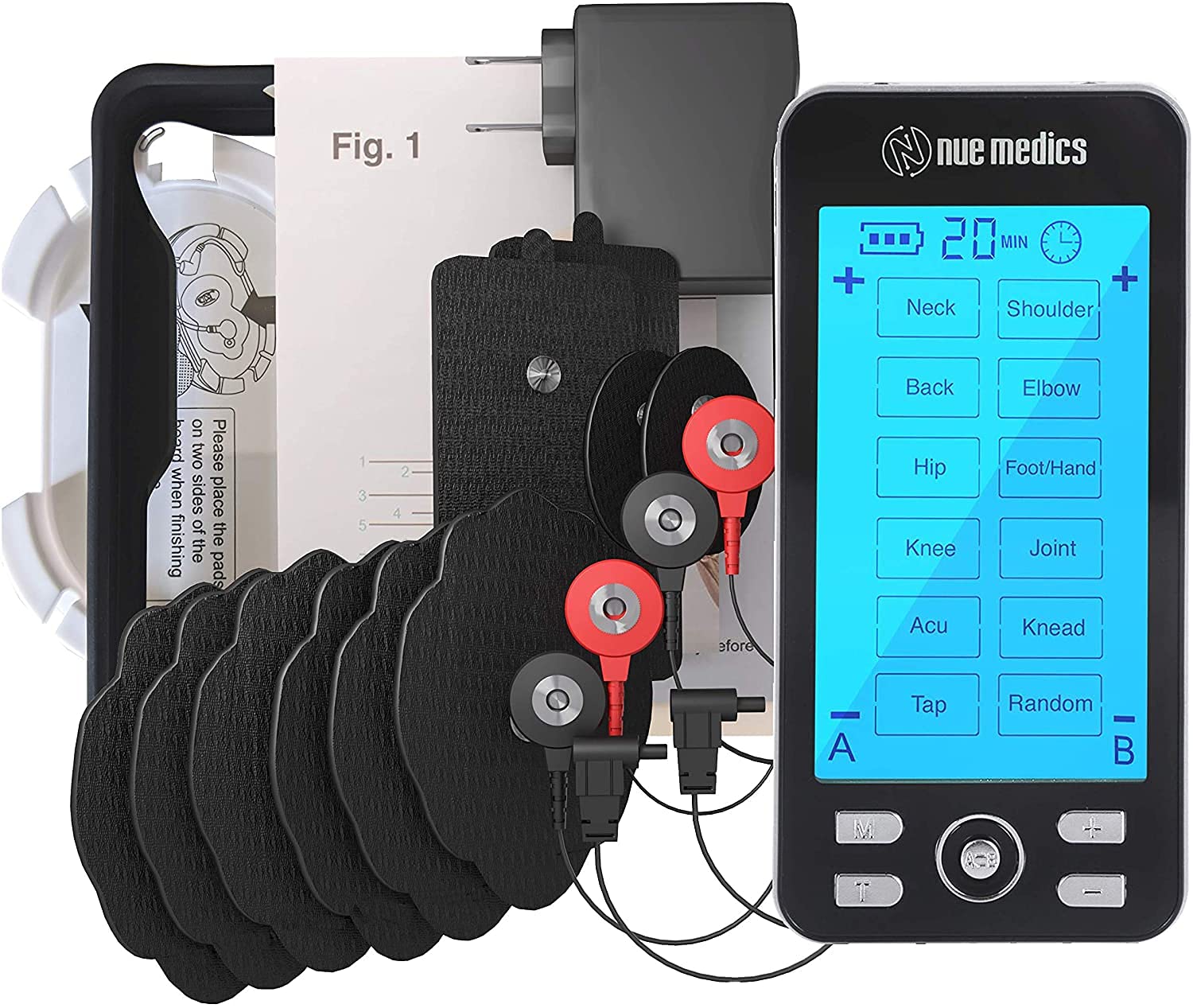
Press the intensity button on the NueMedics Tens 24 before every pad is stuck down and nothing happens. That interlock is the reason it's our top pick. Most stimulators will happily ramp up with one pad dangling, which gets you a sharp, surprising zap instead of relief; this one simply refuses until the circuit is complete, and the display tells you why.

The 24 modes are labeled the way a person thinks about pain — Neck, Shoulder, Back, Knee, Elbow, Hip, Joint, Foot/Hands — rather than P1 through P24, alongside Acu, Knead, Tap and Random. We think those labels earn their keep even though they're broad, because they give a beginner somewhere to start that a 30-mode unit with numbered programs doesn't. In the box you get two lead wires, six large electrodes, a pad-and-wire holder, a USB-C cable and a wall charger.

The trade-offs are real but narrow. The mode names are a guide, not a diagnosis — Back covers a dull ache and a post-gym spasm equally — so expect to spend the first few evenings experimenting with intensity before you settle. The controller also sits toward the top of this group's price band, which means you're paying for the interlock and the complete kit rather than for the biggest mode count on the page.

One detail keeps earning its place: the pad-and-wire holder. It sounds like filler until you've spent ten minutes untangling leads, and having a home for everything is what keeps a TENS unit on the coffee table instead of at the back of a drawer. The controller itself is small enough to sit on a cushion beside you without dragging the wires off your back.

Pros

  • Intensity locked until every pad is on skin
  • Modes labeled by body part, not numbers
  • Ships with six large pads and a wall charger
  • Pad and wire holder keeps the kit together

Cons

  • Only large pads
Our verdict

Our default pick for a first TENS unit: the intensity buttons stay locked until every pad is on skin, so a session can't begin with a jolt.

Check Latest Price
2

Best for Two Areas

AUVON Dual Channel TENS

93 /100
Peggy's Score Outstanding

Key details

Modes
20
Channels
2 (A/B), independent
Pad Rating
Up to 45 uses
Included Pads
4 square, 4 large 2 x 4 inch
Check Details on Amazon

Four of the pads in this AUVON kit measure two by four inches, and that size is most of the argument for it. A two-inch square is fine on a neck or an elbow, but it takes a rectangle to cover the meat of a lower back, where the ache usually sits. You get four large pads and four small squares, two lead wires, a USB cable and a pad holder.

What sells us is the independence. Channel A and channel B are set separately — an acupuncture program at a level you can feel across your back while a gentler pulse runs low on your shoulder — and you can change one without touching the other. That's the difference between treating one problem at a time and treating the two that actually hurt. AUVON rates the pads for up to 45 uses, which we treat as a best case on clean, dry, hair-free skin with the backing film put straight back on.

Eight pads in two shapes covers most situations, but the durability is the part we'd flag to a friend.

Pros

  • Independent channels with separate modes and intensity
  • Four large 2-by-4-inch pads for back work
  • Twenty modes plus a pad holder in the box

Cons

  • Units have quit within months of regular use
Our verdict

The unit we reach for when two areas hurt at once: truly separate channels and four 2-by-4-inch pads for back work.

Check Latest Price
3

Best Kit

Belifu Dual Channel TENS

91 /100
Peggy's Score Outstanding

Key details

Modes
24
Channels
2 (A/B)
Included Pads
10 reusable
Intensity Levels
20
Check Details on Amazon

Ten reusable pads, a drawstring bag and two fastening cable ties: Belifu treats the accessories as part of the product rather than an afterthought. That sounds like filler until you've owned a stimulator for a year and can't find a pad with any tack left, or a lead wire that isn't a knot.

The device is a dual-channel 24-mode unit with 20 intensity levels and an adjustable timer, and each channel runs its own intensity, so two areas at different strengths is on the table. It charges over USB and is small enough for a coat pocket, with the same mode-and-intensity button layout as most of the units here — nothing to relearn if you've used one before.

Where Belifu earns its place for us is the whole-package thinking at a middle-of-the-road price. Ten pads is roughly double what most kits here include, which pushes your first pad purchase months down the road, and the ties keep the leads from turning into a nest at the bottom of a bag. It's the kit you can hand a housemate without a ten-minute explanation of where everything lives.

Pros

  • Ten reusable pads in the box
  • Drawstring bag and cable ties included
  • Independent A/B channels with 20 intensity levels
  • Recharges over USB rather than buying batteries

Cons

  • Pads can stop sticking within a couple of weeks
  • Thin instructions for 24 modes
Our verdict

Ten pads, a bag, and cable ties — the TENS unit most likely to still be complete and tidy a year from now.

Check Latest Price
4

Best Pocket-Sized

AUVON 24 Modes TENS

93 /100
Peggy's Score Outstanding

Key details

Modes
24
Battery
Up to 10 hours per charge
Included Pads
8 square
Intensity Levels
20
Check Details on Amazon

AUVON's controller is small enough to sit in a shirt pocket with the leads running under your clothes, and it's rated for up to 10 hours of use per charge. For a unit that lives in a work bag or goes to the gym, that pairing is why we pick it over the bigger kits here.

The rest of the package is deliberately plain: 24 modes, 20 intensity levels, an adjustable timer, eight square pads, a pad holder, a pouch and a USB-C cable. Square pads suit a neck, a shoulder or the side of a knee better than a rectangle does, and eight of them is enough to keep a clean spare set while another is in use.

Where it gives ground is pads and screen real estate. There's no 2-by-4 rectangle in the box, so a broad lower back is better served by the AUVON dual-channel model above, which ships four of them, and eight square pads is a smaller buffer than the ten-pad kits here. Neither changes what the unit does; both change how soon you're reordering.

Pros

  • Pocket-sized controller with up to ten hours per charge
  • Twenty-four modes and twenty intensity levels
  • Eight pads, holder, pouch, and USB-C cable

Cons

  • Pads stop holding after a few weeks of use
Our verdict

The one to keep in a work bag: pocket-sized, up to ten hours a charge, and enough modes to be useful anywhere.

Check Latest Price
5

Best Battery Life

TechCare PLUS24

93 /100
Peggy's Score Outstanding

Key details

Modes
24
Battery
Up to 20 hours per charge
Channels
2 (A/B), independent
Included Pads
2 large, 6 medium, 2 small
Check Details on Amazon

TechCare rates the PLUS24 for up to 20 hours of continuous use per charge, which is the biggest figure in this group and roughly double the AUVON pocket unit. Read it as a ceiling and it still means charging is a monthly chore rather than a nightly one, and the unit can live where you use it instead of near a cable.

The screen is the other reason it stands out. Mode and intensity are laid out large on the LCD, which matters when the unit is clipped to a waistband and you're reading it in a mirror rather than holding it in your hand. Twenty-four modes and 20 intensity levels sit underneath, with a timer and independent A/B controls.

Twelve pads across three sizes — two large, six medium, two small — map onto the way pain moves around: large for a back, medium for a thigh or shoulder, small for a wrist or the side of a knee. A wall adapter is in the box, alongside the Type-C cable, which isn't true of every kit in this group.

Add it up and this is the unit we hand someone whose TENS habit is a 40-minute session on the couch every evening — the pattern of use that drains a smaller battery inside a week. It also runs EMS muscle-stimulation programs alongside the TENS ones, and the reserve means you can use them without watching the indicator.

Pros

  • Up to 20 hours of use per charge
  • Large LCD readable at arm's length
  • Twelve pads in three sizes plus a wall adapter

Cons

  • Reaching a favorite mode takes a run of presses
Our verdict

The long-session unit: a 20-hour battery, a big legible screen, and twelve pads in three sizes for people who use TENS every night.

Check Latest Price
6

Best Budget

TENKER 24 Modes TENS

91 /100
Peggy's Score Outstanding

Key details

Modes
24
Charging
USB cable, no adapter
Included Pads
6 square, 2 large 2 x 4 inch
Intensity Levels
20
Check Details on Amazon

TENKER is the least expensive unit here and still ships 24 modes, 20 intensity levels, two output channels and eight pads, with a pouch, cable ties and a 12-month warranty behind it. Nothing in the box reads as a corner cut on day one.

This is the one we point a first-time buyer to. The first two sub-modes are steady, constant pulses rather than the kneading and tapping patterns most units lead with, and a plain continuous current is what plenty of people settle on after a week of experimenting. The dual output also lets two people run a channel each, which makes it an easy unit to share in a house.

The pad mix is where the saving shows. Six 2-inch squares and only two 2-by-4 rectangles means a broad lower back gets one pass at a time, and you'll be ordering large pads sooner than expected if that's where your pain sits. Squares on a neck or a shoulder are exactly right, though, and eight pads is a fair opening hand at this end of the group.

Pros

  • Steady-pulse modes for plain continuous stimulation
  • Two output channels that two people can share

Cons

  • No wall adapter in the box
Our verdict

The least expensive way into TENS that still covers the basics: two output channels, 24 modes, and eight pads.

Check Latest Price
7

Widespread Pain

Etekcity 4-Channel TENS

93 /100
Peggy's Score Outstanding

Key details

Battery
Up to 7 days per charge
FSA/HSA
Eligible
Channels
4 (two control pairs)
Pads Supported
Up to 8
Check Details on Amazon

Eight pads, four channels, one controller. If the pain moves around — a neck in the morning, a lower back at night, or two knees at once — the channel count is the reason to look at the Etekcity before another dual-channel unit.

The channels are controlled in pairs, and that's the part the spec line doesn't spell out. Four pads can share one setting while the second four take another, but you can't dial four different intensities across four sites. It's still more coverage than anything else in this group, just not the four-zone control panel the number suggests.

Where the extra money goes furthest is coverage per session, and the FSA and HSA eligibility is a genuine tiebreaker if you have a balance sitting in an account. The battery figure — up to seven days per charge — is the one to treat loosely: the more pads you run and the harder you drive them, the sooner it needs a cable. It's also the largest outlay here, which is the honest reason it sits below the dual-channel picks rather than at the top.

Pros

  • Four channels supporting up to eight pads
  • FSA and HSA eligible
  • Memory function returns to the last setting

Cons

  • Included pads lose their tack quickly
Our verdict

Four channels and up to eight pads at once — the one to buy when the pain isn't in a single place.

Check Latest Price
8

Commuting and Gym

AVCOO 30 Modes TENS

93 /100
Peggy's Score Outstanding

Key details

Size
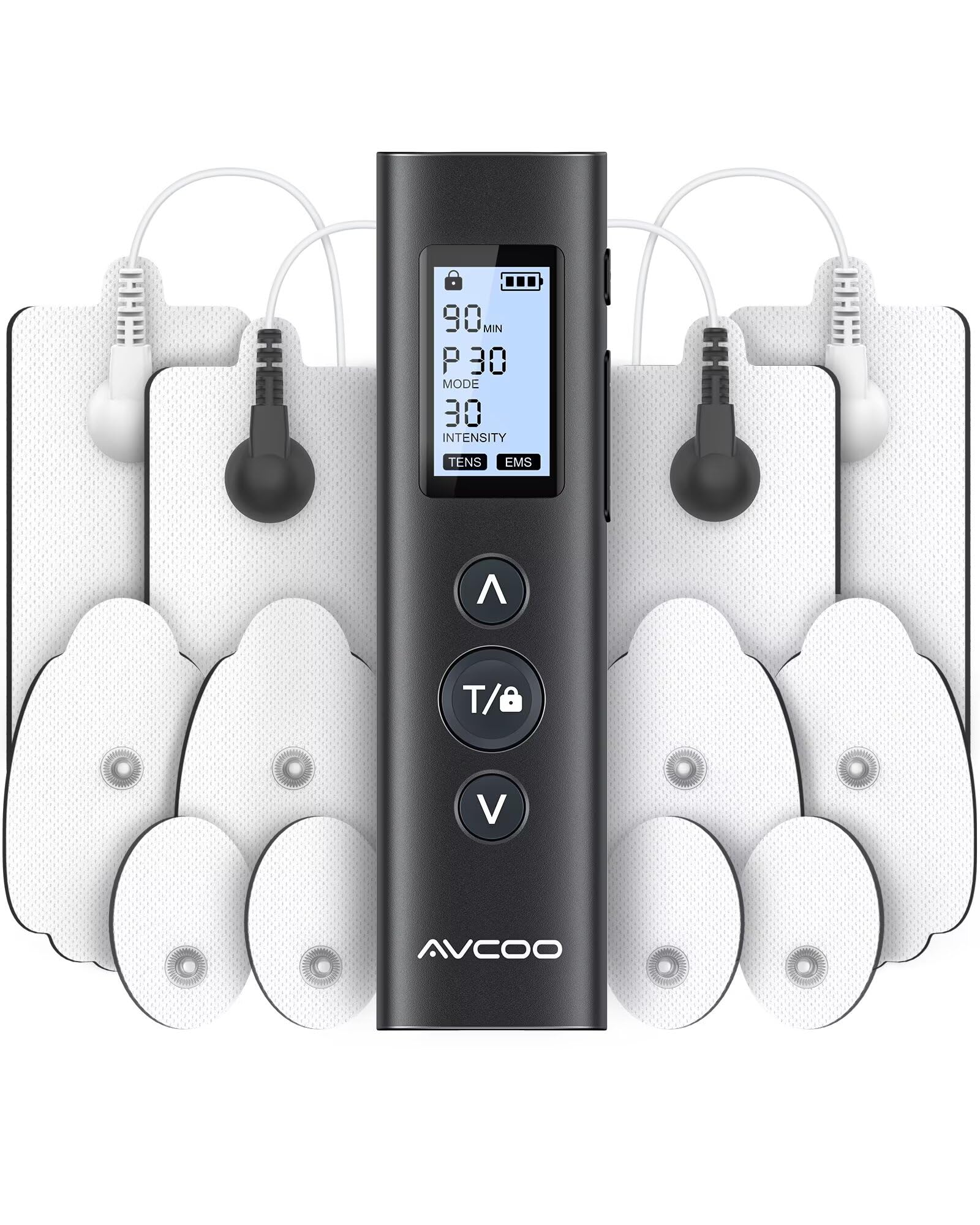
4.8 x 1.3 x 0.5 inches
Modes
30
Included Pads
12 in three shapes
Intensity Levels
30
Check Details on Amazon

Half an inch thick and about the weight of a phone, the AVCOO slides into a jacket pocket or a laptop bag and disappears. Of everything here, it's the one that travels without a pouch full of accessories.

The figure that matters on a long day out is the battery: AVCOO rates it for 30 hours of use, which we treat as a ceiling but still well past a single session. Thirty intensity levels give you finer steps than most units in this group, and the memory function brings you back to the setting you left.

Twelve pads in three shapes is the quiet win. The 1-by-2-inch ovals are the ones that stay put on a wrist or the side of a knee, where a 2-by-4 rectangle won't conform, and the 2-by-3 palm shapes split the difference across a shoulder. Four rectangles are in there too, so a lower back isn't left out.

Thirty modes is more than anyone needs — two or three will do everything you ask — but the thin body, the smaller pads and the long battery add up to the unit we take on a trip. There's no 9-volt fallback, which is the trade every rechargeable unit here makes: a battery you can't swap is the price of a body this slim.

Pros

  • Half an inch thick and pocket-light
  • Thirty modes and thirty intensity levels
  • Twelve pads in three shapes

Cons

  • Charge shortens as the battery ages
Our verdict

Half an inch thick and light enough to forget in a jacket pocket, with 30 modes and three pad shapes for travel.

Check Latest Price

How We Tested 12 TENS Units Over Six Months

We started with roughly 40 units sold by the names you'd recognize in this category, then filtered out anything with fixed intensity levels, pads that were hard to replace, or a battery that couldn't get through a workday. That left 12 models, which we bought ourselves and lived with for six months.

Most testing happened where pain actually shows up: at a desk after eight hours of typing, on the couch the evening after a day of yard work, and on a knee the morning after a run. We timed how long it took to go from sealed box to a comfortable intensity — usually a matter of button presses — and handed the controls to someone who'd never used a TENS unit to see whether it made sense without the manual.

Battery life we measured by running each unit from full charge until it quit, counting how many sessions that covered. Pads got the hard treatment: we stuck them on, did 15 minutes of dishes and laundry, checked whether the edges curled, then reapplied and counted sessions until a pad stopped gripping. We rated pain relief by whether a session let us skip an afternoon dose of ibuprofen or sit through a meeting without shifting in the chair, not by how strong the tingling felt.

Quality showed up in the small stuff — leads that didn't crack at the plug, buttons that still clicked after weeks of use, a belt clip that actually held when we stood up. We also priced out a year of replacement pads for each unit, since the cheapest device can end up the most expensive one to keep.

How to Choose TENS Units

Start With Channels, Not Modes

One channel drives two pads. Two channels let you treat two areas at once, usually with separate intensity and sometimes separate modes — that's the specification that changes daily use, because a single-channel unit makes you choose between your back and your shoulder. The AUVON dual-channel model and the Belifu both run their two channels independently.

Four channels, as on the Etekcity, support up to eight pads. Check how the controls are grouped before you pay for the extra coverage: four channels split into two control pairs give you two settings across four sites, not four independent ones.

Pads Are the Running Cost

Every kit here includes reusable pads, and every one of them will stop sticking long before the device stops working. Buy a spare pack with the unit rather than after the first pad fails, and match the shape to the site: a 2-by-4 rectangle for a lower back, a 2-inch square for a neck or shoulder, an oval for a wrist or the side of a knee.

Treat claims like up to 45 uses as a best case. Clean, dry, lotion-free skin and putting the backing film straight back on gets you closest to it; a hairy back or a humid bathroom gets you well short.

Rechargeable or a Swap-In Battery

Nearly every unit here runs on a built-in lithium battery and charges over USB, which is the right call for something you'll use daily. The trade is that a flat battery means a dead session, and there's no spare in a drawer to swap in.

Battery claims in this group run from ten hours to thirty, and the figure depends on how hard you're driving the unit. More pads and higher intensity drain faster, so read a twenty-hour number as a week of short sessions rather than twenty hours at level fifteen.

Modes, Intensity, and Labels That Help

Units here run from 16 to 30 modes and almost nobody uses more than two or three, so the count is a poor way to choose. What separates a good interface from a fussy one is how fast you find yours: body-part labels such as Neck, Back, and Knee get a beginner started faster than P1 through P24, and a screen you can read at arm's length beats a bigger number of programs.

Intensity range is the figure worth checking. Twenty levels is standard here, and what you want is a first step gentle enough to start on — several units here are already firm at level three.

Safety and the First Session

Two rules apply to everything on this page. Don't use TENS if you have a pacemaker or another implanted electronic device, and keep pads off your head, the front of your throat, and anywhere the current would cross your chest through the heart.

For a first session, place the pads, start at the lowest intensity, and raise it one step at a time until you feel a firm tingling rather than a sting. An interlock like the one on the NueMedics — intensity disabled until every pad is on skin — removes the most common way a first session goes wrong.

Frequently Asked Questions

Final Verdict

If you're buying one unit and want the least chance of getting it wrong, the NueMedics Tens 24 is the one we point to. The intensity interlock makes a first session close to foolproof, the modes are labeled by body part, and the kit arrives with large pads and a wall charger rather than a bare USB cable.

Change one requirement and the answer changes. If two areas hurt at once and you want a rectangle on each, take the AUVON dual-channel model and keep the receipt. If your sessions run long and nightly, the TechCare's battery and legible screen are worth the extra outlay.