Best Stretching Straps of 2026

A stretching strap looks like the simplest thing in your gym bag — a strip of webbing with a few loops — right up until you try to use one. The loop is too small for a shoe, the webbing gives enough that your deep hamstring stretch is really just the strap lengthening, and the stitching fuzzes out after a month. What a good one buys you is independence: a real hamstring, calf, or shoulder stretch you can hold for a full 30 seconds and actually relax into, no partner required.

I started carrying one after a physical therapist handed me a strap for a stubborn calf strain, and since then I've used them on living-room floors, gym mats, and hotel carpet. Over the past three months, my team and I put 14 straps through daily stretching — loop-style straps, long yoga straps with D-rings, figure-eight designs. The differences come down to loop size, hardware, and how much the webbing gives under load, and they matter more than you'd expect. The ones below earned a permanent spot in the bag.

1

Best Overall

OPTP Stretch Out Strap

95 /100
Peggy's Score Outstanding

Key details

Size
One size
Weight
4 oz
Includes
Exercise book
Material
Nylon
Check Details on Amazon

The exercise book is the first thing out of the box, and it's a large part of why this is the strap we point people toward. OPTP sells the Stretch Out Strap in one size in green nylon and pairs it with a printed guide covering positions for the whole body: calves, hamstrings, hips, shoulders. If you left physical therapy with a photocopied sheet and a vague memory of what your therapist actually did, that booklet earns its place.

The whole strap weighs 4 ounces, so it disappears into a gym bag, and the nylon is thick enough that it stays flat against your foot instead of bunching into a rope. It doesn't give, either. You set the distance with your hands and the stretch stays where you put it, which is the entire reason to use a strap rather than a band. The loops along its length let you shorten the lever in steps, so a tight hamstring and a nearly-there split use the same strap.

Our reservation is sizing. One size is the only option, so if you're tall or you like to stretch lying down with a straight leg, one of the 8-foot straps here is the safer buy. And next to the padded CTRL Sports, this is plain webbing: on a long hold, a hard pull registers in your palm.

Pros

  • Non-elastic nylon holds the distance you set
  • Loops at several points shorten the lever
  • Printed exercise book covers the whole body
  • Four ounces, so it lives in a gym bag

Cons

  • One size only; tall users may want more length
Our verdict

We recommend the Stretch Out Strap to nearly everyone: it's light, it doesn't stretch under a hard pull, and the exercise book means you can start the day it arrives.

Check Latest Price
2

Best for Tall Users

SANKUU 12-Loop Yoga Strap

95 /100
Peggy's Score Outstanding

Key details

Loops
12
Width
1.57 inches
Length
8 feet
Includes
Workout poster
Check Details on Amazon

Ninety-eight inches of strap is the reason to buy this one. SANKUU's loop strap runs 8 feet long and 1.57 inches wide with 12 loops spaced along it, and the extra foot over the 75-inch straps here changes what you can do: you can lie on your back, hook a foot, and hold a straight-leg stretch with your hands down at your hips instead of straining toward your toes.

We found the width matters nearly as much. At 1.57 inches the webbing spreads across the sole of a bare foot rather than cutting a line into it, and the loops are roomy enough to take a foot in a sock. Twelve grab points give you fine steps between positions, which is what you want when a hamstring is an inch further along than it was last month.

The length is also the catch. In a small room, 8 feet of strap means coiling and slack management every time you set up, and shorter users will spend the first few seconds of each stretch gathering loops. The guidance in the box is a wall poster rather than a booklet, which is fine in a studio and less useful by the side of a bed.

Pros

  • 98 inches of reach for tall users
  • 1.57-inch webbing is kind to bare feet
  • 12 evenly spaced grab points

Cons

  • Eight feet is a lot of strap for small spaces
  • Wall poster is thinner guidance than a booklet
Our verdict

If you're tall or long-armed, this is the strap we point you to: 98 inches and 12 loops let you reach a full stretch without a fistful of slack.

Check Latest Price
3

Best Padded Grip

CTRL Sports Stretching Strap

95 /100
Peggy's Score Outstanding

Key details

Loops
10
Width
1.5 inches
Length
78 inches
Includes
Carry bag and guide
Check Details on Amazon

Padding is the whole argument for the CTRL Sports strap. The neoprene wraps the grab points, so when you lean back into a hamstring stretch the webbing doesn't cut across your fingers. We noticed it most on the long holds, the kind where your grip gives out before the muscle does.

The rest is solid: 78 inches long, 1.5 inches wide, 10 loops, and a drawstring bag that keeps it from tangling with everything else in a gym bag. At 200 grams it's heavier than the plain nylon straps here, and that weight is the padding talking. If you stretch daily and your hands complain, it's well spent.

The one thing to check before you buy is the end holes. They run small enough that a bare foot slides in but a shoe doesn't, so plan on socks for foot-anchored work. Everything else about this strap is built for people whose grip is the limiting factor: a hand weakened by surgery, by arthritis, or by a long day of pulling.

Pros

  • Neoprene handles are easy on sore hands
  • 78 inches long and 1.5 inches wide
  • Ten loops plus a carry bag and guide

Cons

  • The priciest loop strap in this group
Our verdict

Buy this one if your hands are the weak link: the neoprene handles make a hard pull comfortable, and 78 inches is long enough for most bodies.

Check Latest Price
4

Best Budget Loop Strap

Trideer Stretching Strap

95 /100
Peggy's Score Outstanding

Key details

Width
1 inch
Length
75 inches
Weight
3.2 oz
Material
Polypropylene
Check Details on Amazon

This is the strap for someone who already knows the exercises. Trideer's multi-loop strap is 75 inches long, 1 inch wide, made of polypropylene, and it doesn't stretch: you pull against it and it holds where you put it. What you don't get is much of a guide, so if you're starting from scratch, the booklet that comes with the OPTP is worth the step up.

Three point two ounces is lighter than anything else here, which matters more than it sounds. It rolls into a side pocket and you stop noticing it's in the bag, so it's the one that actually travels to the gym. We used it for the unglamorous work, calf stretches against a wall, hamstring holds on the floor, a shoulder routine, and the evenly spaced loops made it quick to change distance without rethreading anything.

The narrow webbing is where the savings show. On a hard pull, 1 inch digs into the arch of a bare foot more than the 1.5-inch straps here, and the loops are snug over a shoe. Wear socks, or take the webbing across the ball of the foot instead of the arch, and it stops mattering.

Pros

  • Lightest strap here at 3.2 ounces
  • Non-elastic webbing holds your distance
  • Evenly spaced loops for quick changes

Cons

  • Sparse printed guidance in the box
Our verdict

We hand this to anyone who already knows the exercises: the lightest, least expensive clinic-style loop strap here.

Check Latest Price
5

Best Yoga Strap

Tumaz Yoga Strap

96 /100
Peggy's Score Outstanding

Key details

Width
1.5 inches
Buckle
D-ring
Length
6 feet
Material
Cotton blend
Check Details on Amazon

A D-ring buckle and a cotton blend make this a different tool from the loop straps. There are no fixed grab points: you feed the webbing through the ring, cinch it to exactly the length you want, and step into the loop. For yoga that's the better system, because poses want continuous lengths rather than steps of four inches.

The fabric is the part we liked most. It's soft enough to loop around a wrist or an ankle without chafing, and it has just enough texture that it doesn't slide through your fingers when you pull. The 6-foot length is the number to think about: plenty for seated forward folds and shoulder work, short for a tall person stretching a hamstring from the floor. It also comes in enough colors to match your mat, which is not a performance feature and is still the reason ours gets picked up.

Threading the buckle costs a beat that grabbing a loop doesn't, and with sweaty hands the cotton blend takes a second longer to cinch than nylon webbing does. Neither has ever made us put the strap down.

Pros

  • D-ring adjusts to any length
  • Soft cotton blend is gentle on skin
  • Textured webbing grips in sweaty hands
  • Wide choice of colors

Cons

  • Six feet is short for floor hamstring work
Our verdict

We keep the Tumaz with the yoga gear: the D-ring adjusts to any length, the cotton blend is soft on skin, and it's the least expensive strap here.

Check Latest Price
6

Best for Studio Yoga

Gaiam Yoga Strap

95 /100
Peggy's Score Outstanding

Key details

Width
1.5 inches
Buckle
Metal double D-ring
Length
8 feet
Material
Polyester blend
Check Details on Amazon

Where the Tumaz folds into a tote bag, the Gaiam is the strap that stays rolled up by the mat. It's 8 feet of 1.5-inch polyester webbing with a metal double-ring buckle, and the length over a 6-foot strap is what lets you hold a bind in a standing pose without hunching a shoulder up to your ear.

The width is the quiet advantage. A 1.5-inch strap spreads the pull across the sole of your foot instead of concentrating it in a line, and it's easier to take with two hands when you're opening a shoulder. The double ring is metal and cinches in one pull, so you can shorten the loop from a seated position without standing up to fight it.

For a home practice built on poses rather than rehab sets, we recommend it without much hesitation: the length, the width, and the metal hardware all point at the same job. The care note is the small tax. Gaiam specifies hand wash and dry flat, so this isn't a strap that goes in with the towels.

Pros

  • Eight feet covers standing binds
  • 1.5-inch width is kind to the sole
  • Metal double-ring buckle cinches quickly

Cons

  • Eight feet is more length than a beginner needs
Our verdict

We recommend the Gaiam for a home practice built on poses: 8 feet of wide webbing and a metal double ring that cinches a loop in one pull.

Check Latest Price
7

Barefoot Comfort

Gradient Fitness Stretch Strap

95 /100
Peggy's Score Outstanding

Key details

Loops
12
Width
1.5 inches
Length
8 feet
Includes
Storage bag
Check Details on Amazon

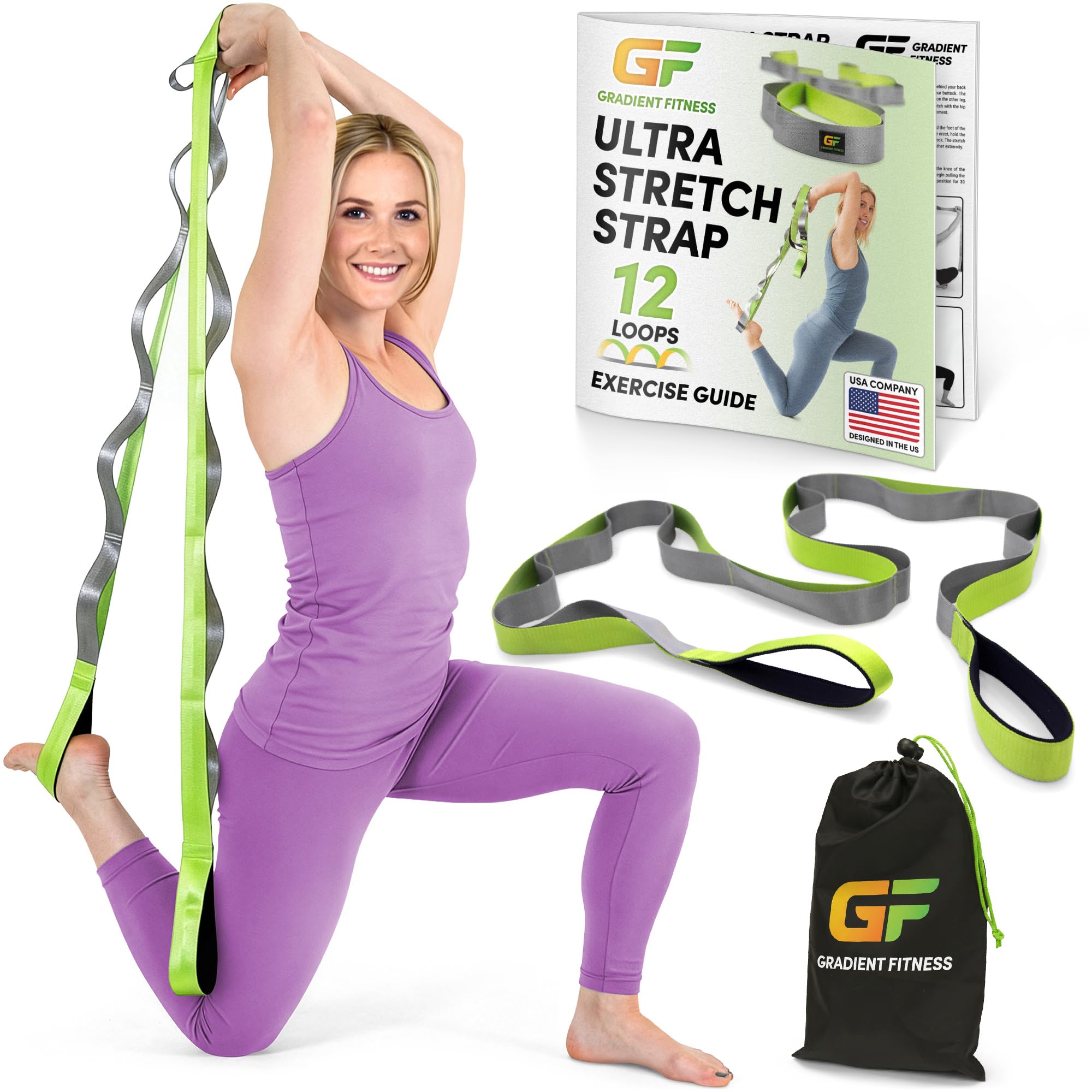
At 1.5 inches wide, this is the strap you forget you're holding. The webbing is wide enough to sit across the arch of a foot without digging in, and the loops at each end are lined with neoprene, so a hard pull lands on padding rather than on the edge of nylon.

Twelve loops along 8 feet is the most grab points of anything here, and the extra options pay off in small increments: you can move a stretch an inch or two without letting go and resetting. The padding is a shock-absorbing SBR layer that resists sweat, and a storage bag comes in the box, so it goes from the floor to the gym bag without collecting lint.

The end loops are on the wide side. That's comfortable in a sock and loose on a small bare foot, so if you're stretching with nothing on your feet, choke up and hold the webbing beside the loop instead.

Compared with the padded CTRL Sports, this one puts the cushioning under your feet rather than in your hands, and it costs less doing it. We found the padding lands where we want it: the CTRL is built for a weak grip, and this is built for barefoot work on a hard floor.

Pros

  • Padded foot loops at both ends
  • 12 loops give the finest adjustment here
  • Sweat-resistant padding and a storage bag

Cons

  • Eight feet is more strap than shorter users need
  • End loops run wide on a small bare foot
Our verdict

The most forgiving strap here for bare feet: padded end loops, 12 grab points, and 1.5-inch webbing that spreads the pull.

Check Latest Price
8

Warm-Ups

DEHUB Elastic Stretching Strap

93 /100
Peggy's Score Outstanding

Key details

Width
1.38 inches
Length
42.52 inches
Stretch
Elastic, 2.5x
Material
Polyester
Check Details on Amazon

The odd strap in the group is this one: it stretches. DEHUB's band is elastic, with 2.5 times its own length listed as the stretch, and it measures 42.52 inches, roughly half the length of the loop straps here. Those two facts make it a different tool rather than a worse one.

The length is the real limit. Lying on your back with a straight leg, a tall user runs out of strap before the stretch gets deep, and there's no way to add reach that isn't already there. For a seated stretch or a doorway shoulder stretch, 42.52 inches is plenty.

What the give is good for is a warm-up. A softer pull suits dance and cheer work and anyone who finds a rigid strap jarring at the end of a range of motion. The fabric is soft in the hand, the loops let you shorten your grip, and at 70 grams it disappears into a practice bag.

We recommend it for a dance bag or a warm-up rather than as your only stretching strap. It's also the one elastic option here that doubles as light resistance work, because the stretch means you can pull against it, which none of the non-elastic straps can do.

Pros

  • Elastic give softens the pull
  • Multi-loop grip points shorten the hold
  • 70 grams, so it travels anywhere

Cons

  • Only 42.52 inches, so tall users run out of reach
  • Elastic give makes progress hard to measure
Our verdict

We keep this one for warm-ups and dance bags: a short elastic strap, and not the one to buy if you're tall or tracking progress.

Check Latest Price

How We Tested the Best Stretching Straps

We started by rounding up every strap that kept surfacing in physical therapy forums, running threads, and studio recommendations, plus the best sellers at major retailers. We filtered by format — loop straps, long yoga straps with D-rings, figure-eight and door-anchor designs — and by construction: double-stitched or bar-tacked webbing, metal rather than plastic hardware, and loops wide enough to fit a sneaker. Fourteen made the cut.

Each strap then lived in a bag for three months and came out at least once a day: on the living-room floor for morning hamstring and calf work before a run, in a doorway at lunch for chest and shoulder openers, on a gym mat for pigeon and IT band stretches, and on hotel carpet during two work trips. We used them barefoot and in shoes, with sweaty hands, and handed a few to a partner for assisted work. Every week we noted how deep we could get into a stretch and whether we could hold it comfortably for 30 seconds without the strap creeping or a loop biting into the foot.

To check for give, we anchored each strap around a post and leaned back until it went taut, watching whether the webbing held firm or stretched like a bungee — a little flex feels gentler on the hands, but too much quietly cheats you out of range of motion. We also timed how long the D-ring took to adjust one-handed, whether a loop slid over a shoe without a fight, and how stitching, hardware, and cut edges held up after three months of daily use and a few machine washes. Several came out frayed or with pitted hardware; a few still looked new.

How to Choose Stretching Straps

Get the Length Right First

Most loop straps here run 75 inches, the long ones reach 8 feet, and the buckle straps often come in at 6 feet. That spread decides which stretches are available to you. Seated forward folds, shoulder work and most yoga binds are comfortable on a 6-foot strap. Lying on your back with one leg straight up is where short straps run out: a tall user needs the extra foot to keep the shoulders down and the neck relaxed instead of hauling on the ends.

If you're tall, or you plan to work hamstrings from the floor, buy 8 feet. If you stretch in a studio corner or a small room, 75 inches is easier to live with, and the SANKUU's 98 inches is the one to choose when reach matters more than tidiness.

Loops or a Buckle

A multi-loop strap gives you fixed grab points every few inches. Nothing slips, and you change the length by moving your hand to the next loop, which is why rehab sets move faster on one. A D-ring strap adjusts continuously, so you can match a pose to the inch, and it costs you a few seconds of threading each time.

The trap with buckles is the webbing itself. A soft, thin strap can slide back through the rings under a hard pull, so look for firm webbing and metal hardware rather than a floppy cotton band with a plastic ring.

Width, Edges, and Your Hands

One-inch webbing is light and packs small. An inch and a half spreads the pull across the sole of your foot and across your palm, which matters if you stretch barefoot, or if your hands are arthritic or still recovering. Check the grab points as well: narrow webbing is snug over a shoe, and padded handles turn a hard pull from a pinch into a press.

This is also where price lands. The padded and wide straps here cost more than the plain 75-inch ones, and the padding is exactly what the difference buys.

Non-Elastic Holds the Distance You Set

A stretching strap should not stretch. Non-elastic webbing gives you a fixed reference: if your hands reach a couple of inches further along the strap than they did last month, you have a real measure of progress. Elastic straps soften the pull, which suits dance and cheer warm-ups and anyone who finds a rigid strap jarring at the end of a range of motion, but the same hand position produces a different stretch every session.

If progress is the point, buy non-elastic. If you want a gentler assist before a workout, an elastic strap has a place in the bag.

Look at What Comes in the Box

If you're working through a rehab protocol, the printed guide matters as much as the strap. A booklet that shows positions for the whole body is worth more than a wall poster when you're doing the routine alone at home, and it's the difference between a strap you use and one that stays coiled in a drawer. The most complete package here is the OPTP; the budget straps tend to include a single sheet.

Frequently Asked Questions

Final Verdict

The OPTP Stretch Out Strap is the default we point people to, because it gets the two things that matter right: non-elastic webbing that holds the distance you set, and loops that let you shorten the lever as a muscle loosens. The exercise book is the difference between a tool and a program.

The exception is reach. It's sold in one size, so if you're tall or you stretch lying on the floor, the SANKUU's 98 inches will serve you better, and its 12 loops are the finest adjustment here. For a practice built on poses rather than rehab sets, go with a D-ring strap, and the Tumaz is the softest and least expensive of those.