Best Reusable Ice Packs of 2026

An ice pack that molds itself around a swollen knee and one that's still cold 45 minutes later are rarely the same product — most of them pick a side. Soft gel packs drape nicely but go warm on you, while the rigid blue slabs hold their cold and then sit against your skin like a brick. The right pick comes down to which tradeoff you can live with, how big an area you're icing, and how fast you need it ready.

I've had two in rotation at my house for months — one for a shoulder that flares up, one for whatever the kids bring in from the driveway. Over the past four months, my team and I froze and re-froze 16 reusable ice packs, timing how fast each one hardened, how long it held, and whether it was still flexible enough to wrap around a wrist. One thing nobody mentions: how a pack freezes matters as much as how it thaws, since a lump that needs chipping apart is useless at 11 p.m. The ones below handle both ends of that cycle.

1

Best Overall

NatraCure FlexiKold Gel Ice Pack

95 /100
Peggy's Score Outstanding

Key details

Size
Medium
Seams
Double-sealed
Exterior
Thick nylon
Pack Count
2
Check Details on Amazon

One pack on the joint, one in the freezer, swap when the cold fades — that rhythm is why this two-pack sits at the top of our list. The gel stays soft straight out of the freezer, so a medium pad drapes around a knee or a shoulder instead of balancing on top of it, and there is always a second one ready when the first gives out.

Flexibility is where it separates from the thin slabs here. Fold it around a shoulder, tuck it under a hip, then double it over to fit between the frozen peas and the ice trays. The double-sealed seams and thick nylon exterior are built for being handed around a household, and the medium size lands where most icing happens: knees, elbows, shoulders, and a stiff lower back when you are in a hurry.

Cold retention is the one place it trails the big pads in this guide — you get a solid session out of it, not an afternoon. For cold therapy that is the right trade, because icing is a short, repeated job, and a pack still cold at hour four is not doing more for a swollen knee than the second pack in the freezer. The nylon is not soft against bare skin, so keep a thin towel between it and you.

Two packs also solve the freezer problem: they fold and stack, taking less room than one rigid block. If the area you are icing is a whole back, a medium pad just moves the problem around — that is a coverage decision rather than a cold one.

Pros

  • Gel stays pliable straight from the freezer
  • Two packs keep one cold while you ice
  • Double-sealed seams and thick nylon exterior
  • Medium contours to knees, shoulders, and elbows

Cons

  • Cold fades after one session, not hours
Our verdict

Our pick for most people: two pliable gel packs so one is always frozen, and a medium pad that wraps a knee or shoulder instead of sitting on it.

Check Latest Price
2

Best for Large Areas

Rester's Choice Large Gel Ice Pack

95 /100
Peggy's Score Outstanding

Key details

Weight
2.6 lb
Therapy
Hot or cold
Exterior
Non-abrasive, reinforced binding
Dimensions
11 x 14.5 in
Check Details on Amazon

Eleven by fourteen and a half inches is enough gel to cover a whole lower back without repositioning halfway through, and that coverage is the entire argument for this pad. It is a large-format pack for large-format aches: a hip, a shoulder blade, the length of a thigh.

We rank it the best of these for large areas because coverage is what actually shortens an icing session — one placement and you are done, rather than chasing the sore spot with a pad half the size. It holds its cold through a full session, the reinforced binding is built for being rolled up and pushed into a crowded freezer drawer, and the same pad goes into the microwave when you want heat instead.

The thing to plan around is how it comes out of the freezer: stiff for the first minute or two, so work it between your hands before you lie back on it. After that it follows the curve of a hip or a shoulder instead of digging in. Rolled up, it stores in a gap that a flat pad cannot use.

Pros

  • Covers a whole back or hip in one placement
  • Holds cold through a full session
  • Reinforced binding resists leaks
  • Works as a microwave heat pack

Cons

  • Heavy at 2.6 pounds when frozen
  • Too large for knees and lunch bags
Our verdict

Buy the large pad when the sore area is a back or a hip; it covers in one placement what a medium gel pack chases all evening.

Check Latest Price
3

Best for Coolers

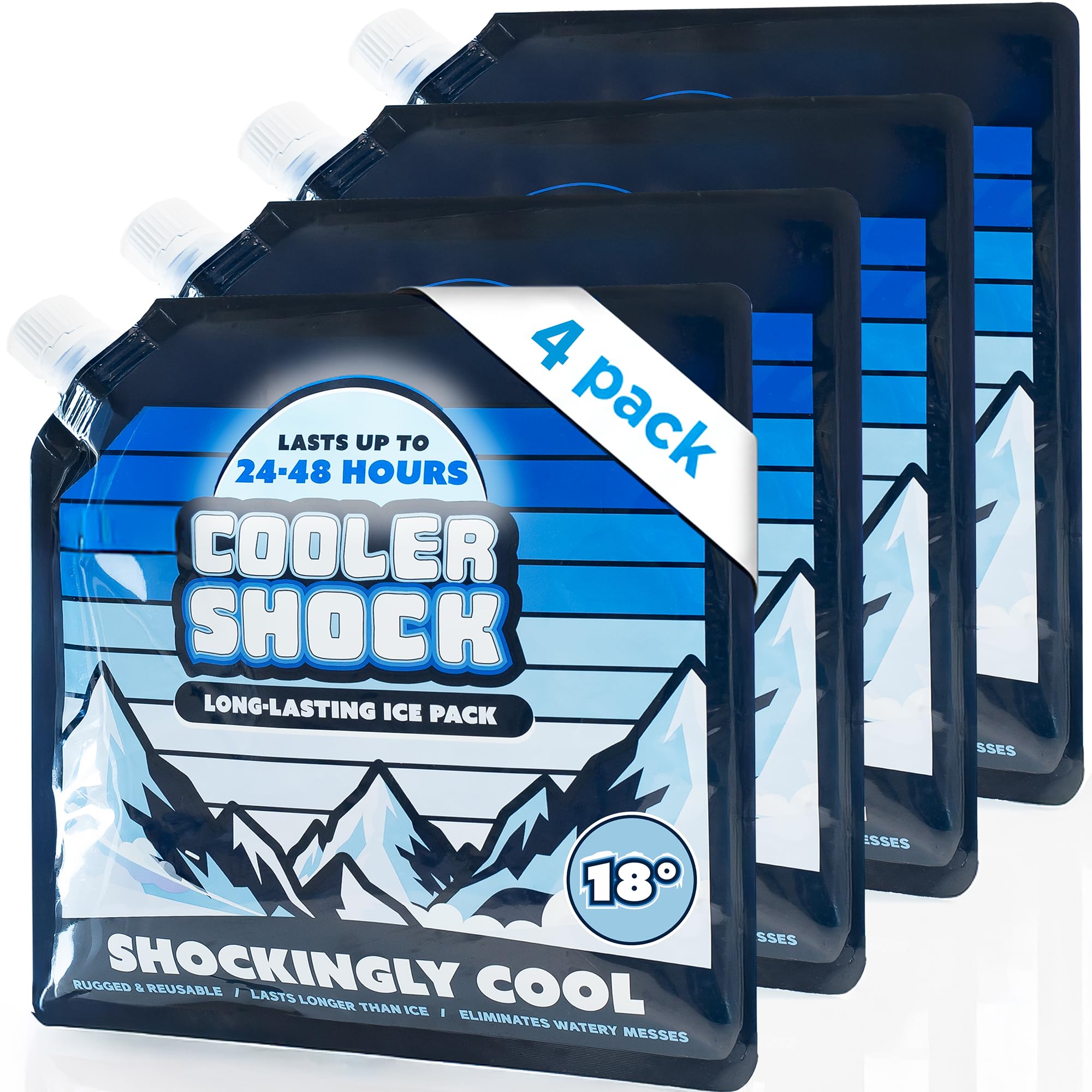
Cooler Shock Reusable Ice Packs

93 /100
Peggy's Score Outstanding

Key details

Fill
Add water
Dimensions
10 x 10 x 1 in
Pack Count
4
Phase Change Point
18°F
Check Details on Amazon

The 18-degree phase-change point is the number to understand here: these packs are built to hold a cooler just above freezing rather than to feel cold in the hand, and that is why we rate them the best of this set for a loaded cooler. The claim of up to 48 hours applies to a size-matched, well-packed cooler — not a beach bag with a six-pack in it.

They arrive empty, and that is the point. Fill each through the included funnel, shake, cap, and freeze flat; a frozen pack is ten inches square and an inch thick, so four of them tile the bottom of a medium cooler like books on a shelf. Each is meant to stand in for five or six pounds of bagged ice, and what you notice at the campsite is the absence of meltwater soaking the food.

The weak spot is the shell. A pack can split at a seam after a season of hard use, and a split one is finished. They are slow to refreeze as well, so the set works as a rotation rather than as spares — plan the four together and you will not be caught with a cooler and nothing frozen. Buy them for the cooler, not for the freezer drawer's daily lunch duty.

Pros

  • Holds a cooler near freezing, not just cold
  • Replaces bagged ice and its meltwater
  • Fills from the tap and freezes flat
  • Four packs tile a medium cooler

Cons

  • Can split at a seam after heavy use
  • Slow to refreeze between trips
Our verdict

For a cooler rather than a bruise, these are the ones we reach for: four packs, tap water, and no bagged ice turning to soup by Saturday.

Check Latest Price
4

Best for Lunch Boxes

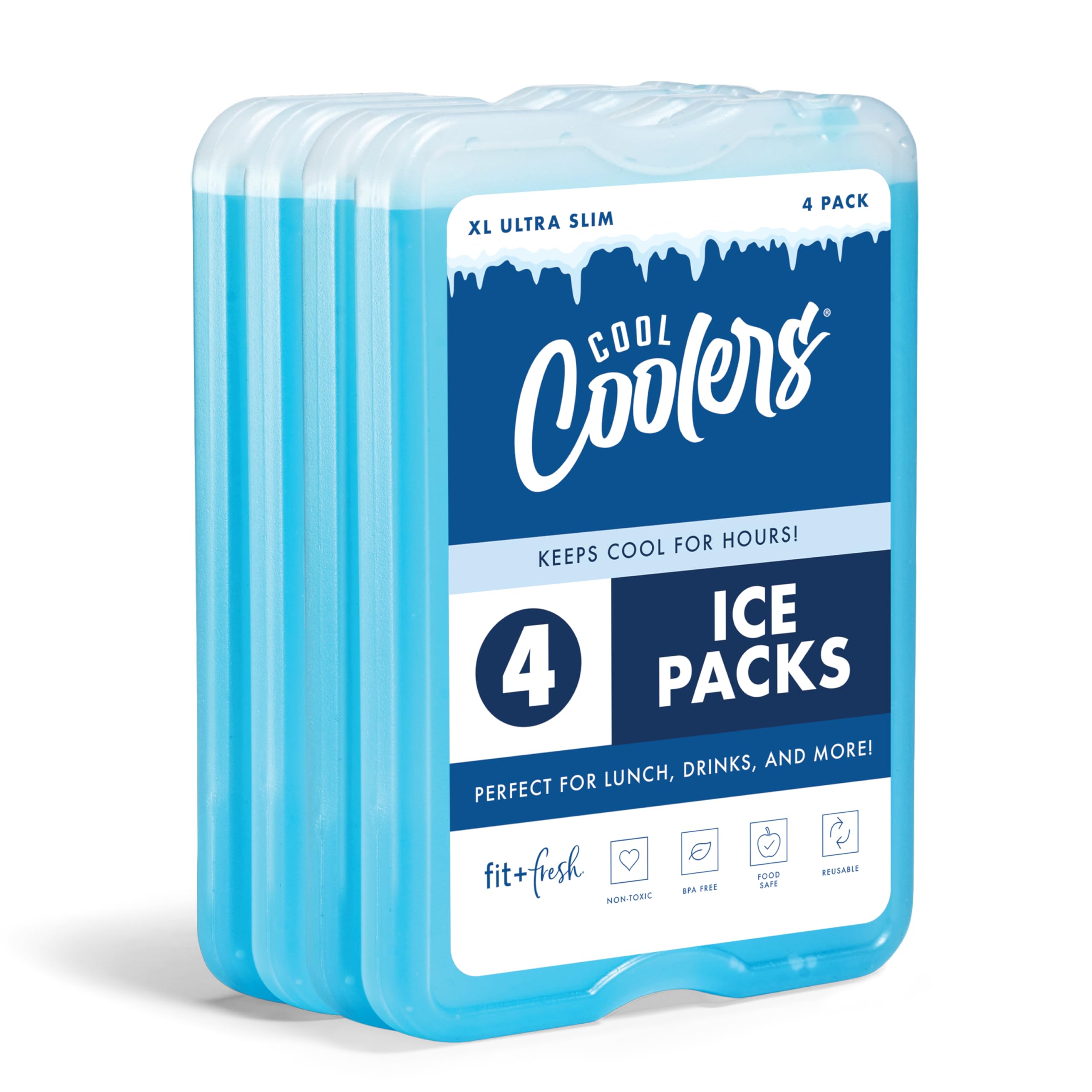
Fit & Fresh Cool Coolers XL Slim

93 /100
Peggy's Score Outstanding

Key details

Care
Hand wash only
Material
BPA-free plastic
Thickness
0.5 in
Pack Count
4
Check Details on Amazon

Half an inch thick is the whole design brief here, and it is what makes these useful: one slides down the side of a lunch bag, a second lies across the top, and the sandwich box still closes. They are lunch-box shaped rather than cooler shaped, and that is exactly the job most weekdays need done.

Four in the pack means two can live in a work freezer and two at home, and the thin profile freezes solid overnight without needing a shelf to itself. The BPA-free shell wipes clean with a damp cloth, though the maker asks for hand washing rather than the dishwasher.

We rate these the pick for lunch bags because half an inch buys back room that a thicker gel pack takes, and at noon that trade is worth more than a longer, colder burn. The same thinness is why they are ready again the next morning. Two per bag is the sweet spot — one down the side, one across the top — and the spare pair means a forgotten pack is not a ruined lunch.

Pros

  • Half an inch thick fits a packed lunch bag
  • Four-pack keeps a spare set frozen
  • Freezes solid overnight
  • BPA-free shell wipes clean

Cons

  • Thaws faster than a thick gel pack
  • Hand wash only
Our verdict

The weekday answer: thin enough to disappear into a packed lunch bag, economical enough to buy four, and ready again by morning.

Check Latest Price
5

Best Hands-Free Wrap

TrekProof Hot & Cold Wrap Set

93 /100
Peggy's Score Outstanding

Key details

Fit
Ankle, knee, shoulder
Set
3-piece with wrap
Therapy
Hot and cold
Check Details on Amazon

A strap changes how much you actually use an ice pack. Instead of lying still with a pad balanced on a knee, you thread the wrap around the joint, drop the gel pack into it, and get on with the evening. The set arrives with two gel packs and the elastic wrap, which is the combination that makes it work.

We rate it the best of these when the cold has to stay where you put it: the strap holds through a whole session, the fabric cover keeps the gel off bare skin, and the second pack is waiting in the freezer when the first warms up. The packs take heat as well, so the same wrap handles a stiff shoulder the night after.

The strap is the part to think about first. It is generous around an ankle or a knee and short on a broad chest or a heavy thigh, and a wrap that will not close is no use to you. The packs themselves are ordinary gel — a good session's worth of cold, not an hour of it — so treat this as a wrap purchase that happens to come with packs.

Pros

  • Strap keeps the pack in place hands-free
  • Two gel packs keep one always frozen
  • Fabric cover sits between gel and skin
  • Packs work hot as well as cold

Cons

  • Strap runs short on a broad chest or thigh
Our verdict

If you want to ice a knee while you move around the house, the strap is what you are buying, and this set's strap does the job.

Check Latest Price
6

Best Refillable Ice Bag Set

elitehood Reusable Ice Bags

95 /100
Peggy's Score Outstanding

Key details

Fill
Ice and water
Sizes
6, 9, 11 in
Weight
3.5 oz (9 in)
Includes
Compression strap
Check Details on Amazon

Refillable bags are the old answer to cold therapy and they still make sense: fill, cap, ice, with nothing to wait on in the freezer and no gel to soften. What you give up is storage convenience — a bag full of ice is heavy, and it wants to be somewhere cold.

Three sizes cover the awkward jobs: the six-inch bag for a child's forehead or a migraine, the nine-inch for a shoulder, the eleven-inch for a knee. The nine-inch weighs about three and a half ounces empty, so it packs flat in a travel bag, and the cap opening is wide enough for full-size cubes rather than crushed ice only.

The strap is the piece we did not expect to lean on. It holds the bag against a shoulder or a knee while you move, and the waterproof textile keeps the melt off your clothes. Fill two-thirds with ice and top up with a splash of water, and the bag molds to the joint instead of sitting on it.

We rate this the best refillable set here because it covers the sizes a household actually uses — headache, shoulder, knee — and the strap makes it usable without a second pair of hands. It lives on ice, though, so it is no help in a hotel room with a mini-fridge that produces two cubes an hour; for that trip, a gel pack is the better companion.

Pros

  • Three sizes from a child's brow to a knee
  • Wide cap takes full-size ice cubes
  • Strap holds the bag in place
  • Packs flat at 3.5 ounces empty

Cons

  • Needs ice cubes on hand for every use
Our verdict

The best refillable option here: three sizes, a strap that keeps the bag where you put it, and no gel to wait on in the freezer.

Check Latest Price
7

Slim Lunch Packs

Healthy Packers Slim Ice Packs

93 /100
Peggy's Score Outstanding

Key details

Material
Gel
Dimensions
4.7 x 0.7 x 7 in
Pack Count
4
Check Details on Amazon

Same lunch-box footprint as the thinner packs here, with noticeably more gel inside: these run about seven-tenths of an inch thick against half an inch.

Four sealed gel packs, roughly four and a half by seven inches, BPA-free. There is no filling to do and no water to top up, and they slot into the same side pockets as a slimmer set, wrapping around a bento box or a bag of grapes without rearranging anything.

They land just behind our lunch-bag pick, and the extra gel is the whole of the argument in both directions: more cold in the same footprint, but thicker, so a tightly packed bag has less room for food. In a decent insulated tote they hold past lunch; in a thin fabric bag nothing here will. If your current set gives up by early afternoon, this is the upgrade to try first.

Pros

  • Extra gel in a familiar lunch-box footprint
  • Sealed packs, nothing to fill
  • Four packs cover a week of lunches

Cons

  • Thicker than the slimmest packs here
Our verdict

A step up in cold from our lunch-bag pick if your bag has room to spare; the gel is sealed, so there is nothing to fill or top up.

Check Latest Price
8

Hot and Cold Therapy

Perfect Remedy Gel Ice Packs

93 /100
Peggy's Score Outstanding

Key details

Size
Regular
Therapy
Hot or cold
Material
Gel
Pack Count
2
Check Details on Amazon

Hot and cold from one pad is the appeal: freeze it for a swollen knee, microwave it for a stiff shoulder, same pack. Two come in the set, so one can be cooling while the other is warming.

There is a lot of gel in these, and the regular size suits a knee, an elbow, or a shoulder rather than a whole back. The exterior is a soft, leak-resistant material that sits comfortably against skin, and the pair stores flat between uses.

Cold retention is solid, and the heat side is genuinely useful — a warmed pad across a cramped shoulder does more at the end of a long day than another round of ice. Sizing is friendly to joints: the pad covers a kneecap with a little to wrap around the sides.

It sits in also-consider rather than higher because flexibility is the thing this guide leans on hardest, and this pad is the least predictable of the picks on it: one session it bends around a knee, the next it comes out stiff and needs a minute of working between your hands. Buy it for the heat-and-cold combination, and give it that minute before you judge it.

Pros

  • Freezer or microwave, same pad
  • Two pads keep one always ready
  • Soft exterior against skin
  • Regular size wraps a knee

Cons

  • Seams can split with repeated use
Our verdict

Worth it if you want one pad for both ice and heat; the two-pack means the warm one is ready while the cold one refreezes.

Check Latest Price

Our Four-Month Freezer Test

We started with every reusable ice pack we could find from brands we'd trust in a first-aid kit, then cut the list by reading the labels and the one-star reviews. Anything with repeated leak complaints, a stiff outer shell, or dimensions that sounded wrong for a knee or a shoulder didn't make the cut. That left 16 packs, from palm-sized rounds to full back wraps.

For four months, those 16 lived in my kitchen freezer and my testers' freezers, and we timed the same two things on every one. First, how long each took to freeze solid from room temperature, checked at 30-minute intervals — a pack that needs eight hours is a pack you'll forget about. Second, how long it actually stayed cold against skin: we wrapped each in a thin towel and wore it on a shoulder or a knee, noting at 10-minute intervals when the cold faded, rather than trusting what the box claimed.

We also pressed each pack around a frozen juice can and then around a wrist to see whether it cracked or molded to the shape, and measured it against a knee and a lower back to judge coverage. Along the way we kept a simple log of whether the area felt genuinely better or just numb. After roughly 40 freeze-thaw cycles apiece, we checked seams for leaks, watched for that tacky film cheaper packs develop, and noted how much condensation each left behind on a pillowcase.

How to Choose Reusable Ice Packs

Start with the format

Sealed gel pads, rigid freezer blocks, and refillable ice bags are three different tools. Gel conforms to a joint and stays soft enough to wrap, which is why it dominates injury use. Rigid blocks and phase-change packs hold a cooler longer but sit awkwardly against a body. Refillable bags give you real ice and instant readiness, at the cost of needing ice on hand.

The trap is buying a cooler pack for a knee. A block that stays cold for a day is the wrong shape to strap on, and a medium gel pad will disappoint you in a cooler full of drinks.

Your bag decides how long the cold lasts

A thin pack in a well-insulated bag outperforms a thick one in a fabric tote, so if your bag is the weak link, part of the budget belongs there. Count packs for the round trip rather than the hour: a workday lunch plus the ride home is two packs in most bags, which makes a four-pack the sensible minimum.

Recharge time matters as much as hold time. A pack that needs a full day to refreeze will not manage daily duty, and a set you rotate beats a single heroic pack every time.

Fit against a body

Coverage and flexibility pull in opposite directions. A large pad covers a back or hip in one placement but is heavier and stiffer out of the freezer; a medium gel pack wraps a knee or shoulder and bends straight away. If you will be moving while you ice, buy for the strap — a wrap with an elastic band keeps a pack where you put it, and a pad that will not bend cannot be held in place by a towel.

Measure the joint, not the pad. A pack that covers the kneecap with a little to spare is more useful than one that swallows the whole leg and slides off.

What kills a reusable pack

Almost every failure happens at the seam, the cap, or the shell. Gel packs that bulge or crack in the freezer are being pushed past what their shell can take, and a bag whose cap no longer seals will leak on a sofa eventually. Check the seams after the first few freeze cycles while a return is still possible, wash by hand unless the maker says otherwise, and leave headspace in a refillable bag so the ice can move.

Frequently Asked Questions

Final Verdict

The FlexiKold two-pack is the one we point most people to: gel that stays soft enough to wrap a knee straight from the freezer, seams built for being handed around, and a second pack waiting while the first warms up.

If the area you are icing is a whole back or a hip, the large Rester's Choice pad covers it in one placement. If the job is a cooler rather than a body, Cooler Shock's four-pack is the better buy.