Best Resistance Bands of 2026

A resistance band looks like the safest purchase in fitness: a few dollars, a few ounces, nothing to break. Then one snaps mid-row and you understand why people are so particular about a stretchy strip of latex. What you're actually buying is a band that still delivers its stated resistance after a hundred workouts, stays where you put it against a door frame or under a foot, and covers enough range — light for shoulder work, heavy for squats and pull-up assists — that one set does the job of four.

I've kept a set in a desk drawer, a carry-on, and a gym bag, and the differences between a good set and its near-identical twin don't show up in photos. My team and I spent the past four months working through 15 sets — flat latex loops, fabric loops, tubes with handles — pulling them, measuring them, and handing them to people of different heights to see how length and fit played out. The picks below are the ones that held their tension, stayed put, and didn't shred.

1

Best Overall

Renoj Fabric Resistance Bands

95 /100
Peggy's Score Outstanding

Key details

Weight
12.7 oz
Material
Cotton-polyester fabric
Band Size
28.35 x 3.15 in
Resistance Levels
3, up to 35 lb
Check Details on Amazon

Anyone who has done lateral walks with a latex loop knows the moment it starts sliding down the thigh — you stop, haul it back up, and lose the set. The Renoj bands do not do that. Woven fabric, 28.35 inches around and 3.15 inches wide, grips shorts and bare skin instead of skating over both, and the extra width spreads the pressure so the band sits flat rather than rolling itself into a rope.

The set is aimed squarely at legs and hips: three loops, from a warm-up band up to one rated at 35 pounds of tension, which covers glute bridges, squats, hip abduction, and the banded walks that make up most home lower-body work. All three pack into a mesh bag, and at 12.7 ounces for the set they disappear into a gym bag — the kind of thing you take on a weekend without thinking about it.

What we appreciated most is how little fuss there is around them. No powder, no talc, no careful storage, and nothing to snap: fabric loops fail far less dramatically than latex, and the weave does not pinch or catch hair on bare legs the way a rubber band does. They have stayed grippy rather than stretching out, which is the quiet way a cheap band usually ends its life.

It is the set we tell most people to buy first, and the one that leaves room to add a tube set later if you decide you want handles and a door anchor. Nothing about it is fussy and nothing about it wears quickly, which is most of what we want from a band we grab four times a week.

Pros

  • Fabric grips instead of sliding down the thigh
  • Three levels cover warm-up through working sets
  • Woven material resists snapping
  • Mesh bag and 12.7 oz total travel easily

Cons

  • Caps at 35 lb, which heavy squatters will outgrow
  • Only three levels, so the jumps are wide
Our verdict

The set we tell most people to buy first: three woven loops that stay on your legs, resist snapping, and cost less than almost anything else here.

Check Latest Price
2

Best Full-Body Set

WHATAFIT Tube Bands with Handles

93 /100
Peggy's Score Outstanding

Key details

Weight
2 lb
Included
Handles, ankle straps, door anchor, bag
Material
Natural latex
Resistance Range
10-150 lb across 5 tubes
Check Details on Amazon

Clip a tube into the door anchor and a bedroom wall becomes a cable station. That is the argument for this set over every loop band on the page: five latex tubes rated 10, 20, 30, 40, and 50 pounds snap onto two cushioned handles and two ankle straps with carabiners, and you can stack them for up to 150 pounds of combined resistance.

Stacking is the part that matters. Adding a 10-pound tube is a finer jump than most home dumbbell sets allow, so rows and chest presses climb in small steps instead of doubling. The door anchor changes the angle, too — pulling horizontally at chest height is what makes band work feel like strength training rather than a warm-up, and it is the piece we reach for most. The ankle straps handle kickbacks and hip work that a loop cannot load properly.

Two practical notes before you buy. The anchor needs a door that closes and latches; a sliding door or an open doorway gives you nothing to pull against. And the tube ends, where the latex meets the collar and the clip, are where any set like this eventually gives out — check them before you load everything on and hang on. At two pounds packed, the whole kit still fits in a backpack.

Pros

  • Five tubes stack to 150 lb in 10-lb steps
  • Door anchor opens up rows and presses
  • Handles and two ankle straps included
  • Packs to 2 lb with a carry case

Cons

  • Door anchor needs a closed, latched door
  • Natural latex, so not for sensitive skin
Our verdict

The closest thing here to a cable gym: five stackable tubes, cushioned handles, and a door anchor for anyone who wants to press and pull at home.

Check Latest Price
3

Best for Heavier Leg Work

Vergali Fabric Bands 4-Pack

96 /100
Peggy's Score Outstanding

Key details

Included
Printed training guide, carry case
Band Material
Fabric and latex blend
Resistance Levels
4, from 14 to 60 lb
Check Details on Amazon

Four bands, and the heaviest is rated 45 to 60 pounds — close to double where our top pick stops. That single fact is the reason this set is here. It is the one for people who have already worn out a three-band starter set and want something to grow into, and the 60-pound band gives a banded squat or hip thrust enough bite to feel like load rather than therapy.

The four levels step from 14 to 25 pounds through 25 to 35 and 35 to 45 before that heaviest band, and the resistance is marked on each one, so you are not guessing which is which halfway through a circuit. The weave is a fabric and latex blend, broad enough that it does not pinch bare legs or roll down mid-set, and it comes with a printed training guide and a carry case — genuinely useful if you have never programmed band work before.

Two trade-offs to weigh. The latex blend means it is not the set for sensitive skin, and it costs noticeably more than the Renoj loops. What you get for that is headroom: this is the fabric set that will still be challenging in six months, and the marked levels make progression something you can actually plan.

Pros

  • Heaviest band reaches 60 lb of tension
  • Resistance level marked on each band
  • Printed training guide and carry case included

Cons

  • Fabric-latex blend is not for sensitive skin
  • Costs noticeably more than our top fabric pick
Our verdict

The set to buy when three fabric bands have stopped being enough: four levels topping out at 60 lb, with a printed guide to use them.

Check Latest Price
4

Best for Physical Therapy

THERABAND Resistance Band Set

93 /100
Peggy's Score Outstanding

Key details

Weight
1.6 oz
Material
Latex-free TPE
Band Size
5 ft x 4 in
Resistance Range
3-6.7 lb across 3 bands
Check Details on Amazon

Five feet of flat band is a different tool from a loop. You tie it to a door handle, loop it around a foot, or hold it at shoulder width and press out, which is why a strip this long still earns a place in a gym bag. THERABAND gives you three of them at genuinely light tensions: yellow at 3 to 4.3 pounds, red at 3.7 to 5.5, and green at 4.6 to 6.7.

That is the point rather than a shortcoming. These are the tensions used for rotator cuff work, posture exercises, and the first weeks back after an injury, where a 20-pound band is not a tool but a hazard. The material here is latex-free TPE, which matters if you have reacted to latex before, and the surface wipes clean after a session — useful when a band gets used on a shoulder, then a knee, then a shoulder again.

We keep these for the sessions where control is the whole exercise: slow shoulder rotations, hip marches, the kind of work where you are counting quality reps rather than chasing fatigue. Expect to replace them eventually — light TPE bands are consumables, and the ends are where they go. The ceiling is the honest limitation: nothing in this set gets near strength training, so treat it as one tool, not the only one.

Pros

  • Light tensions suited to rehab and shoulder work
  • Latex-free and easy to wipe clean
  • Five feet of length for tying or anchoring
  • Packs down to almost nothing

Cons

  • Maxes out under 7 lb, so not for strength work
Our verdict

The set for a careful return to movement: five-foot latex-free bands at rehab-level tension that tie to almost anything.

Check Latest Price
5

Best for Pull-Up Assistance

WSAKOUE Pull-Up Band Set

93 /100
Peggy's Score Outstanding

Key details

Material
Natural latex
Band Size
82 x 2 in
Thickness
0.2 in
Resistance Range
5-125 lb across 5 bands
Check Details on Amazon

Loop a band over the bar, put a foot in the bottom, and a pull-up you could not do becomes five. WSAKOUE's five bands run from 5 to 125 pounds of assistance, and the 82-inch length is what makes them work: long enough to go over a bar and still take a foot, with room left for a full stretch at the bottom instead of a snap.

Two inches wide and a fifth of an inch thick, they are heavy enough that the strongest band takes real effort to pull into place, which is exactly what you want from a band that is carrying part of your weight. We use them for assistance, for banded pull-aparts between sets, and for the hamstring and hip stretches that are easier with a loop than with a strap. They come with a storage bag and a manual. There are no handles here, so pressing moves are limited to what you can grip — for that, a tube set does more.

Pros

  • Covers 5 to 125 lb of pull-up assistance
  • 82-inch loops fit over a bar with room for a foot
  • Sturdy natural latex takes real stretch

Cons

  • Long loops with no handles limit pressing work
  • Natural latex, so not for sensitive skin
Our verdict

The set we keep for bar work: five long loops that take anywhere from 5 to 125 pounds of your bodyweight off a pull-up.

Check Latest Price
6

Heavy Band Work

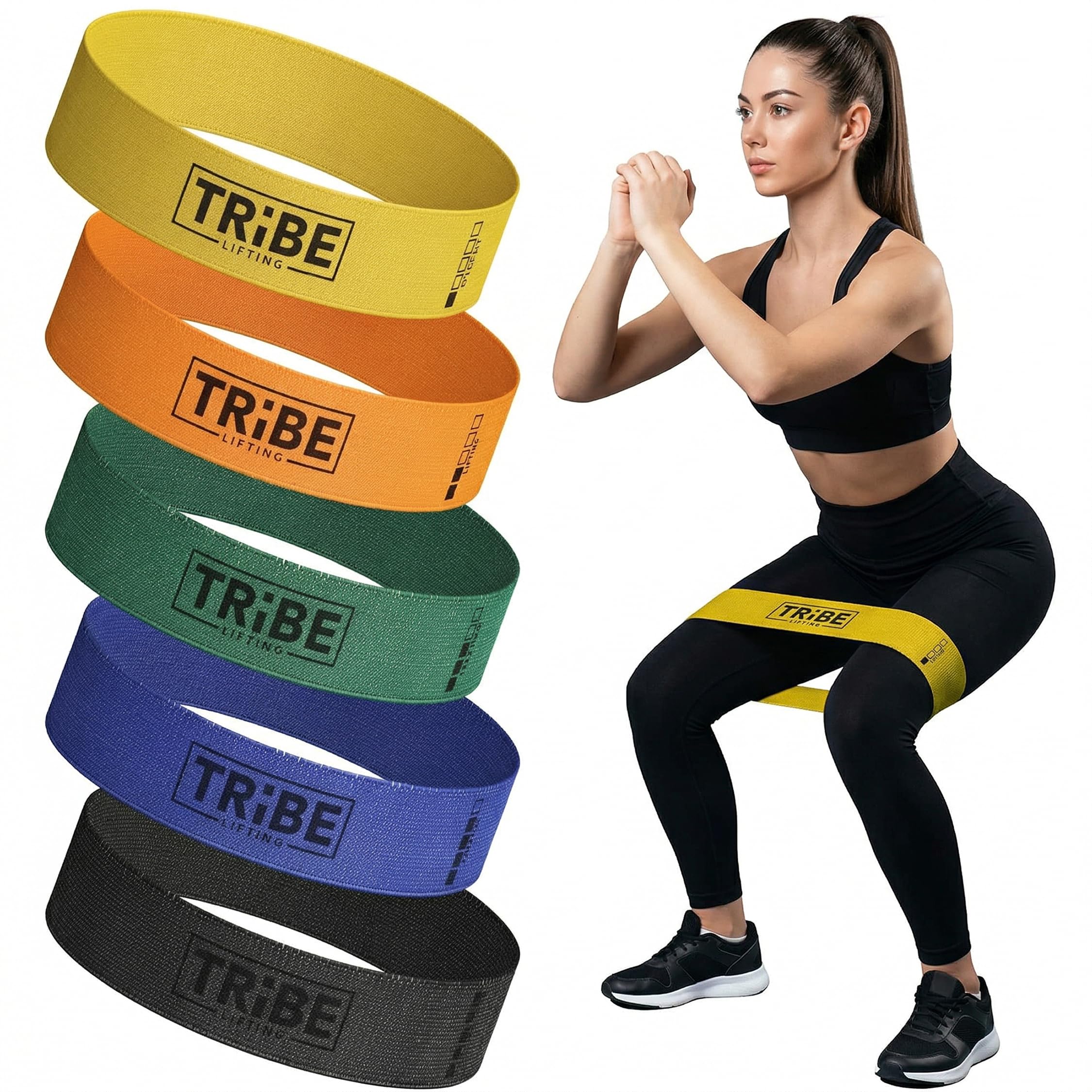
Tribe Lifting Fabric Bands 5-Pack

95 /100
Peggy's Score Outstanding

Key details

Weight
7.36 oz
Material
Cotton-latex blend
Band Size
12 x 2 in
Resistance Range
40-180 lb across 5 bands
Check Details on Amazon

A 180-pound resistance rating in a 12-inch fabric loop is an unusual thing, and it tells you who this set is for. This is the pack you reach for when a band is going around a barbell or across the hips under load, not when you are warming up for a run. Five loops step from 40 pounds up to that 180-pound band, all two inches wide and made from a cotton-latex weave that stays flat against the leg.

The build is the reason to buy it. The weave is dense enough that it does not bunch behind the knee during squats, the band does not bite bare skin, and at 7.36 ounces for five bands it still fits in a gym bag alongside a water bottle. We liked the width most: two inches is narrow enough to sit above the knee without riding up, wide enough that the heaviest band does not feel like a wire against the hip.

The gap is at the bottom. Nothing here is lighter than 40 pounds, so the set cannot warm you up, cannot do shoulder work, and cannot be handed to someone new. If you want one pack for everything, this is not it — but as the heavy end of a collection that already includes a lighter band, it does the one job the others cannot.

Pros

  • Reaches 180 lb, the heaviest fabric loop here
  • Dense weave stays flat during squats
  • Five bands pack into 7.36 ounces

Cons

  • Nothing below 40 lb, so no light warm-up band
  • Fabric-latex blend contains latex
Our verdict

For lifters who want banded squats and hip thrusts to feel heavy: five fabric loops reaching 180 lb, with no light band in the set.

Check Latest Price
7

Durable Tube Work

TheFitLife Tube Band Set

93 /100
Peggy's Score Outstanding

Key details

Included
Handles, ankle straps, door anchor, bag
Material
Natural latex
Resistance Range
10-110 lb across 5 bands
Check Details on Amazon

Tube sets rarely fail in the middle of the rubber. They fail where the tube meets the webbing and the clip, which is why TheFitLife's pitch is about that joint: thicker webbing, reinforced stitching, and larger connection points at exactly the spot the last set gave out. If you have had a tube snap mid-row, that is the detail worth paying for.

The rest of the kit is familiar and complete: five natural latex tubes rated 10 to 110 pounds combined, two cushioned handles, two ankle straps, a door anchor, a waterproof carry bag, and an instruction card with enough exercises to start on day one. Natural latex gives a smooth, even pull through the whole range rather than the sudden stiffening you get from cheap synthetic tubing, and the handles are comfortable enough for high-rep sets.

The trade-offs are a lower combined ceiling than the WHATAFIT set and the highest price here. Neither bothers us much for the intended use — a handful of tubes for rows, presses, and arm work at home — but if you want to stack toward 150 pounds, this is not the set that gets you there. Buy it for build quality, not for maximum load.

Pros

  • Reinforced webbing and stitching at the joints
  • Smooth natural latex pull through the range
  • Complete kit with handles, straps, anchor, and bag

Cons

  • Combined resistance stops at 110 lb
  • The priciest set here
Our verdict

A tube set built for people whose last one snapped: reinforced joints, five levels to 110 lb, and a waterproof bag for travel.

Check Latest Price
8

Budget Stretching

Lianjindun Flat Resistance Bands

93 /100
Peggy's Score Outstanding

Key details

Weight
14.1 oz
Material
Latex-free TPE
Band Size
60 x 6 in
Resistance Range
3-20 lb across 5 bands
Check Details on Amazon

Six inches wide is the number that stands out. Most flat bands are four, and the extra two inches make a difference when you wrap one around a hand or a foot: the load spreads across the palm instead of cutting into it. Five latex-free TPE bands run from 3 to 20 pounds, they are 60 inches long, and the set is the least expensive thing on this page.

For stretching, banded shoulder work, and light toning in front of the television, that is a sensible package, and the TPE surface is softer against skin than natural latex. It is not a strength set — 20 pounds at full stretch is where it ends — and the heavier strips in the pack are the ones that can snap with repeated use, so check them for nicks before a stretch that puts a band near your face. Ours live in a drawer and get used more than we expected.

Pros

  • Six-inch width spreads pressure on hands and feet
  • Latex-free TPE, gentle on sensitive skin
  • Five levels at the lowest price here

Cons

  • 20-lb ceiling keeps it to stretching and toning
  • Heavier bands can snap with repeated stretching
Our verdict

The cheapest way into flat bands: five wide, latex-free strips for stretching and light toning, with a low ceiling by design.

Check Latest Price

How We Tested the Best Resistance Bands

We started with a list of more than 60 sets and narrowed it the way a shopper would: which resistance levels come in the pack, how long each band is, what it's made of, and what the set costs against buying single bands. That left 15 sets, all bought at retail, which we used for four months.

Those 15 lived where bands actually live — looped around a door anchor in a spare bedroom, packed in a carry-on for hotel-room workouts, used for shoulder warm-ups before a run, and passed around among people from 5-foot-2 to 6-foot-3. Testing across that height range was the only honest way to judge fit: some bands ran too short for taller users to get into a squat stance, others too long to build any tension for shorter ones.

Bands fail in the same two places, so that's where we looked. Every few sessions we ran a thumbnail along the edges, hunting for the nicks and chalky patches that turn into a tear, and we pulled hard on the seam where a tube meets its handle. To check whether the printed resistance meant anything, we stretched each band to twice its resting length, noted how much give it had, then hung a 10-pound weight from it and measured the stretch.

We also did rows, squats, and lateral walks on carpet and hardwood, watching whether a band rolled down a thigh, crept out from under a foot, or slid on a sweaty arm. At the end we tallied which bands we'd actually reached for and which never left the pouch, since a 12-piece set used twice is worse value than three bands you grab daily.

How to Choose Resistance Bands

Start With the Format

Fabric loops sit on your legs and load glutes, hips, and thighs. Flat bands are for tying, anchoring, and light upper-body or rehab work. Tube sets with handles and a door anchor come closest to a cable machine, and long pull-up loops add assistance on a bar or heavy resistance to a lift. The format decides which exercises are even possible, so pick it first and treat the resistance rating as secondary.

If you want one purchase to cover pressing and pulling, a tube set is the only format here that does both — the WHATAFIT set's door anchor is what makes a row or a chest press possible. If your training is leg day at home, buy fabric and skip the handles entirely.

What the Resistance Numbers Do and Don't Tell You

Ratings describe tension at a given stretch, not a fixed load. A 35-pound loop around your thighs and a 35-pound tube in your hands feel nothing alike, and brands do not calibrate to a common scale, so a number that means something in one set means very little in another. A combined figure such as 150 pounds also assumes every tube clipped on at once, which is rarely how you train.

Look instead for a set with a light band you can finish 15 clean reps with and a heavy one you can barely move for 8. If every band in the set is heavy — as with the Tribe Lifting loops, which start at 40 pounds — you will spend the first month guessing.

Fabric, Natural Latex, or TPE

Fabric loops grip and do not roll, and they fail slowly, usually by stretching out rather than snapping. Latex and TPE bands stretch further and cost less, but natural latex degrades with heat, sunlight, and skin oils, and it tends to fail suddenly at a nick or a clip. TPE is latex-free and softer against skin, which is why the flat-band rehab sets use it.

Our rule: fabric for leg work you do every week, latex or TPE for stretching and rehab where you expect to inspect and eventually replace the band. Store either kind away from a hot car or a sunny windowsill — heat is what shortens a band's life fastest.

Length, Width, and the Hardware

A 12-inch loop goes above the knees. A 28-inch loop fits around both legs or around the ankles, which is why the Renoj set works for banded walks. A 5-foot flat band can be tied to something solid, and an 82-inch loop is long enough to go over a pull-up bar and still take a foot. Width is about comfort: 2 inches is standard, 3 inches and up spreads pressure on bare skin, and a 6-inch flat band is easier to wrap around a hand.

On tube sets, the door anchor is only as good as your door — it needs to close and latch, with a clear line of pull, and the hinge side is where it sits. Check that before you order, because a sliding door or an open doorway gives you nothing to anchor against.

Frequently Asked Questions

Final Verdict

For most people, the Renoj fabric loops are the set to buy first: three bands that stay on your legs, do not snap, and ask nothing of you between workouts. Add the WHATAFIT tube set when you want handles, a door anchor, and 150 pounds of stackable resistance for pressing and pulling — between the two you can cover the whole body at home.

If the bands are for rehab rather than training, start with THERABAND's flat bands instead, where the heaviest band is under 7 pounds and the point is control, not load.