Best Meditation Chairs of 2026

Meditation is supposed to quiet the mind, but a bad seat makes you aware of your tailbone, your knees, and the foot that fell asleep. I spent years folding a blanket into a lumpy square and calling it a setup, and I know I’m not alone in cutting a session short because the cushion slid or the floor felt harder than it looked. A good meditation chair fixes that: it sets your hips at a height where your knees can drop, gives your back honest support, and looks like furniture you don’t need to hide.

Over the past seven months, my team and I tried 11 chairs in real apartments, during morning sits, evening wind-downs, and long reading sessions. The pattern was clear: a pretty frame can wobble, a plush seat can flatten, and a chair that feels fine for five minutes can turn into a cage at twenty. We weighed appearance against comfort, timed assembly, and noted which seats still felt supportive after weeks of daily use. The picks below are the ones that made sitting still feel easier.

1

Best Overall

DUMOS Cross-Legged Chair

91 /100
Peggy's Score Outstanding

Key details

Seat
Nearly 4 in. thick, height adjustable 0–4.7 in.
Backrest
Height-adjustable with a knob, 22.75 in. wide
Footstool
30 x 16 in., rotating
Weight Limit
350 lb
Check Details on Amazon

The knob on the back of this chair is why it leads our list. Reach behind you and the lumbar pad rises or drops while you are still sitting, no tools and no getting up. Meditation posture changes over a session — you settle upright, then ten minutes later you want the support lower — and being able to chase that without breaking the sit is worth more than any single line on the spec sheet.

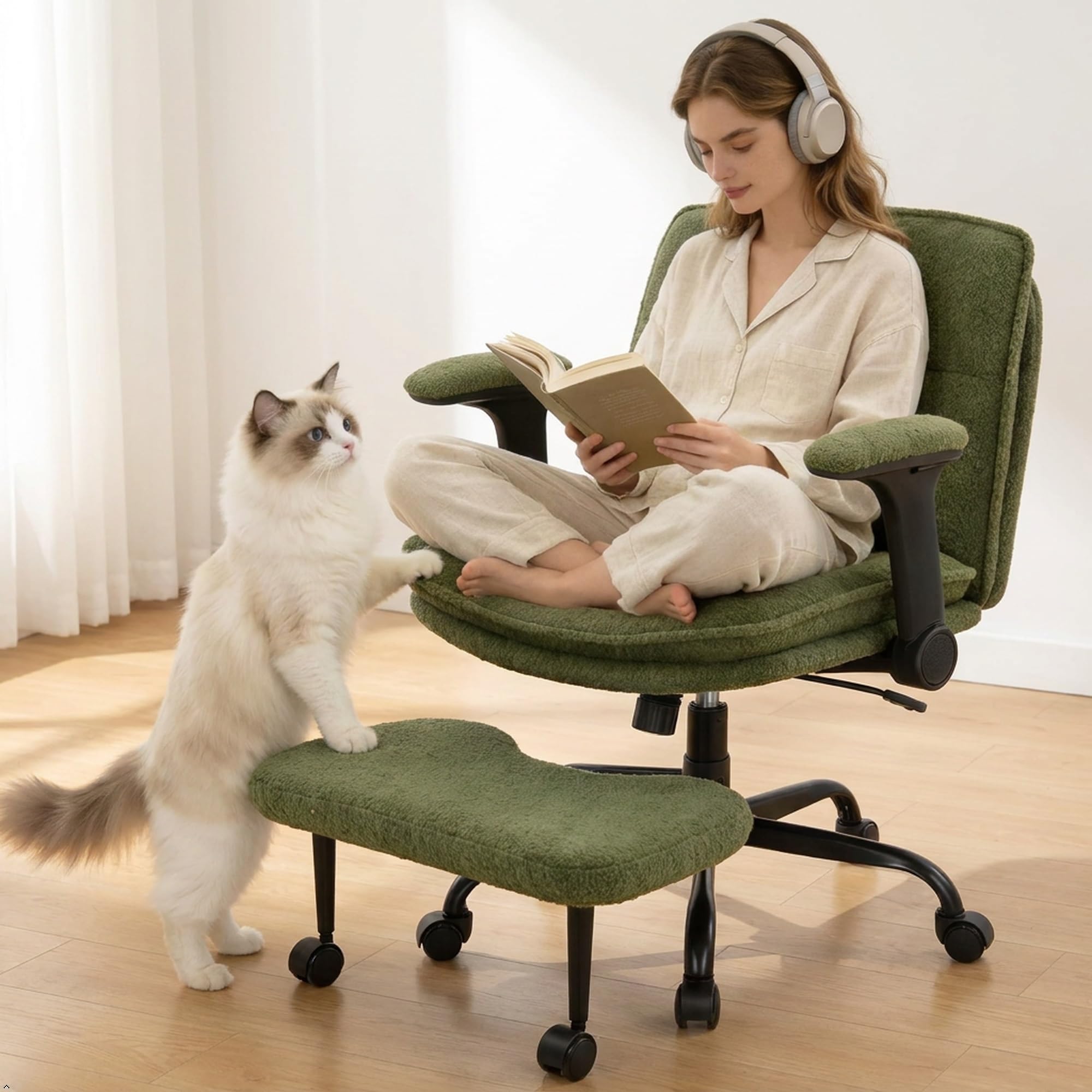
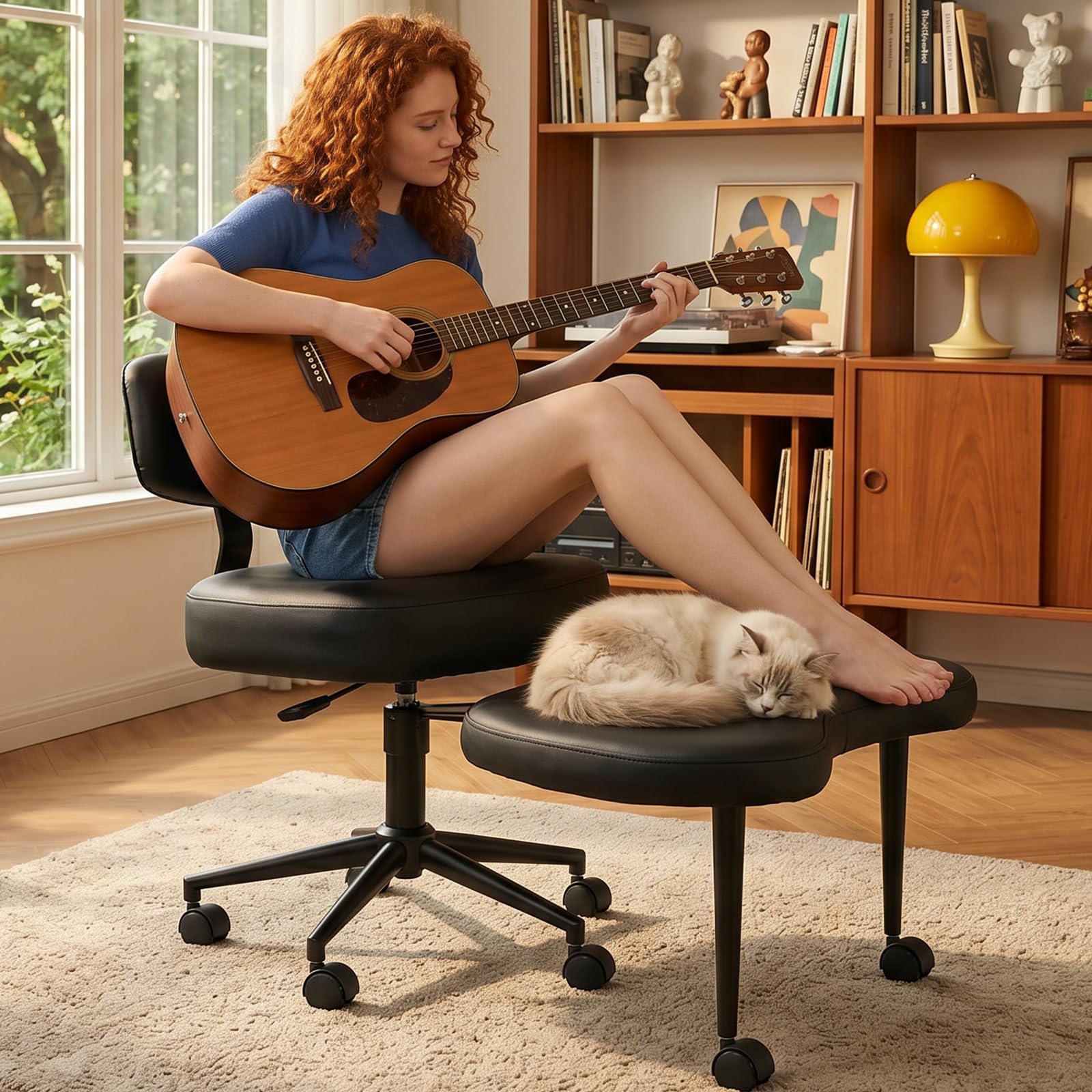
Everything else is built for the same problem. The seat height adjusts from 0 to 4.7 inches, and a 30-by-16-inch footstool rotates out to meet your legs, so cross-legged and kneeling postures get a platform under the knees instead of a dangling edge. The cushion is nearly four inches thick, which is the part that decides whether you last ten minutes or thirty: the pressure lands on the sit bones and the outside of the ankles, and a thin pad announces itself fast.

We also like that it keeps its day job. There is a 360-degree swivel and casters, an SGS-rated gas lift and a steel base rated to 350 pounds, so the same chair rolls from the mat to the keyboard. Most people do not have a spare corner for a dedicated meditation seat, and this one does not ask for one.

Upkeep is a damp cloth. The seat and back are faux leather with no removable cover, which means spills wipe up in seconds and there is nothing to unzip and launder after a hot session — a fabric cover would breathe better, and that is the trade you are making.

Pros

  • Backrest height adjusts while you sit
  • Swing-out footstool supports cross-legged sitting
  • 350-pound capacity on a steel base
  • Rolls and swivels between desk and mat

Cons

  • Footstool needs about three feet of floor depth
Our verdict

Our pick for most people: the backrest adjusts where your lower back actually needs it, and the footstool turns cross-legged sitting at a desk into something you can do for an hour.

Check Latest Price
2

Best Dedicated Meditation Chair

Mindful Modern Meditation Chair

88 /100
Peggy's Score Excellent

Key details

Weight
7.6 lb
Backrest
Adjusts through 90°
Folded Size
29.92 x 3.15 x 20.47 in.
Weight Limit
250 lb
Check Details on Amazon

If your practice has a time and a place but no room of its own, this is the chair built for that. It weighs 7.6 pounds, folds to roughly three inches flat, and arrives assembled — the whole ritual is unfold, sit, fold, slide it under the couch.

The back adjusts through 90 degrees on a hinge and measures 20.5 inches across, enough to stop a slump without turning the thing into a recliner. We like that it commits to being a floor seat: hips low, knees up, spine stacked, no pretence of being office furniture. The thing to check before you commit is where the top of that backrest lands on you. It is a short back, and on a long torso it finishes around the shoulder blades rather than between them.

The frame is powder-coated metal under foam, the cover wipes clean, and it is the only chair in this group sold for indoor and outdoor use, so a lawn or a patio is fair game — more than the velvet and faux-leather picks can offer.

Pros

  • Folds to about three inches, no assembly
  • 7.6 pounds, easy to carry and stash
  • Rated for indoor and outdoor use

Cons

  • 250-pound limit is the lowest here
Our verdict

Buy this if your practice deserves its own seat — it folds to three inches, weighs under eight pounds, and disappears into a closet between sessions.

Check Latest Price
3

Best Budget Floor Chair

COSTWAY Folding Floor Chair

87 /100
Peggy's Score Excellent

Key details

Weight
10 lb
Backrest
14 positions, 0–84°
Folded Size
39 x 19.5 x 5.5 in.
Weight Limit
335 lb
Check Details on Amazon

Fourteen positions, thick sponge under a coral-velvet cover, and nothing to assemble: this is the floor chair we point to when someone wants floor-level sitting without a floor cushion's worth of discomfort. It is one of the least expensive floor chairs here, and nothing about it reads as the cheap option — the tufted cover and the plush fill are precisely what the chair is selling, and it delivers both.

What you are buying is a chair for sitting, not for lying back. The click-clack hinge steps through its positions in a second, so shifting from upright to a reading angle does not interrupt what you are doing; the alloy-steel frame is rated to 335 pounds; and the whole thing folds flat to about five and a half inches, thin enough to slide behind a sofa.

At ten pounds it moves room to room with one hand, which matters more than it sounds — a floor chair that is awkward to carry ends up staying where you left it. There is no strap and no handle, so it is a two-arm carry, but for a fixed spot in a living room or a spare bedroom that costs you nothing.

Pros

  • Fourteen locking backrest positions
  • Thick sponge under a soft velvet cover
  • Arrives assembled and folds flat

Cons

  • Velvet cover is spot clean only
Our verdict

The plushest floor chair near the bottom of the price range, and the one we point to when you want a floor seat that arrives ready to use.

Check Latest Price
4

Best Adjustable Recline

Nnewvante Adjustable Floor Chair

86 /100
Peggy's Score Excellent

Key details

Weight
5.7 lb
Backrest
42 positions, 90–180°
Folded Size
30 x 18.9 x 3 in.
Weight Limit
220 lb
Check Details on Amazon

Folded, this is a three-inch slab of crystal velvet that slides under a bed. Unfolded, it is a floor chair whose backrest locks through 42 positions between 90 degrees and flat — more range than anything else in this group.

Forty-two sounds like a marketing number, and mostly it is: nobody needs the difference between position 31 and 32. What the count buys you is that the stops sit close enough together to land on the angle your lower back actually wants rather than the one a designer picked. The frame is alloy steel, the cover unzips and washes, and there is a water-resistant base underneath, so a porch or a balcony does not ruin it.

We keep coming back to how little it asks of you. At 5.7 pounds it is the lightest chair here, it needs no assembly, and it holds itself upright without propping against a wall, which is rarer in this category than it should be. What it will not do is sprawl: the seat pad is a shallow 12.1 inches deep, so this is a chair for upright sitting with your legs forward.

Pros

  • Locks at 42 angles from upright to flat
  • Removable washable cover, water-resistant base
  • 5.7 pounds and folds to three inches

Cons

  • 220-pound limit is the lowest in this group
Our verdict

Choose it for the backrest: it locks anywhere from upright to flat, and the cover comes off when a season of practice leaves it less than fresh.

Check Latest Price
5

Best for Desk Work

FelixKing Criss Cross Chair

88 /100
Peggy's Score Excellent

Key details

Seat
24.4 in. wide, dual-layer cushion
Backrest
Flips forward or back, 2 positions
Seat Height
22 in.
Weight Limit
300 lb
Check Details on Amazon

This chair sits low even at the top of its range, and that is the entire point. A criss-cross chair has to drop your hips close enough to the seat that your knees fall below them; a standard office chair at desk height turns cross-legged sitting into a balancing act. Pair this one with a full-height desk and you will be reaching up to type — put it at a low desk, a vanity or a coffee table and it makes sense. We think that is the right trade for anyone who genuinely works cross-legged.

The backrest flips. Forward, it is a lumbar panel for desk work; flipped back, it clears the seat entirely, and the company claims 30 percent more cross-legged room. The geometry is easy enough to check yourself: the seat is 24.4 inches wide and 19.7 inches deep, and with the back out of the way all of it is usable.

Two backrest positions is the compromise — this is a chair that is either supporting your lumbar or out of your way, never halfway. The arms flip up to slide under a desk, the PU leather wipes clean, the base is rated to 300 pounds, and at 34 pounds it stays where you put it. Give yourself a clear hour to assemble and leave the bolts loose until every one is threaded; the seat and back arrive attached, so the time goes on the base.

Pros

  • Flip backrest clears room for crossed legs
  • 24.4-inch-wide seat with a dual-layer cushion
  • Flip-up arms slide under a desk

Cons

  • Backrest has two positions, not a range
Our verdict

A desk chair built around cross-legged sitting — we recommend it if you work at a low desk and want the backrest out of your knees' way.

Check Latest Price
6

Best Without Wheels

NEO CHAIR Criss Cross, No Wheels

87 /100
Peggy's Score Excellent

Key details

Base
Glide base, no wheels
Seat
25.5 in. wide, 19.5 in. deep
Weight
26.5 lb
Weight Limit
300 lb
Check Details on Amazon

No wheels. That is the feature, and it is worth more than it sounds: a meditation chair that rolls away the moment you shift your weight is a chair you spend the session correcting. This one sits on a glide base with non-slip pads, swivels 360 degrees when you want it to, and otherwise stays exactly where you put it.

The seat is 25.5 inches wide, 19.5 inches deep and armless, which is the other half of the argument — crossed ankles need width and nothing else competing for it. Underneath, an SGS-rated gas lift and a BIFMA-certified metal base carry up to 300 pounds, and the cushion's inner support is FSC-certified wood under the foam rather than foam alone.

It is the best-looking chair in this group by some distance: beige fabric, tapered legs, no arms, a shape that reads as furniture rather than equipment. It is also among the least expensive here, which makes the case an easy one to argue.

Two adjustments are worth knowing about. Height is the obvious one, and there is a tilt function that lets the seat give slightly — not a recline, just enough movement that a long sit does not lock you into one shape. The 360-degree swivel handles the rest of the moving.

Pros

  • Glide base stays put with no wheels
  • 25.5-inch-wide armless seat
  • 300-pound capacity on a certified base

Cons

  • Can rock on an uneven floor
Our verdict

Our choice for a fixed seat: it swivels but does not roll, so your knees stay where you put them, and the wide cushion has room for both.

Check Latest Price
7

Wide, Soft Seating

IWMH Cross-Legged Chair

86 /100
Peggy's Score Excellent

Key details

Seat
25.6 in. wide, 4.7 in. thick
Weight
41.9 lb
Footrest
Stretchable, 360° swivel
Weight Limit
400 lb
Check Details on Amazon

Twenty-five point six inches wide and four point seven inches thick: on paper this is the biggest seat in the roundup, and the cushion is the part you notice first. Thickness is not automatically a virtue in a meditation chair, but height under the hips is — cross-legged sitting wants your knees below the crease of your hip, and a deep pad gets you closer to that.

The rest is designed around fidgeting. The armrests flip up so the chair slides under a desk, the seat and a stretchable footrest swivel 360 degrees, and the gas lift is an SGS-rated Class 3. The teddy-knit cover is the softest surface in this group, and it is the detail that most changes how the chair feels to sit in.

It is also heavy, at 41.9 pounds, and that weight is what you are paying for: a wide seat, a footrest that extends, and a 400-pound rating. If you are broad through the hips, this is the chair here that will not make you feel like you are perching.

What we cannot tell you is how the foam and the swivel hold up after a year of daily use, and at this price that is the open question worth answering before you buy — sit in one if you can. If you want the widest, softest seat here and you work at a low desk, it earns the money.

Pros

  • 25.6-inch-wide, 4.7-inch-thick seat
  • 400-pound weight capacity
  • Flip-up arms and a stretchable footrest

Cons

  • Premium price against the rest of this group
  • Heavy at about 42 pounds
Our verdict

Worth the extra money if you want the widest, thickest seat here and a footrest that swings out — measure your desk before you order.

Check Latest Price
8

Occasional Floor Use

GIANTEX Folding Floor Chair

87 /100
Peggy's Score Excellent

Key details

Seat
21 in. wide, 17.5 in. deep
Weight
7 lb
Backrest
14 positions, folds flat
Weight Limit
355 lb
Check Details on Amazon

Fourteen positions, a flannel-velvet cover, a steel frame and a non-slip pad underneath: this is the classic folding floor chair, and it is the least expensive one in this group. It folds flat, weighs seven pounds, and needs no assembly at all.

The seat is 21 inches wide and 17.5 inches deep, the frame is rated to 355 pounds, and the backrest holds itself upright without leaning on a wall — the three things that make a floor chair usable rather than decorative. The flannel is genuinely soft, and the fourteen stops click into place rather than sliding.

What you do not get is longevity. The padding goes first: the fill compresses where you sit, and the back stops giving you the support it gave you in the first month. The hinge is the other part to keep an eye on, since a folding frame takes the load every time you change position. Neither is a reason to avoid the chair — they are a reason to buy it for light, occasional use.

For a kid's gaming corner, a reading seat on the rug, or a spare chair for guests, that is honest value. If it is going to be sat in every morning, put a firm throw cushion under you from the start and expect to replace the chair before you replace the cushion.

Pros

  • Fourteen backrest positions
  • Soft flannel-velvet cover
  • Folds flat and weighs seven pounds

Cons

  • Cushion flattens with regular use
Our verdict

Fine as a light-use floor seat for kids and occasional sitting — we would not build a daily practice on it.

Check Latest Price

How We Tested (and Lived With) 11 Meditation Chairs

We began with a long list of nearly three dozen meditation chairs sold online and in specialty shops, then narrowed it by seat height range, frame material, return policy, and whether the chair looked at home in a living room rather than a clinic. We ordered 11 and assembled every one ourselves, timing the process and noting whether the instructions made sense without a second cup of coffee. We also compared materials and construction against price to see which chairs offered genuine value rather than a nice photo.

For seven months, each chair lived in a real apartment. I used them for 20-minute morning sits on hardwood floors, my partner tested them during evening breathing sessions, and a colleague who prefers a kneeling bench tried each one at her low desk. We sat cross-legged, half-lotus, and with feet flat, then shifted side to side and leaned back to check stability.

We paid attention to whether the cushion felt soft but not bottomless, whether the frame creaked or walked across the floor, and whether the seat height let our knees settle below our hips without a prop. Shorter and taller testers also rated how easy each chair was to adjust, from seat height to back support.

After the first month and again at the end, we checked every joint for wobble, every cushion for sagging, and every finish for scratches. We moved chairs between rooms, folded or adjusted the models that allowed it, and kept notes on which ones still felt solid after weeks of daily use. A chair only made the final cut if it stayed steady on uneven floors, supported long sits without pressure points, and justified its price over the cheaper alternatives we compared.

How to Choose Meditation Chairs

Start With the Room, Not the Features

The first decision is where the chair lives. A floor chair keeps your hips a few inches off the ground and folds away, which suits a corner, a mat, or a room you share with other furniture. A cross-legged chair raises you toward desk height with a footrest under your knees, which suits someone who works at a laptop and sits crossed-legged while doing it.

The two are not interchangeable. A floor chair pulled up to a desk leaves your shoulders below the work surface, and a desk chair parked in a bedroom corner eats three feet of floor. Decide which failure you can live with before you compare anything else.

Seat Height and Depth Do the Real Work

For crossed legs, what matters is that your knees drop below the crease of your hip. Seat height gets you partway there; seat depth finishes the job. A 25-inch-wide seat that is only 15 inches deep gives your ankles nowhere to land unless a footrest extends to meet them, which is exactly how our top pick and the IWMH solve it.

If you are buying a floor chair with no extension, look for a seat depth closer to 20 inches and expect to sit with your legs forward rather than folded. A wide seat that is shallow is a bench, not a meditation chair.

Know What Your Backrest Does When You Lean

Backrests here come in two kinds: a hinge that locks at a set of angles, and a flip panel that is either behind you or not. Both are honest designs answering different questions. A multi-angle hinge, like the 42 stops on the Nnewvante, lets you find the angle your lower back wants and stay there through a long sit. A flip panel, like the FelixKing's, trades that range for knee room.

What to avoid is a backrest that only holds while you lean gently. If you can try one before buying, push back into it and watch whether the angle creeps.

Wheels or No Wheels

A rolling base is a convenience on a chair that doubles as desk seating and a nuisance on one whose job is stillness. If your practice is twenty minutes in the same spot every day, a glide base with non-slip pads, like the NEO CHAIR's, keeps you where you put yourself.

If the chair has to travel between a desk and a corner, casters earn their place. Just put a rolling chair on carpet: a hard floor plus a swivel seat turns cross-legged sitting into a balancing exercise.

Plan for the Padding to Age

Foam is the part of these chairs that ages first, and it is the part no product photo shows. A thick pad is comfortable on day one; what matters is whether the fill recovers between sessions. Choose a chair whose cover unzips so you can add or replace foam, as on the Nnewvante and the COSTWAY.

Then be honest about frequency. A seat for guests and occasional floor sitting can be thin and inexpensive. A daily practice deserves the denser cushion, the higher weight rating, and the frame that does not flex when you shift.

Frequently Asked Questions

Final Verdict

The DUMOS is the chair we recommend for most homes: the backrest adjusts where your lower back actually needs it, the footstool makes cross-legged sitting at a desk sustainable, and nothing about it is precious enough to stop you rolling it back to the keyboard.

If your practice is a floor-level ritual that comes out of a closet, the Mindful Modern is the better answer — under eight pounds, three inches thick, and honest about being a floor seat rather than a chair.