Best Medicine Balls of 2026

A medicine ball looks like the simplest piece of gym equipment you can own—until a lopsided one pulls your shoulder mid-throw or a slick surface sends it skidding across the floor. The right ball should feel balanced in your hands, grippy even when your palms are sweaty, and dense enough to absorb a slam without bouncing back at your shins. Over the past six months, I've tested 12 medicine balls in my garage gym and at a local fitness studio, running them through wall throws, overhead slams, and rotational core work.

What surprised me most is how much texture and weight distribution change the way a ball behaves. A slightly tacky surface gives you confidence to throw harder, while an uneven fill can make even a light ball feel unpredictable. I also paid attention to odor—some balls smell strongly of rubber for weeks—and to whether the weight printed on the side matched what I felt in my hands. The picks below are the ones that held up across all of it, from gentle rehab tosses to full-force slams, and felt worth their price tag.

1

Best Overall

Champion Sports Leather Medicine Ball

92 /100
Peggy's Score Outstanding

Key details

Cover
Synthetic leather
Weight
9 - 10 pounds
Diameter
7.79 inches
Ball Type
Traditional
Check Details on Amazon

The first thing you notice about the Champion leather ball is what is missing: no tire smell when the box comes open, no chemical haze hanging over the corner where you store it. The cover is synthetic leather, sewn in panels, and in the hand it feels closer to a well-worn basketball than to the rubber balls most of us learned on.

At 9 to 10 pounds and just under 8 inches across, it is the one we kept coming back to — chest passes off a wall, Russian twists, squats with the ball at your chest, one-arm throws. The size does more work than we expected: small enough to wrap both hands around for a wood chop and to hold one-handed at the hip, big enough to catch cleanly. And the cover stays tacky when your palms do not, which is the difference between a controlled throw and a ball slipping out at the top of the rep.

Roll it across the floor when it arrives. A sewn ball that wobbles at rest will feel off-center on one-arm work, and that is worth an exchange rather than a workaround. Past that there is little to say against it: the stitching has stayed tight and the cover wipes clean with a damp cloth.

Pros

  • Grip holds up with sweaty hands
  • 9-10 pounds suits most adult training
  • No rubber-tire odor indoors
  • Basketball-sized for two- and one-hand work

Cons

  • Not built for repeated slam work
Our verdict

For most people this is the ball to buy: 9 to 10 pounds of synthetic leather that grips when your hands are wet, bounces straight, and does not leave your spare room smelling of rubber.

Check Latest Price
2

Best Value

Amazon Basics Weighted Medicine Ball

96 /100
Peggy's Score Outstanding

Key details

Cover
Textured rubber
Weight
4 lb
Diameter
7.6 inches
Ball Type
Traditional
Check Details on Amazon

Pick up the Amazon Basics ball and it feels like a heavy basketball, pebbled texture and all, which is most of why we like it. It bounces off a hard wall, it grips in sweaty hands, and it is the least expensive bounce ball in this group.

We used it for twists, sit-up throws, and light chest passes, and it did all of them without fuss. The firm rubber shell is why it bounces so predictably; the pebbled surface is why it does not squirt out of your hands halfway through a set.

The rubber is the catch. Ours smelled strongly of tire for the first few days, and it faded — leave it in the garage or a spare room with a window open before it moves into your living space. If you want one ball for throwing, catching, and core work without spending much, this is the simplest way to get there.

Pros

  • Grippy pebbled surface, even when sweaty
  • Real bounce off hard walls and floors
  • Least expensive bounce ball in this group

Cons

  • 4-pound ball is a warm-up weight, not a strength weight
Our verdict

The best value here: a grippy, bouncy ball that feels like a heavy basketball and costs less than any other bounce ball in this group.

Check Latest Price
3

Best for Slams

Yes4All Sand-Filled Slam Ball

95 /100
Peggy's Score Outstanding

Key details

Fill
Sand-filled PVC
Weight
15 lb
Diameter
9.75 inches
Ball Type
Slam (dead weight)
Check Details on Amazon

Drop the Yes4All and it stays dropped. No bounce at the shins, no chase across the room — that is the entire argument for a sand-filled slam ball, and this one makes it at 15 pounds in a 9.75-inch shell.

What surprised us was the grip. The PVC has raised panels and ridges molded into it, so there is something to hold from almost any angle: overhead slams, chest passes, twists. Our hands are the weak link rather than the ball — the texture is rough at volume, and a pair of gloves makes high-rep sets considerably more pleasant.

The weight is the other thing to think about. Fifteen pounds is a genuine working load for slams and conditioning, heavy enough that you feel your core brace on every pickup, which is the point of dead weight. We came away treating it as a conditioning tool more than a strength one: short, hard sets, then put it down.

Pros

  • Dead drop with no bounce or roll
  • Molded ridges grip from any angle
  • 15 pounds is a real working weight

Cons

  • Sand fill shifts inside during hard slams
Our verdict

If your training is slams, throws, and conditioning circuits, this is the ball: a 15-pound dead weight that lands where it hits and never rolls away.

Check Latest Price
4

Best Soft Wall Ball

ProsourceFit Soft Medicine Ball

91 /100
Peggy's Score Outstanding

Key details

Cover
Padded PU leather
Weight
8 lb
Diameter
14 inches
Ball Type
Soft wall ball
Check Details on Amazon

If you have ever caught a hard rubber medicine ball thrown by a training partner, you know why the soft shell exists. The ProsourceFit soft ball is a 14-inch padded PU leather sphere with just enough give to absorb a hard pass — and enough that a bad catch does not sting.

We used ours for wall-ball style throws and partner passes. Two things stood out: how quiet it is against a wall, and how easy it is to catch with two hands. Fourteen inches is a big ball, built to be caught rather than palmed, so it suits wall balls, thrusters, and partner work and rules out one-handed twists and wood chops. For those you want something closer to 8 inches across.

The 8-pound weight is light for loaded strength work and right for high-rep conditioning, which is how this ball gets used anyway. It also sits among the most expensive balls here, and if you mostly work alone against a garage wall, the cheaper bounce balls do the same job without the padding.

Pros

  • Padded shell absorbs hard catches
  • Quiet and easy to catch at 14 inches
  • Color-coded weights across the line

Cons

  • Not designed for slam training
Our verdict

For partner throws and wall-ball sets, the padded 14-inch ProsourceFit is the one we hand people: soft on the catch and quiet on the wall.

Check Latest Price
5

Best with Handles

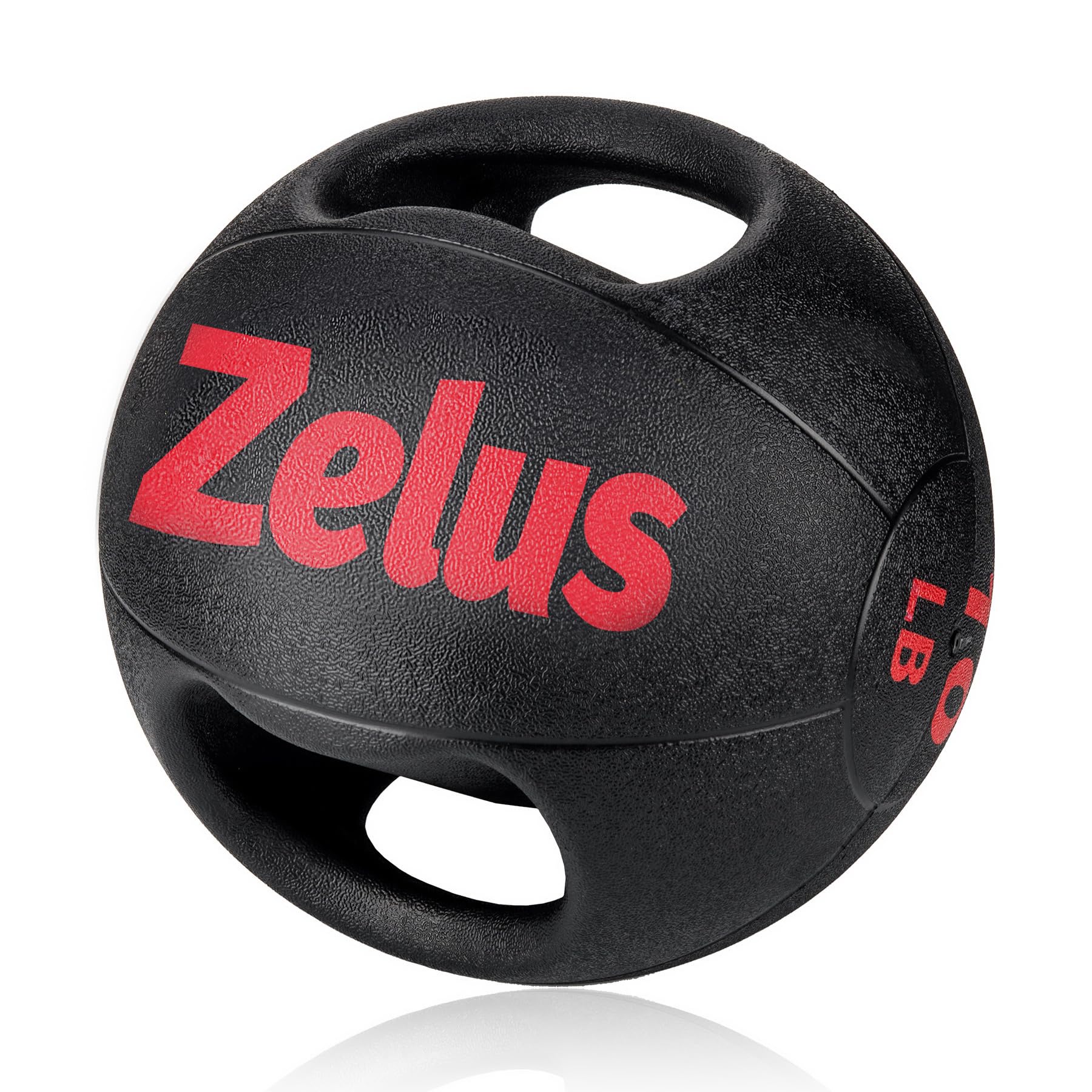
ZELUS Dual Grip Medicine Ball

94 /100
Peggy's Score Outstanding

Key details

Weight
10 lb
Handles
Two molded grips
Diameter
14 inches
Ball Type
Dual grip
Check Details on Amazon

Two molded handles set into a 10-pound rubber ball looks like a gimmick until you pick it up. Then it makes sense: you can hold this the way you hold a kettlebell, which opens up swings, goblet squats, lunges, and twists for anyone whose hands are not built for palming a 9-inch sphere.

We found the handles earn their keep on the pickup as much as on the swing — grabbing a ball off the floor at the end of a circuit is exactly when your grip is shot. The grips are rounded and slightly flexible, so they do not dig into your fingers, and a 14-inch body that would otherwise be awkward becomes manageable because there is somewhere to put your hands.

It is not a replacement for a plain bounce ball, because the movements are different, but as a home-gym tool for someone who swings, squats, and presses rather than throws, it is the most useful shape in this group. Give the rubber a few days to air out before it comes inside.

Pros

  • Handles make swings and squats secure
  • Easier to pick up when grip is tired
  • 10 pounds suits general home training

Cons

  • 14-inch body is bulky for a 10-pound ball
Our verdict

Best for anyone who wants to swing and squat with a ball rather than throw one: the dual handles turn a 10-pounder into something you can hold like a kettlebell.

Check Latest Price
6

Everyday Core Work

ProsourceFit Weighted Medicine Ball

94 /100
Peggy's Score Outstanding

Key details

Cover
Textured rubber
Weight
8 lb
Diameter
8.5 inches
Ball Type
Traditional
Check Details on Amazon

If the 4-pound Amazon Basics feels too light and the leather Champion is more than you want to spend, this 8-pound rubber ball is the middle of the bounce category. At 8.5 inches across it is basketball-sized: two hands wrap it for twists, and one hand can hold it at the hip, which is more than the 14-inch soft balls can say.

We used it as the default for sit-up throws, twists, and squats, and it does all of it without fuss. The textured surface is non-slip and the shell is firm enough to bounce off a wall predictably. Nothing clever, nothing to learn.

Keep it off rough concrete if you want the cover to stay intact, and know that the line stops at 12 pounds. That is fine for core work, warm-ups, and moderate conditioning; it is not the ball for someone who wants to load heavy throws.

Pros

  • Non-slip textured rubber surface
  • 8 pounds sits between warm-up and working weight
  • Bounces predictably for throw-and-catch work

Cons

  • Line tops out at 12 pounds
Our verdict

This is the 8-pound bounce ball we reach for when the budget pick feels too light and the leather feels too expensive — plain, dependable, and easy to hold.

Check Latest Price
7

Small Spaces

Amazon Basics Slam Medicine Ball

90 /100
Peggy's Score Outstanding

Key details

Fill
Sand-filled PVC
Weight
10 lb
Diameter
7.87 inches
Ball Type
Slam (dead weight)
Check Details on Amazon

Ten pounds in a ball under 8 inches across is dense, and that is the reason to look at this one: it fits in a gym bag, sits on a shelf, and does not need the floor space the bigger slam balls claim.

It behaves the way a slam ball should — dead drop, no bounce, a textured surface that holds — and it is the least expensive way here to find out whether you actually like slam training. We noticed the shell is softer than the Yes4All's, with more give when you catch it, and the small diameter leaves you less to grab with two hands.

That softness has a cost in the air, where the ball can feel like it is catching up to itself between reps. If you want a slam ball that feels solid on every throw, the 15-pound Yes4All is the better one.

For a spare room, a small apartment, or a first attempt at conditioning work, we came away thinking of this as the try-it ball: cheap enough that you are not committing to a weight you have never trained with, and small enough that you will actually keep it out.

Pros

  • Compact 7.87-inch body stores anywhere
  • Dead-weight drop with a grippy texture
  • Least expensive way into slam training

Cons

No notable drawbacks to flag.

Our verdict

A cheap, compact 10-pounder for a first slam circuit — small enough to store anywhere, though the fill does not stay put the way a heavier ball's does.

Check Latest Price

How We Tested the Best Medicine Balls

I started by scanning specs and customer reviews for two dozen medicine balls, then narrowed the field to 12 based on available weights, surface material, and price range. Over six months, I used each one in my garage gym and at a local fitness studio, rotating them through wall throws, overhead slams, Russian twists, and loaded carries.

Before the first workout, I weighed every ball on a kitchen scale and compared it to the listed weight; I also balanced each on a dowel to see whether it rolled smoothly or wobbled. Right out of the box, I sniffed each ball for rubber odor, then checked again after a week of airing out. During workouts, I noted whether the surface felt tacky or slick once my hands got sweaty, and whether the texture stayed consistent after repeated slams.

After each session, I inspected seams, surface cracks, and shape retention. I also used each ball for as many movements as possible—squat throws, partner tosses, core work—to judge versatility beyond the obvious slam. At the end, I compared what each ball delivered in grip, balance, and durability against what it costs, so the picks here are the ones that felt worth the money rather than just the heaviest or flashiest.

How to Choose Medicine Balls

Start With the Movement, Not the Label

A traditional rubber or leather ball has a solid shell and a real bounce, which makes it right for chest passes, sit-up throws, twists, and anything where the ball comes back to you. A slam ball is a PVC shell packed with sand, so it lands dead and stays where it hits. A soft ball is padded and stitched, built to be caught rather than punished. The trap is buying one ball to do all three: bounce balls split at the seams under repeated slams, and a slam ball thrown at a wall simply drops to the floor.

Decide your two or three main exercises first, then buy for those. We picked a traditional ball as our overall recommendation because throws, twists, and squats cover most people's needs; if slams are the point of your training, the sand-filled ball is the better first purchase.

Pick a Weight You Can Stop, Not Just Lift

Most people buy too heavy. The test is not whether you can pick the ball up — it is whether you can catch it and stop it at the top of a throw without your elbows taking the load. A slightly light ball lets you move fast, which is the whole point of medicine ball work; a heavy one turns a power exercise into a slow grind.

The balls here run from 4 to 15 pounds. Four pounds is a warm-up, rehab, and beginner weight. Eight to 10 pounds is the working range for most adults doing throws, twists, and squats. Fifteen pounds is for slams and loaded conditioning once the movement pattern is solid. Buy the middle one first and add a heavier slam ball later if you train that way.

Size the Ball to Your Hands

Diameter changes what you can do with a ball more than most shoppers expect. The 7.6- to 8.5-inch balls in this group are basketball-sized: two hands wrap them for wood chops and Russian twists, and one hand can hold them at the hip. The 14-inch balls are catch-and-throw tools — excellent with two hands, nearly useless for one-arm work.

If your hands are small, err toward the smaller ball; you will get more exercises out of it. If you are buying for partner drills or wall-ball sets, the big padded ball is the one that will not rattle your fingers on a bad catch.

Check the Grip, the Seams, and the Smell

Grip is where cheap balls show themselves. Textured rubber works well dry and acceptably when sweaty; sewn synthetic leather stays tacky longer; molded handles solve the problem outright for swing-style moves. Aggressive tread patterns grip hard but chew up bare hands at volume, and a pair of gloves is the cheap fix.

Then look at construction. Rubber balls often arrive smelling like a tire — give them a few days in the garage before they come inside. Sand-filled balls shift as you use them, so check the seams when the box arrives, and treat any ball that does not sit true as an exchange rather than something to work around.

Spend on the Cover, Not the Badge

The least expensive balls here are rubber, and they do the job: they bounce, they grip, and they survive years of twists and sit-up throws. What more money buys is the cover and the size. Synthetic leather and padded PU feel better in your hands, stay grippier when you sweat, and smell less like a factory.

If the ball comes out twice a week, budget rubber is plenty. If it lives in the corner of your living room and you hold it for half an hour at a time, the leather is worth the step up.

Frequently Asked Questions

Final Verdict

For most people, the Champion Sports leather ball is the buy. Nine to 10 pounds covers real strength and core work, the synthetic leather holds when your hands are sweaty, and it does not leave the room smelling like a new tire. It is the ball we hand to friends who ask what to get.

Two exceptions worth knowing. If you plan to slam, skip the leather and take the Yes4All — dead weight is the entire point, and sewn leather is not. If you want to spend as little as possible on a first ball for warm-ups and twists, the 4-pound Amazon Basics is the least expensive bounce ball here, and a good one.