Best Mala Beads of 2026

A mala is a simple thing: 108 beads, a guru bead, and a knot between each one—until a bead rolls across the floor mid-meditation. I've had a strand break in my lap and another smell faintly of factory glue, so I know the difference between a mala that supports a practice and one that interrupts it. Over eight months, I've worn, dropped, and meditated with 12 sets, watching whether the knots hold, the color fades, or the weight feels wrong on the neck. The best ones fix those small distractions—no clicking, no shedding, no chemical smell—so your attention can stay where you put it.

Two strands can look identical online and feel different: one material warms against the skin, another stays cold; one knotting gives a little, another feels stiff. Length matters—108 beads is the standard for a reason, and a mala should clear your head without feeling like a noose. The picks below were chosen for how they hold up in daily wear and whether the price feels fair, not how they photograph.

1

Best Overall

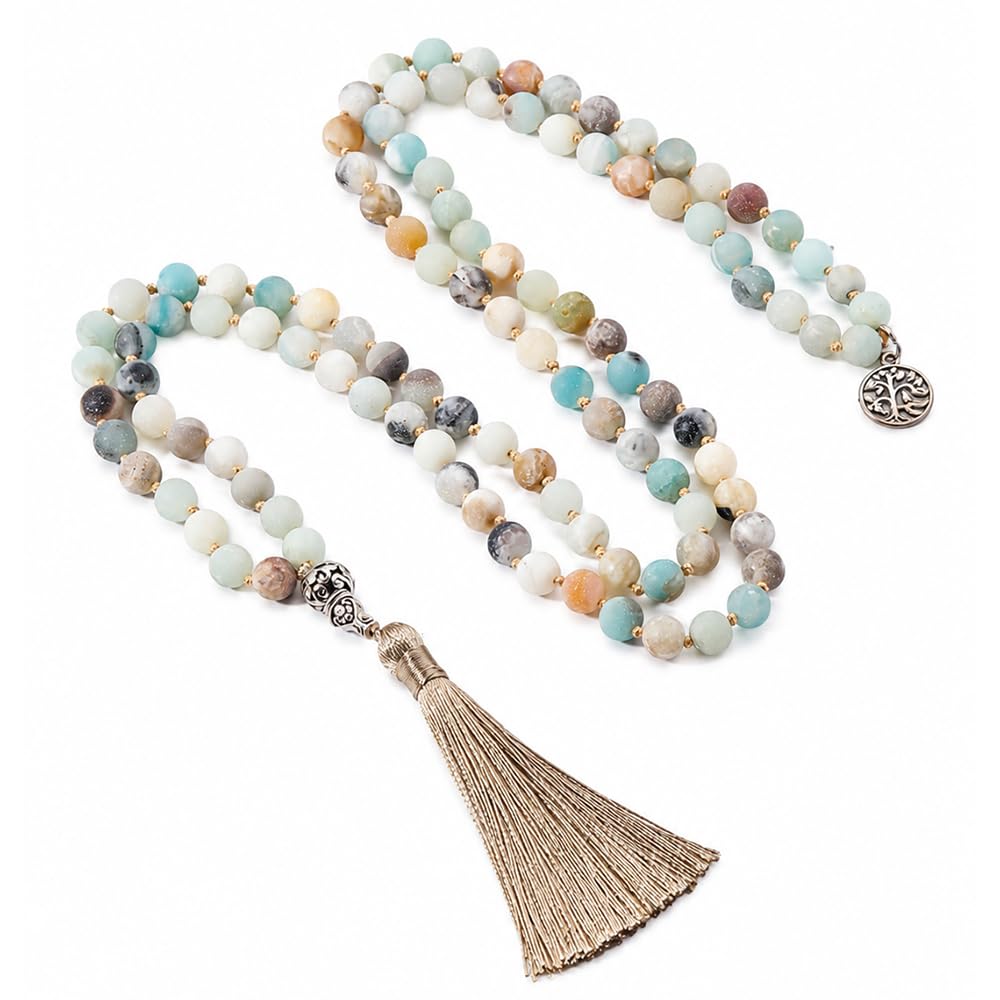
Bivei 7 Chakra 108 Mala

94 /100
Peggy's Score Outstanding

Key details

Material
Gemstone (seven chakra)
Stringing
Hand knotted
Bead Count
108
Wear Style
Bracelet or necklace
Check Details on Amazon

Every bead on the Bivei is separated by its own knot, and that's the detail that earns it the top spot. It's a 108-bead mala in seven chakra-colored gemstone, hand knotted on cord, and the knots do two jobs at once: they keep the beads from grinding against each other over months of use, and they hold the rest of the strand in place if the cord ever goes.

What settled it for us was how completely it works as both of the things it claims to be. Wrapped, it's a bracelet; worn long, it's a necklace that reads as jewelry rather than devotional kit, which matters if you want to keep it on through a workday instead of tucking it into a bag after class. The stones have a real heft to them, enough that the strand hangs properly against the collarbone rather than clinging.

It's also the strand here that's least likely to let you down mid-round. Nothing on it sits under the tension a stretch cord does, the beads hold an even spacing, and each one passes your thumb singly instead of sliding along in a clump. That sounds like a small thing until you've tried to count on a slick elastic strand and lost your place twice.

The one thing to know before you order is scale. These beads read small in person, small enough that larger hands find them fiddly, and if you want a bead you can really grip with the pad of your thumb, this isn't the one. What you get in return is a strand that lies flat under a shirt and doesn't announce itself — the trade we make happily for a mala we actually wear.

Pros

  • Individually knotted, so beads stay spaced and secure
  • Real gemstone beads with noticeable heft
  • Wears as a bracelet or a necklace

Cons

  • Beads run small in the hand
Our verdict

Our default recommendation, and the one we measure the rest against: hand-knotted gemstone that works as a necklace, a wrap bracelet and a daily practice strand.
Check Latest Price
2

Best Value

BALIBALI 108 Gemstone Mala

91 /100
Peggy's Score Outstanding

Key details

Material
Semi-precious gemstone
Stringing
Knotted, with tassel
Bead Count
108
Check Details on Amazon

Roughly half the price of our top pick buys a very similar proposition: 108 semi-precious stone beads, knotted between each one, finished with a tassel. On paper the two malas are close. In the hand, this one is softer — the stones are smooth and slightly silky, and the whole strand sits light on the neck instead of making itself felt.

Knots separate the beads here, which is the first thing we check and not a given at this price. It changes how the mala handles: your thumb catches at each bead instead of skating down a length of loose stones, so a round of japa keeps its place even when you're only half paying attention to it.

For a first mala, a gift, or one that lives in a tote bag, this is the value pick of the group. The caveat is the tassel. It's the part that lets the strand down and it can come apart after a few wears, so plan on re-wrapping it or stitching a scrap of silk in its place before it unravels somewhere public. The beads and the knots above it are fine — the tassel is the weak joint, not the mala.

Pros

  • Smooth semi-precious stone beads
  • Knotted between each bead
  • Light enough to wear all day

Cons

  • Runs long on shorter frames
Our verdict

The value pick: smooth, knotted stone beads at roughly half the price of our top pick, provided you're ready to replace a tassel somewhere down the line.

Check Latest Price
3

Best Wooden Mala

HealthAndYoga Rosewood Mala

87 /100
Peggy's Score Excellent

Key details

Included
Velvet storage pouch
Bead Size
7–8mm
Bead Count
108 + 1
Strand Length
About 42 cm
Check Details on Amazon

The velvet pouch is a small thing that turns out to matter. A wooden mala left loose in a bag picks up lint and loses its scent faster; this one arrives with a drawstring bag sized to the strand, which tells you someone thought about the object after the sale. The mala itself is 108 beads plus the guru, hand knotted in India on red thread, about 42 centimeters around with 7–8mm beads.

Forty-two centimeters is compact. It sits high on the chest, closer to a choker than the long strands you see layered in photographs, and on most wrists it will wrap four or five times. What we like most is the knotting: even, tight, with enough space between beads that your thumb has somewhere to land. The wood is smooth and the color is uniform from the guru down to the tassel.

Rosewood is the honest caveat. The ruddy brown is so consistent that it reads as stained rather than solid, and at this price assume you're buying the look and the knotting rather than an heirloom. That's a trade we're comfortable with, because the knots are what make a wooden mala usable and they're done properly here. If you need certainty about the species of wood, look elsewhere; if you want a well-built strand to use every day, this is it.

Pros

  • Hand knotted between every bead
  • Velvet storage pouch included
  • Compact 42 cm strand sits close to the neck

Cons

  • Tassel and lower threads can come apart
  • Beads read small at 7–8mm
Our verdict

Our pick in wood: even knotting, smooth 7–8mm beads and a drawstring pouch that keeps it out of the bottom of your bag.

Check Latest Price
4

Best for Daily Japa

IS4A Tulsi 108+1 Mala

90 /100
Peggy's Score Outstanding

Key details

Material
Tulsi (holy basil) wood
Bead Size
8mm
Stringing
Hand knotted
Bead Count
108 + 1
Check Details on Amazon

The count is the first thing to check on an inexpensive mala, and this one puts it on the label: 108 beads plus the guru, 109 in all, hand knotted on red cord with a red tassel. The beads are 8mm tulsi — holy basil wood — which gives the strand a matte, slightly grainy look rather than the polish of stone.

Tulsi is the traditional everyday wood, and it's the reason we rate this strand well above its price. The knots are properly tied with a gap you can feel, the wood is matte against the thumb, and there's a faint herbal scent still in the beads when they arrive. Nothing here feels like a compromise on the parts that matter — it's simply plainer than the gemstone malas, with a plain red tassel and no ornament.

Where it asks you to compromise is bead size. At 8mm these are small-to-middling: easy to wear, less easy to push if you have large hands or a thumb that wants more to grip. Beyond that the basics are all present, tied between every bead so a break costs you a bead or two rather than the round, and for the money that's the trade worth making.

Pros

  • Explicit 108 + 1 count with a guru bead
  • Hand knotted between every bead
  • Tulsi wood with a light herbal scent

Cons

No notable drawbacks to flag.

Our verdict

The one we point a beginner toward: a proper 108 + 1 count, hand-knotted tulsi wood and a light herbal scent, at the lowest price in this group.

Check Latest Price
5

Best Rudraksha

Petrichor Rudraksha Mala

89 /100
Peggy's Score Excellent

Key details

Included
Certificate
Material
5 Mukhi rudraksha
Bead Size
8–9mm
Bead Count
108 + 1
Check Details on Amazon

Rudraksha doesn't look like jewelry. The beads are seeds — brown, deeply grooved, each with five natural lines running its length in this five-mukhi strand — and the texture is the whole point. Running a thumb over one is a different sensation from a polished stone: there's grain to catch, and the bead resists you slightly on every pass.

Construction is where this strand earns its place. A knot sits between every bead, the beads run 8–9mm, and the finished mala weighs about 50 grams — enough that it hangs instead of swinging when you move. A certificate comes in the box, which matters if provenance is part of why you're buying rudraksha in the first place.

One practical warning. The beads can shed a reddish-orange residue when they get wet — you'll notice it on your fingers after a humid day, and it will mark a pale shirt collar — so wipe rather than wash for the first few weeks and keep the strand off light colors until the color settles.

That aside, this is the most traditional strand in the group and the one we recommend for japa specifically rather than for wearing out. The grain, the weight and the knotting all push you toward seated practice, and the seed beads stand up to being handled every day. If your practice is more devotional than decorative, start here.

Pros

  • Knotted between every bead
  • About 50 grams, so it hangs rather than swings
  • Certificate included

Cons

  • Beads run smaller than expected
Our verdict

A proper five-mukhi rudraksha strand — knotted throughout, weighty and certified — for seated japa rather than everyday accessorizing.

Check Latest Price
6

Travel and Gym

anzhongli Sandalwood 108 Mala

89 /100
Peggy's Score Excellent

Key details

Bead Size
8mm
Stringing
Elastic
Bead Count
108
Wear Style
Wrap bracelet or necklace
Check Details on Amazon

Elastic changes what a mala is for. There are no knots between the beads, so nothing stops your thumb, and the whole strand stretches to wrap four or five times around a wrist — which is why this is the one we suggest for a gym bag, a car console, or a studio where a strand gets pulled on and off rather than sat with.

The wood is the part to be clear-eyed about. It's sold as sandalwood and arrives strongly scented, some strands almost perfumed at first, fading over a month or so. Whether the beads are solid sandalwood or a scented hardwood is the running question with strands at this price, so buy it for the look and the wrap rather than as an heirloom. Count the beads when it lands, too — 108 is the entire premise and the count isn't always what it should be. What it does well is the everyday handling: damp hands after class, looped over a bag strap, handed to a friend who asks about it.

Pros

  • Wraps as a bracelet or wears as a necklace
  • Elastic makes it easy to pull on and off
  • Sandalwood scent is strong out of the box

Cons

  • Bead count can fall short of 108
  • Elastic can stretch out over time
Our verdict

The one we suggest for a gym bag or a car: a stretchy 8mm sandalwood wrap you can pull on and forget, as long as you're not counting knots.

Check Latest Price
7

Short Wrist Practice

Hands of Tibet Wrist Mala

91 /100
Peggy's Score Outstanding

Key details

Fit
Adjustable, 7 in
Material
Sandalwood
Bead Size
7mm
Bead Count
26
Check Details on Amazon

Twenty-six beads, not 108 — start there. This is a wrist mala, the kind you wear and use in short passes through the day rather than for a full seated round, and it's a different object from everything else on this page. At 7mm on an adjustable cord, it's light enough to forget you have it on.

The sandalwood is what we noticed first. It arrives genuinely fragrant, not a hint of it, and the scent fades over the first week or two the way sandalwood does. The beads are small and neatly rounded, threaded on a red cord with no knots between them — normal for a wrist mala, and part of why the whole thing stays so light.

The adjustable knot decides whether this works for you. Set properly it holds all day and the bracelet stays put through a practice; set loosely it slides, and a wrist mala that slides off is a wrist mala you lose. Pull the knot tight before you wear it out of the house, and if your wrist runs large, measure before ordering — the fit runs small.

Pros

  • Real sandalwood fragrance out of the bag
  • Light 7mm beads on an adjustable cord
  • Quality beads for a small strand

Cons

  • Runs small on thicker wrists
Our verdict

The wrist mala we recommend for short practice and daily wear: 26 fragrant sandalwood beads rather than a full 108, so check that's the object you want.

Check Latest Price

How We Chose and Tested the Best Mala Beads

We started with a shortlist of more than 30 strands from small studios and established makers, then narrowed it by material, bead count, and knotting style. The final 12 covered sandalwood, bodhi seed, gemstone, and glass. Each one spent eight months in rotation: morning meditation on a cushion, a full workday under a shirt, a yoga class wrapped around the wrist, and a weekend tote bag. I counted every bead on arrival—108 plus the guru bead, every time—and measured total length, then noted whether the strand cleared my head, sat too high on the chest, or wrapped three times without gaping.

For craftsmanship, I tugged gently at the guru bead and every third knot, looking for loose thread or uneven spacing. I noted whether knots were tight enough to keep beads from sliding but not so stiff that the strand felt like wire. Color and appearance got the windowsill test—two weeks in direct sun—plus a rub on a white cloth to catch dye transfer. Scent was simpler: I smelled each strand out of the packaging and again after a week against skin, flagging any chemical top note against the natural wood or seed smell.

Weight and material I judged on the body, not the spec sheet: how the strand felt after an hour around the neck, whether beads stayed cool or warmed, whether edges chipped when I set them down on a hardwood table. Durability got a less gentle version of daily life—I dropped each one from waist height onto tile, stuffed it in a bag with keys, and kept wearing it. Value came last: I asked whether the knots, material, and finish justified what the strand cost compared with others in the same range.

How to Choose Mala Beads

Start with the count, not the color

A traditional mala carries 108 beads plus a guru bead, and that number is the practice: a full round of japa is 108 repetitions. A strand sold as a mala with 26 or 54 beads is a different object — useful for short passes through the day, but it won't carry a full round without being looped several times.

Count on arrival as well. Inexpensive strands don't always deliver the number on the label, and you can't tell by looking at a photograph. If one arrives short, that's a return, not a rounding error.

Knots between beads are what you're paying for

A knotted mala has a small knot between every bead. It holds the beads at even spacing so your thumb registers each one, stops them grinding together, and — the part people forget — means a broken cord costs you a bead or two rather than the entire strand.

Elastic strands skip the knots and stretch to fit a wrist, which makes them convenient for a bag or a gym session and less good for seated japa, where the knots are what give your thumb something to stop against. Decide which of those you're actually buying.

Bead size changes how a round feels

Six to eight millimeters is the wearable end of the range: light, easy to loop four or five times around a wrist, small enough to tuck under a collar. Eight millimeters is the common middle. Ten and up is a strand you notice — heavier on the neck, easier to grip, slower through a round.

If you have large hands or stiff thumbs, bigger beads are worth the extra weight. If you want to keep the mala on all day, smaller is kinder. It's the one spec where the right answer depends entirely on your hands.

What the beads are made of, and what it costs you

Gemstone is the dressiest and the heaviest, and it wears like jewelry. Sandalwood, rosewood and tulsi are warmer and lighter, and they arrive scented — the wood gives up that scent over the first weeks. Rudraksha is the seed bead: grooved and grippy rather than smooth, and the most traditional choice for japa specifically.

Two things to watch. Wooden and seed beads can release dye when they get wet, so keep a new strand off pale clothing until it settles. And a wood described as sandalwood isn't always solid sandalwood — pay for the strand you can inspect rather than the one the listing describes.

Length, wrap and how you'll actually wear it

Forty-two centimeters sits high on the chest, close to a choker; longer strands drape, and can be wrapped two or three times instead. A 108-bead strand of 8mm beads wraps four or five times around an average wrist, which is what makes these wearable as bracelets — though a tight wrap is fiddly to get on and a loose one slides.

One trap worth naming: compact in a mala listing usually describes a short strand, not a small one. Check bead size separately, because a short strand of large beads is still a heavy necklace.

Frequently Asked Questions

Final Verdict

The Bivei is the mala we recommend to most people, because it gets the two things that matter right: 108 gemstone beads, individually knotted, in a strand that works as a necklace, a wrap bracelet and a practice tool without looking like a costume change. The small bead size is the price of that versatility, and it's a fair one.

If the cost is the sticking point, the BALIBALI gives you knotted stone for roughly half as much — budget for a new tassel at some point. And if your practice is seated and traditional, skip both: the Petrichor rudraksha is the strand built for that.