Best Lifting Straps of 2026

Your back can pull more than your hands can hold. That’s the wall every heavy deadlift, row, and pull day eventually hits: the bar starts slipping, your grip quits, and the set ends before the muscles you came to train do. Lifting straps solve that by tying your wrists to the bar so your hands don’t set the ceiling. I’ve used them for years, and in the past four months my team and I put 16 pairs through deadlift, row, and pull-up sessions to find the ones that actually hold.

The surprise is that more material doesn’t mean more grip: too long or too stiff a strap can bunch in your palm and make a heavy pull feel worse. Comfort matters as much as strength, especially on high-volume days, and so does the small stuff—stitching that doesn’t fray, a width that sits cleanly on the wrist, and enough length to wrap the bar without a wrestling match. We weighed those tradeoffs and value against how each pair performed under load, and the picks below cover different hands, bars, and styles.

1

Best Overall

Gymreapers Lifting Straps

95 /100
Peggy's Score Outstanding

Key details

Sizing
One size
Sold As
Pair
Material
Cotton webbing with neoprene padding
Strap Length
18 in
Check Details on Amazon

Most lifters should start here and stop looking. Eighteen inches of cotton webbing, a neoprene cuff, one size, sold as a pair, and it handles every pulling job in a normal program — deadlifts, rows, shrugs, pull-ups, lat pulldowns. The cuff is the part we care about: it sits flat across the back of the wrist and takes the bite out of a heavy hook grip instead of concentrating it in one spot.

Grip is where the conversation gets more careful. Cotton against a knurled power bar is dependable. Cotton against smooth chrome, a rubber-coated dumbbell handle or a machine handle polished by ten years of use can creep, particularly if you cinch the strap very tight and the webbing bunches under itself. Two deliberate wraps taken slowly hold better than four rushed ones, and that is the only technique note this strap really needs.

One size covers the range better than most single-size straps, because the padding gives enough for the cuff to close on a smaller wrist without digging in, and the pair disappears into a gym bag. Nothing here is easier to recommend to someone buying a first pair, and nothing is a better all-rounder once it is in the bag.

Pros

  • Handles every pulling lift in a normal program
  • Neoprene cuff spreads pressure on the wrist
  • One size fits a wide range of wrists
  • Low price for a pair

Cons

  • Grip can creep on smooth, non-knurled bars
Our verdict

This is the pair we tell most lifters to buy first: padded enough for heavy pulls, one size that covers most wrists, and simple enough that there is nothing to learn.
Check Latest Price
2

Best Budget Classic

Harbinger Padded Cotton Straps

95 /100
Peggy's Score Outstanding

Key details

Sold As
Pair
Strap Width
1.5 in
Strap Length
21.5 in
Wrist Padding
NeoTek synthetic cushion
Check Details on Amazon

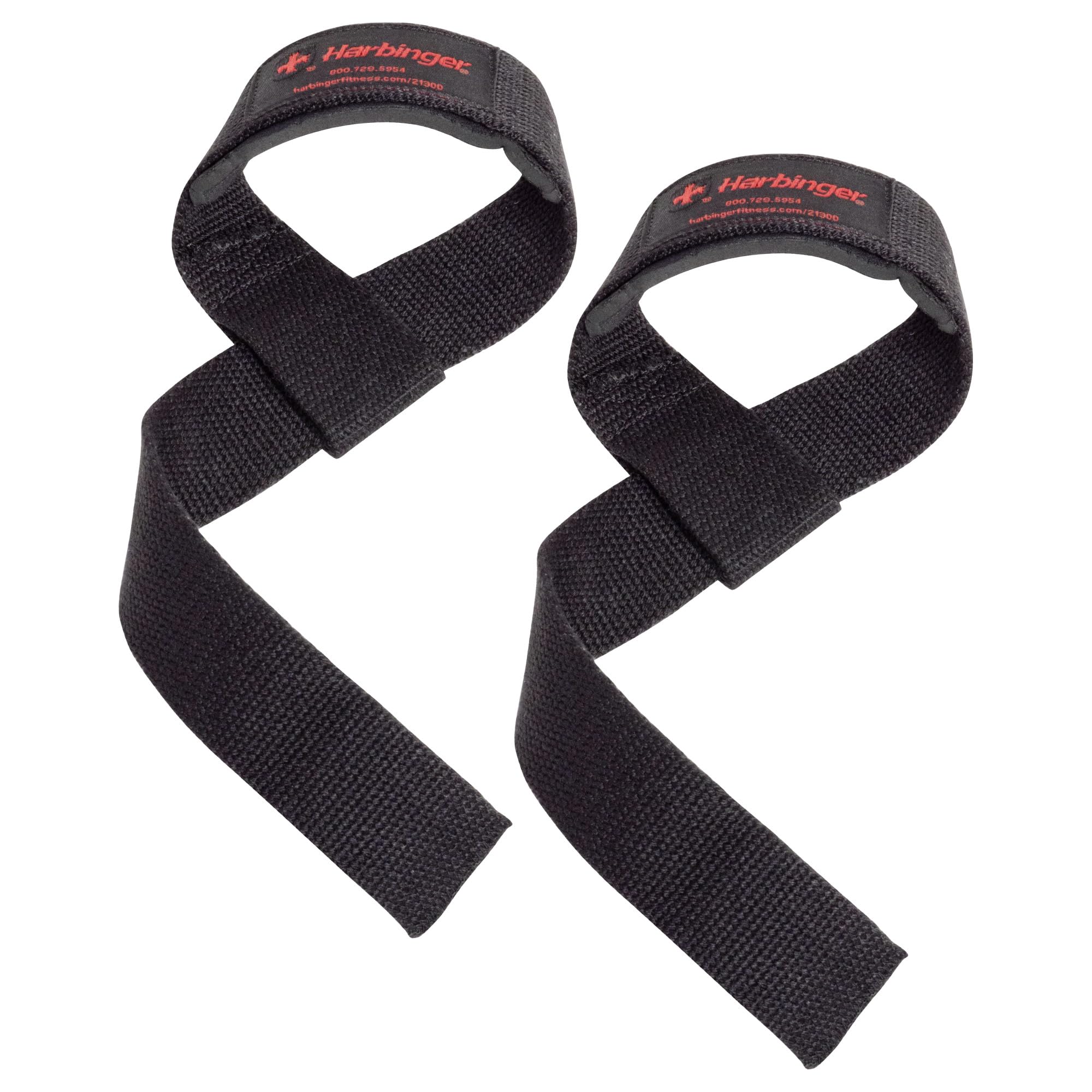
Twenty-one and a half inches of cotton, an inch and a half wide. That is longer and wider than most of the straps in this set, and the extra length is the argument: more strap means more wraps around the bar, more wraps spread the load across a wider patch of webbing, and a wider patch gives the strap less chance to saw into one spot on a heavy pull.

The padding is a soft synthetic cushion rather than a folded cotton hem, and it is the plushest of the plain-cuff straps here, which matters on high-volume rows where the same wrist takes load thirty times. The length costs you an extra pass or two when you set up — a few seconds per set traded for noticeably more contact area.

Where these go is the seams. The stitched joint between pad and strap, and the edge stitching running the length of the webbing, are the two places a Harbinger wears out. Run a thumb along both before a heavy pull. This is still the least expensive way into a classic wrap strap, and for a lifter who wants maximum bar contact without paying for it, it is the obvious starting point.

Pros

  • Extra length gives more wraps on the bar
  • 1.5-inch width spreads the load
  • Plush NeoTek wrist cushion
  • Least expensive strap in this set

Cons

  • Stitching and padding seams wear through
  • Longer strap takes more wraps to set
Our verdict

Buy these if you want the most bar contact for the least money — a longer, wider cotton strap that wraps deep, as long as you check the seams.

Check Latest Price
3

Best for Slick Bars

Fitgriff Lifting Wrist Straps

93 /100
Peggy's Score Outstanding

Key details

Sizing
Standard (6.3 in wrist and up) or small
Material
Cotton with neoprene padding
Grip Face
Classic cotton or silicone
Strap Length
Approx. 23 in
Check Details on Amazon

Flip the Fitgriff strap over and there is a rubberised honeycomb pattern on one face — the face that goes against the bar. That texture is the whole reason to consider it. On smooth chrome, or a gym bar whose knurling has been worn to a shine, silicone does work plain cotton cannot, and it keeps doing it as your hands get sweaty.

The cuff comes in two sizes and the standard runs generous. If your wrist measures around 6.5 inches, take the smaller option — the standard will close, but only just, and a cuff with slack in it rolls under load. At roughly 23 inches you get two to three wraps depending on bar diameter, which is the useful middle ground. You can also order the classic plain face instead if texture is not what you are after.

For back-day volume on bars that fight back, this is the pair we reach for. It is not the strap we pick for Olympic lifts — the length gets in the way when you are rotating under a bar — but for rows, pulldowns and deadlifts on a slick bar, it is the most reassuring hold in this set.

Pros

  • Silicone face grips smooth bars
  • Two sizes including a smaller cuff
  • Roughly 23 inches for two or three wraps
  • Orderable with a plain or grip face

Cons

  • Standard cuff runs large for smaller wrists
Our verdict

We recommend these for anyone lifting on smooth or worn bars, where the silicone face holds what plain cotton lets go of.

Check Latest Price
4

Best Grip-Assist for Fast Sets

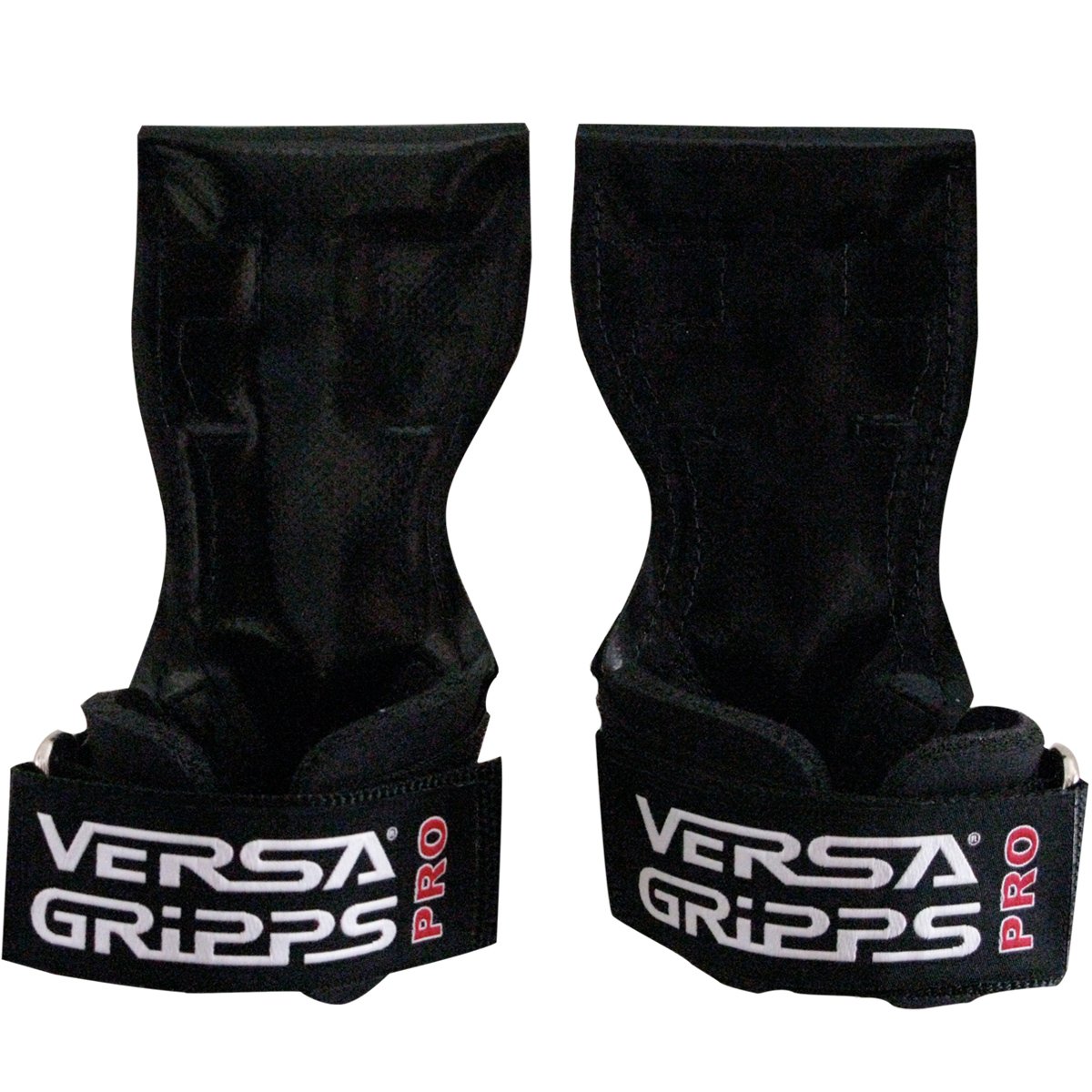
Versa Gripps PRO

95 /100
Peggy's Score Outstanding

Key details

Grip
Custom no-slip pad
Style
Cuff with hook-over grip pad
Wrist Size
Reg/Large, 7-1/8 to 8 in
Check Details on Amazon

This is the most expensive item here by a wide margin, and it is not a wrapping strap at all. It is a wrist cuff with a stiff no-slip pad that hooks over the bar: you set it once at the start of a set, the pad does the holding, and there is no tail to thread or bar-spinning to take up slack.

The payoff is rhythm. Across a back day of six or seven pulling movements we never take them off between sets — flip the pad out of the way and your hands are free for a plate change, a drink or a pressing set, then it is back over the bar in a second. That is a different way to train rather than a fancier strap, and the pad protects the palm at the same time.

The pad needs a few sessions to soften into the shape of your hand, and until it does it feels stiff and slightly slick. Past that, this is the pick for anyone whose sessions are dense enough that wrapping is the friction — someone running supersets, or a lifter who pulls and presses in the same block. If you pull twice a week and do not mind the wrap, a cotton strap does the work for a fraction of the cost.

Pros

  • No wrapping between sets
  • No-slip pad holds heavy pulls
  • Cuff supports the wrist under load

Cons

  • Sizing limited to a 7-1/8 to 8-inch wrist range
Our verdict

Worth it if wrapping is what slows your sessions down; the price is the only real argument against it.

Check Latest Price
5

Best for Olympic Weightlifting

Warm Body Cold Mind V1

91 /100
Peggy's Score Outstanding

Key details

Sold As
Pair, left and right labeled
Material
100% cotton canvas webbing
Strap Width
2.5 in
Strap Length
13 in
Check Details on Amazon

Thirteen inches long, two and a half inches wide — the shortest and widest strap here, and deliberately so. This is an Olympic weightlifting strap: cotton canvas webbing, a loop closure, and left and right labels, built around snatches and clean pulls rather than around a deadlift lockout.

Short is the point. A long strap wrapped three times around a bar gets in the way when you are holding a hook grip and rotating under the bar; this one takes a single pass and stays flat. The width spreads pressure across the wrist instead of cutting a line into it, and the labels mean you stop fumbling to work out which strap goes on which hand.

New canvas is stiff, and these take a few sessions of pulls before the webbing softens enough to feel like they belong on your hands. That break-in is the whole cost of the design, and it is short.

The boundary is real, though. If your program is deadlifts and heavy rows, thirteen inches will not give you the multiple wraps you want on a thick bar or a trap bar handle. We recommend these for weightlifting and for weightlifting only; buy something longer for the platform.

Pros

  • Short, wide body suits Olympic pulls
  • Left and right labels speed up setup
  • Canvas webbing stays flat on the bar

Cons

  • Stiff canvas needs breaking in
Our verdict

The pair we point Olympic lifters toward: short, wide and flat against the bar, with no extra length to fight during a snatch.

Check Latest Price
6

Best Figure-8 for Deadlifts

RDX Figure 8 Straps

91 /100
Peggy's Score Outstanding

Key details

Style
Figure-8 loop
Sizing
Small, medium, large (current: medium)
Material
Cotton webbing
Stitching
Three-layer cross-stitch
Check Details on Amazon

Two loops and a short bridge between them. You put a hand through each loop, the bridge goes under the bar, and your hands are locked in place — no tail, no wrap, nothing to creep as a set grinds on. Of everything here, this is the design with the least to go wrong mid-rep.

Sizing needs attention. RDX builds three sizes off wrist measurement, and the current medium sits at the big end for an average wrist. A figure-8 that is slightly too long rides up over your knuckles instead of locking down, so if you are between sizes, take the smaller one.

The trade is release. With a wrap strap you open your hands and the strap follows; with a figure-8 the bar stays tied to you until you pull your wrists out of the loops. On a deadlift that costs nothing. Anywhere you might need to bail, it matters. That makes this the best deadlift-specific strap in this set and the wrong choice for a lifter who wants one pair for everything.

Pros

  • Locked grip with nothing to creep
  • Three sizes based on wrist measurement
  • Three-layer cross-stitched centre

Cons

  • Runs large; size down between sizes
Our verdict

Buy these for deadlift day if you want the bar tied to your hands and nothing creeping at lockout — and accept that release takes a beat.

Check Latest Price
7

Thick Handles

DMoose Lifting Straps

93 /100
Peggy's Score Outstanding

Key details

Sold As
Pair
Grip Face
Silicone webbing
Strap Length
24 in
Wrist Padding
5 mm neoprene
Check Details on Amazon

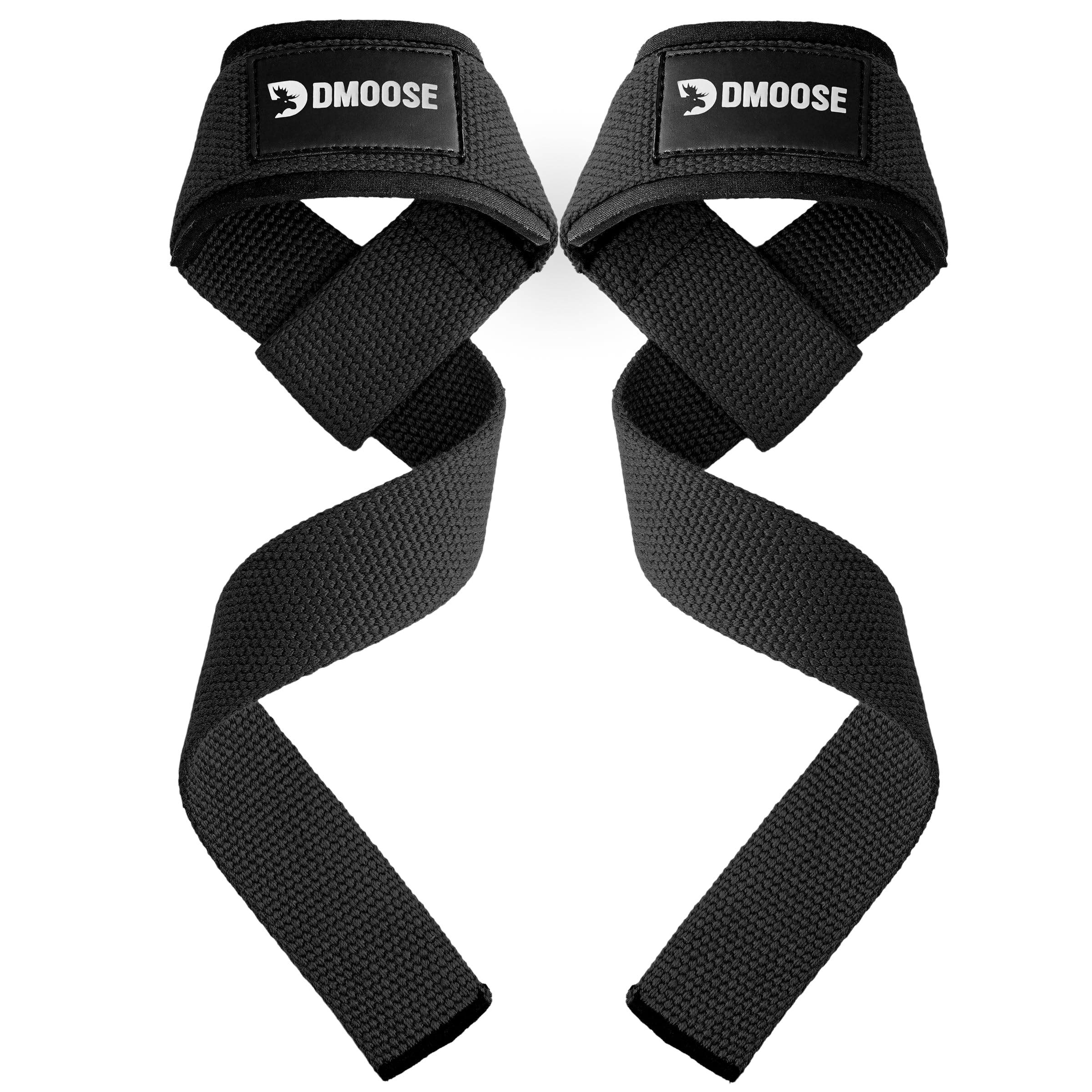
Take our top pick, add six inches of strap, and put a silicone web on the inside face — that is roughly the DMoose proposition. Twenty-four inches of cotton webbing, 5mm of neoprene at the wrist, and raised silicone dots down the length so the wrap does not slide against itself or against the bar.

Length is the reason to pick it. Around a thick axle, a trap bar handle or a set of fat-grip dumbbells, twenty-four inches gives you the wraps an 18-inch strap simply cannot, and the padding is thick enough that the load spreads instead of pinching. The silicone adds a margin of hold on smooth bars that plain cotton does not have.

The cuff is built for a larger wrist, though, and the strap runs long — a smaller lifter ends up managing a lot of tail and a cuff that will not cinch down. For bigger hands and thicker handles we rate it near the top of this set on the things that matter: contact area, padding and stick.

Pros

  • 24-inch length wraps thick bars
  • 5mm neoprene wrist padding
  • Silicone webbing resists slipping

Cons

  • Runs large for smaller wrists
Our verdict

Our pick for bigger wrists and thick handles: the extra length and silicone face make a fat bar feel like a normal one.

Check Latest Price
8

Supersets and Circuits

Fitgriff Elite Straps

90 /100
Peggy's Score Outstanding

Key details

Style
Rubber grip pad with hook-and-release
Sizing
Four sizes (current: small-medium)
Material
Nylon with natural rubber grip
Check Details on Amazon

Hook-and-release is the idea: a rubber grip pad stitched to a Velcro cuff, four sizes, and a design that lets you peel the pad off the bar and out of the way between sets without taking the cuff off your wrist. It is built for sessions where pulling and pressing alternate and you do not want to re-rig every time.

On a back day of supersets it earns its keep. The rubber grips a chrome bar harder than any cotton strap in this set, and getting your hands back on the bar takes a second rather than a wrap. It is a pulling tool, though — the pad and cuff do not let the wrist rotate the way an Olympic lift wants, so it stays out of snatch and clean work.

Sizing is the part to get right. Four sizes cover a lot of wrists, and the closure only holds neatly when the cuff matches yours; a loose cuff lets the rubber pad shift off centre. Check the size chart rather than assuming you are a medium.

The honest comparison is with the standard Fitgriff above: same maker, same idea, a very different price. The Elite buys you speed and stickiness; the standard buys simplicity and change back in your pocket. We rate the Elite for dense sessions on smooth bars and the standard for everyone else.

Pros

  • Hook-and-release is fast between sets
  • Rubber pad grips chrome bars
  • Four sizes to fit the cuff

Cons

  • Not suited to Olympic lifts
Our verdict

Choose these if your training runs in circuits and you want your hands back on the bar in a second, not a wrap.

Check Latest Price

How We Tested Lifting Straps

We started by gathering straps that varied in width, length, material, and stitching, skipping novelty designs and focusing on pairs with enough length to wrap a standard bar and a price that made sense for a gym bag staple. We ordered 16 pairs and used them for four months, rotating them through deadlift, row, and pull-up sessions rather than testing them on a rack.

On heavy pulling days, we loaded the bar and noted whether each strap bit into the knurling or slipped once sweat and chalk mixed. We paid attention to how quickly we could thread and wrap a strap between sets, how the material sat against the wrist during a long set, and whether a pair left red marks or hot spots after multiple pulls. We also had lifters with different hand sizes try the same straps on thinner and thicker bars to see how length and width changed the wrap.

After every session, we checked stitching, frayed edges, and stretched-out tails; by the end, some pairs had softened nicely while others had lost their shape. We compared that wear against how the strap felt at lockout, because a cheap strap that distracts you mid-pull is no bargain. The final picks are the ones that held up, stayed comfortable, and kept our hands connected to the bar when the weight got heavy.

How to Choose Lifting Straps

Start With the Style, Not the Material

A wrap strap is a tail of webbing with a wrist loop, and it works on any bar, dumbbell handle or cable stack — it is the only style you can move between a deadlift and a lat pulldown without a second piece of kit. A figure-8 locks your hands to the bar through two fixed loops and cannot be released quickly. A hook-over grip pad sets in one motion and comes off in another.

The trap is in the naming, because plenty of listings call a grip pad a wrist strap. If you want the loop-and-tail wrap you remember from a powerlifting gym, confirm the product has a tail before you order; shoppers who expected a wrap find out on the first set.

Length and Width Set How Many Wraps You Get

Length mostly tells you how many times the strap can go around a bar. An 18-inch strap gives two to three wraps on a standard bar, 21.5 to 24 inches gives more, and a 13-inch Olympic strap gives a single pass. More is not automatically better: a wrap that bunches under itself slips more than a clean two-pass wrap, which is why we rate the 18-inch top pick and the 24-inch DMoose on different jobs rather than one above the other.

Width works differently. An inch and a half is standard; a two-and-a-half-inch strap spreads pressure across more of the wrist and suits fast Olympic pulls, where the strap sits on the arm rather than biting a line into it.

Grip Surface and Wrist Padding

Plain cotton relies on friction and chalk. Silicone or rubber dots and webbing add stickiness on smooth chrome, polished knurling and rubber-coated handles — the situations where a plain strap creeps mid-set. Check which face carries the texture before you buy, because a grip pattern on the outside is decoration and does nothing for your hold.

Padding is the other half. Five millimeters of neoprene is a real cushion; a folded cotton hem is not. If you pull high volume on back day, the extra padding on the Ekkovision cuff or the DMoose wrist section is worth more than an extra inch of strap.

Fit Is a Measurement, Not a Guess

One-size straps genuinely cover most wrists, but most leaves people out at both ends: a cuff with slack rolls under load and pinches, and a cuff that is too small clamps. Measure around your wrist bone and buy a sized strap where one exists — Fitgriff offers two sizes, the Fitgriff Elite four, RDX three, and the Versa Gripps PRO states a 7-1/8 to 8-inch Reg/Large range.

When you land between sizes, take the smaller one. A cuff that closes snugly can be eased out; a cuff that never closes has nothing to grip.

Know When to Retire a Strap

Treat stitching as a wear item. Edge stitching that has begun to fray and a pad separating from the webbing are the two failure points, and both show up in a five-second inspection before a heavy set. The Harbinger is the clear example in this set: generous length and padding, but its seams are where it goes.

A strap that lets go at lockout on a max deadlift costs you more than the lift. Keep a spare pair if you train heavy often — cotton straps are the cheapest insurance in the gym bag.

Frequently Asked Questions

Final Verdict

For most lifters the Gymreapers strap is the buy: padded where the load actually sits, one size that covers a wide range of wrists, and simple enough that there is nothing to learn before your next deadlift session. Choose the Fitgriff instead if the bars in your gym are smooth and you want silicone between you and the steel.

If the wrapping itself is what slows your sessions down, the Versa Gripps PRO is the one that changes how a back day runs, and the Harbinger remains the cheapest way to get maximum bar contact. Lifters chasing a deadlift PR should look at the figure-8 first.