Best Inversion Tables of 2026

An inversion table sells a simple promise: hang upside down for a few minutes and let gravity pull some tension out of your back. The reality is a machine you have to assemble, size to your body, and trust while you're hanging by your ankles. A good one makes that feel secure enough to repeat. I've spent nine months with 11 inversion tables, and the difference is rarely one big feature.

Assembly is the first hurdle, and a few tables lost us before we ever inverted. The best went together with clear instructions, stayed quiet, and didn't flex or walk across the floor. Adjustability mattered too: height settings, ankle holders, and angle controls had to move smoothly and lock down, especially when two people shared the table. We noted comfort, how much each table weighed against its user weight rating, and whether the price felt honest for the build. Pain relief is personal, but the tables that made a five-minute session easy to repeat earned a spot below.

1

Best Overall

Teeter EP-560

90 /100
Peggy's Score Outstanding

Key details

Frame
Heat-treated steel
Warranty
5 years
Certification
FDA 510(k) registered, UL certified
Weight Capacity
300 lb
Check Details on Amazon

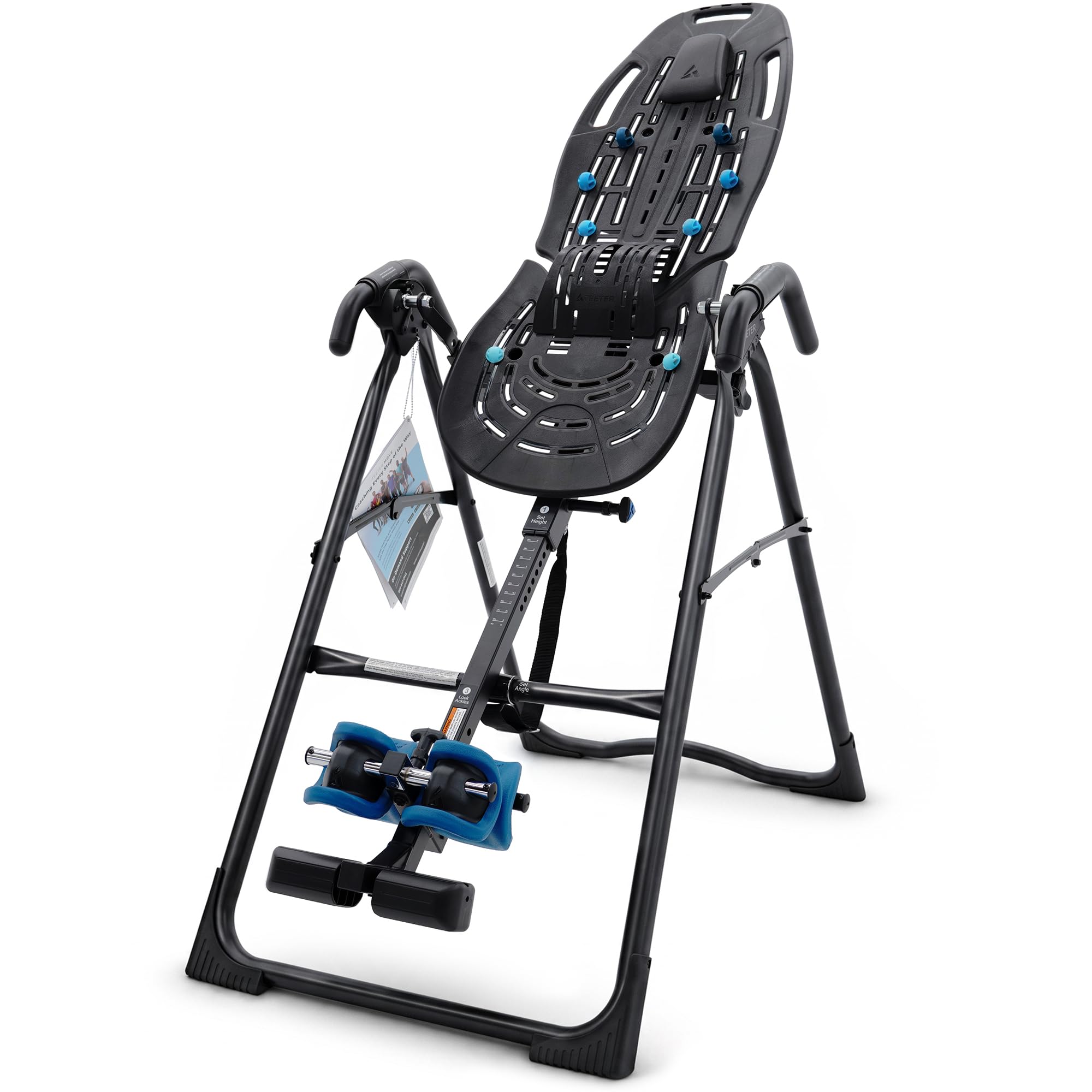
Two marks on the EP-560's frame do more for our confidence than any feature list. It is registered with the FDA as a 510(k) medical device, it carries UL safety certification, and it is built from heat-treated steel with a five-year manufacturer warranty — the longest of anything here. On a machine that holds you upside down by the ankles, that is the part worth paying for.

The ankle hold is where that money lands in daily use. Wrap-around cups cradle each ankle rather than pressing a roller into it, and the easy-dial two-position foot platform takes up the slack for thick socks and narrow ankles alike. We are also fond of the angle-limit strap: set it once and the table stops in the same place every session, which turns a five-minute hang into something repeatable instead of a negotiation.

Storage is the quiet advantage. The EP-560 folds without coming apart, so a spare room goes back to being a spare room between sessions. The grip-and-stretch handholds at the head end give your arms somewhere to go other than the frame, and the free Teeter Move app is there if you want a guided routine rather than guesswork.

The bed is a taut, firm surface rather than a padded one, and a long hang is not a soft one. Teeter shapes it that way so your body can slide as you rotate, which is the opposite of a grippy pad. Most people will not care at three to five minutes a session; if you want a plusher landing, the Body Vision's foam backrest is the softer surface in this guide.

Pros

  • FDA-registered and UL-certified design
  • Five-year warranty, the longest here
  • Folds flat without disassembly
  • Wrap-around ankle cups and dial platform

Cons

  • Firm, unpadded bed for long sessions
  • Heavy at 65 pounds once built
Our verdict

If you want to make this decision once, the EP-560 is the table we name: certified, backed for five years, and it folds away without tools.

Check Latest Price
2

Best Value

Innova ITX9900

93 /100
Peggy's Score Outstanding

Key details

Backrest
Inflatable air lumbar
Height Range
4 ft 10 in to 6 ft 6 in
Weight Capacity
300 lb
Inversion Positions
Six pinned positions
Check Details on Amazon

Where the Teeter asks you to pay for certification and five years of cover, the Innova ITX9900 asks you to give those up and keeps almost everything else. Six lockable angles sit on a covered pin rather than a strap, the True Balance pivot follows your arm movement, and the ankle hold pairs a large front cup with a smaller rear one. It fits 4 ft 10 in to 6 ft 6 in and 300 pounds.

The inflatable lumbar pad is the extra we rate highest of anything in this guide. You pump it to fill the gap under your lower back instead of accepting whatever curve the bed happens to have, and on a firm table that is the difference between a quick hang and a session you settle into. It does something you can feel on day one, which is more than most add-ons manage.

The ankle holders are the one place it asks something of you. They press firmly, and long socks turn that from a complaint into a non-issue. Set the height scale once and note your number — in a house with two users it is the setting you will touch most often.

What you give up against the EP-560 is the certification and four years of warranty, since Innova backs this one for a single year. If you are still finding out whether inversion helps you at all, that is a fair trade. If you already know you will be on it several mornings a week for years, it is not.

Pros

  • Six pinned angles, no strap to fight
  • Inflatable lumbar pad adjusts to your back
  • Fits 4 ft 10 in to 6 ft 6 in at 300 pounds
  • Clear instructions and a simple build

Cons

  • Backrest lets you slide an inch or two when inverted
  • One-year warranty only
Our verdict

The table we point value-minded buyers to: six pinned angles, a pump-adjustable lumbar pad, and a fit range that covers most adults in a house.

Check Latest Price
3

Best Premium

Teeter FitSpine X3

93 /100
Peggy's Score Outstanding

Key details

Backrest
8-point floating suspension
Warranty
5 years
Ankle Lock
EZ-Reach long handle
Weight Capacity
300 lb
Check Details on Amazon

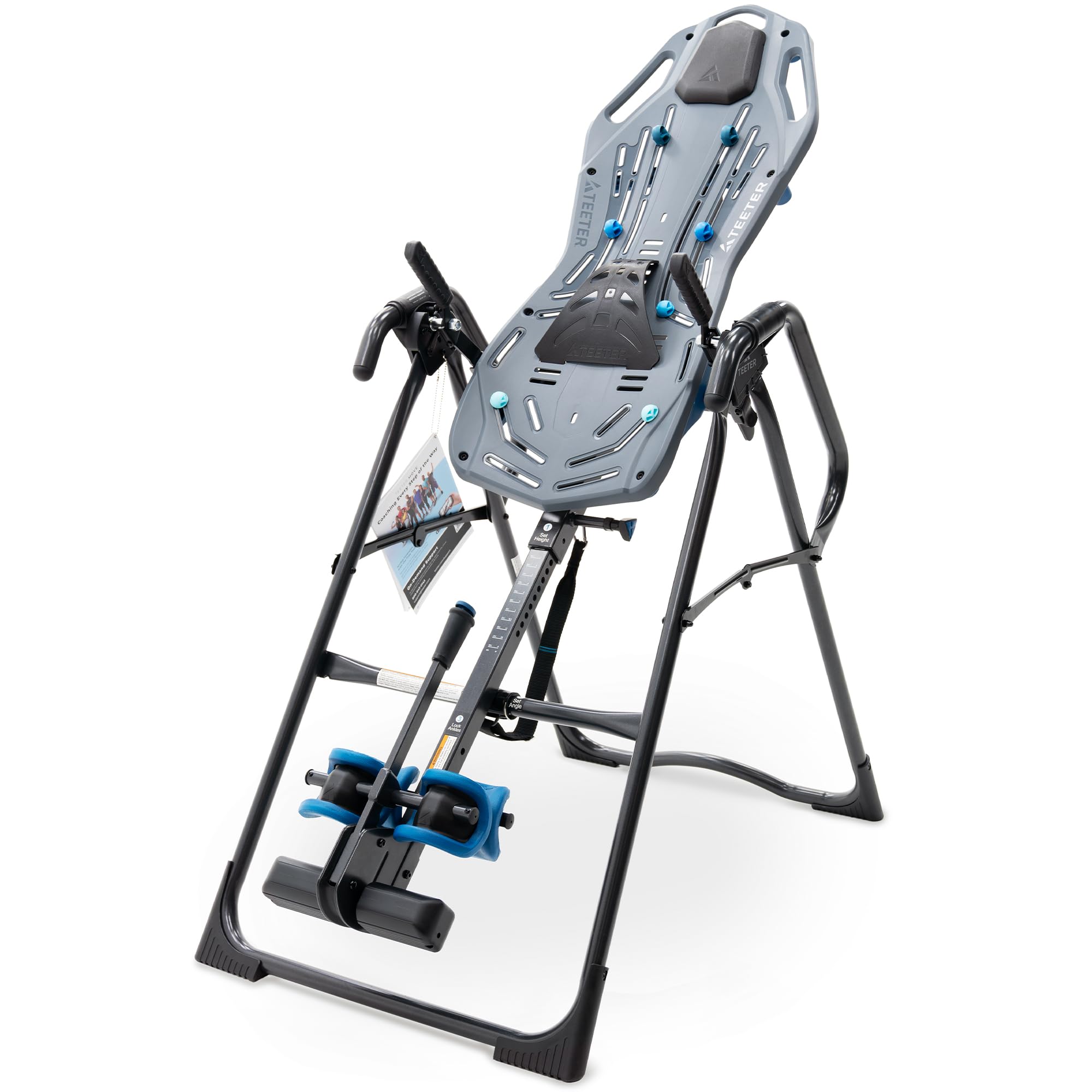
Reaching the ankle lock is the part of inversion nobody warns you about. You bend forward, hold the position, and crank a knob while your lower back is already complaining — which is why the X3's extra-long stainless handle matters more than a spec sheet suggests. It brings the lock up to where your hands are, and a secondary gravity-activated latch backs it up.

The bed is the other half of the case. Eight suspension points let the surface flex under you instead of holding a rigid plane, and the eight acupressure nodes and the Lumbar Bridge arch can be positioned where you want them or pulled out entirely. Whether the nodes do anything for you is a matter of taste; we like that removing them costs nothing and takes seconds.

Where the premium earns itself is repetition. Invert once a week and the EP-560 does the same work for less. Get on it most mornings and the handle plus the suspended bed change the routine from something you schedule into something you do not skip, and the five-year warranty covers a machine you are asking to work every day.

It is 66 pounds of alloy steel, so it goes where it is assembled; the traction handles at the head end are what you will grip when you want a deeper stretch. FDA-registered and UL-certified, same as the EP-560, which is the other reason we are comfortable recommending a table at this end of the range.

Pros

  • Long handle makes the ankle lock easy to reach
  • Suspended eight-point bed flexes with you
  • Removable acupressure nodes and lumbar arch
  • Five-year warranty and certified design

Cons

  • Premium price without a higher weight rating
Our verdict

If you will invert most days, this is the table we point to: the long ankle-lock handle spares your back on every entry, and the suspended bed is the one we liked best here.

Check Latest Price
4

Best Budget

Body Vision IT9550

91 /100
Peggy's Score Outstanding

Key details

Backrest
38 by 16 inches
Ankle Hold
Four foam rollers
Table Weight
46 lb
Weight Capacity
250 lb
Check Details on Amazon

Two hundred fifty pounds is the number that decides this one. The Body Vision is rated to 250 where nearly everything else here carries 300, so check that before anything else. Under it, this is the most straightforward table in the guide: 46 pounds assembled, a memory-style foam backrest, and a frame that goes together in an afternoon.

The padding is where the budget goes. The backrest is 38 inches of 1.5-inch foam with a removable headrest pillow, and the lumbar pad slides and lifts out so you can put the support under your lower back, your mid-back, or nowhere at all. Four high-density foam rollers spread the load across your ankles instead of pinching either side of the calf, which is what you notice first on a single-point hold.

The parts that are not foam are where it shows. The manual has gaps — the hardware goes together easily enough, but matching bolts to steps takes patience the first time, so lay everything out and dry-fit before you tighten anything.

One more thing for taller users: the backrest measures 38 inches, and much above six feet your head will hang past the top of it. At 5 ft 8 in that is a non-issue; at 6 ft 4 in it is the reason to look at the YOLEO or the Innova instead.

Pros

  • Lightest table here at 46 pounds
  • Sliding lumbar pad and removable headrest
  • Four foam rollers spread ankle pressure
  • Straightforward, quick assembly

Cons

  • 250-pound weight limit
  • No manufacturer warranty listed
Our verdict

A genuinely light, genuinely simple table for anyone under 250 pounds — we recommend it when the budget is the deciding factor.

Check Latest Price
5

Taller Users

YOLEO ITX320

89 /100
Peggy's Score Excellent

Key details

Headrest
Adjustable
Height Range
4 ft 10 in to 6 ft 6 in
Table Weight
52.9 lb
Inversion Positions
Four pinned positions
Check Details on Amazon

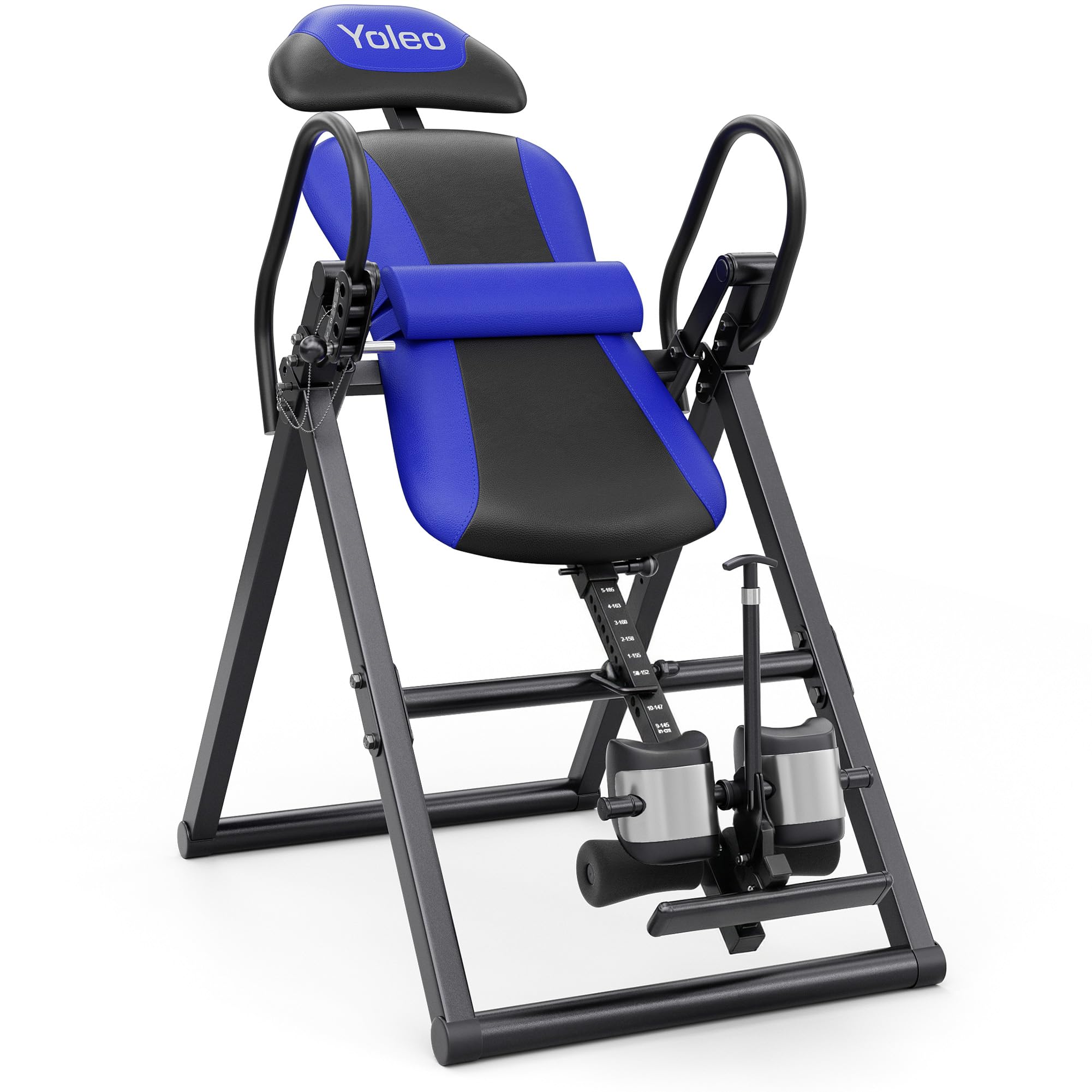
Most backrests end roughly where your neck begins, and if you are tall that is exactly where the pressure collects. The ITX320's headrest adjusts on its own, so the pad follows you up the frame instead of stopping short, and the backrest is a wide one. It fits 4 ft 10 in to 6 ft 6 in, which is the same range the Innova tables list.

Four angles is the trade you make. Where the Innova and both Teeter tables pin at six positions, this one gives you four, so the jump from a partial hang to full inversion is a bigger step. If you already know the angle you like, four is plenty; if you want to creep up on it a few degrees at a time, the six-position tables are the better buy.

The rest is sensible. It folds, the ankle release is shaped to be easier on the joint than a plain roller, and at 24 kg it is well under the weight of the Teeter frames. Instructions are the usual weak point in this band.

What it will not do is grow with you. The four-position pin is the whole angle range, and a taller user's real benefit here is the headrest rather than adjustability elsewhere — the reason to choose it over the Body Vision, which ends before your neck does.

Pros

  • Adjustable headrest supports the neck
  • Wide backrest with padded ankle hold
  • Folds for storage
  • Lighter than the Teeter tables

Cons

  • Four pinned angles leave less fine control
Our verdict

We keep it on the list for taller users: the headrest adjusts so your neck is not left hanging off the pad, though four pinned angles leave less room to fine-tune.

Check Latest Price
6

Lowest Price

Verakare ITX9550

89 /100
Peggy's Score Excellent

Key details

Warranty
1 year
Ankle Hold
Reversible ankle holders
Dimensions
46 by 28 by 62 inches
Inversion Positions
Six pinned positions
Check Details on Amazon

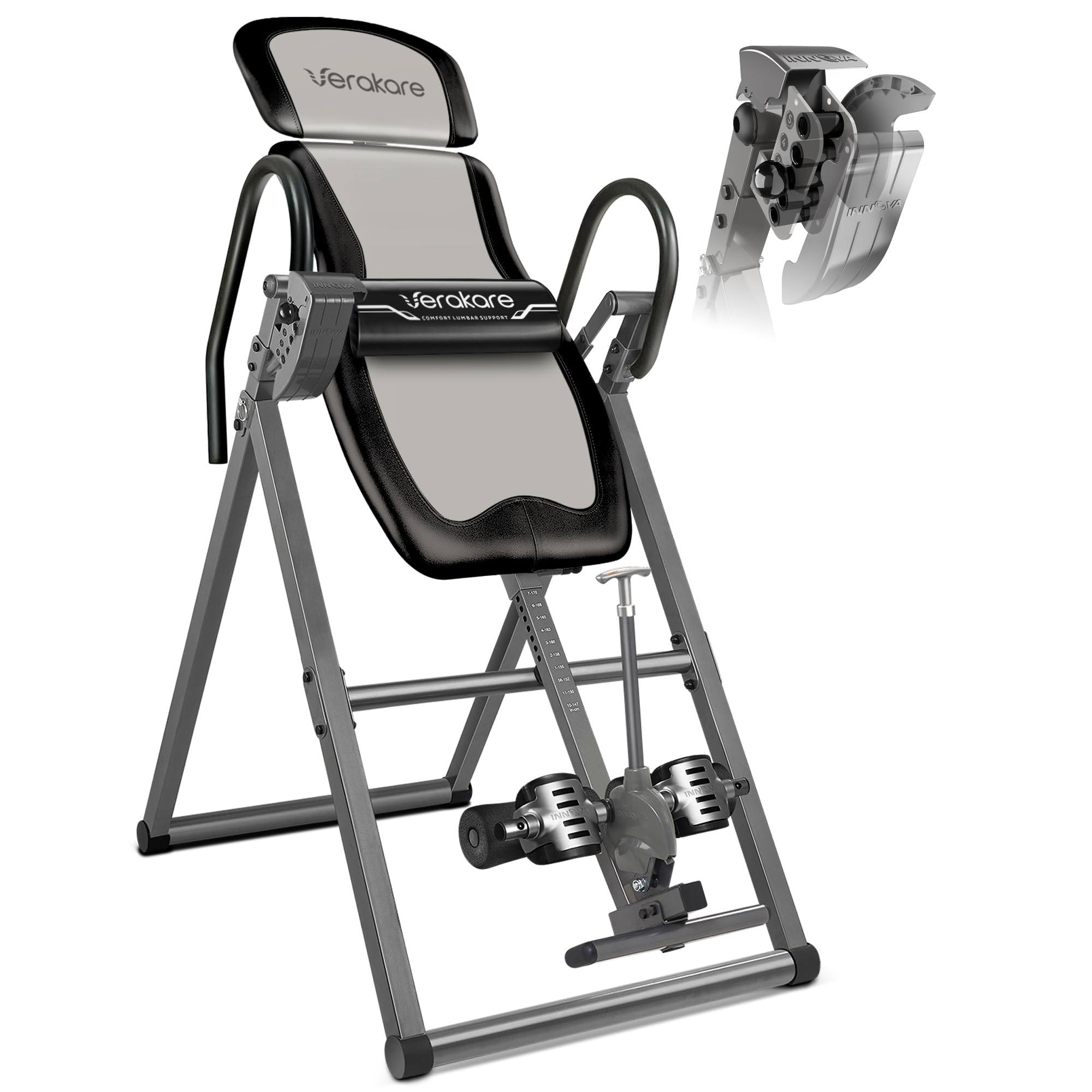
Six positions, reversible ankle holders that trade places, an adjustable headrest, and a stated one-year manufacturer warranty. The ITX9550 lines up with the mid-priced tables on paper and does not line up with them on price, which is the whole reason it stays in this guide.

The frame is better than the position in the range suggests. Construction reads as sturdier than the money would imply, the polyurethane surfaces wipe clean with a damp cloth, and the True Balance pivot is the same idea the more expensive tables use.

Assembly is the pleasant surprise: the hardware is labeled step by step and one person can have it standing without help. The trade is floor space — 46 by 28 by 62 inches is more footprint than the Body Vision takes — so measure the corner before you commit to it. For a first table that has to do the basics and nothing else, that is a fair set of compromises.

Pros

  • Six-position pin and reversible ankle holders
  • Stated one-year manufacturer warranty
  • Adjustable headrest and large backrest
  • Clearly labeled, one-person assembly

Cons

  • Larger footprint than the other budget pick
Our verdict

Our budget alternative: it lines up with the mid-priced tables on paper and brings a stated one-year warranty, which is more than the other cheap table offers.

Check Latest Price

How We Tested 11 Inversion Tables

To build our shortlist, we started with models that had published weight capacities, height ranges, and safety straps, then narrowed by price and whether replacement parts and clear assembly guides were available. We ended up testing 11 inversion tables over nine months, in living rooms and spare bedrooms, using them after long desk days, on weekend mornings, and after workouts. Each table was assembled solo with the included tools, and we timed the build and noted every moment the instructions left us guessing.

Once assembled, we did what you'd actually do: moved the table to the spot where it would live, climbed on, and inverted. We checked stability by buckling in, shifting side to side, and seeing whether the frame rocked or crept across the floor. Ankle holders and backrests were judged by how they felt during five- and ten-minute sessions, not just on first contact. We adjusted height, footrests, and angle stops between users of different sizes to see whether settings changed smoothly and stayed put.

Comfort and weight overlapped more than we expected: the tables with generous padding were often heavier and harder to move, so we balanced each unit's own weight against its user weight rating and footprint. Value came down to frame quality, welds, squeaks, and whether the controls matched the price. We also kept a simple log after each session—whether we felt looser, stiffer, or just annoyed by the ankle straps—because effectiveness matters more than any spec sheet.

How to Choose Inversion Tables

Fit Comes Before Features

A table only decompresses you if your hips land at the pivot and your head stays on the pad, so check the stated height range and weight rating first. The Innova and YOLEO tables here list 4 ft 10 in to 6 ft 6 in and 300 pounds; the Body Vision stops at 250 pounds. Near the top of a range, your inseam matters more than your height, because the ankle lock position is what sets where you sit.

The trap is a shared table. A height range assumes the lock is set to your number, and every user who changes it moves the balance point with it. Note your setting on the frame the day you build it and reset it before each session — an inch out and the table feels nose-heavy in a way you will blame on the machine.

Angle Control and Ankle Hold Are What You Live With

Most tables here pin the angle through a covered plate — six positions on the Innova, Teeter and Verakare tables, four on the YOLEO — and that pin is what lets you stop at a shallow hang instead of going all the way over. That partial range is where most people spend their time, so count positions if you like fine control; a limit strap, as on the EP-560, does the same job a different way.

Ankles decide whether you keep using it. Wrap-around cups, foam rollers and reversible holders all work, and all of them press. Thick socks are the cheapest fix in this category, and a hold that spreads load across the top of the foot rather than a single point is worth choosing if you plan to hang for more than a few minutes.

Where It Lives Decides How Often You Use It

Assembled tables here run from 46 to 70 pounds, and nobody moves one daily. Pick the spot before you build: a room where the frame can sit level, and clearance behind the head end for the bed to rotate through its arc.

Folding designs are the upgrade worth paying for. The EP-560 folds without coming apart, and the YOLEO and Verakare frames fold too, which matters when the room does double duty. Compact in a listing usually means it folds, not that it is small in use — an open table still needs its full length of floor.

What the Extras Are Actually Worth

We rank extras by whether they change the contact with your back. An inflatable lumbar pad, as on the Innova, does: you control the fill instead of accepting the bed's fixed curve. Acupressure nodes, as on the Teeter X3, are a matter of taste and cost nothing to pull out.

Heat and massage pads did not earn a place in our priorities. They add wiring and cost to a machine whose actual job is to hold you at an angle for a few minutes, and the two jobs do not overlap much.

Warranty and Certification Are the Boring Part That Matters

Most of the tables here carry a one-year limited warranty. Both Teeter models carry five years, and both are registered with the FDA as 510(k) medical devices and UL safety certified.

Our position: on a device that holds you upside down by the ankles, warranty length and certification are worth more than a second pair of handgrips. If you expect to use a table several times a week for years, buy the longest warranty you can find; if you are still testing whether inversion helps you, a one-year table is a reasonable place to start.

Frequently Asked Questions

Final Verdict

Buy the Teeter EP-560. The FDA registration, the UL certification, the five-year warranty and the wrap-around ankle cups add up to the least risky way to start inverting, and it folds away when the room needs to be a room again.

If the Teeter is more than you want to spend on an experiment, the Innova ITX9900 does the same core job with a better lumbar pad and a one-year warranty. And if you are under 250 pounds and simply want the most straightforward table that works, the Body Vision is the one.