Best Gua Sha Tools of 2026

A gua sha tool is deceptively simple: a flat stone you hold at a low angle and sweep up and out along your jaw, cheeks, and brow. Which is exactly why a bad one is so irritating — an edge that drags instead of gliding, a curve that won't sit under your cheekbone, a stone so light you can't tell whether it's doing anything. The right one turns a two-minute routine into the part of the morning you actually look forward to.

I've been at this long enough to know that price is a lousy guide here; an inexpensive stone with a smooth, well-shaped edge can beat a boutique one that looks gorgeous on a shelf and chips in a drawer. Over the past four months, my team and I used 14 tools through real morning and evening routines, and the standouts got the basics right: a comfortable grip, a cool, weighty feel, edges that glide without tugging, and a jaw that looked a little less puffy after a rough night. Below, the ones worth keeping on your bathroom counter.

1

Best Overall

Nuanchu Stainless Steel Gua Sha

95 /100
Peggy's Score Outstanding

Key details

Weight
3.2 oz
Includes
Velvet travel pouch
Material
304 stainless steel
Dimensions
4 x 3.5 x 2.2 inches
Check Details on Amazon

Stone is the part of gua sha that photographs beautifully and the part that lets you down: a jade or quartz board that slides off the sink can chip, crack, or snap, and a rough edge means that tool is finished. Stainless steel sidesteps the whole problem, which is why the Nuanchu board is the one we recommend first.

At 3.2 ounces it has real weight behind it, and that changes the massage: the board supplies the pressure while your hand only steers. We felt the difference along the jaw, where a light stone skips over the muscle and a heavier steel edge stays exactly where you put it. Because the surface is non-porous, oil and serum wipe off with soap and water instead of soaking in.

It's also cool to the touch without a trip to the refrigerator, which is most of what we want on a puffy morning. The heart shape gives you one long sweeping edge for the neck and a tighter inner curve for the jaw and brow, and the 304 stainless steel feels solid rather than plated. A velvet pouch comes in the box, so it can live in a gym bag without collecting grit.

What you give up is the look and the ritual of stone. This is a tool, not a vanity object, and it feels like one in the hand. If a pink stone on the shelf is part of why you do this at all, one of the quartz boards below will serve you better.

Pros

  • Won't chip or shatter like a stone board
  • Stays cool without refrigeration
  • Non-porous, so it wipes clean
  • Velvet travel pouch included

Cons

  • Heavier than stone; some hands find it tiring
Our verdict

Our default recommendation: a cool, weighty steel board that cleans up in seconds and survives the drop that ends most stone tools.

Check Latest Price
2

Best Budget Stone

Rena Chris Jade Gua Sha

93 /100
Peggy's Score Outstanding

Key details

Weight
1.69 oz
Includes
Instruction booklet and cleaning cloth
Material
Jade stone
Dimensions
3.59 x 2.4 x 0.67 inches
Check Details on Amazon

The Rena Chris board is the least expensive tool here, and it still does the thing most people buy a gua sha for: a smooth, cool edge that glides over serum without dragging the skin. It measures 3.59 by 2.4 inches and weighs 1.69 ounces, so it sits in the hand like a flat river stone rather than a piece of hardware.

The box holds more than we expected at this end of the range: the board, an instruction booklet, a cleaning cloth, and packaging nice enough to give away. The booklet matters more than it sounds. Gua sha is a technique, not a scrub, and a first-timer with stroke directions in front of them is far more likely to keep going than someone guessing in the bathroom mirror.

We think it's the smartest first stone board for exactly that reason: it asks very little of your wallet and hands you the directions to do it properly. Once you know the habit is sticking, the Beauty by Earth is the upgrade; until then, this is enough tool to learn on.

Pros

  • Glides smoothly without pulling skin
  • Instructions and cleaning cloth included
  • Light enough to work the neck without strain

Cons

  • Stone shade and translucency vary between boards
Our verdict

A smooth, cool jade board for the least money here, and the one we hand to someone who has never done gua sha before.

Check Latest Price
3

Best Stone Upgrade

Beauty by Earth Jade Gua Sha

94 /100
Peggy's Score Outstanding

Key details

Weight
1.4 oz
Includes
Magnetic gift box
Material
Aventurine jade
Dimensions
3.5 x 2.5 x 0.25 inches
Check Details on Amazon

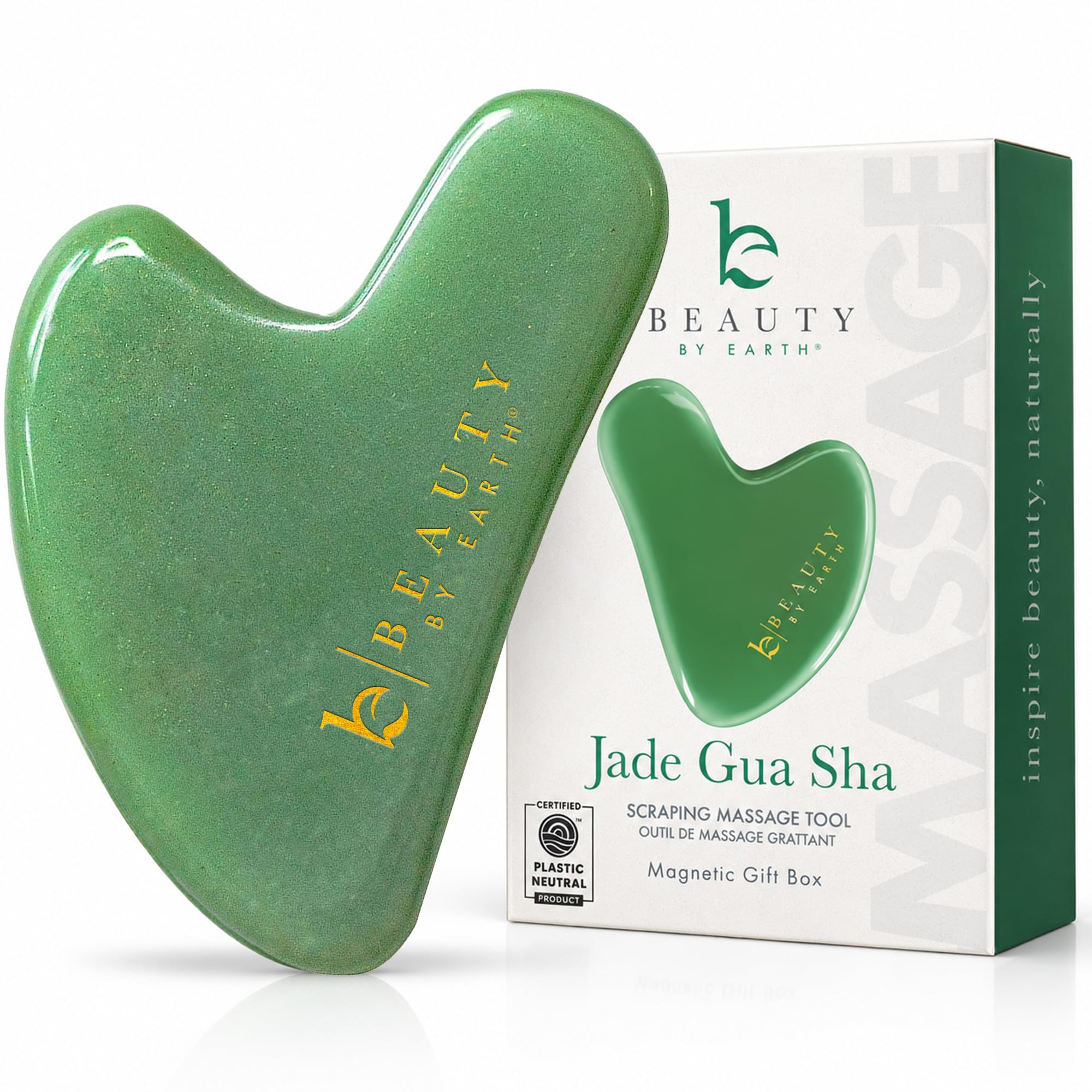
This is the most expensive tool on the page, and what the money buys is a thicker slab of stone: 0.25 inches against 0.2 on the cheaper quartz boards, cut from aventurine jade with contoured edges that curve to follow the cheek and jaw.

We reach for it when we want the stone version of the ritual. It stays cool, the extra thickness gives it a substantial feel in the hand, and the magnetic box doubles as storage instead of a sleeve you throw away. The curved edge suits the cheekbone and jawline, where a flat board tends to ride over the contour rather than following it.

The box is the detail that sells it for us: it protects the stone between uses and looks presentable enough to hand over as a gift without re-wrapping. If you're buying for someone who already has a routine and will notice better stone, this is the one.

Pros

  • Thick, contoured stone that follows the jaw
  • Magnetic box protects it and gifts well
  • Listed as genuine aventurine, not resin

Cons

  • Premium price for a stone board that still needs careful handling
Our verdict

Buy this one when the stone itself is part of the pleasure: thicker aventurine, contoured edges, and a magnetic box worth keeping.

Check Latest Price
4

Best for Detail Work

Kitsch Stainless Steel Gua Sha

91 /100
Peggy's Score Outstanding

Key details

Weight
3.14 oz
Material
Stainless steel
Dimensions
3.3 x 2.4 x 0.13 inches
Check Details on Amazon

At 0.13 inches thick, the Kitsch board is the slimmest tool here, and that thinness is why we keep it for the fiddly areas: it slips under the cheekbone and along the jawline where a thicker slab rides on top of the contour. It's stainless steel, 3.3 by 2.4 inches, and 3.14 ounces, so there's still enough mass that you aren't pressing.

Metal handles the upkeep: cool without the refrigerator, easy to wash, and it won't shatter if it slides off the vanity. We also like that the steel warms quickly under running water when you want warmth instead of a cold pass — a small thing that makes it more adaptable than a board that only does one temperature.

Pros

  • Slim edge reaches under the cheekbone
  • Cools naturally and warms under water
  • Steel won't break and wipes clean

Cons

  • Slim edges cover less ground per pass on the neck
Our verdict

The pick for anyone who works the jawline and under-eye closely: a slim steel board that gets into contours a thick slab skates over.

Check Latest Price
5

Roller Plus Board

BAIMEI IcyMe Roller & Gua Sha Set

93 /100
Peggy's Score Outstanding

Key details

Weight
3.53 oz
Material
Rose quartz
Dimensions
5.71 x 3.54 x 0.98 inches
Set Contents
Roller and gua sha board
Check Details on Amazon

Two tools instead of one is the pitch here: a rose quartz roller and a rose quartz gua sha board in a gift box, 3.53 ounces together. The roller is the piece you use half-awake, working from the center of the face outward; the board is the piece that gets into the jaw and down the neck with real pressure.

They do different jobs well enough that we didn't mind having both on the shelf. The roller covers ground quickly in the morning and slips under the eye without much aiming; the board's long edge works the jawline and the sides of the neck in a way a roller can't. Keep the pair in the refrigerator and the first pass is genuinely cold, which is the point of the IcyMe name.

What we appreciate most is that it makes the routine feel like a treat rather than a chore, and that matters more than any single edge shape when you're trying to build a habit. The box has a magnetic closure, so both pieces store together and it gifts without extra wrapping.

Pros

  • Roller and board cover different jobs
  • Magnetic gift box keeps both pieces together
  • Cold from the fridge for morning puffiness

Cons

  • Both pieces are fragile rose quartz
Our verdict

A gift-ready rose quartz roller and board that covers a whole routine, provided you treat both pieces like the glass-fragile stone they are.

Check Latest Price
6

Rose Quartz Fans

Flagest Rose Quartz Gua Sha

93 /100
Peggy's Score Outstanding

Key details

Weight
2.82 oz
Material
Rose quartz
Dimensions
3.03 x 2.48 x 0.2 inches
Check Details on Amazon

Rose quartz is the pink, slightly softer-looking stone, and it behaves much like jade on the skin: cool, smooth, and heavy enough to feel like something. This one is the heaviest stone tool here at 2.82 ounces, and we noticed that along the jaw, where the extra weight does the pressing for you.

At 3.03 by 2.48 inches with a 0.2-inch profile, it's a full-face board rather than a travel miniature, and it ships in a metal tin with foam cut to shape — protection most boards at this level don't get. That tin makes it the easy one to keep in a gym bag or a drawer, and the pink settles the question of whose tool is whose if two people in the house are using it.

Pros

  • Heavier stone does the pressing along the jaw
  • Metal tin with foam cut to shape
  • Smooth, cool rose quartz surface

Cons

No notable drawbacks to flag.

Our verdict

The rose quartz board we reach for when we want a heavier stone in hand, and the one that travels best thanks to its foam-lined tin.

Check Latest Price

How We Tested 14 Gua Sha Tools Over Four Months

We started by gathering the tools people actually buy — classic heart-shaped rose quartz, stainless steel, bian stone, obsidian, and a few oddly shaped designs — then narrowed by price, edge variety, and whether the maker would state plainly what the stone was and accept a return. That left 14 tools, which my team and I used for four months, twice a day on most days.

Each one went through the same routine: a quick morning pass on clean skin with facial oil, a longer evening session after cleansing, and a week riding in a toiletry bag. Before any of that, I ran a thumb along every edge hunting for nicks and dragged each tool across the back of my hand to feel how much it pulled. In the mornings I compared my jaw and under-eye area in the same window light before and after, especially on days following a salty dinner or a short night, and noted whether the notch curved under my cheekbone or skipped over it. Grip got tested with slick, oiled fingers; the most telling result was whether I still reached for a tool on a tired Tuesday or quietly stopped.

Relaxation got tested at 10 p.m., when some stones stayed cool and calming and others felt like a chore. Durability came down to real accidents — two drops onto bathroom tile, a month of travel, then a check for chips, hairline cracks, and edges that dulled or scratched. We also left all 14 on the counter the entire time to see which ones still looked worth leaving out.

How to Choose Gua Sha Tools

Stone or Stainless Steel

The material decides almost everything else. Stone — jade, rose quartz, aventurine — is lighter, prettier, and gives the cool, smooth glide the ritual is known for, but it is brittle: a chip along the working edge finishes the tool, and every stone board here can break if it's dropped. Stainless steel is heavier and plainer and effectively indestructible, and because it's non-porous, oil and serum wipe off rather than soaking in.

Choose steel if the tool will live on a bathroom counter or in a gym bag. Choose stone if the object itself is part of why you do this at all.

Edges and Shape

Most boards give you three working surfaces: a long sweeping edge for the neck, a shorter concave curve for the cheekbone, and a small notch for the brow and under-eye. Think about the two areas you'll actually work. For the jawline, prioritize a long edge with a gentle curve; for under-eye puffiness, a narrow edge matters more than overall size.

Thickness is the specification most people skip — our slimmest pick is 0.13 inches and our thickest stone is 0.25, which is roughly the difference between an edge that gets under the cheekbone and one that rides over it.

Weight and Pressure

A gua sha stroke should be light: the tool does the work, not your wrist. Weight matters for that reason. A three-ounce steel board presses with its own mass, while a lighter stone board asks you to add pressure — and most of us add too much. If you have grip or wrist trouble, go lighter and use shorter strokes; if you want deeper work along the jaw, the heavier boards here make it easier.

Under the eye, use the lightest pass you can manage and save the firmer pressure for the jaw and the sides of the neck.

Cleaning and Storage

Stone holds onto oil more than steel does, so wash either board in warm water with mild soap after use, then dry it before it goes back in its case. Wash it between users too: sharing a tool is fine, sharing residue isn't.

The case matters more than it looks. The picks here that come with a box, tin, or pouch are the ones that survive being carried, and a 0.2-inch stone landing on tile is how most boards die.

Frequently Asked Questions

Final Verdict

Start with the Nuanchu stainless steel board. It stays cold without the refrigerator, wipes clean in seconds, and won't shatter the first time it slips out of a soapy hand — and the 3.2-ounce weight does the pressing along your jaw so your wrist doesn't have to.

If you want stone for the look or the ritual, the Rena Chris is the least expensive way in and comes with instructions; the Beauty by Earth is the upgrade once the habit has stuck.