Best Gratitude Journals of 2026

The way a gratitude journal usually fails isn't dramatic. You buy a nice one, write in it for four days, and it migrates to the bottom of a drawer — I have three of those on my shelf, and I suspect you might too. So when my team and I set out to find the ones actually worth buying, the question wasn't which cover looked best on a nightstand but which book you'd still be reaching for two months in.

That's the job these journals are supposed to do: take the blank-page decision out of your evening and hand you a structure that takes five minutes, not twenty. We spent four months with 16 of them, writing at kitchen tables and in hospital waiting rooms, and the pattern showed up fast — paper weight, prompt variety, and whether the book lies open flat matter far more than the quote on the cover. A pretty journal with pages that ghost and the same three questions for 52 straight weeks is decor, not a habit. The picks below are the ones that survived daily use.

1

Best Overall

Gratitude Day and Night Reflection Journal

95 /100
Peggy's Score Outstanding

Key details

Pages
184
Dimensions
5.75 x 8.25 inches
Daily Format
Morning and evening sections
Check Details on Amazon

A page that carries both ends of the day is the reason this is our pick. The top half sets up the morning, the bottom half closes the evening with a short reflection, and each half is small enough to finish in a minute. We found the two-part shape easier to keep than a single long entry, because neither sitting asks much of you.

The prompts do the work a blank page will not. There is a question waiting both times, which removes the small decision, what do I even write, that ends most journaling attempts in the second week. We were struck by how quiet the design is: one day per page, a clean layout, nothing to fill in but the lines.

At 5.75 by 8.25 inches and just over 14 ounces it is a bedside book rather than a bag book, and that is the trade we accept for a page with room on it. Leaving it out on a nightstand is the point. In our experience that is where a daily practice actually happens, and a book you have to dig out of a drawer is a book you skip.

Against the 6-Minute Diary it asks less of each sitting and costs less; against the budget books, you are paying for a better-made page and a calmer design. What settled it is the balance, with enough structure that a distracted Tuesday still produces an entry and not so much that keeping it feels like homework.

Pros

  • Two short prompts a day on one page
  • Structure that removes the blank-page decision
  • Clean, uncluttered page design
  • Comfortable size and weight for a nightstand

Cons

No notable drawbacks to flag.

Our verdict

We recommend this one to almost everyone: the morning-and-evening page makes a daily gratitude habit feel small enough to keep, and it is calm enough to live on a nightstand for months.

Check Latest Price
2

Best Budget

GOSSIP FOX Gratitude Journal

94 /100
Peggy's Score Outstanding

Key details

Pages
120
Coverage
Six months
Dimensions
8.38 x 5.27 inches
Daily Format
Morning and evening sections
Check Details on Amazon

Nothing about the price shows up in the book. The cover is linen-wrapped, the paper has some body to it, there is a ribbon marker and a back pocket, and it covers six months of undated mornings and evenings with the same two-part split as our top pick.

That is why it is the one we point to first when someone wants to try gratitude journaling without spending much. A daily habit is a bad place to spend a lot of money before you know it will stick. Nothing is dated either, so a missed week does not leave a row of blanks to feel bad about, and you pick up on the next clean page.

Set it beside the other inexpensive books here and the difference is the shape of the day: the One-Minute and the Paper Peony formats ask for one short entry, this one asks for two. More practice for less money is a good trade, and the linen cover means it does not look like the cheap option sitting on your counter.

Pros

  • Morning and evening sections in one slim book
  • Undated, so a missed week leaves no gaps
  • Linen cover, ribbon marker and back pocket
  • Looks far more expensive than it is

Cons

  • Compact 5 x 8 page leaves less writing room
Our verdict

Our budget pick: two short sittings a day, a linen cover and undated pages that forgive a missed week, which makes it the least expensive way here to try the real thing.

Check Latest Price
3

Best Premium

UrBestSelf 6-Minute Diary

93 /100
Peggy's Score Outstanding

Key details

Size
A5
Cover
Linen hardcover
Pages
288
Format
Morning and evening prompts
Check Details on Amazon

How long do you want to keep going? That is the question this one answers with 288 pages, a linen cover and a price at the top of the group. If you finish journals rather than start them, it is the least fussy way to buy a long stretch of practice in one go.

The daily shape will be familiar from our top pick: short morning prompts, an evening reflection, and six minutes in total by the book's own arithmetic. The coaching section at the front is worth reading once. After that, what we kept coming back to is the pair of ribbon markers, glued into the morning and evening columns so your place is held in both.

What you are paying for is the object. The paper has real body under a pen, the cover feels like a book rather than a notebook, and the binding is made to be kept rather than filled and replaced. It turns the practice into a ritual, which is either the point or an unnecessary expense depending on how you journal.

Pros

  • A long run of pages in a single book
  • Two ribbon markers, one for each half of the day
  • Linen hardcover and substantial paper
  • Guidance at the front for anyone new to the practice

Cons

  • Heavy enough that it stays on a desk
Our verdict

If you actually finish journals, this is the one worth paying for: a long run of pages, two ribbons for a two-part day, and a cover that feels built to last.

Check Latest Price
4

Best for Prompt Variety

Clever Fox Gratitude Journal

93 /100
Peggy's Score Outstanding

Key details

Size
A5
Paper
120 gsm
Prompts
New questions daily
Coverage
Three months
Check Details on Amazon

New questions every day is the promise, and it is the reason this one holds attention. Several books here give you the same three lines to fill in for months; Clever Fox changes the prompts daily and adds weekly and monthly exercises on top, so the book keeps asking for something you have not already answered.

What we did not expect to care about: the stickers. Three sheets of them sound like filler until you are marking a good day with one, and the pen loop and elastic band turn out to be the details you notice when a book does not have them. The 120gsm paper has more body than most journal pages too.

Three months is the catch. A fresh set of questions every day means more design and fewer days per book, so you will reorder sooner than with the six-month and year-long books here. If repetition is what kills your journaling, that is a fair trade; if you want one book to last, it is not.

Pros

  • A different set of prompts each day
  • Weekly and monthly exercises
  • Thick 120gsm paper with pen loop and elastic
  • Sticker sheets for marking good days

Cons

No notable drawbacks to flag.

Our verdict

Buy this if repetition is what ends your journaling: new questions every day, thick paper and weekly exercises that keep a three-month run interesting.

Check Latest Price
5

Best for Goal Setting

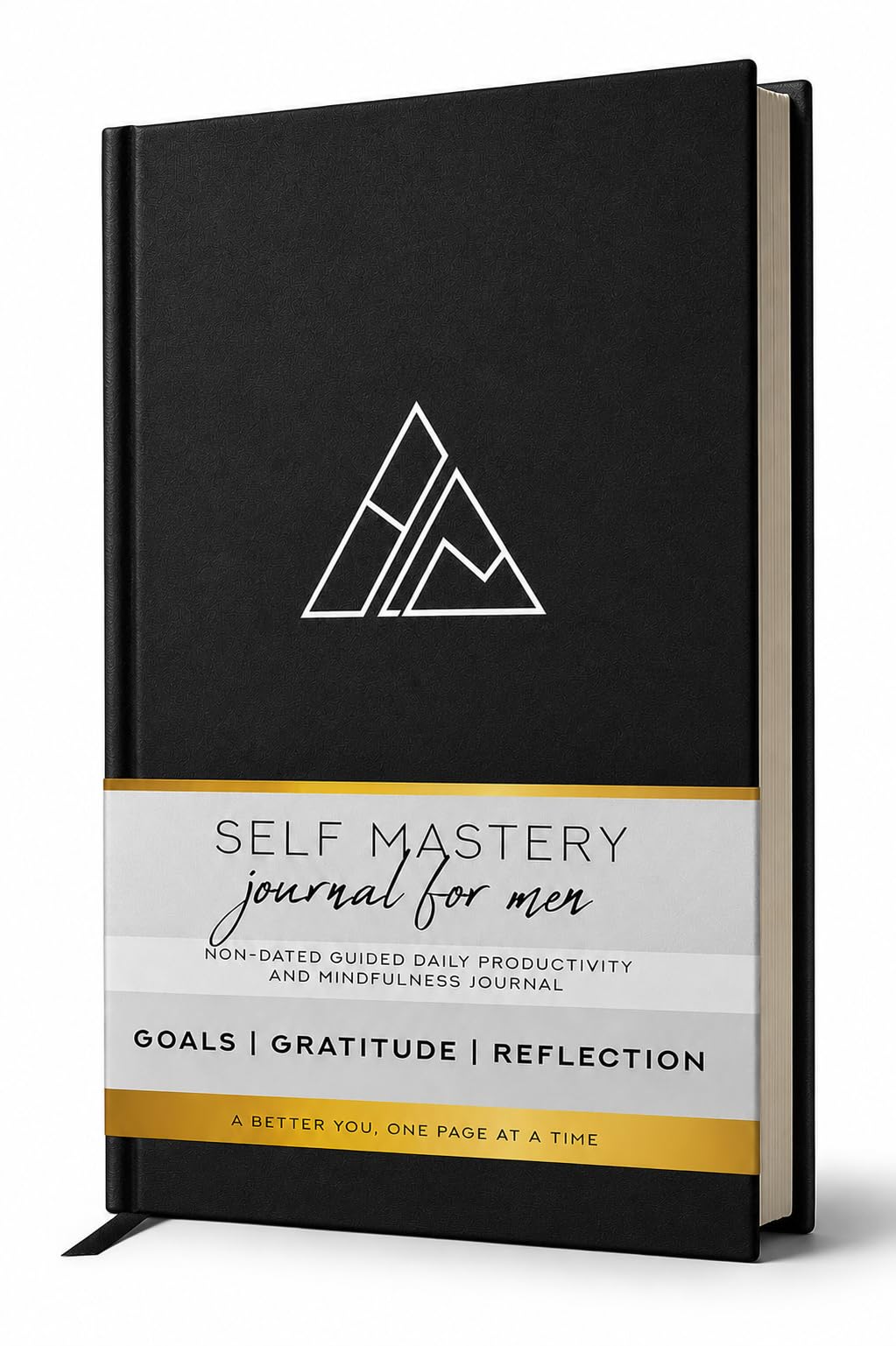
Realizations Self-Mastery Journal

93 /100
Peggy's Score Outstanding

Key details

Size
A5
Pages
220
Ruling
Ruled and dotted
Coverage
13 weeks
Check Details on Amazon

Thirteen weeks is a quarter, and this book is built around that span: goal pages, affirmations, a daily question and a gratitude section, all in one arc. It is the most structured journal in this group, and it expects you to show up with something to work on.

We appreciated the accountability. The questions come back to the same few themes, goals, affirmations, gratitude, reflection, and a returning question is genuinely useful when the point is to notice how your answer changed. The ruled-and-dotted pages leave room for notes the prompts never ask for, which is where half the useful writing ends up.

The book itself holds up its end: linen hardcover, 220 pages, A5, with a weight and finish that feel considered. Where it differs from the 6-Minute Diary is focus, since that book is about the day and this one is about the quarter, and where it differs from the simpler books is attention: it wants a real sitting, not two lines before bed.

Pros

  • Goal pages and a daily question alongside gratitude
  • Quarter-long structure with built-in accountability
  • Linen hardcover with ruled and dotted sections
  • Extra space for free notes

Cons

  • Thirteen weeks, then you start over with a new book
Our verdict

For anyone who thinks better with a target in front of them: gratitude, goals and a daily question arranged into a quarter you can actually finish.

Check Latest Price
6

Best Gift

Paper Peony Gratitude Journal for Women

93 /100
Peggy's Score Outstanding

Key details

Pages
128
Edition
Premium keepsake
Dimensions
5 x 8 inches
Check Details on Amazon

Gold foil on the front, a dusty pink ribbon, and a size that sits in one hand: this one looks like a present before it is wrapped. Left on a nightstand it reads as an object rather than a workbook, which is most of the reason it is our gift pick.

Inside it is deliberately plain, with a few lines a day for what you are grateful for, a quote here and there, and a layout that gives a week to each spread. We like that for a gift, because it does not presume the recipient wants a system. Nobody has to learn a method before writing three things.

What it will not do is push you. There are no probing questions to answer, so if you want prompts that make you think, one of the guided books above is the better fit. This one is for someone starting out, or for someone who would rather have a pretty place to write than a course in gratitude.

Pros

  • Gold foil cover and ribbon make it gift-ready
  • Three lines a day is easy to keep
  • Quotes sprinkled through the pages
  • Compact 5 x 8 size

Cons

No notable drawbacks to flag.

Our verdict

We buy this one as a gift: gold foil, a ribbon and three lines a day that ask for no method and no commitment beyond a minute at bedtime.

Check Latest Price
7

Best for Busy Mornings

The One-Minute Gratitude Journal

93 /100
Peggy's Score Outstanding

Key details

Pages
112
Dimensions
6 x 9 inches
Item Weight
9.9 oz
Check Details on Amazon

A minute is the whole ask here: a short entry and a quote, and that is the page. It is the least demanding format in this group, which makes it the one we reach for on a morning when there is no time but you still want the practice kept.

At 112 pages and just under ten ounces it is a book that lives in a bag without you noticing it, and the 6-by-9 page gives more room than the compact books here. We were surprised by the quotes: a fresh one on each page turns the ritual into a small treat rather than a task, and they sit a notch above the usual inspirational filler.

It will not teach you a method, and that is the point: the book assumes you already know what you are grateful for and just want somewhere to put it. If you want questions to answer, the Paper Peony or the 5-Minute is the better buy. This one is for writing three things and getting on with the day.

Pros

  • One short entry and a quote per page
  • Slim enough to live in a work bag
  • Quotes worth reading, not filler
  • More page room than the compact books

Cons

No notable drawbacks to flag.

Our verdict

Five minutes on a train is enough: a quote, a few lines and no system to learn, which makes this the pick for anyone who wants the habit without the homework.

Check Latest Price
8

Beginners

The 5-Minute Gratitude Journal

95 /100
Peggy's Score Outstanding

Key details

Pages
132
Dimensions
5.83 x 8.27 inches
Item Weight
8 oz
Check Details on Amazon

This is the book we hand to someone who has never finished a journal. The questions are short, the entries are short, and 132 pages in a light 5.83-by-8.27 paperback is a low-stakes thing to leave in a bag until the habit holds.

It is a good introduction for the same reason it travels well: nothing about it is precious. A prompt gives you somewhere to start when the blank page would have stopped you, and a sitting takes a few minutes, which is the difference between a book you finish and one you admire.

Where it sits in this group is as a starter rather than a keeper. The paper is ordinary, the cover is a cover, and once the habit is established you may want one of the linen-bound books above. That is not a knock on a book that costs about as little as anything here; it is what a first journal should be.

Pros

  • Short, answerable prompts for beginners
  • Light enough to carry anywhere
  • A few minutes a day is the whole ask
  • Low cost of entry

Cons

  • The same questions come around again
Our verdict

A gentle first journal: short questions, a light paperback and a few minutes a day, which makes it the right buy if a blank page is what stopped you before.

Check Latest Price
9

Carrying with You

ZICVIBE Original Gratitude Journal

93 /100
Peggy's Score Outstanding

Key details

Size
A5
Pages
199
Format
Undated daily prompts
Check Details on Amazon

A weekly challenge layered on top of the daily prompts is the extra here, and on a book this compact it earns its place: the page asks for a few lines, the challenge gives the week a shape, and a quote sits alongside.

Undated pages mean starting mid-week costs nothing, and the A5 linen hardcover has the same size and finish as books that sell for more. We noticed the format most when deciding where to keep it, because it is slim enough to go in a bag and good-looking enough to leave out, which is a narrower window than it sounds.

What it does not do is go deep. A few lines a day, a quote and a challenge is the whole format, with none of the weekly exercises or goal pages the bigger books here carry. That makes it a good daily tool rather than a workbook, and at a budget price it is an easy one to try.

Pros

  • Undated, so you can start any time
  • Weekly challenge adds a little structure
  • Linen A5 cover at a budget price
  • Quotes alongside the prompts

Cons

No notable drawbacks to flag.

Our verdict

A pretty, compact daily book with a weekly challenge to keep it interesting, best for someone who wants a simple habit in a cover worth leaving out.

Check Latest Price

How We Tested: Four Months of Daily Writing

We started with the formats readers ask about most — undated versus dated, prompted versus blank, slim softcovers versus thick hardbacks — then cut anything that lost points on paper stock or binding before it ever reached a nightstand. From that shortlist, 16 journals got four months of real use, each one written in for at least two consecutive weeks so we weren't judging a book on its honeymoon phase.

Entries happened where journaling actually happens: a few rushed lines with morning coffee and a longer page at the bedside before lights out. I wrote with a gel pen on some pages and a fountain pen on others, then held the sheet up to a lamp to see whether ink showed through or soaked into the reverse side. Each journal rode around in a tote bag for a week or two so I could check the corners and spine afterward, and I opened every one to a middle page to see if it stayed flat or fought me the whole time.

Prompts got the closest read, since that's where most journals quietly fall apart. I tracked the week each book started repeating itself — a few ran out of new angles by day 12 — and noted whether the questions left room for a genuinely bad day or pushed relentlessly toward silver linings. Dated pages were judged harder than undated ones, because a missed Tuesday leaves a visible gap that makes people quit.

Finally, I counted pages: how much of each book was actual prompted writing versus inspirational quotes, blank notes, and eleven pages of front matter. That gave a rough cost per usable page, which is where several thicker, pricier journals lost to slimmer, cheaper ones. The ones that made the list are the ones I was still opening in week 14 without having to talk myself into it.

How to Choose Gratitude Journals

Decide when you'll write, then pick the layout

Most of these books take one of two shapes: a single entry a day, or a page split into morning and evening halves. One entry is easier to sustain; a split page brackets the day and gives a bad afternoon somewhere to go, but it asks for two sittings. Be honest about which one survives your schedule, because a two-part book bought by someone whose mornings are a scramble becomes an evening-only book with guilt attached. The once-a-day formats, like the Paper Peony and the One-Minute, are the more forgiving choice for a chaotic week.

Look at pages per day, not page count

A thick book is not automatically a generous one. Page count and writing room are different measurements, and the number that matters is how much of a page each day gets. The Gossip Fox covers six months in 120 pages, so every day works within a share of a page; a 288-page book like the 6-Minute Diary has far more to spread across its run. Divide the pages by the days the book claims before you order, and you will know whether you are buying room for a paragraph or room for a list.

Match the run length to what you know about yourself

Ninety days, thirteen weeks, six months, a year: a short book is cheaper to try and gives you a natural point to stop and judge whether the practice is doing anything. Undated pages are the flexible option, because a skipped week does not leave a row of empty dated boxes. If you have kept a journal before, buy the longer book and spare yourself a reorder; if this is an experiment, start with a 90-day or 13-week format and let the habit earn the upgrade.

Check the binding before you commit to a daily habit

These books get opened twice a day for months, and a journal that sheds pages is worse than no journal at all. A hardcover with a stitched or reinforced spine is the safer bet; a thin perfect-bound paperback is the format most likely to crack at the front hinge. Carry it loose in a bag and the corners take the damage first, so a slipcase or a dedicated spot on a shelf is worth the trouble.

Weigh the extras against your own habits

Quotes, weekly challenges, stickers, goal pages, a pen loop: an extra is only worth having if it is the thing that gets you back to the page. A weekly challenge suits people who like a finish line; stickers appeal if the book lives somewhere visible; goal pages matter when your reflection is tied to a project. If you are unsure, buy the simpler book, because a plain daily page is easier to return to than a workbook you skip.

Frequently Asked Questions

Final Verdict

Start with the Day and Night Reflection Journal. It is the one we recommend without a caveat: a morning prompt, an evening reflection, and a page that does not intimidate, which is the combination that keeps a daily practice alive past February.

If money is the deciding factor, the Gossip Fox gives you the same two-part day for less. If you want a book that feels made to be kept for years, the 6-Minute Diary is the upgrade. And if your reflection is really about where you are headed, the Realizations journal is the one that puts goals on the page.