Best Fitness Planners of 2026

The first week of a new training plan is fun; the fourth is where things get messy. I've watched good intentions dissolve into a notes app full of half-finished workouts and no sense of whether I was improving. A good fitness planner fixes that by giving you one place to plan sessions, log what you did, and see the pattern without turning training into homework. Over the past three months, my team and I used 14 fitness planners through strength days, dog walks, rest days, and the occasional skipped workout.

What separated the keepers wasn't how much content they packed in; it was whether the layout matched how we train. Too many prompts make a week feel like a second job, while too few leave you scribbling in the margins. Paper quality and binding mattered once these lived in a gym bag, and size decided whether a planner stayed on the counter or got buried. Value came down to whether it survived three months of tracking without falling apart, and the picks below are the ones we kept reaching for.

1

Best Overall

Nextnoid Fitness Journal

95 /100
Peggy's Score Outstanding

Key details

Pages
140 pages
Binding
Hardcover spiral
Page Size
5.7 x 8.3 in (A5)
Tracking Span
Up to 8 months
Check Details on Amazon

Every week in the Nextnoid has a page for the session itself: exercise, weight, sets, reps, a cardio line and notes. That's the minimum a workout journal should offer, and it's where plenty of them fall apart — too few rows for a real session, or boxes so small the numbers run together. At 5.7 by 8.3 inches this one sits in the useful middle: narrow enough to rest on a bench beside you, wide enough to keep sets and weights readable.

The front of the book is what lifts it above a plain log. There's a goal section to fill in before your first session, a calendar for marking training days, progress pages for body weight and measurements, and a before-and-after page with room to stick a photo. We like that it asks for the plan once and then gets out of the way — the weekly spreads don't spend half a page on motivational quotes.

Hardware counts for more than it sounds. The hard cover stops the pages curling in a bag that also holds a water bottle and a towel, the spiral folds back so the book lies flat on a bench, and the elastic band keeps it shut between sessions. At 140 pages the listing puts it at about eight months of regular training, so you aren't rebuying every season. Structure up front, roomy pages, a cover that survives — that combination is why it's our default.

One boundary worth knowing: this is a training book, not a nutrition one. If the food side of your training needs a page too, the NewMe journal below covers both in a single daily spread, and the plainer FL logbook is the faster choice if you already carry a program in your head.

Pros

  • A full session fits on one spread
  • Hard cover and spiral lie flat and travel well
  • Goals, calendar and progress pages up front
  • About eight months of pages

Cons

  • Weeks are numbered, not dated
Our verdict

Our default pick: roomy weekly pages, a hardback that survives a gym bag, and just enough structure to keep a program honest for most of a year. Start here.

Check Latest Price
2

Best No-Frills Log

FL Fitness Logbook

95 /100
Peggy's Score Outstanding

Key details

Cover
Polypropylene plastic
Paper
100 GSM
Extras
Free app, scan feature
Page Size
8 x 6 in (A5)
Check Details on Amazon

The best thing about the FL logbook is what it refuses to print. No motivational quotes, no recipes, no pre-filled exercise list telling you to do three sets of lat pulldowns — just columns for the exercise, the weight, the reps, cardio and notes. If you already turn up with a program, that's a relief. If you were hoping the book would build the plan for you, it won't.

The money goes into the physical side instead. The paper is 100 GSM, and we noticed it most when erasing a weight written in the wrong box — it takes a correction without shredding, which is not true of every journal here. The polypropylene cover wipes clean after a session, and the whole book is light enough to forget about in a bag. There's also a free companion app with a scan-to-digital feature; the conditions are on the maker's site, so read those before you count on it.

We'd hand this to the lifter who already has a plan — from a coach, a spreadsheet or an app — and wants a fast, clean record to carry. What it gives up is guidance: no goal prompts, no weekly review, nothing to shape your training. That's the trade, and for someone who arrives with their own program it's the right one.

Pros

  • Clean columns for lifts, cardio and notes
  • 100 GSM paper takes erasing
  • Wipe-clean plastic cover
  • Free app with a scan-to-digital feature

Cons

  • No preset exercise fields or guidance
Our verdict

Buy it if you already know your program and want clean columns, thick paper and nothing else — it's the best pure log in this group.

Check Latest Price
3

Best for Food and Workouts

NewMe Fitness Journal

91 /100
Peggy's Score Outstanding

Key details

Logs
Workouts and nutrition
Pages
148 pages
Page Size
5.5 x 8.5 in
Tracking Span
66 days
Check Details on Amazon

Most workout journals treat food as somebody else's problem. The NewMe puts both on a single daily spread: the session's exercises, sets and reps on one side, the day's meals and water on the other. If your training and your eating are one project — a cut, a bulk, a first serious year — keeping the two in the same place is a real convenience.

The workout side isn't thin, either. Each exercise has six sets of rep and weight columns, there's space for cardio, and the front of the book carries muscle charts and nutrition reference pages rather than the usual filler. We were also taken with the small daily extras — sleep, water and mood — because they explain a bad session better than the numbers do.

The catch is length. Sixty-six daily pages is a little over two months of tracking, so you'll be buying another before the year is out. At the lowest price in this group that stings less than it would elsewhere, and it's the book we'd choose if you want one record for food and training without spending much to find out whether the habit sticks.

Pros

  • Workouts and food on one daily spread
  • Six sets of rep and weight columns
  • Muscle and nutrition reference pages
  • Lowest price of the picks here

Cons

  • Only 66 days per book
Our verdict

The one we point to when food and training are the same project: both on one daily spread, at the lowest price here.

Check Latest Price
4

Best for Big Pages

SaltWrap Daily Fitness Journal

91 /100
Peggy's Score Outstanding

Key details

Logs
Training, nutrition, weekly check-in
Pages
100 pages
Format
Two-page daily spread
Page Size
7 x 10 in
Check Details on Amazon

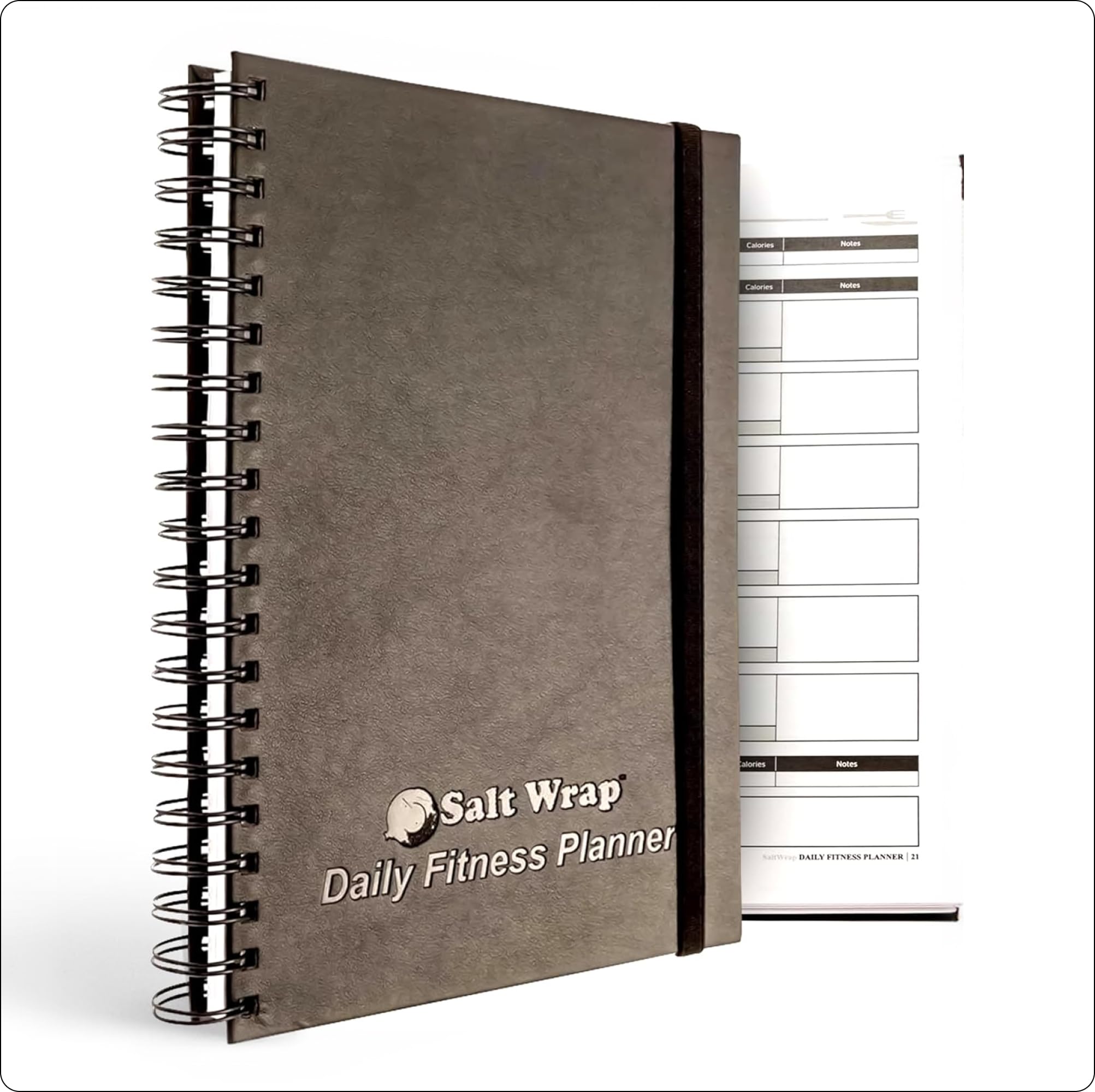
If you want the verdict before the details: this is the planner we keep on a desk, not in a bag. SaltWrap uses 7-by-10-inch pages, roughly the footprint of a magazine, and each day gets a two-page spread — the training log on one side, meals and notes on the other. The faux leather cover and the size make it feel like a journal you'd leave out on purpose, the nutrition block is built around whole meals rather than macro math, and the space means you can write in sentences instead of abbreviations.

The detail we didn't expect was the weekly check-in, which asks you to rate energy levels and joint health alongside your lifts. Across a few months those ratings say more about whether a program is working than another column of numbers, and nothing else here offers that prompt. The trade-off is portability: it's over an inch thick and the better part of a foot long, so it takes real room in a gym bag and lives where you train rather than travelling with you. If your sessions happen in a garage or a spare room, that costs you nothing.

Pros

  • Two-page daily spread with room for meals
  • Weekly check-in on energy and joint health
  • Training and nutrition in one book
  • Faux leather cover feels like a journal

Cons

  • Too large to carry to a commercial gym
Our verdict

For a detailed, two-page daily ritual at a desk or home rack, nothing here matches it — just don't expect it to commute to a commercial gym.

Check Latest Price
5

Best for Goal Setting

Clever Fox Fitness Journal

92 /100
Peggy's Score Outstanding

Key details

Extras
Goal pages and calendar
Guarantee
60-day money-back
Page Size
8 x 5.83 in (A5)
Workout Pages
126
Check Details on Amazon

Where the Nextnoid eases you into a plan, Clever Fox makes you write one down and date it. The front section asks for your top fitness goals with deadlines, then a workout calendar for scheduling sessions, then a weekly tracking page, and only then the 126 workout pages — about four months of daily training, according to the listing. If you need a deadline in ink before you'll show up, that order is the whole point.

The pages themselves are thick, the double wire binding lays flat on a bench, and each session sheet has room for the exercise, sets, reps, weight and notes. We appreciate the 60-day money-back guarantee most of all, because it turns a planner you might not finish into a low-risk purchase. What it isn't is a book for someone who wants to log food beside training, or who'd rather fill blank columns than answer a prompt.

Pros

  • Goals with deadlines and a workout calendar
  • 126 workout pages per book
  • Thick paper and lay-flat double wire
  • 60-day money-back guarantee

Cons

  • Costs more than the other A5 journals here
Our verdict

Choose it if deadlines get you training: goals with dates, a workout calendar and 126 session pages, backed by a guarantee.

Check Latest Price
6

Best for Calendar Planning

SUNEE Fitness Journal

90 /100
Peggy's Score Outstanding

Key details

Pages
145 pages
Extras
Elastic strap, pocket, ruler bookmark
Calendars
5 full-page months
Page Size
6.4 x 8.3 in (A5)
Check Details on Amazon

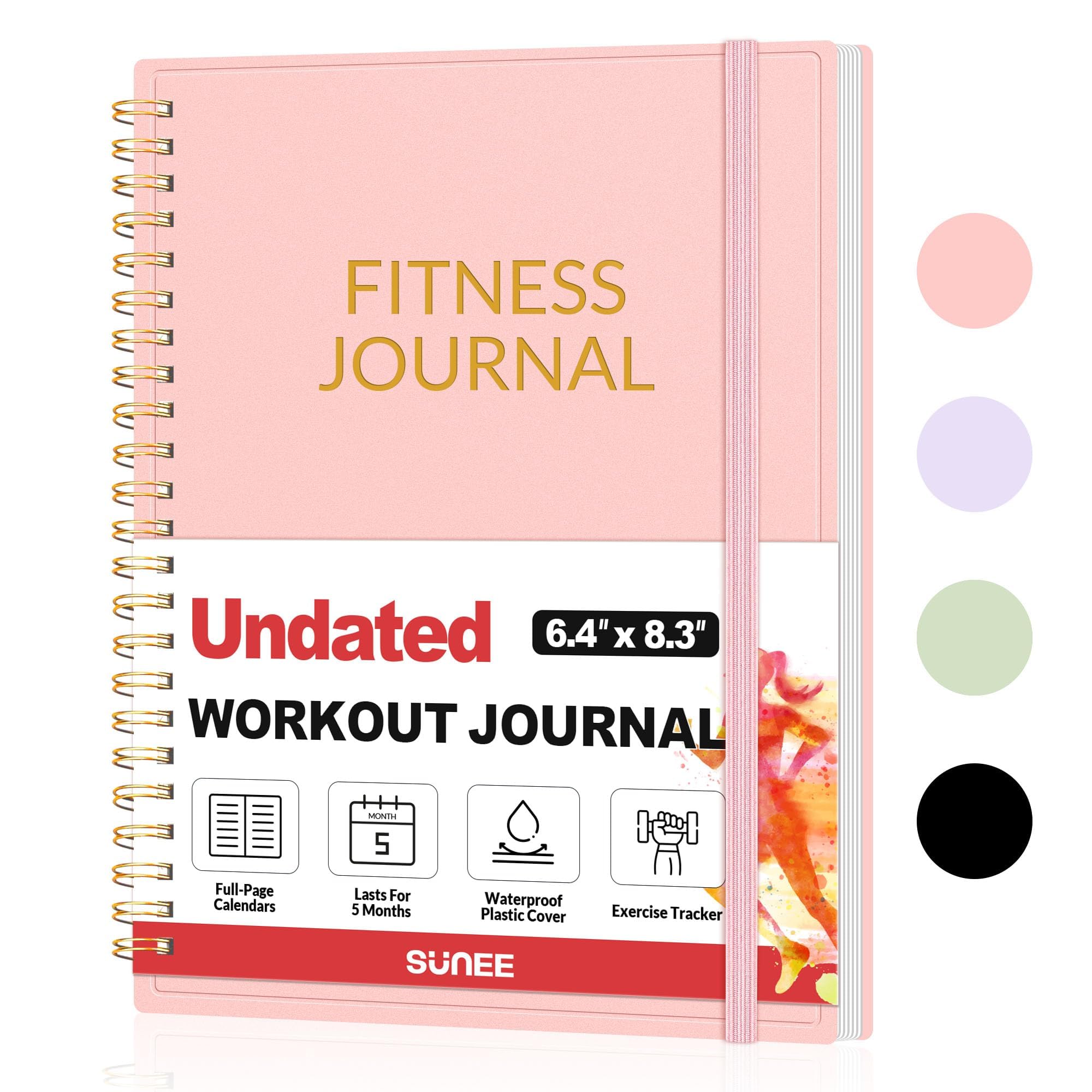
Five full-page monthly calendars is an unusual thing to find in a book this size, and it's the reason to pick the SUNEE. Instead of a small grid of squares at the front, you get a page per month to write sessions into — which turns the planner into something you can glance at and see whether the month is actually taking shape.

The rest of the 145 pages is familiar, useful material: five goals to set at the start, space to record body measurements before and after a block, and workout pages with rows for a range of exercises plus cardio and notes. The small extras are what we kept reaching for, though — a bookmark that doubles as a ruler, an elastic strap, and a double-sided pocket for a membership card or a folded program.

It suits people who plan training by the month rather than by the session, and who like flipping back to see what a good month looked like. It's the same A5 footprint as most of this group, so it slips into a bag without argument. If you never look at a calendar and just want to log today's sets, the simpler books here involve less page-turning.

Pros

  • Five full-page monthly calendars
  • Space for goals and body measurements
  • Ruler bookmark, elastic strap and pocket
  • 145 pages of logging space

Cons

  • Flexible plastic cover, not a hardback
Our verdict

We recommend it to anyone who plans training by the month; five full-page calendars do more for consistency than another column of reps.

Check Latest Price
7

Best Budget Hardcover

ZICOTO Fitness Journal

93 /100
Peggy's Score Outstanding

Key details

Pages
140 pages
Extras
Elastic band and bookmark
Binding
Ring-bound hardcover
Page Size
8.27 x 5.83 in (A5)
Check Details on Amazon

A rigid cover and an elastic band are the two things that decide whether a journal comes back from the gym intact, and the ZICOTO has both. The boards don't bend, the ring binding keeps the pages in line, and the band holds the whole thing shut inside a bag.

Inside, 140 pages open with short- and long-term goal prompts and then settle into workout pages you can use one per session or split between two shorter ones. That flexibility is more useful than it sounds: a 45-minute session doesn't need a full page, and getting two onto one spread stretches the book further than its page count suggests.

The detail that made us smile is the coil. It's wide enough to grip a pen, so the thing you write with stays attached to the book — small, practical, and the sort of touch you only appreciate after you've lost a pen at the gym twice.

We'd steer you here if you want a hardback and don't need the calendar and photo pages of the top pick. What you trade is a little writing room per exercise when you split a page between sessions. For short, frequent workouts, that's a fair exchange.

Pros

  • Rigid hardback with an elastic band
  • Sessions can share a page
  • Coil wide enough to hold a pen
  • Goal prompts at the front

Cons

No notable drawbacks to flag.

Our verdict

A rigid little hardback that takes a bag's worth of punishment for less money than the top pick — we'd happily carry it instead.

Check Latest Price
8

Measurement Tracking

Taja Fitness Journal

92 /100
Peggy's Score Outstanding

Key details

Goals
10 goal slots
Pages
160 pages
Tracking
Pre and post body measurements
Page Size
5.5 x 8.2 in (A5)
Check Details on Amazon

Most logs here give you a single line for body weight. The Taja adds pre- and post-workout body measurements, so a change you can see in the mirror gets a number beside it — and the front of the book has ten goal slots to write the target down before you start measuring.

It's also the longest book in this group at 160 pages, with rows for a spread of exercises, cardio and notes space on the session pages, and an elastic closure to keep it tidy. The A5 footprint is small enough to move between machines with you rather than living on the floor between sets.

The measurement pages reward a routine. Take them at the same time of day, at the start and end of a training block, or the numbers become noise — a weekly weigh-in and a monthly tape measure tell you more than a daily check does.

For anyone working through a block of training and wanting proof of what changed, we'd take the extra pages and the measurement section over a nicer cover. If you only ever write down sets and reps, the cheaper A5 books here cover it.

Pros

  • Pre- and post-workout body measurements
  • 160 pages, the longest book here
  • Ten goal slots at the front
  • Small enough to carry between machines

Cons

No notable drawbacks to flag.

Our verdict

Pick it if you track measurements as closely as lifts; 160 pages and a proper measurement section make it the longest-running book here.

Check Latest Price

How We Tested These Fitness Planners

To build our shortlist, I started with the fitness planners shoppers actually review well, then narrowed by format: daily pages versus weekly spreads, habit trackers versus open workout logs, spiral-bound versus lay-flat binding. I ruled out anything that looked flimsy in the photos, anything with a page count that didn't justify its price, and anything too large to carry to the gym or too small to write a full workout in. That left 14 planners, which my team and I used for three months.

Each planner went into rotation for at least a week of real training: one lived in my gym bag, another sat on the kitchen counter for morning check-ins, and a third traveled between my desk and the couch for Sunday planning. We logged strength sessions, cardio, rest days, and missed workouts, then noted whether the layout made tracking faster or forced us to flip back and forth. We wrote with gel pens and pencils to see whether ink bled through or smudged, and we opened each planner to the current week dozens of times to judge daily ease of use. Size got checked against a tote, a crowded counter, and a small bedside table.

We also followed the content the way a first-time buyer would: filling in goal-setting pages, weekly reflections, and habit prompts for a full month before deciding whether they helped or just added busywork. At the end, we compared cover wear, binding tightness, and page durability, and asked whether the price felt fair for what survived. The planners that made the list were the ones that kept tracking simple and held up without making us dread opening them.

How to Choose Fitness Planners

Structured pages or a bare log

There are two kinds of book in this group, and the choice comes before anything else. A structured planner walks you through goals, a calendar and a progress check before it hands over the session pages — the Nextnoid and Clever Fox are the clearest examples. A bare log gives you columns and nothing else, like the FL logbook.

If you already follow a program from a coach, an app or a spreadsheet, the bare log is faster and stays out of your way. If you're building the plan yourself, the prompts earn their pages: they're the difference between a book you fill in and one you abandon by February.

How many sessions one book holds

Page counts are the most misleading number on a listing, because a journal might use one page per session or two. SaltWrap spends a two-page spread on every day, so its 100 pages go faster than a one-page-per-session log; Clever Fox counts its capacity directly at 126 workout pages, and NewMe at 66 days.

Before you buy, work out your sessions per week and how long you want to go before replacing the book. Someone training three times a week gets months out of a 140-page journal. A daily lifter fills the same book in a season.

The size you'll actually carry

Most of these are A5, roughly 5.5 by 8.3 inches, which fits a gym bag and rests on a bench without taking over. The exception is the SaltWrap at 7 by 10 inches, and that's a deliberate trade: more room for meals, notes and large handwriting in exchange for a book that stays where you train.

The trap is buying the size you think you'll carry rather than the one you will. If your sessions happen at a commercial gym with lockers and machines, take the smaller book; if you train at home, the bigger page is free real estate.

Whether food belongs in the same book

Combining nutrition and training saves carrying two books and makes it easier to see why a week went well or badly. It also splits the page. The NewMe handles it by giving each day one spread with the workout on one side and meals on the other, and it works because the food section is a summary rather than a macro spreadsheet.

If you weigh and log every gram, a nutrition app plus a workout-only journal is the cleaner split. If you just want to notice that you eat badly on heavy days, one book does the job.

Paper, cover and the extras worth paying for

Two physical details decide how a journal feels after a month. Paper weight shows up when you erase: thick stock takes a correction without shredding, which is why the FL logbook's 100 GSM paper is worth noting. The cover decides whether the corners stay square inside a bag — a hardback or rigid board protects the pages, while a flexible plastic cover wipes clean but bends.

Elastic bands, pockets and ruler bookmarks are pleasant, and the SUNEE's ruler bookmark gets used, but we'd trade all of them for paper that doesn't tear.

Frequently Asked Questions

Final Verdict

We'd buy the Nextnoid for most people: a hardback that survives a gym bag, weekly pages with room for a full session, and just enough structure to keep a program honest for the better part of a year.

Two situations change the answer. If your program is already written down elsewhere, the FL logbook does the recording job with thicker paper and no filler. If the food side of your training needs tracking too, the NewMe journal puts both on one daily spread.