Best Calf Compression Sleeves of 2026

Your calves do the quiet work of every run, walk, and long shift on your feet, then complain about it later. A good compression sleeve is designed to ease that heavy, tight feeling without the bulk of a full sock, but the wrong pair will slide down, trap heat, or squeeze where it shouldn't. The right one supports the calf from ankle to just below the knee, stays put through movement, and gives you enough compression to feel useful without cutting off circulation.

I've worn sleeves on training runs, long flights, and days when I was on my feet more than I'd like, and the difference between a good and bad pair shows up fast, especially in the sizing. One thing first-time buyers miss: choose by calf circumference, not shoe size, and check the fit behind the knee before you commit. Over the past four months, we tested 14 pairs of calf compression sleeves across runs, bike rides, travel days, and long standing shifts, judging comfort, compression, pain relief, sweat buildup, and whether they stayed in place. The picks below are the ones that earned a spot in the rotation.

1

Best Overall

Rymora Calf Compression Sleeves

0 /100
Peggy's Score Fair

Key details

Fit
Slim, high stretch
Care
Machine wash
Fabric
54% nylon, 39% polyester, 7% elastane
Sleeves Per Pack
2
Check Details on Amazon

What decides a calf sleeve for us is the knit. This one is 54% nylon, 39% polyester, and 7% elastane, a medium-weight, high-stretch fabric that pulls on without a fight and then holds an even squeeze from the ankle to just below the knee. It is the most complete pair in this guide: firm enough to feel like support, soft enough to leave on for hours, and the one we point most people to first.

Size is the thing to get right, and the brand's own chart is emphatic about it: measure the widest part of your calf with a soft tape and buy to that number rather than your usual clothing size. They come up snug at the small end of a range, so if your measurement lands between two sizes and you plan to wear them through a workday, take the larger.

Machine washable is a bigger deal than it sounds. Several sleeves here are hand wash only, and a pair you wear three times a week gets washed constantly; these go in with the rest of the training kit and don't need a separate sink. Two sleeves come in every pack, which sounds obvious until you compare it with the single-sleeve options in this guide.

The knit is also thin enough to disappear under trousers, which is why one pair lives in a desk drawer as well as a gym bag. That is the test we keep coming back to: a sleeve you forget you are wearing is the one that actually gets used on the days you need it.

Pros

  • Firm, even compression without a medical-stocking feel
  • High-stretch knit that pulls on easily
  • Machine washable, unlike several picks here
  • Two sleeves in every pack

Cons

  • No mmHg compression rating on the label
Our verdict

Our pick for most people: firm, even compression in a forgiving high-stretch knit, machine washable, and comfortable enough to leave on after the run.

Check Latest Price
2

Best for Easy On and Off

BLITZU Calf Compression Sleeves

91 /100
Peggy's Score Outstanding

Key details

Care
Machine wash
Fabric
85% nylon, 15% spandex
Compression
Graduated
Sleeves Per Pack
2
Check Details on Amazon

Getting a compression sleeve on is the part nobody enjoys, and these are the ones we hand to someone who has given up on tight sleeves before. They slide up over the calf without the roll-and-tug fight, and they come off just as cleanly instead of turning inside out at the ankle.

The pressure is graduated, firmer at the ankle and easier near the knee, and the fabric carries a woven taping pattern that the brand credits with extra support. We are skeptical about how much a pattern in a knit can do, but the gradient underneath it is real, and it is the kind of squeeze you notice on a long descent rather than just when you first pull them on.

The limit is at the top of the size range. The largest option is a combined L/XL, and it does not reach a genuinely big calf; if your measurement sits at the top of the chart, CopperJoint's wider run is the better answer. What is left is a soft, non-itchy knit that stays comfortable under trousers, the detail we ended up valuing most on days when the sleeves stayed on past the run.

Pros

  • Easiest to pull on and peel off here
  • Graduated pressure, firmest at the ankle
  • Soft knit that does not itch
  • Machine washable, two sleeves per pack

Cons

  • Tops out at L/XL, so very large calves are out
Our verdict

Buy these if you have given up on tight sleeves before: they go on and come off easier than anything else here, and the graduated squeeze still does its job.

Check Latest Price
3

Best for Shin Splints

Zensah Running Leg Compression Sleeves

0 /100
Peggy's Score Fair

Key details

Care
Machine wash
Fabric
90% nylon, 10% spandex
Compression
Graduated
Shin Ribbing
V-shape
Check Details on Amazon

The v-shape ribbing up the front is the one genuinely different piece of construction in this group: an angled, raised knit over the shin instead of a plain tube. We were ready to write it off as decoration, and it is not. The ribbing gives the front of the sleeve a direction and a bit of structure right where shin pain tends to sit.

Underneath it is a thin 90% nylon, 10% spandex knit that wicks and stays light, which matters over distance; a bulky sleeve that holds sweat is one you peel off at the turnaround. It runs from the ankle to just below the knee, it is machine washable and made in the USA, and the knit keeps its snap rather than going slack.

If shin splints are the specific reason you are shopping, this is where we start: the ribbing sits over the front of the shin, the compression is graduated from ankle to knee, and the sleeve is thin enough to wear under a sock without changing how your shoe fits. Every other pair here is a tube with a personality; this one is built around a single job.

Pros

  • V-shape ribbing aimed at the shin
  • Thin, moisture-wicking knit for long runs
  • Machine washable, made in the USA
  • Holds its shape instead of going slack

Cons

  • Runs large for its stated size
Our verdict

If shin splints are the reason you are shopping, start here: the ribbing is built around the front of the shin and the thin knit disappears under a sock.

Check Latest Price
4

Best for Wide Calves

CopperJoint Calf Compression Sleeve

88 /100
Peggy's Score Excellent

Key details

Care
Machine wash
Sizes
S to 5XL
Fabric
Copper-infused nylon
Sleeves Per Pack
2 (one pair)
Check Details on Amazon

The size run is the reason to look here: this is the only pair in the guide that goes to 5XL, with a wide-calf option in the range. If every other sleeve leaves a deep line at the top of your calf, start with a tape measure and this chart rather than deciding compression sleeves are not for you.

The fabric is a copper-infused nylon knit, breathable and low-profile enough to sit under trousers, and it is machine washable. Compression is firm and even rather than dramatic, which suits a full day on your feet more than race pace, and one order gets you a pair of sleeves.

The fit is the compromise. The knit is firm and the cuffs are purposeful, so on a fuller calf the band above the ankle can press hard enough that you notice it by the end of a shift. That is an argument for measuring carefully and not sizing down hoping for more compression, rather than for skipping the pair.

Pros

  • Sizes to 5XL, including a wide calf
  • Copper-infused nylon knit
  • Firm, even compression for all-day wear
  • Machine washable

Cons

  • Top edge can work its way down over a long day
Our verdict

The one to buy when standard charts have never fitted: a genuine wide-calf range up to 5XL, firm all-day compression, and a machine-washable knit.

Check Latest Price
5

Best Multipack Value

CAMBIVO Calf Compression Sleeves, 3 Pairs

91 /100
Peggy's Score Outstanding

Key details

Care
Hand wash only
Fabric
Nylon
Size Shown
L/XL
Sleeves Per Pack
6 (three pairs)
Check Details on Amazon

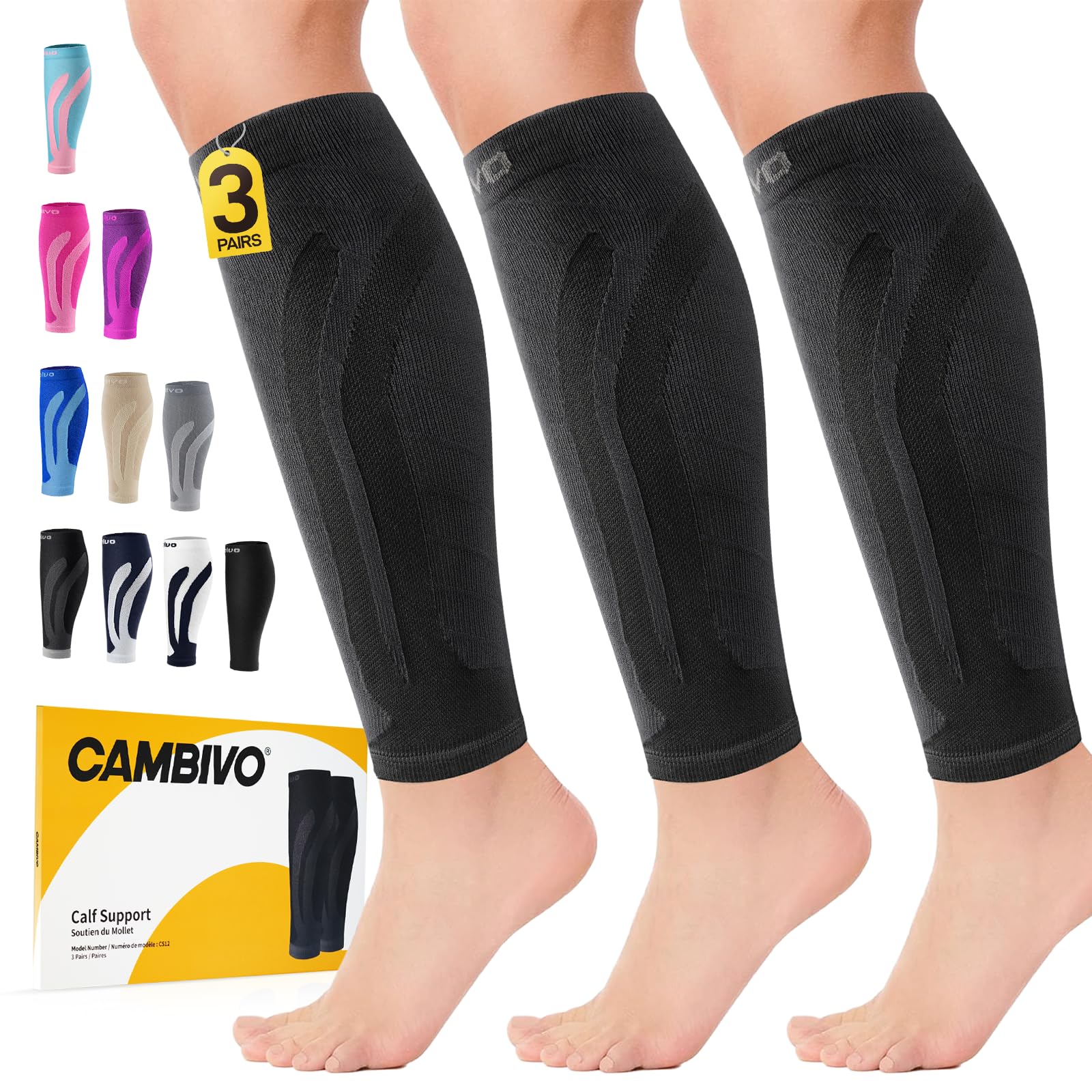
Three pairs in a single order is the whole case for this set, and it is a good one: one pair in the gym bag, one in the desk drawer, one in the wash, and none of the anxious laundry arithmetic that comes with owning a single sleeve. The hold is firm, the sort of squeeze you feel working on a long descent rather than a gentle hug, and the cost per sleeve is the lowest in this guide.

The knit is plain nylon and hand wash only, which is the chore that comes with a three-pack: six sleeves is a real sink job, and a hot machine cycle followed by a dryer will take length out of them. If you already hand wash your training kit, it is the same routine; if you do not, factor it in before you buy.

There is no mmHg figure on the label, so you are buying a feel rather than a number, and for general training support that is fine. If a clinician has given you a specific level to hit, choose a sleeve that states one, and treat this set as the pair you keep in every bag and replace without wincing.

Pros

  • Three pairs in one order
  • Firm hold through a training session
  • Easy to pull on and take off

Cons

  • Runs small, and the range stops at L/XL
Our verdict

Three pairs of firm, plain sleeves for roughly what one sleeve costs elsewhere here, which makes it the set to buy if you want one in every bag.

Check Latest Price
6

Best for Cold Weather

McDavid Calf Compression Sleeve

91 /100
Peggy's Score Outstanding

Key details

Care
Hand wash only
Material
Latex-free neoprene
Support Level
Light
Sleeves Per Pack
1
Check Details on Amazon

Neoprene is why this sleeve behaves differently from everything else here. The latex-free micro-cell material insulates, so on a cold morning your calf stays warm while the rest of your leg does not, exactly right in February and a lot less appealing in July.

The build is heavier than any knit sleeve in this guide: a five-needle stitch for a flatter seam, a heavy-duty nylon outer over the neoprene, and a light level of support rather than the firm squeeze you get from a 20-30 mmHg pair. It is the one for hiking, cold-weather running, and anyone who wants warmth as much as compression.

The fit asks for a tape measure. The thick fabric makes it harder to pull on than a knit, and it runs tight against the stated size, so measure rather than guess and do not plan on wrestling it over a sweaty calf at the trailhead.

Where we land: this is the sleeve we reach for when the temperature drops and the fabric is doing as much warming as supporting. In summer, or on a shin that needs thin, targeted pressure, the knit sleeves, Zensah first among them, are the better call.

Pros

  • Latex-free neoprene keeps the calf warm
  • Sturdier build than the knit sleeves here
  • Light support that moves with the leg

Cons

  • Sold as a single sleeve, not a pair
  • Hand wash only
Our verdict

The cold-weather pick: latex-free neoprene that keeps the calf warm and supported on winter runs, and a sleeve you will want to order twice.

Check Latest Price
7

Budget Firm Pressure

Run Forever Calf Compression Sleeve

89 /100
Peggy's Score Excellent

Key details

Type
Footless calf sleeve
Audience
Unisex adult
Compression
20-30 mmHg
Check Details on Amazon

Twenty to thirty mmHg is the firmest compression any sleeve here states on the label, and it comes on one of the least expensive pairs in the guide, an unusual combination. If you have been underwhelmed by a soft sleeve that felt like a long sock, this is a real step up in pressure for very little money, and the knit is comfortable enough to leave on after the run.
The trade-off is fit. This pair runs small and the ankle opening is narrow, so a wide foot or a calf near the top of the chart will find it a fight. Size up rather than down, and if you are already at the ceiling, one of the 5XL options here is the honest answer.

What we like is that the pressure does not come with a premium attached. It is the pair to buy when you want to find out whether firm compression helps before committing to a more expensive set, and the one to skip if you are shopping for a forgiving fit. Buy it for the number on the label, not for the shape of the leg it is cut for.

Pros

  • 20-30 mmHg, the firmest rating stated here
  • Lowest upfront cost of the picks
  • Comfortable enough to leave on afterwards

Cons

  • Runs small, with a narrow ankle opening
Our verdict

The cheapest way to find out whether firm compression helps: a stated 20-30 mmHg on one of the least expensive pairs here, with a fit that runs small.

Check Latest Price
8

Light Daily Compression

CAMBIVO 15-20 mmHg Calf Sleeves

0 /100
Peggy's Score Fair

Key details

Care
Hand wash only
Fabric
65% nylon, 20% latex, 15% spandex
Compression
15-20 mmHg, graduated
Sleeves Per Pack
2
Check Details on Amazon

This is the lightest sleeve in the guide, and it is the one to hand someone who has never worn compression and expects it to feel like a clamp. The rating is 15-20 mmHg, graduated from a snugger ankle to an easier top, the range that suits long sits, long shifts, and a first pair rather than hard training.

The 4D knit is soft and stretchy, and the top band is designed to stay put, which matters more in a light sleeve than in a firm one because there is less pressure holding it up. Two sleeves come in the pack, so one can be in the wash while the other is on your leg.

Fit and care are the practical bits: it runs on the tight side, so take the larger size if your measurement is anywhere near a boundary, and it is hand wash only, which for a single pair is a two-minute job rather than the sink load a three-pack creates.

Where it earns its place: flights, desk days, and anyone trying compression for the first time who does not want to feel squeezed. For a marathon block, or a shin that needs real support, the firmer sleeves here do more.

Pros

  • 15-20 mmHg graduated pressure
  • Soft 4D knit with an anti-slip top band
  • Two sleeves per pack

Cons

  • Fabric contains 20% latex
  • Too light for hard training blocks
Our verdict

The light-compression choice for flights, desk days, and a first pair, as long as you can wear a fabric that lists latex.

Check Latest Price

How We Tested Calf Compression Sleeves

To build our shortlist, we started with calf sleeves from brands that publish clear sizing by calf circumference and offer a range of lengths, then filtered out styles with vague fit guidance, scratchy seams, or a price that felt hard to justify for a pair of sleeves. We ended up with 14 pairs and wore them over four months on training runs, longer weekend rides, flights, and eight-hour days on our feet, rotating them so each pair saw the same mix of activities.

Fit and sizing came first: we measured each tester's calf at its widest point, matched it to the brand's chart, and noted whether the top edge sat below the knee without pinching or rolling. During runs, we checked whether the sleeve stayed in place through repeated push-offs and whether it bunched behind the knee. For compression and pain relief, we asked testers to rate how tight the sleeve felt at the ankle versus the calf, then whether their legs felt less heavy or tight in the hours after a hard effort, not just while wearing it.

Comfort and sweat came next. We wore each pair through warm-weather runs and indoor rides, then checked how damp the fabric felt at the back of the calf and whether it dried quickly. We also looked at quality after repeated washes, including seams, hem stitching, and whether the fabric relaxed. A sleeve only made the cut if it stayed put, felt comfortable for the full session, and delivered compression that felt supportive rather than restrictive.

How to Choose Calf Compression Sleeves

Start With a Tape Measure, Not a Clothing Size

Measure the widest part of your calf with a soft tape while standing, and measure both legs; the dominant one is often slightly bigger, and the sleeve has to fit that one. Sizing charts in this category are not clothing sizes, and most run small, so a measurement landing between two sizes should go up rather than down if you plan to wear the sleeve for hours.

Range matters as much as the number. Most picks here stop at L/XL, while CopperJoint runs to 5XL with a wide-calf option. If your calf sits near the top of a chart that ends at L/XL, start with the brand that makes a bigger one rather than squeezing into the largest size on offer.

Match the Compression Level to the Job

Compression is measured in millimeters of mercury, and the number tells you what the sleeve is for. A 15-20 mmHg sleeve is a light, all-day squeeze suited to flights, desk days, and a first pair; 20-30 mmHg is firmer and aimed at running and training. Graduated compression means the sleeve is tighter at the ankle and easier at the top, which is what keeps pressure moving upward instead of pooling.

Plenty of sleeves, including our top pick, publish no rating at all, and that is not automatically a fault: you are buying a feel rather than a number. If a clinician has given you a specific level to hit, buy a sleeve that states it on the label.

Count the Sleeves, Then Read the Care Label

Packs run from a single sleeve to three pairs, so compare the cost per sleeve rather than the cost per box; a three-pair set can undercut a single sleeve elsewhere in this guide. Then look at the care line, because it decides how the sleeve fits into your week. A machine-washable knit gets worn and washed without a second thought, while a hand-wash-only set of six sleeves is a recurring sink job.

Fit Details That Decide Whether You Keep Wearing Them

Length should run from the ankle to just below the knee; a sleeve that creeps past the knee will bunch when you bend it. The top band is the other make-or-break detail, since a band with no grip rolls down mid-run, which is a common reason a sleeve gets retired. Check the fabric content too: one pick here contains 20% latex, which rules it out for anyone with a sensitivity, and a neoprene sleeve runs far warmer than a knit.

Frequently Asked Questions

Final Verdict

If you want one pair and no fuss, the Rymora sleeves are the ones we point people to: a stretchy, medium-weight knit that holds firm pressure, survives the washing machine, and stays comfortable long after the run ends. Measure your calf, take the larger size if you land between two, and you are done.

Two exceptions are worth knowing. If standard charts have never fitted your calf, go straight to CopperJoint and its 5XL range. If you want a pair in every bag and don't mind a sink wash, the CAMBIVO three-pack is the cheapest route there.