Best Ankle Weights of 2026

Ankle weights are deceptively simple: a strap, a pouch, weight. The trouble starts when the strap slides, the pouch bunches, or the closure gives out halfway through a set of leg lifts. The right pair stays put without pinching, lets you pull weight out when you scale back, and feels balanced enough that you forget you're wearing it.

Over four months, I wore 14 pairs through lunchtime walks, mat Pilates, physical therapy exercises, and at-home leg days. Some were pared-down straps with removable sandbags; others were wider, cushioned cuffs. The pattern was clear: adjustability only helps when the system is easy to use and the weight stays evenly distributed, and comfort only counts if the closures hold through a full session.

One thing first-time buyers miss: ankle weights are sold as a pair, so a 2-10 pound set means the total across both ankles, not each one. Start lighter than you think you need, especially for walking and rehab work. The picks below are the ones that survived wear, stayed put, and didn't make me dread putting them on.

1

Best Overall

Sportneer Adjustable Ankle Weights

91 /100
Peggy's Score Outstanding

Key details

Material
Neoprene, iron sand
Fits Ankle
7.5 to 12.5 in
Pair Weight
2 to 10 lb
Weight Per Cuff
1 to 5 lb
Check Details on Amazon

The only pair here that publishes an ankle circumference range is also the one with the widest adjustable load: five one-pound iron-sand bags per cuff, one to five pounds on each ankle, and a stated fit of 7.5 to 12.5 inches. That combination is why it sits at the top of this list. You can run a single pound for a rehab exercise in the morning and stack five pounds a side for step-ups the same week, without buying a second pair.

The build is the part we are happiest with. Neoprene outside, a moisture-absorbing lining inside, and reinforced trim that keeps the bag edges from rolling up and digging in. The strap closes over a wide pad, so there is room to crank it down over leggings or leave it looser over a thick sock, and it never feels like it is one pull away from letting go.

Where it gives ground is at the top of the range. Loaded to four or five pounds, each cuff carries enough mass to work its way down a calf on a longer walk, and you will be hitching it back up at the halfway point. At one to three pounds a side — where most walking, Pilates, and early rehab work lives — it stayed exactly where we put it.

Order by the number rather than by hope. A 7.5-inch ankle is genuinely small, and if yours measures under that, this pair is out; no amount of strap tension fixes a cuff that is too big. Over 12.5 inches, look at a long-strap design instead.

Pros

  • One to five pounds per cuff
  • Published 7.5 to 12.5 inch ankle fit
  • Neoprene shell with moisture-wicking lining

Cons

  • Pouches are fiddly to reinsert
  • Stitching can give out with steady use
Our verdict

This is the pair we recommend first: one set covers a single pound of rehab work and five pounds of strength work, with a published ankle range that takes the guesswork out of ordering.

Check Latest Price
2

Best Fixed-Weight Pair

HEALTHYMODELLIFE Ankle Weights Set

93 /100
Peggy's Score Outstanding

Key details

Fill
Sand
Material
Neoprene
Pair Weight
6 lb
Weight Per Cuff
3 lb
Check Details on Amazon

There is nothing to swap, nothing to lose, and nothing to re-thread: this pair is simply three pounds per ankle, sewn into a padded neoprene cuff with a Velcro strap. That fixed load is the whole idea, and it is why we reach for these on an ordinary walk. Put them on, forget them, take them off at the door — more than we can say for cuffs full of loose bags.

It is also the least fussy pair we tried. The padding does not chafe on a bare ankle, the strap holds through a full loop of the neighborhood without needing a second tighten, and getting them on one-handed is genuinely easy, which matters more than it sounds when you are already halfway out the door.

What you give up is progression. Three pounds per ankle is too much for early rehab and heavier than most people want for mat Pilates, and there is no way to dial it back to one. Buy them as a walking and leg-day pair, or as the second set you keep by the door — not as the only ankle weights you own.

Pros

  • Nothing to swap or reinsert
  • Padded neoprene does not chafe
  • Easy to put on and take off

Cons

  • Fixed three pounds per ankle
  • Generous sizing swamps slim ankles
Our verdict

Buy these when you want a fixed three pounds per ankle and no pouches to lose — they go on, stay put through a walk, and come off without a fight.

Check Latest Price
3

Best for Yoga and Pilates

BAGAIL Ankle Wrist Weights

91 /100
Peggy's Score Outstanding

Key details

Care
Hand wash only
Material
Lycra-SBR fabric
Pair Weight
2 lb
Weight Per Cuff
1 lb
Check Details on Amazon

A pound per ankle in a Lycra-SBR shell, for less than anything else on this page. The BAGAIL pair is the one we hand to someone who wants ankle weights for a mat class rather than a strength block, because at this weight the cuff is thin enough to sit under leggings without a visible lump.

The shell resists sweat and wipes clean, and the hook-and-loop strap is wide enough that it holds through a flow without a mid-session re-tighten — the usual failure point on cheap light pairs that skimp on the band. It also comes with a lifetime warranty, which for a cuff worn barefoot through hot classes is a reasonable bet to make.

This is the pair for yoga, barre, Pilates, and long days of errands where you want a little extra load and nothing that rubs. It is not the pair for loading: one pound per cuff is the ceiling, so if you want a single set that runs from rehab to strength work, the adjustable picks are where to look.

Pros

  • Slim enough to wear under leggings
  • Sweat-resistant shell wipes clean
  • Lowest price in this guide

Cons

  • Hand wash only
Our verdict

Our pick for yoga and Pilates: a pound per ankle in a slim, sweat-resistant shell that disappears under leggings, at the lowest price in this guide.

Check Latest Price
4

Best Budget Adjustable

Amazon Basics Adjustable Ankle Weights

89 /100
Peggy's Score Excellent

Key details

Closure
Dual Velcro
Exterior
Polyester
Pair Weight
5 lb set
Adjustment Range
0.5 to 2.5 lb per cuff
Check Details on Amazon

Half-pound steps are the whole point here. Each cuff is a 2.5-pound sleeve with removable inserts, so you can run it at 0.5, 1, 1.5, 2, or 2.5 pounds — the finest steps you can get for the least money in this set, and a good way to find out how much load your knees will actually tolerate.

That makes it our budget pick for anyone easing back into walking or leg work after time off. You start light, add half a pound when the current load starts to feel ordinary, and you never have to guess at a three-pound jump. The dual closure — two passes of hook-and-loop rather than one — is a real part of why a cuff this light stays flat instead of rotating around the ankle.

The trade is bulk. This is a padded sleeve, and the polyester exterior is not the softest thing against bare skin, so we wear them over socks or leggings rather than straight on the ankle. It is a workhorse for the money, not a pair you will forget you have on.

Pros

  • Half-pound steps from 0.5 to 2.5 lb
  • Dual closure resists rotation
  • Cheapest adjustable pair here

Cons

  • Runs large on slim ankles
  • Inserts are stiff to swap
Our verdict

If you are unsure how much load your knees will tolerate, these let you move in half-pound steps for very little money — our budget choice for adjustable weight.

Check Latest Price
5

Best for Physical Therapy

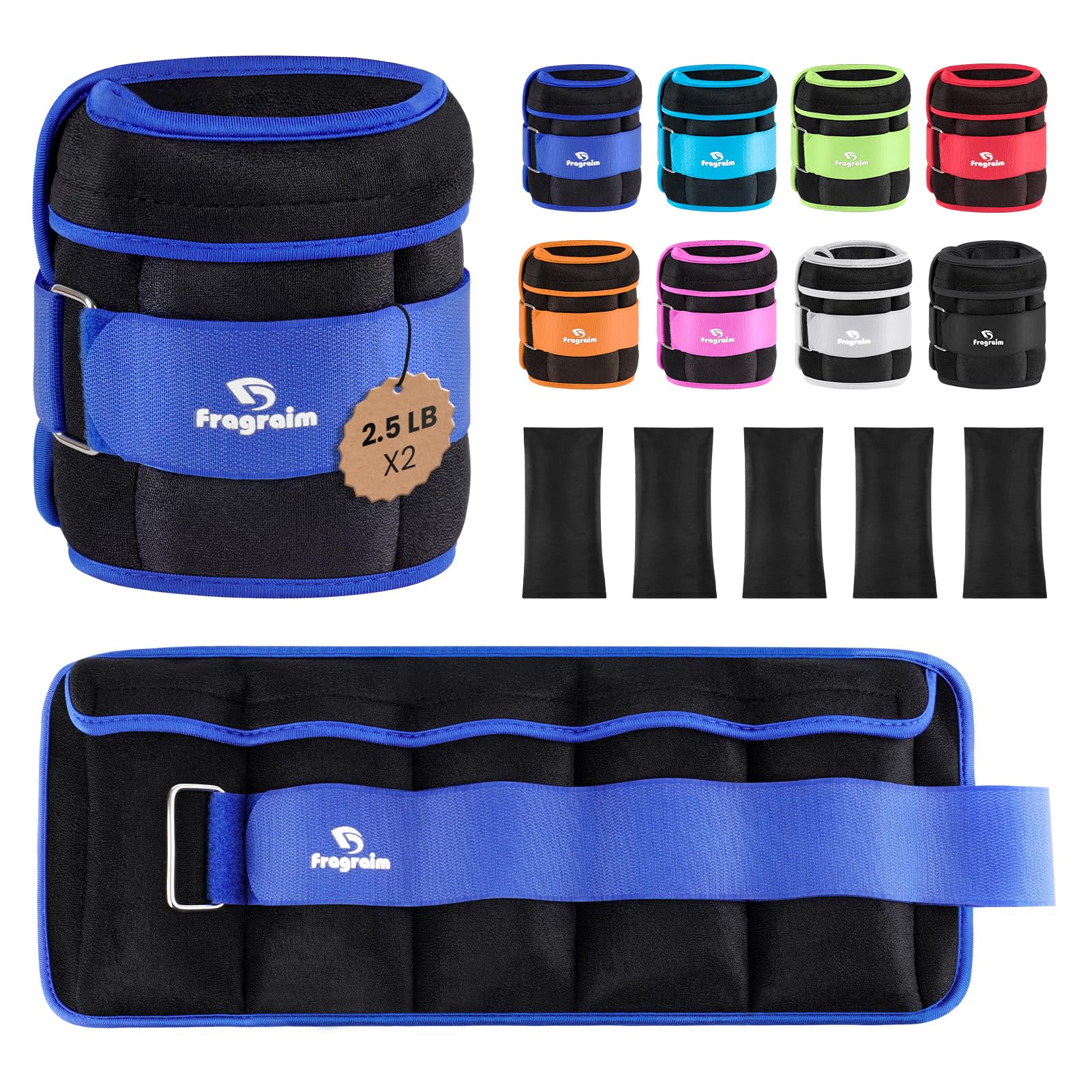
Fragraim Adjustable Ankle Weights

91 /100
Peggy's Score Outstanding

Key details

Inserts
Five 0.5 lb sandbags
Material
Cotton and neoprene
Pair Weight
5 lb
Weight Per Cuff
2.5 lb
Check Details on Amazon

Physical therapy is where small increments pay off. Five half-pound sandbags per cuff mean you can start at half a pound on one ankle and add a bag a week, which is the kind of progression a therapist writes down and a three-pound fixed cuff simply cannot follow.

The shell is mercerized cotton over a moisture-absorbing lining, softer and less rubbery against the skin than the neoprene pairs here, and the stitching around the weight pockets is tidy — that seam is the part that usually fails first on a cheap cuff. The strap has a long hook-and-loop run, which is generous for a thick ankle and overkill for a slim one.

It stays on our shortlist for rehab because of those half-pound bags. The trade is bulk: at 2.5 pounds a cuff it is a chunky thing under trousers, and on days when you want to forget you are wearing weights, a slim one-pound pair does that job better.

Where it beats the fixed pairs is the first two weeks, when half a pound is a real starting load and you can hold there without buying anything else. Above that, remember what it is: a 2.5-pound cuff, not a five-pound one. For heavy leg work, the pairs that go to five pounds a side are the ones to look at.

Pros

  • Starts at half a pound per cuff
  • Five removable sandbags per cuff
  • Soft cotton lining against skin

Cons

  • Strap runs long on slim ankles
Our verdict

We keep these on the rehab shortlist because you can start at half a pound per ankle and add weight slowly — the finest progression here, if the strap fits you.

Check Latest Price
6

Everyday Walking

APEXUP Adjustable Ankle Weights

91 /100
Peggy's Score Outstanding

Key details

Inserts
Five 1 lb modules
Material
Neoprene
Pair Weight
Up to 10 lb
Weight Per Cuff
1 to 5 lb
Check Details on Amazon

Here is the thing about the APEXUP pair: at one to three pounds per ankle it is as comfortable as anything on this page, and at five it is not. The strap is a single hook-and-loop band over a neoprene sleeve, and once all five one-pound modules are stacked in, there is more weight than that band wants to hold through a walk.

That is a real limitation, but a narrow one. Most ankle-weight work happens between one and three pounds, where the modules sit close to the leg and the cuff stays put. Loading it is genuinely easy too — five separate one-pound modules rather than a handful of loose sandbags, so you are not chasing half-filled pouches across the floor.

The other thing worth knowing is granularity and fit. Every module is a full pound, so one pound per cuff is the floor; if you are starting rehab at half a pound, a half-pound design is the right call. The sleeve also runs on the narrow side, and a thick ankle or a high calf placement can leave the strap short.

Set against our top pick, this one gives up the top of the range and the half-pound steps and gains a softer cuff and simpler modules. If you know you will be at four or five pounds for step-ups and squats, pay for the pair that holds there; for everything else, this is the easier one to live with.

Pros

  • Five separate one-pound modules
  • Soft neoprene against bare skin
  • Modules load without loose pouches

Cons

  • No load below one pound per cuff
  • Runs narrow on thick ankles
Our verdict

The adjustable pair we hand to someone who wants comfort over capacity: soft neoprene, five easy modules, and a strap that behaves at walking loads.

Check Latest Price
7

Light Daily Wear

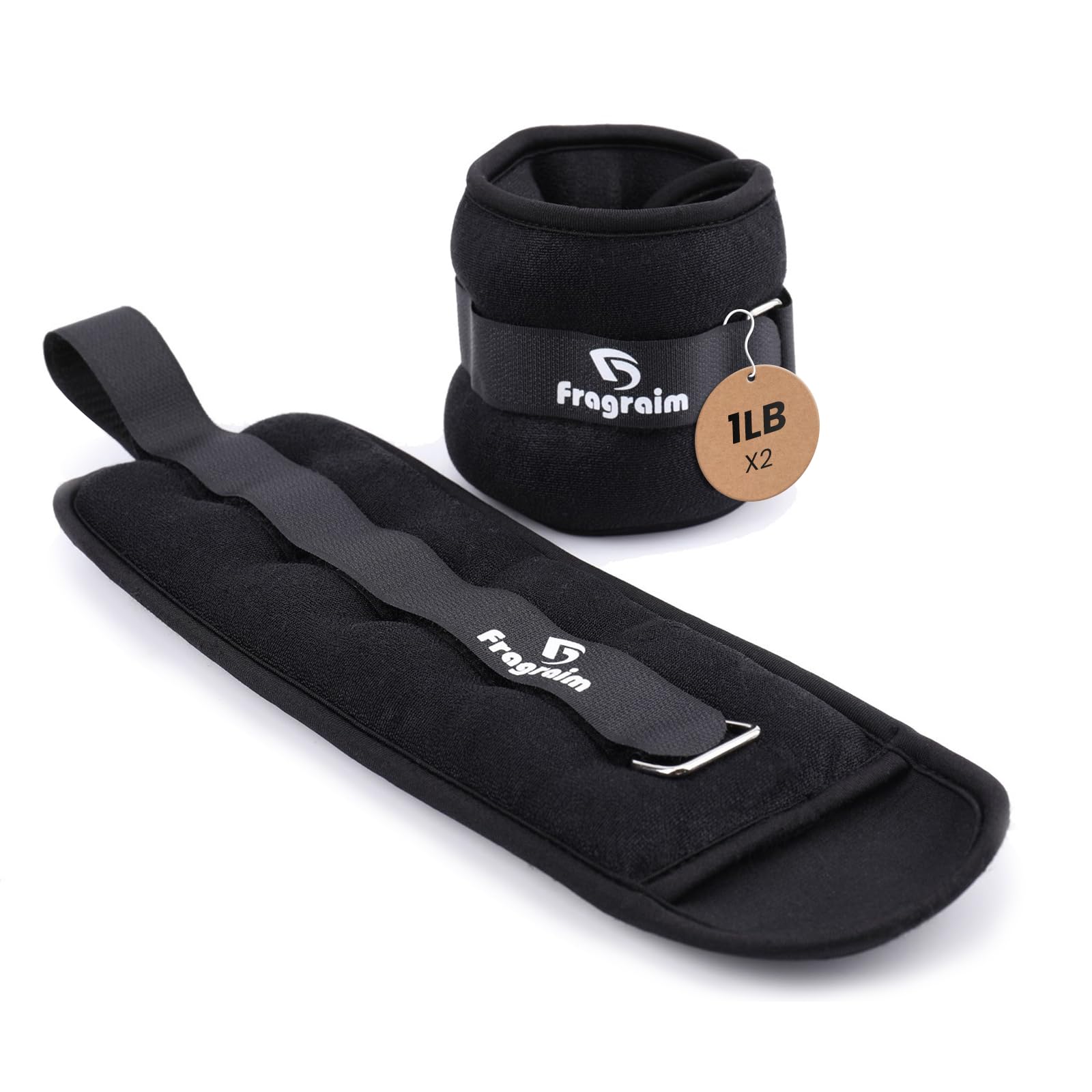
Fragraim Ankle Weights 2 lb Pair

93 /100
Peggy's Score Outstanding

Key details

Fill
Iron shot
Material
Cotton and neoprene
Pair Weight
2 lb
Weight Per Cuff
1 lb
Check Details on Amazon

Two pounds total, one per ankle, and a strap that keeps going after most cuffs have run out. That is the appeal here: a fixed pair for someone with a thicker ankle or calf who has given up on straps that end before they reach the pad. We like it for exactly that — it closes with room to spare, and one pound per ankle is light enough to wear through a morning of errands.

Light is the point. At a pound a cuff you feel it on stairs and in leg lifts but can keep it on for an hour without thinking about it, and the cotton-neoprene shell stays cool rather than clammy. It goes on in one motion and comes off in one, which is the whole reason to choose a fixed pair over an adjustable one.

Where it loses to the BAGAIL pair is profile: same load, more bulk, so it is the wrong choice if you want these invisible under a slim trouser. Where it wins is that long strap. If you need a light pair that reliably closes around a wide ankle, this is the one to get.

Pros

  • Long strap fits thicker ankles
  • Light enough for all-day wear
  • Soft cotton-neoprene shell

Cons

  • Shell is bulky for one pound
  • Narrow hook-and-loop strip is fiddly
Our verdict

The simplest light pair here: one pound per ankle, a long strap that closes around bigger calves, and nothing to adjust mid-session.

Check Latest Price

How We Tested Ankle Weights

To build the shortlist, we started with the ankle-weight styles shoppers actually compare: fixed-weight cuffs, adjustable straps with removable filled pouches, and wider padded bands that can pull double duty on the wrists. We filtered out listings with vague weight labels, sparse sizing information, or closure systems that looked too narrow for the load. That left 14 pairs, which we tested for four months.

Each pair went into the same rotation: lunchtime walks, mat Pilates, physical therapy exercises, and at-home leg days. We put them on over bare ankles and socks, then again over leggings, and noted whether the straps pinched, slid down, or bunched at the front of the ankle. We timed how long it took to add or remove a pouch, checked whether the filled bags went back in without fighting the seam, and weighed a few pouches on a kitchen scale to see how close the stated weight felt in hand. For closure strength, we did repeated leg lifts and side-lying reps, then tugged the strap ends to see if the grip had loosened.

We also paid attention to size and bulk: how much strap was left over on narrower ankles, whether the cuffs caught on pant legs, and whether the pair felt balanced during walking versus floor work. Durability checks were simple but repeated—looking at stitching, seam stress, and pouch wear after each week of use. The pairs that made the list were the ones that stayed comfortable, adjusted without a struggle, and kept their shape through the whole test.

How to Choose Ankle Weights

Start With the Load, Then Choose Fixed or Adjustable

Most people need less weight than they expect. One to two pounds per ankle is the working range for yoga, Pilates, barre, and early rehab; two to three pounds suits walking and leg lifts; three to five pounds is strength work and later-stage rehab. If your plan moves through those ranges, adjustability earns its extra hardware — the Sportneer pair covers one to five pounds per cuff, and the Fragraim pair starts at half a pound.

If you already know your working weight, a fixed pair is simpler and has nothing to lose on a walk. Just be honest about progression: a three-pound cuff is a three-pound cuff forever, and buying a second pair later is the hidden cost of skipping adjustability.

Fit Is Where Most Pairs Fail

Measure the narrowest part of your ankle, just above the bone, and treat "one size fits most" as a strap length rather than a promise. A long strap on a slim ankle leaves a tail that catches on pant legs; a short strap on a thick ankle will not close at all.

The Sportneer pair publishes a 7.5 to 12.5 inch range, which is the most useful fit number in this guide. If you measure outside it — especially on the wide end — choose a design with a long strap, like the Fragraim 2-pound pair, rather than forcing a cuff that barely meets the pad.

What Keeps a Cuff From Sliding

Load and closure fight each other. A single narrow band holds a one- or two-pound cuff all day and struggles at five, which is why light-strapped pairs drift down the calf at their heaviest settings. Look for a wide pad, and for two passes of hook-and-loop if you plan to load up; the Amazon Basics pair uses two, which is part of why it stays put at half its weight.

Placement matters as much as hardware. Sit the weight above the ankle bone rather than on it, wear the cuff over a sock or leggings instead of bare skin, and tighten the strap before you add the last bag, not after.

Fill, Seams, and How Long a Pair Lasts

Ankle weights are filled with iron sand, iron shot, or plain sand, and the fill is what escapes when stitching gives way at the corners. Iron shot shifts and rattles less; fine sand finds seams faster. Neither matters as much as the shell, which is why reinforced stitching around the pockets is worth more than a fancy fill.

Keep them out of the machine. Spot clean with a damp cloth, air dry flat, and close the hook-and-loop first so it does not grab lint or fray. A pair treated that way outlasts one that lives at the bottom of a gym bag under a water bottle.

Frequently Asked Questions

Final Verdict

Start with the Sportneer pair. One set runs from a single pound of rehab work to five pounds per ankle for strength training, and it publishes the ankle range it actually fits, which is more than any other pair here does. For most people that combination ends the search.

If you know you will never fiddle with the load, the HEALTHYMODELLIFE pair is the simpler buy: three pounds per ankle, no bags, nothing to lose on a walk. And if the plan is mat work rather than strength, the BAGAIL set does the job for the least money — as long as one pound per ankle is enough.